
VOC Emissions from Coating Lines: Capture, Abatement, and Operating Tradeoffs
VOC emissions from coating lines are defined by how solvent evaporates through the process, how effectively each release point is captured, and how the exhaust is routed to treatment. In most industrial coating operations, the VOC load is distributed across the application area, flash-off section, drying or curing oven, cleaning activities, and solvent or waste handling points. These zones do not have the same airflow, temperature, VOC concentration, or operating pattern.
For plant managers, EHS managers, and process engineers, the practical issue is not only annual solvent consumption. The more important design questions are where the solvent is released, how much is captured, how much dilution air is added, and what happens during non-steady conditions such as oven warm-up, product changeover, cleaning, and idle ventilation. A coating line with moderate solvent use can still create short VOC peaks that affect LEL controls, oxidizer temperature stability, or carbon bed breakthrough. A line with high solvent use can still deliver a dilute exhaust stream if large volumes of booth or building air are extracted with the process emissions.
A useful VOC evaluation starts with the line itself: coating formulation, application method, line speed, coating weight, oven profile, exhaust zoning, fan operation, damper settings, filtration, cleaning procedures, and production schedule. The abatement unit should then be evaluated against the actual captured VOC load and not against solvent purchasing data alone.
This article focuses on the operational and engineering issues that affect coating line VOC control: emission source mapping, exhaust capture, abatement technology selection, pressure drop, energy demand, maintenance, troubleshooting, and wastewater or liquid waste implications.
Why VOC Control on Coating Lines Requires Process-Specific Evaluation
VOC control on coating lines cannot be separated from process ventilation, oven operation, product quality, and production scheduling. A change made to improve one part of the system can create a constraint elsewhere. Increasing exhaust flow may improve booth containment, but it can also dilute the VOC stream, increase fan power, reduce oxidizer heat balance, and increase auxiliary fuel demand. Reducing exhaust flow may improve energy performance, but it can affect oven pressure, solvent accumulation, capture efficiency, or LEL margin.
The abatement system should therefore be selected against the measured exhaust flow range, VOC concentration profile, solvent blend, oven temperature, production schedule, and cleaning load cases. If those inputs are incomplete, the selected system may be technically correct on paper but unstable or expensive to operate in the plant.
Multiple VOC Release Zones Across the Line
Coating lines normally release VOCs in several zones. Application areas can release solvent from atomized coating, exposed wet film, coating trays, overspray, or manual touch-up. Flash-off sections can release a large part of the solvent before the substrate enters the oven. Ovens generate heated exhaust with a concentration profile that may vary by zone. Cleaning and purging can create short-duration peaks that are not visible during steady production measurements.
These release zones should be treated separately during evaluation. A spray booth may contribute most of the airflow but not the highest VOC concentration. An oven exhaust may carry less air but a higher VOC mass per cubic metre. Cleaning emissions may be intermittent and poorly captured. Combining all streams without understanding these differences can oversize the treatment system, reduce oxidation efficiency, or leave fugitive sources unresolved.
Why Solvent Use Alone Is Not Enough for Abatement Design
Solvent consumption gives an upper-bound indication of potential VOC load, but it does not show what reaches the abatement system. Some solvent may remain in waste coating, cleaning residues, wash water, containers, or the finished product. Some may be released through fugitive pathways before it reaches a hood or exhaust duct.
For design, the critical values are captured VOC mass flow, exhaust volume, concentration range, temperature, solvent composition, and operating variability. A system based only on annual solvent use can miss peak load cases or overestimate continuous load. Both errors matter: one can create instability or safety constraints, while the other can lead to oversized equipment and unnecessary operating cost.
How Exhaust Flow, VOC Concentration, and Production Variability Affect System Selection
A booth exhaust stream may contain most of the air volume but only a limited share of the VOC mass. Oven exhaust may contain a smaller flow with higher VOC concentration. If these streams are combined without review, the oxidizer or concentrator may be sized around dilution air rather than the VOC load.
Production variability is equally important. A line running one stable product on long campaigns behaves differently from a line with frequent recipe changes, weekend shutdowns, and solvent-intensive cleaning. The selected system must be able to handle normal load, low-load operation, short peaks, and idle periods without excessive fuel use, breakthrough, fouling, or control instability.
Where VOC Emissions Occur in Industrial Coating Lines
VOC emissions from coating lines follow the physical layout of the line and the evaporation profile of the coating system. The main emission points are typically the application area, flash-off section, drying or curing oven, cleaning operations, and solvent or waste handling areas. Each source requires a different capture strategy and creates different implications for abatement design.
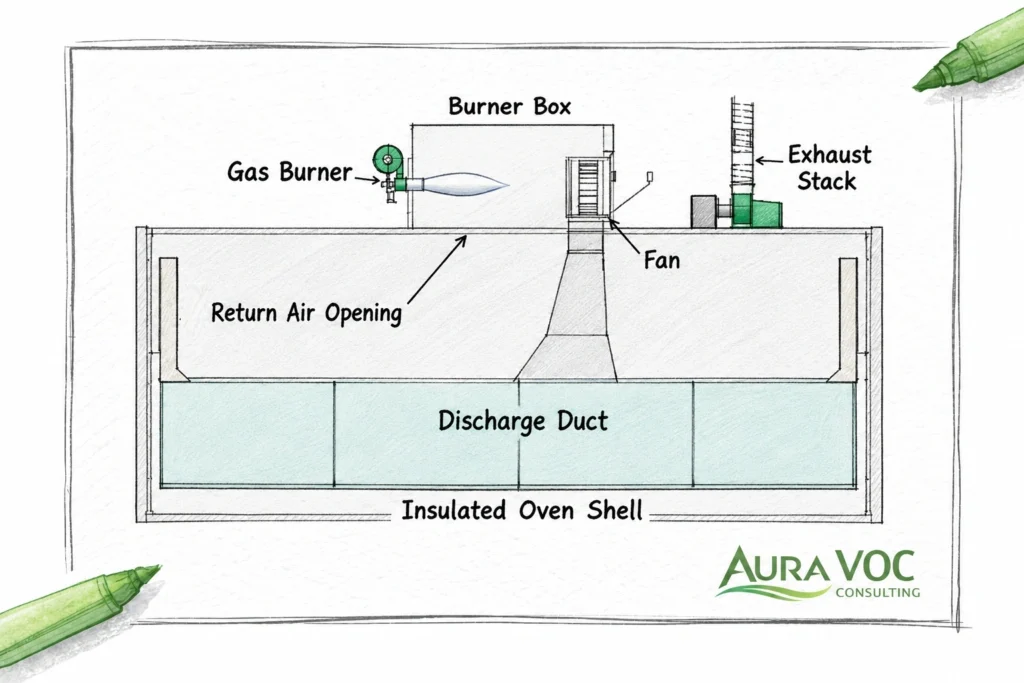
A useful emission map should identify not only where VOCs are generated, but also whether they are continuously emitted, intermittently emitted, well captured, partially captured, diluted, heated, or mixed with particulate and aerosol carryover. These details determine whether the exhaust can be treated directly, whether pre-filtration is needed, whether condensation or fouling is likely, and whether the abatement system will see stable or variable load.
Coating Application Areas and Spray Booth Exhaust
The coating application area is often one of the most important zones for VOC capture, especially in spray coating, roll coating, curtain coating, dip coating, and manual touch-up operations. VOC release can occur from atomized coating, exposed wet film, coating reservoirs, overspray, and open containers. In spray booths, the airflow is usually driven by containment, operator protection, and overspray management, which can result in high exhaust volume and relatively diluted VOC concentration.
For abatement design, booth exhaust should be reviewed for both VOC load and particulate or aerosol carryover. Overspray can foul ductwork, filters, concentrator media, catalyst surfaces, or heat recovery components if not properly removed. Filter loading can increase pressure drop and reduce capture airflow, creating a feedback loop where poor maintenance affects both process containment and VOC control performance.
Booth configuration also matters. Open access points, cross-drafts from supply air, unbalanced building ventilation, or frequent door opening can reduce capture efficiency even when the design exhaust flow appears adequate. In existing plants, poor capture is often caused by airflow distribution and enclosure design rather than total fan capacity alone.
Flash-Off Zone VOC Emissions
The flash-off section allows solvent to evaporate before the coated substrate enters the oven. Depending on the coating formulation, film thickness, residence time, and airflow, this area can release a substantial portion of the VOC load. Flash-off emissions are often more difficult to capture than oven emissions because the area may be partially enclosed, accessible to operators, or located between the booth and oven entrance.
If flash-off is insufficient, solvent load may shift into the oven, increasing oven exhaust concentration and potentially affecting drying quality or LEL control. If flash-off ventilation is excessive, the VOC stream may become highly diluted, increasing the load on downstream fans and treatment equipment.
Flash-off areas should be reviewed for local capture effectiveness, enclosure leakage, and pressure balance relative to both the coating booth and oven. Poorly controlled flash-off zones can become a significant fugitive VOC source even when the oven exhaust is connected to an abatement system.
Drying and Curing Oven Exhaust
Drying and curing ovens often produce the most defined VOC exhaust stream on a coating line. Solvent evaporation is accelerated by temperature, and the oven enclosure provides a more controlled capture environment than an open application area. However, oven exhaust is not automatically simple to treat. VOC concentration can vary along the oven zones with line speed, coating weight, solvent blend, and oven temperature profile.
Oven pressure balance is a critical operating factor. Excessive negative pressure can pull in dilution air, reduce energy efficiency, and affect temperature uniformity. Insufficient exhaust can increase solvent concentration and may interfere with LEL safety margins or drying performance. Exhaust damper settings, fan operation, and make-up air control should therefore be considered part of the VOC control system, not separate utilities.
For thermal oxidation systems, oven exhaust can be favorable because it is often warmer and more concentrated than booth exhaust. This advantage can be lost if the oven exhaust is mixed with large volumes of dilute air before treatment. In retrofit projects, reviewing the existing ductwork and exhaust zoning is often necessary before selecting or resizing an abatement unit.
Cleaning, Purging, and Product Changeover Emissions
Cleaning and product changeover emissions are frequently underestimated because they do not always occur during steady production measurements. Solvent cleaning of spray guns, rollers, coating heads, tanks, trays, hoses, and surrounding surfaces can create short-duration VOC peaks. These emissions may occur while doors are open, local exhaust is reduced, or the main abatement system is operating outside normal production mode.
From a design perspective, cleaning emissions matter because they can define peak concentration cases or explain fugitive VOC issues despite acceptable steady-state performance. They can also introduce solvent blends that differ from the coating formulation used during production. A cleaning solvent may have different volatility, flammability characteristics, adsorption behavior, or catalyst compatibility.
Operational procedures should therefore be included in the VOC evaluation. This includes where cleaning is performed, whether containers are closed, how waste solvent is stored, whether local exhaust is active, and whether the abatement system remains online during changeover.
Solvent Handling, Waste Coating, and Fugitive Emission Points
Solvent storage, coating preparation, waste coating containers, used wipes, open trays, and wastewater or wash water systems can all contribute to VOC emissions around a coating line. These sources may be smaller than oven or booth exhaust during normal production, but they can be relevant for fugitive emissions and troubleshooting.
The practical issue is that these emissions are often outside the main captured exhaust path. A plant may have a well-performing oxidizer while still detecting solvent vapors near mixing stations, waste containers, or cleaning areas. For this reason, an emission source map should include ancillary operations, not only the main coating and drying equipment.
Good engineering practice is to distinguish between process exhaust that can be routed to abatement, local sources that require improved containment or handling procedures, and waste streams that may require segregation, covered storage, or wastewater review. This prevents the abatement system from being treated as the only control point when part of the VOC load is generated elsewhere in the coating operation.
Process Variables That Change VOC Load, Concentration, and Capture Requirements
VOC emissions from a coating line are not fixed by the coating formulation alone. The same line can produce different VOC load profiles depending on line speed, coating weight, drying temperature, exhaust balance, and cleaning frequency. For this reason, process variables should be reviewed as part of the VOC control basis, not treated as secondary production details.
In operating plants, many VOC control problems are linked to changes that appear minor from a production standpoint. A higher coating weight, a new solvent blend, a faster line speed, or a modified oven temperature profile can shift the VOC load enough to affect oxidizer fuel use, concentrator performance, carbon bed life, or LEL operating margins. These effects are often more visible during transitional conditions than during steady production.
Coating Formulation and Solvent Blend Composition
The coating formulation defines the potential VOC load, but the solvent blend determines much of the evaporation behavior. Fast-evaporating solvents may release a large fraction of VOCs near the application or flash-off zone. Slower, higher-boiling components may carry further into the oven or remain in the film longer. This affects where capture is needed and which exhaust streams carry the highest load.
Solvent chemistry also influences abatement technology selection. A thermal oxidizer may tolerate a wide range of hydrocarbon solvents, provided the system is designed for the expected flow, concentration, and safety envelope. Catalytic oxidation requires more attention to catalyst compatibility, potential poisons, particulates, silicone-containing compounds, halogenated solvents, and other contaminants. Activated carbon performance depends on adsorption capacity, humidity, solvent boiling point, bed temperature, and regeneration strategy.
For plants running multiple coating recipes, it is not enough to evaluate the highest annual-volume product. A lower-volume formulation may contain a solvent blend that creates higher peak concentration, stronger odor impact, more difficult adsorption behavior, or greater corrosion potential after oxidation. Recipe-specific data should therefore be included in the VOC evaluation.
Line Speed, Coating Weight, and Production Rate
Line speed and coating weight directly affect solvent evaporation rate. Increasing line speed can increase the hourly mass flow of VOCs even when the coating formulation remains unchanged. Increasing wet film thickness or coating weight can have the same effect, while also changing the drying demand in the oven.
From an abatement perspective, the relevant issue is not only total solvent input but the rate at which solvent is released into the captured exhaust. A line running at a higher speed may produce a VOC load that approaches the capacity of an existing oxidizer, concentrator, or carbon system. If the abatement system was originally sized for a lower production rate, higher throughput can lead to elevated inlet concentrations, unstable temperature control, increased pressure drop through loaded filters, or more frequent interlock limitations.
Production rate changes can also affect residence time. If the oven residence time decreases without corresponding adjustment to temperature, airflow, or exhaust zoning, solvent may leave the oven later than expected or remain in the product. This can create quality issues and may shift VOC release to downstream cooling or handling areas that were not designed as primary emission capture points.
Oven Temperature, Residence Time, and Air Exchange Rate
Oven temperature and residence time control the evaporation profile along the drying or curing section. Higher temperatures generally accelerate solvent release, but they can also create sharper VOC concentration peaks in specific oven zones. Lower temperatures may spread evaporation over a longer distance or increase the risk of incomplete drying.
Air exchange rate is a major operating variable. Increasing oven exhaust can reduce solvent concentration inside the oven and support LEL safety margins, but it also increases heat loss and may dilute the exhaust sent to the abatement system. Excessive dilution air can reduce thermal oxidizer efficiency and increase fan power. Reducing exhaust flow may improve energy performance, but it can affect pressure balance, drying uniformity, and solvent accumulation risk.
In practice, oven exhaust settings should be evaluated together with temperature profile, line speed, coating formulation, and LEL monitoring. Treating oven exhaust as a fixed utility can lead to poor control. Dampers, fans, and make-up air arrangements are part of the VOC control system because they determine both capture and abatement inlet conditions.
Water-Based Coatings, High-Solids Coatings, and Wastewater Impacts
Switching from solvent-based coatings to water-based or high-solids systems can reduce air-phase VOC load, but it does not remove the need for process evaluation. Water-based coatings may still contain co-solvents, additives, amines, surfactants, or other volatile and semi-volatile components. They can also move part of the operational burden from air treatment to wastewater and sludge handling.
Wash water from coating preparation, booth cleaning, equipment rinsing, and line changeover may contain coating solids, dissolved organics, solvent traces, surfactants, and cleaning chemicals. This can increase COD load, affect wastewater pretreatment, or create sludge management requirements. If scrubbers are used for specific soluble compounds, blowdown can create another liquid waste stream that must be evaluated.
High-solids coatings can reduce solvent per unit of coating applied, but they may introduce viscosity, application, cleaning, and curing constraints. Changes in atomization, film build, or drying temperature can still affect VOC release location and capture requirements. Any coating reformulation should therefore be reviewed not only for VOC content but for its effect on line operation, cleaning practice, oven loading, and downstream waste streams.
Start-Up, Shutdown, Cleaning, and Batch Operation Effects
Many coating lines do not operate at one stable condition. Start-up, shutdown, cleaning, and product changeover can define the most difficult VOC load cases. During oven warm-up, solvent evaporation may occur before the abatement system reaches normal operating temperature. During shutdown, wet product, residual coating, or open containers may continue to release solvent after the main line stops. During cleaning, concentrated solvent evaporation may occur in areas that are only partially captured.
Batch operation adds another layer of variability. Short production campaigns can produce intermittent VOC loads that are inefficient for thermal systems, especially if the oxidizer remains hot during idle periods. Frequent changeovers may increase cleaning solvent use and cause VOC peaks that are not represented in average hourly measurements.
For this reason, operating modes should be documented separately. Steady production data are useful, but they should be supplemented by measurements or estimates for start-up, shutdown, cleaning, idle ventilation, and changeover. These modes influence abatement turndown, fuel consumption, interlock logic, maintenance scheduling, and operator procedures.
VOC Capture and Exhaust Ventilation Design for Coating Lines
The performance of a VOC abatement system depends first on what is captured. An oxidizer, concentrator, adsorption system, or scrubber can only treat the VOCs delivered to its inlet. If emissions escape from application areas, flash-off sections, oven openings, or cleaning stations, the treatment unit may operate correctly while the plant still has fugitive VOC issues.
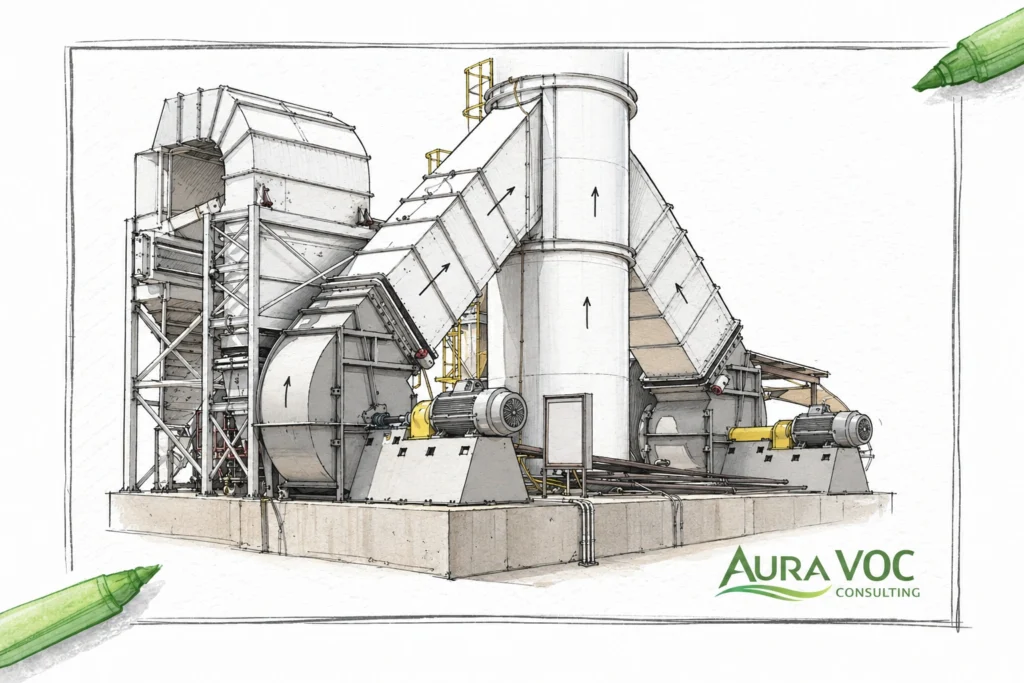
Capture design is often the most important part of the evaluation because it determines exhaust volume, VOC concentration, fan energy, duct layout, pressure drop, and abatement sizing. The objective is not maximum airflow. The practical objective is reliable capture with controlled dilution and stable pressure balance across all relevant operating modes.
Booth, Hood, and Enclosure Design Around VOC Release Points
Coating application areas require capture geometry that matches the way VOCs and aerosols are released. Spray booths, roll coaters, curtain coaters, dip tanks, and manual touch-up stations each have different emission patterns. A capture system designed only around total exhaust volume may miss local release points if hood position, enclosure shape, face velocity, or supply air distribution are poorly matched to the process.
Operator access is a common constraint. Doors, openings, inspection panels, and maintenance access points can disturb airflow and reduce capture effectiveness. In existing lines, capture issues often become visible only when doors are open, operators are loading material, or cleaning is in progress. These conditions should be included in smoke testing, airflow checks, or VOC measurement campaigns.
Where overspray is present, filtration must be considered part of the capture system. Filter loading increases pressure drop and can reduce exhaust airflow if the fan does not have sufficient margin. A poorly maintained filter bank can therefore reduce both overspray control and VOC capture. Differential pressure monitoring across filters is a basic but important operating indicator.
Pressure Balance Between Application, Flash-Off, Oven, and Building Areas
Pressure balance across the coating line affects both fugitive emissions and process stability. VOC-generating zones are often maintained under slight negative pressure to limit release into surrounding plant areas. However, excessive negative pressure can pull in unnecessary dilution air, disturb coating application, increase oven heat loss, and increase the size or operating cost of the abatement system.
The relationship between the application booth, flash-off zone, oven entrance, oven exhaust, and building ventilation should be reviewed as one system. A supply air change in the production hall can alter booth performance. An exhaust damper adjustment can shift oven pressure. A clogged filter can reduce local capture and change airflow distribution elsewhere in the line.
Pressure control is especially important around oven openings. If the oven is not properly balanced, solvent-laden air can escape at the inlet or outlet, or excessive ambient air can be drawn into the oven. Both conditions create operational problems: fugitive VOCs in one case, energy loss and diluted exhaust in the other.
Capture Efficiency vs Exhaust Dilution
Increasing exhaust airflow is a common response to VOC capture problems, but it is not always the best engineering solution. More airflow can improve containment at a weak capture point, but it also lowers VOC concentration and increases the volume that must be moved and treated. For thermal oxidation, this can increase fan power and auxiliary fuel demand. For concentrators, it can increase rotor size and pressure drop. For carbon systems, it can affect bed sizing and contact time.
A booth exhaust stream may contain most of the airflow but only a limited share of the VOC mass, while oven exhaust may carry less air with higher VOC concentration. Combining both streams can reduce the average inlet concentration to the oxidizer and increase auxiliary fuel demand. In that case, exhaust segregation, enclosure improvement, selective capture, or concentration before oxidation should be checked before specifying equipment.
The best result is usually obtained by reducing unnecessary dilution air while maintaining reliable capture at the actual emission points. This may involve enclosure modifications, local exhaust improvements, air curtain adjustments, damper balancing, or changes to supply air distribution rather than simply increasing fan capacity.
Ductwork Design, Condensation Risk, and Inspection Access
Ductwork for coating line exhaust must handle solvent-laden air, aerosols, particulates, and sometimes elevated temperatures. Poor duct design can create pressure drop, accumulation points, condensation, or maintenance access problems. Long duct runs, sharp elbows, undersized sections, and unbalanced branches can affect both capture and abatement system inlet conditions.
Condensation risk should be checked when exhaust contains higher-boiling solvents, moisture, or streams that cool before reaching the treatment unit. Condensed solvent or coating residues can accumulate in low points, dampers, or poorly drained sections. This can create odor, corrosion, fire load, or cleaning problems.
Inspection access is often underestimated. Ducts serving coating operations may require periodic checks for overspray deposits, filter bypass, residue accumulation, or damper fouling. Access doors, cleanout points, safe platforms, and isolation arrangements should be considered during design or retrofit planning, not added after maintenance problems occur.
Fan Capacity, Damper Position, and Pressure Drop Effects
Fans and dampers determine whether the intended capture conditions are actually achieved. A fan may have adequate nameplate capacity but still fail to deliver required flow if filters are loaded, duct resistance is higher than expected, dampers are mispositioned, or downstream equipment pressure drop has increased.
Pressure drop should be tracked across filters, mist eliminators, concentrator rotors, oxidizer beds, duct branches, and stacks where relevant. Rising pressure drop can reduce exhaust flow, change pressure balance, increase fan power, and reduce capture at critical points. In some plants, the first visible symptom is not an alarm at the abatement system, but a process complaint near the coating booth or oven entrance.
Damper settings should be documented and controlled. Unrecorded field adjustments can change the distribution of exhaust between booth, flash-off, and oven zones. After maintenance shutdowns, filter changes, or production modifications, airflow balancing should be verified rather than assumed.
How to Quantify VOC Load Before Selecting an Abatement System
A coating line VOC evaluation should define the mass flow, concentration range, exhaust volume, solvent composition, temperature, and variability of the captured emissions. The same annual solvent use can lead to different abatement choices depending on whether the VOCs are captured in a concentrated oven exhaust, a large dilute booth exhaust, or a variable combination of both.
Quantification should combine process data with field measurements where possible. Solvent use and coating formulation provide the starting point. Exhaust flow and VOC concentration measurements confirm what reaches the capture system. Operating mode data explain how the load changes across production cycles.
Coating Line VOC Mass Balance
A mass balance begins with solvent input from coatings, thinners, cleaning solvents, and related materials. The balance should then account for solvent retained in the product, waste coating, cleaning residues, wastewater or wash water, captured exhaust, and fugitive losses. The purpose is not to create a theoretical emissions number only, but to understand where the solvent actually goes.
For abatement design, the most important fraction is the captured VOC load entering the treatment system. If the mass balance suggests a high solvent input but exhaust measurements show low captured VOC concentration, the difference may be due to fugitive losses, waste handling, intermittent emissions, dilution, or measurement timing. This gap should be investigated before equipment is selected.
Exhaust Flow and VOC Concentration Measurement
Exhaust flow should be measured by zone where possible: application booth, flash-off, oven sections, cleaning exhaust, and combined headers. Measuring only the final common duct can hide useful information about which areas generate the main VOC load and which areas contribute mainly dilution air.
VOC concentration measurements should cover representative products and operating modes. Total VOC readings can be useful for screening and trending, but compound-specific analysis may be needed when solvent chemistry affects oxidation by-products, catalyst compatibility, carbon adsorption, or corrosion risk. Measurement locations should be selected to avoid poorly mixed duct sections or unrepresentative sampling points.
Peak Load Cases vs Average VOC Concentration
Average VOC concentration is often not sufficient for coating line design. The treatment system must handle steady operation, but it also has to tolerate peaks during line acceleration, oven warm-up, heavy coating application, cleaning, purging, and product changeover.
Peak cases should be described in practical operating terms: expected concentration, duration, exhaust flow, solvent blend, and production mode. This information affects RTO temperature control, concentrator desorption load, carbon breakthrough risk, LEL margin, and alarm settings. If only average concentration is used, short-duration events can be missed even though they may define the real operating limit.
Solvent Composition and Compound-Specific Constraints
The solvent blend should be reviewed for more than VOC content. Halogenated compounds, sulfur- or nitrogen-containing solvents, silicones, high-boiling components, and reactive compounds can influence technology selection and maintenance requirements. Oxidation may generate acid gases or other by-products that require material selection or downstream treatment review. Catalysts may be deactivated by contaminants. Carbon systems may show poor performance with very light compounds or excessive humidity.
A compound-specific review is especially important when multiple coating recipes or cleaning solvents are used. The worst case may not be the formulation with the highest solvent mass, but the formulation with the most restrictive chemistry.
LEL Monitoring and Safe Operating Envelope
LEL monitoring should be reviewed as part of the coating line operating envelope, especially for drying and curing ovens. Sensor location matters because solvent release may not be uniform along the oven length. A measurement point that is suitable for normal operation may not fully represent a zone where solvent evaporation peaks during a formulation change, coating weight increase, or line speed adjustment.
For coating and dipping operations, OSHA guidance on ventilation and lower flammable limit control can be used as a reference point when reviewing oven and solvent exhaust safeguards.
Purge sequences, exhaust interlocks, damper positions, and oven temperature controls should be checked against the highest credible solvent loading condition. Reducing exhaust flow to save energy, changing line speed, or increasing coating weight can all affect LEL margin. Where streams are concentrated before oxidation, the effect on flammable concentration ranges must also be reviewed before operating changes are made.
VOC Abatement Technology Options for Coating Line Exhaust
Equipment selection should start from the exhaust data, not from a preselected abatement technology. Flow rate, VOC concentration, solvent chemistry, temperature, particulate carryover, operating schedule, and maintenance access determine which systems are technically reasonable.
Regenerative Thermal Oxidizers for Coating Oven and Mixed Exhaust Streams
RTOs are often used for coating oven exhaust and mixed coating line exhaust because they can handle variable hydrocarbon solvent mixtures and provide high thermal heat recovery. They are most effective when the VOC concentration is sufficient to contribute useful heat release and when exhaust flow is stable enough for reliable chamber temperature control.
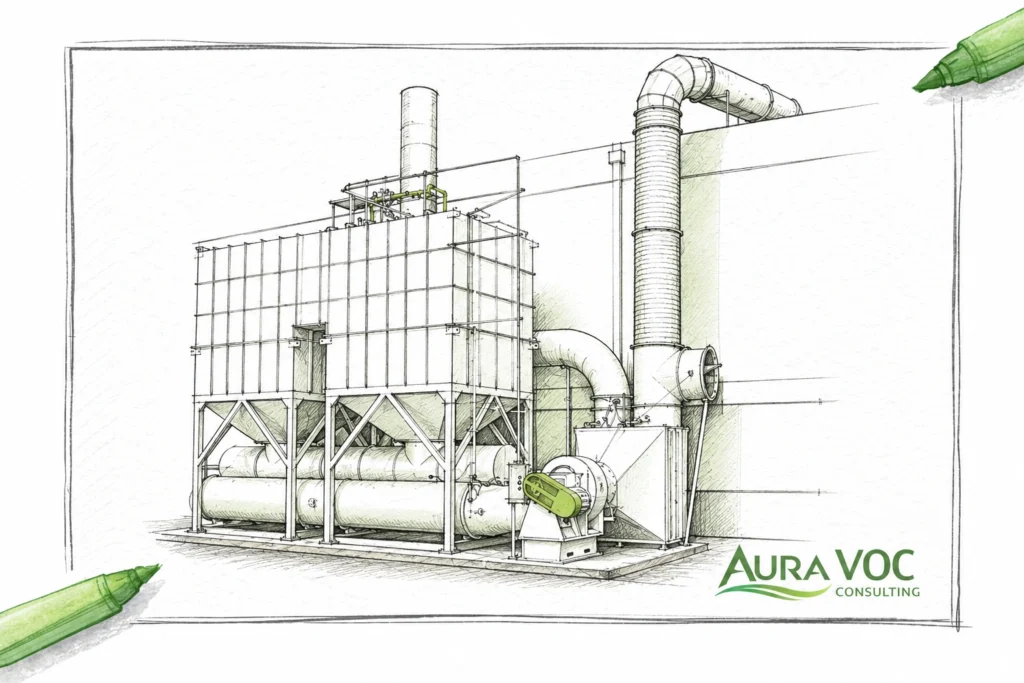
EPA technical material on thermal oxidizers provides useful reference information for monitoring and operating VOC destruction systems.
The main operating risk is treating excessive dilution air. If booth exhaust dominates total flow but carries limited VOC mass, the RTO may operate with high fan power and high auxiliary fuel demand. Other common issues include valve leakage, ceramic media fouling, poor burner tuning, insulation damage, and long idle periods with low VOC load. For retrofit projects, the review should include inlet VOC trends, exhaust flow, RTO bed differential pressure, valve condition, and actual operating schedule.
Recuperative Thermal Oxidizers for Stable or Smaller VOC Loads
Recuperative thermal oxidizers may be considered for smaller or more stable exhaust streams where operating conditions are less variable. They use a heat exchanger rather than ceramic beds, which can simplify some aspects of operation. However, heat recovery is usually lower than in an RTO, and fuel consumption should be checked carefully for dilute or intermittent exhaust.
They are generally more attractive for controlled flows with moderate-to-high VOC concentration and less attractive for large, dilute, variable booth exhaust. Heat exchanger fouling, corrosion potential, burner maintenance, and turndown capability should be reviewed against the actual coating schedule.
Catalytic Oxidizers and Catalyst Compatibility Limits
Catalytic oxidizers operate at lower temperatures than thermal oxidizers, which can reduce fuel demand in suitable applications. Their limitation is compatibility. Catalyst performance can be affected by coating aerosols, particulates, silicones, sulfur compounds, halogenated compounds, heavy metals, phosphorus-containing additives, or cleaning chemicals.
Before selecting catalytic oxidation, the plant should review all coating formulations and cleaning solvents, not only the main production recipe. Pre-filtration and mist elimination are often critical. Catalyst inspection and periodic activity testing should be included in the maintenance plan.
Zeolite Concentrators for High-Flow, Low-Concentration Coating Exhaust
Zeolite concentrators are relevant where the coating line produces high-flow, low-concentration VOC exhaust, especially when booth or enclosure ventilation dominates total airflow. The concentrator reduces the volume sent to the oxidizer by adsorbing VOCs onto a rotating zeolite media and desorbing them into a smaller, more concentrated stream.
This can reduce oxidizer size and fuel demand, but it adds its own constraints. The system introduces pressure drop, rotating equipment, seals, desorption heat demand, and sensitivity to fouling. Coating aerosol, overspray, plasticizers, high-boiling compounds, or poor pre-filtration can reduce performance. Typical checks include inlet filtration condition, rotor differential pressure, desorption temperature, seal leakage, and concentration ratio.
Activated Carbon Adsorption and Solvent Recovery Options
Activated carbon can be suitable for selected coating exhaust streams, particularly where solvent recovery is technically practical or where the stream is relatively cool, clean, and controlled. Suitability depends on solvent type, concentration, humidity, bed temperature, contact time, and regeneration method.
Carbon systems require careful attention to breakthrough and heat generation. High humidity, light compounds, solvent mixture changes, poor regeneration, or channeling can reduce bed life. Fire risk management, temperature monitoring, and clear replacement or regeneration criteria are essential. Carbon adsorption is usually less suitable for hot, aerosol-laden, highly variable, or poorly filtered exhaust.
Condensation for Higher-Concentration Recoverable Solvent Streams
Condensation is generally not a primary solution for large dilute booth exhaust. It is more relevant for higher-concentration solvent vapor streams where the recovered solvent has potential reuse or disposal value. The feasibility depends on solvent boiling points, moisture content, cooling demand, achievable outlet concentration, and recovered solvent quality.
In many coating applications, condensation may require downstream polishing because the remaining VOC concentration is still too high for discharge or too variable for stable operation. Condensate handling should also be reviewed, especially where solvent-water mixtures, phase separation, or contaminated recovered solvent are expected.
Scrubbers for Specific Water-Soluble or Chemically Absorbable VOCs
Scrubbers should not be treated as a general solution for solvent-based coating VOCs. Many coating solvents are poorly suited to simple water scrubbing because of limited solubility. Scrubbing may be appropriate for specific water-soluble or chemically absorbable compounds, but the process creates a liquid stream that must be managed.
Chemical absorption can involve reagent consumption, pH control, blowdown, and wastewater treatment constraints. Before selecting a scrubber, the plant should confirm compound solubility, removal mechanism, liquid-to-gas requirements, blowdown composition, and compatibility with existing wastewater treatment capacity.
How to Select a VOC Abatement System for a Coating Line
A coating line abatement system should be selected against measured exhaust conditions and realistic operating modes: steady coating, oven warm-up, cleaning peaks, product changeover, idle exhaust, and shutdown. A stable oven exhaust, a high-flow spray booth, and a variable multi-recipe coating line may require different treatment approaches.
For European industrial installations, the BAT reference document for surface treatment using organic solvents is a useful technical reference when reviewing coating, drying, cleaning, and VOC control options.
Exhaust Flow Rate and VOC Concentration Range
The relationship between airflow and concentration is often the most important selection factor. If booth exhaust dominates total flow, direct oxidation may size the oxidizer and fan system around dilution air rather than VOC mass. In that case, exhaust segregation, enclosure improvement, selective capture, or concentration before oxidation should be checked before equipment is specified.
High-flow, low-concentration exhaust increases equipment size, pressure drop, and energy use. More concentrated streams may support direct oxidation or recovery, provided flammability, temperature, and solvent chemistry are controlled.
Solvent Chemistry, Corrosion Risk, and Catalyst Poisoning Potential
Solvent chemistry affects more than destruction efficiency. Halogenated or sulfur-containing compounds can create corrosion or acid gas concerns after oxidation. Silicone-containing compounds, aerosols, and certain additives can damage catalysts or foul concentrator media. Cleaning solvents should be included because they often differ from production coatings and may define the most restrictive case.
Material selection, catalyst compatibility, adsorbent suitability, and condensate handling all depend on the compound list. A formulation change should therefore trigger a review of the existing abatement basis, not only the product quality specification.
Production Schedule, Recipe Variability, and Future Capacity
A line with stable campaigns and continuous operation may support a different abatement strategy than a line with frequent short runs. Low utilization can increase the fuel penalty of thermal systems. Frequent recipe changes can affect VOC peaks, solvent compatibility, and maintenance intervals.
Planned production increases should be checked against fan curves, duct pressure drop, oxidizer capacity, media loading, carbon bed life, and LEL controls. A line speed increase may appear to be a process improvement but can move the VOC system closer to its operating limit.
Direct Oxidation vs Concentration Before Oxidation
Direct oxidation is mechanically simpler and can be robust for moderate or concentrated VOC streams. For high-flow, dilute exhaust, it may result in high fan power and auxiliary fuel demand. Concentration before oxidation can improve energy performance, but it introduces rotor fouling risk, seal maintenance, desorption control, filtration requirements, and additional pressure drop.
The decision should be made from actual airflow and VOC concentration data. If most of the exhaust volume is dilution air, concentration or better source capture may be more effective than simply installing a larger oxidizer.
Centralized VOC Treatment vs Line-Specific Abatement
Centralized treatment can reduce equipment count, but it increases duct length, balancing complexity, and the risk that one line’s operating mode affects another. If one coating line is idle while another is operating, the central system may run inefficiently unless airflow control is well designed.
Line-specific abatement can provide better process control and clearer troubleshooting, but it increases equipment count and maintenance points. The choice should consider operating independence, shutdown requirements, space, duct routing, controls integration, and future expansion.
Solvent Recovery vs VOC Destruction
Solvent recovery is realistic when the solvent blend is consistent, concentration is high enough, and recovered solvent quality is acceptable for reuse or off-site recovery. VOC destruction is generally more robust for variable formulations, contaminated exhaust, or solvent blends that are difficult to separate.
Recovery should not be selected without reviewing condensate quality, storage, fire risk, and downstream polishing needs. A technically recoverable solvent may still be impractical if the recovered stream is contaminated or inconsistent.
Capital Cost, Energy Consumption, Maintenance, and Downtime Tradeoffs
Equipment comparisons should include more than purchase price. Fan power, auxiliary fuel, filtration, pressure drop, catalyst replacement, carbon regeneration, media cleaning, instrumentation, access platforms, and planned shutdown windows affect the real operating cost.
For critical coating lines, maintainability and production availability may be more important than a small difference in installed cost. Equipment that is difficult to inspect, isolate, or clean can create avoidable downtime even if the basic technology is suitable.
Pressure Drop and Energy Implications in Coating Line VOC Systems
Pressure drop affects capture performance, fan energy, oven balance, and abatement reliability. It should be monitored from the capture point to the stack, not only at the treatment unit.
Pressure Drop Sources from Capture Point to Stack
Pressure losses can occur across booth filters, mist eliminators, duct branches, elbows, dampers, balancing devices, concentrator rotors, RTO media, recuperative heat exchangers, silencers, and stacks. Each component may be acceptable alone, but the combined resistance determines whether the fan can maintain design flow.
In coating applications, pressure drop often changes over time as filters load, overspray accumulates, dampers foul, or media becomes contaminated. Baseline values should be recorded after commissioning or cleaning so future changes can be interpreted correctly.
Fan Energy, Exhaust Volume, and Dilution Air
Unnecessary dilution air increases fan power and may reduce VOC concentration below efficient oxidizer operation. If the fan system is moving large volumes of low-VOC air, the plant may pay for air handling and treatment capacity that does not contribute much VOC mass.
Capture should be improved by controlling release points and enclosure leakage, not only by increasing total exhaust. Reducing unnecessary dilution can improve abatement performance, but only if local capture and safe operating margins are maintained.
RTO Fuel Consumption During Low VOC Load or Idle Operation
When VOC concentration is too low to provide meaningful heat release, the RTO must maintain chamber temperature with auxiliary fuel. The issue is often not the oxidizer alone, but the amount of non-process air routed into it and the time the unit operates at low load.
Common checks include inlet VOC trend, exhaust flow, idle airflow settings, media differential pressure, valve leakage, burner tuning, insulation condition, and production utilization. Weekend operation, warm standby, or long idle ventilation periods can dominate fuel use on some lines.
Heat Recovery Opportunities and Limitations
Heat recovery can reduce utility demand, but it must be compatible with the process. Fouling, solvent composition, exhaust temperature, corrosion risk, duct routing, and the availability of a useful heat sink all affect feasibility. Heat recovered to an oven or make-up air system must be controlled so it does not disturb process temperature stability.
Heat recovery should also be reviewed against operating schedule. A recovery system that looks attractive during full production may provide limited benefit if the line has frequent idle periods, short campaigns, or variable exhaust temperature.
How Fouling Increases Energy Demand and Reduces Capture Performance
Loaded filters, coated ductwork, fouled concentrator media, plugged RTO beds, or dirty heat exchangers increase system resistance. If the fan cannot maintain design flow at the increased resistance, capture velocity drops at booths, hoods, or oven openings. The abatement unit may remain online while fugitive emissions increase upstream.
Fouling also affects energy performance. Higher resistance increases fan load, while fouled heat transfer or ceramic media can increase fuel demand. Tracking differential pressure by component helps identify whether the restriction is in the capture system, ductwork, pre-filtration, concentrator, oxidizer, or stack.
Wastewater and Liquid Waste Implications of Coating Line VOC Control
Some VOC control decisions create liquid waste streams. These should be evaluated before selecting scrubbers, recovery systems, or water-based coating conversions. An air treatment decision can create wastewater, sludge, condensate, or spent media issues that affect plant operation.
Water-Based Coating Wash Water and COD Load
Water-based coatings can reduce solvent emissions, but they may generate wash water containing resins, additives, co-solvents, surfactants, pigments, suspended solids, and cleaning chemicals. These streams can increase COD load, affect pretreatment performance, or increase sludge production.
A water-based conversion should therefore be reviewed with the wastewater system in mind. Rinse frequency, cleaning method, segregation of concentrated waste, and compatibility with existing treatment capacity can be as important as the reduction in air-phase solvent load.
Scrubber Blowdown and Spent Absorbent Streams
Scrubber systems require purge management. Blowdown may contain absorbed organics, reaction products, salts, pH adjustment chemicals, and suspended solids depending on the system design. Spent absorbent or chemical solutions may require specific handling.
Before selecting absorption, the plant should confirm whether the resulting liquid stream can be treated in the existing wastewater system or requires segregation. A scrubber that transfers VOC load to a difficult liquid waste stream may not simplify plant operation.
Condensate from Solvent Recovery or Carbon Regeneration
Condensation and carbon regeneration can produce solvent-rich or solvent-water condensate. Composition may vary with coating recipe, regeneration cycle, humidity, and cleaning solvent use. Some condensates may separate into phases, while others may form mixed streams requiring disposal or further treatment.
Recovered solvent quality should be checked before assuming reuse is possible. Contamination with water, coating additives, or mixed solvents can limit reuse options and change the economics of recovery.
Coating Sludge, Cleaning Solvent, and Waste Segregation
Cleaning residues, coating sludge, spent solvent, used wipes, and wash water should not be treated as one uniform waste stream. Segregation can improve recovery options, reduce wastewater loading, and prevent incompatible mixtures.
Waste containers and sludge handling points can also become local VOC sources if left open or poorly ventilated. These points should be included in the emission source map, especially where operators report solvent vapor near waste storage or cleaning areas.
Air-to-Water Pollution Transfer Risks in VOC Control Decisions
A system that reduces air emissions may create wastewater or liquid waste constraints if cross-media impacts are not reviewed. Scrubbers, condensation systems, carbon regeneration, and water-based coating conversions can all shift part of the operational burden to liquid waste management.
For coating lines, this review should include wastewater capacity, COD load, sludge generation, solvent-water separation, pH control, chemical consumption, and waste classification. These items can influence technology selection as much as exhaust flow or VOC concentration.
Troubleshooting VOC Capture and Abatement Problems on Coating Lines
Troubleshooting should start at the process and capture points before assuming the abatement unit is the root cause. A useful method is to compare the symptom with recent operating changes, airflow data, differential pressure trends, and maintenance history.
VOC Peaks During Start-Up, Shutdown, and Product Changeover
VOC peaks often come from oven warm-up, heavy coating application, solvent cleaning, open containers, purging, or residual solvent evaporation after the line stops. These events should be checked against VOC trend data and operator procedures.
If peaks occur during cleaning, verify whether local exhaust is active, containers are closed, and the abatement system is in the correct operating mode. If peaks occur during oven warm-up or line acceleration, review oven temperature ramp, coating weight, line speed, and exhaust damper sequence.
Poor Capture Despite High Exhaust Flow
High total exhaust flow does not guarantee local capture. Common causes include poor hood position, open booth doors, cross-drafts from supply air or plant doors, blocked filters, fan belt slip, VFD setting changes, unbalanced dampers after maintenance, or insufficient make-up air control.
Typical checks include smoke testing, booth face velocity, filter differential pressure, fan speed, damper position, access door position, and airflow balance between application, flash-off, oven, and building ventilation. Capture issues should be diagnosed at the release point, not only at the fan or stack.
High Fuel Consumption in RTOs and Thermal Oxidizers
High fuel use is usually linked to low VOC concentration, excessive dilution air, low production utilization, long idle periods, heat recovery degradation, valve leakage, media fouling, insulation damage, or burner tuning issues.
The first checks should be inlet VOC concentration, exhaust flow, idle airflow, RTO temperature profile, valve condition, bed pressure drop, and production schedule. Increasing solvent use is not the only reason fuel use changes; routing more dilution air to the oxidizer can have the same effect.
High Pressure Drop Across Filters, Concentrators, or Oxidizers
Rising pressure drop can reduce capture flow and move the fan away from its design point. In coating applications, common causes include overspray carryover, loaded filters, coating residue in ductwork, fouled mist eliminators, plugged concentrator media, or RTO media contamination.
Pressure drop should be trended by component where possible. A single total system pressure reading may not show whether the restriction is at the booth filters, ductwork, rotor, oxidizer bed, or stack.
Carbon Breakthrough, Catalyst Deactivation, and Media Fouling
Early carbon breakthrough may be caused by high humidity, light solvents, increased inlet concentration, poor regeneration, bed channeling, or changes in solvent blend. Catalyst deactivation can result from poisons, aerosols, coating additives, or inadequate pre-filtration. Concentrator media fouling is often linked to overspray, plasticizers, high-boiling compounds, or poor inlet filtration.
When performance changes after a formulation or cleaning solvent change, the solvent list should be reviewed before assuming a mechanical failure. A new recipe or cleaning procedure can change adsorption behavior, oxidation by-products, catalyst compatibility, or fouling rate.
Fugitive VOC Emissions and Odor Despite Operating Abatement Equipment
Fugitive VOCs can remain even when the abatement unit is functioning. Typical causes include incomplete capture, bypass leakage, open waste containers, cleaning outside captured areas, oven inlet or outlet leakage, or solvent handling points that are not connected to treatment.
The review should separate treatment efficiency from capture efficiency. Stack performance may be acceptable while emissions still occur upstream of the abatement system. This distinction is important when troubleshooting plant-floor VOC readings or odor observations near coating operations.
Maintenance Considerations for Coating Line VOC Abatement Systems
Maintenance planning should be part of the design basis. Access, shutdown windows, spare parts, and monitoring points determine long-term reliability. A system that performs well after commissioning can degrade if filters, dampers, sensors, media, valves, or ducts are not inspected on a suitable schedule.
Filter, Mist Eliminator, and Duct Cleaning Requirements
Overspray and coating residues should be controlled before they reach sensitive equipment. Filters and mist eliminators protect concentrator media, catalysts, heat exchangers, RTO beds, and ductwork. Differential pressure should be tracked so filter loading does not reduce capture airflow.
Duct cleaning requirements depend on coating type, overspray control, exhaust temperature, and maintenance access. Deposits can increase pressure drop, create odor sources, and complicate fire risk management.
RTO Media, Valves, Burners, and Temperature Controls
RTO reliability depends on valve sealing, burner tuning, ceramic media condition, insulation integrity, and temperature instrumentation. Valve leakage can reduce destruction performance and heat recovery. Media fouling can increase pressure drop and fuel consumption. Burner or temperature control issues can create unstable operation during low-load periods.
Maintenance checks should include bed differential pressure, valve actuation, burner condition, chamber temperature trends, insulation condition, and alarm history.
Catalyst Inspection and Activity Testing
Catalyst performance should be checked periodically, especially when solvent formulations or cleaning agents change. Catalyst deactivation may not be obvious immediately; it can appear as higher operating temperature demand, lower removal efficiency, or increased outlet concentration.
Inspection should include evidence of fouling, masking, thermal damage, or contamination. Activity testing can help determine whether cleaning, replacement, or process changes are required.
Carbon Bed Monitoring and Replacement Planning
Carbon systems require breakthrough monitoring, regeneration control, temperature checks, and planned bed replacement. Bed life can change significantly with humidity, solvent mix, inlet concentration, and operating schedule.
Temperature monitoring is important where adsorption heat or high solvent loading may create risk. Replacement or regeneration intervals should be based on operating data, not only calendar time.
Differential Pressure, VOC, LEL, and Flow Instrument Calibration
Instrumentation should be treated as operating equipment, not only compliance hardware. Differential pressure transmitters, VOC monitors, LEL sensors, temperature probes, and flow instruments all support safe and stable operation.
Calibration intervals should reflect the process conditions and the criticality of each instrument. Sensors exposed to solvent mixtures, particulates, humidity, or high temperatures may require more frequent checks than standard plant instruments.
Access, Isolation, and Shutdown Planning for Maintenance
Safe access to filters, ducts, dampers, oxidizers, concentrators, carbon beds, and monitoring ports reduces unplanned downtime. Isolation dampers, platforms, cleanout doors, lifting access, and spare parts should be reviewed during design or retrofit planning.
Maintenance constraints can influence technology selection. A system that cannot be inspected or cleaned within available shutdown windows may not be suitable for a production-critical coating line.
Design Data Checklist for Coating Line VOC Evaluation
The evaluation should be based on operating modes that the line actually runs: steady coating, oven warm-up, cleaning peaks, idle exhaust, changeover, and shutdown. The following data help define the technical basis for capture review, abatement selection, pressure drop evaluation, and operating cost assessment.
Coating Formulations and Solvent Consumption Data
Collect production coatings, thinners, cleaning solvents, and expected formulation changes. The solvent list is needed for mass balance, flammability review, catalyst compatibility, adsorption behavior, corrosion risk, and condensate handling.
Annual consumption is useful, but hourly use and recipe-specific solvent content are more important for sizing and peak load assessment.
Exhaust Flow by Application, Flash-Off, and Oven Zone
Separate zone data helps distinguish VOC-bearing air from dilution air. Measuring only the combined duct can hide whether the booth, flash-off section, or oven is driving abatement size.
Flow should be reviewed against fan capacity, damper positions, filter condition, and production mode. A balancing report is most useful when it reflects actual operating conditions.
VOC Concentration Profiles by Operating Mode
VOC measurements should include steady operation and non-steady modes. Cleaning peaks, oven warm-up, and product changeover may define the design case even if they represent a small share of annual operating hours.
Where solvent chemistry affects technology selection, compound-specific data should be collected in addition to total VOC measurements.
Oven Temperatures, Line Speed, and Production Schedule
These values determine solvent evaporation rate, residence time, oven load, and VOC variability. Any planned line speed increase should be checked against exhaust capacity, abatement capacity, and LEL margin.
Production schedule matters because idle operation, weekend shutdowns, and short campaigns can change fuel use, maintenance needs, and abatement turndown requirements.
Cleaning Procedures and Changeover Frequency
Cleaning can be a major VOC source. Document where cleaning occurs, which solvents are used, how waste is stored, whether local exhaust is active, and whether the abatement system remains online.
Changeover frequency affects solvent use, peak emissions, waste generation, operator exposure controls, and abatement stability.
Existing Ductwork, Fans, Dampers, and Abatement Equipment
Retrofit feasibility depends on available fan capacity, duct routing, damper condition, current pressure drop, stack location, available footprint, access for maintenance, and integration with oven controls.
Existing systems should be reviewed through drawings, field inspection, airflow measurements, differential pressure trends, and equipment operating history.
Utility, Space, Maintenance, and Wastewater Constraints
Fuel, electricity, compressed air, wastewater capacity, access platforms, spare parts, and shutdown windows should be reviewed before selecting equipment. A technically suitable system may still be impractical if it cannot be maintained or integrated into the existing plant layout.
Wastewater and liquid waste constraints should be checked when considering scrubbers, condensation, carbon regeneration, or water-based coating conversions.
When to Request a Technical Review of a Coating Line VOC System
A technical review is useful when process changes, unstable VOC loads, high fuel consumption, pressure drop, or poor capture begin to affect line operation or permit margins. The review should start with process conditions and captured exhaust data before focusing on the abatement unit alone.
New Coating Line or Oven Installation
Early review helps define capture points, exhaust zoning, abatement sizing, and safe operating limits. It is easier to design effective capture, inspection access, and duct routing before the line layout is fixed.
For new lines, the review should include expected coatings, solvent blends, line speed, oven profile, exhaust zoning, LEL controls, utilities, maintenance access, and future capacity assumptions.
Production Increase or Coating Formulation Change
Higher line speed, increased coating weight, or a new solvent blend can change VOC load and abatement performance. The existing system should be checked before assuming it can absorb the additional load.
A formulation change may also affect catalyst compatibility, carbon adsorption performance, corrosion risk, wastewater load, or condensate quality. These effects may not be visible from VOC content alone.
High RTO Fuel Consumption or Unstable Abatement Operation
Fuel use, temperature instability, or frequent alarms usually require review of both process load and equipment condition. Excess dilution air, idle operation, media fouling, valve leakage, or low VOC concentration may be more important than oxidizer design alone.
Operational data should include inlet VOC trends, exhaust flow, chamber temperature, bed pressure drop, valve operation, burner performance, and production schedule.
VOC Peaks, Fugitive Emissions, or Poor Capture Performance
VOC peaks and fugitive emissions often originate upstream of the abatement unit. Cleaning procedures, oven openings, flash-off capture, booth airflow, open waste containers, or bypass leakage should be reviewed.
Poor capture should be investigated with airflow checks, pressure balance review, smoke testing, filter differential pressure, and damper position verification.
Pressure Drop, Fouling, or Maintenance Reliability Issues
Increasing pressure drop or frequent cleaning may indicate inadequate filtration, poor duct design, excessive overspray carryover, fouled media, or unsuitable technology selection.
A review should identify where the resistance is increasing and how it affects capture flow, fan operation, fuel use, and maintenance downtime.
Comparing RTO, Concentrator, Carbon, Condensation, or Recovery Options
Technology comparisons should be based on measured flow, concentration, solvent chemistry, utilities, pressure drop, maintenance requirements, and operating schedule. Vendor sizing alone is not enough if the process basis is incomplete.
For coating lines, the main comparison is often not only removal performance. It is whether the system can operate reliably with the actual exhaust profile, production variability, cleaning load, and plant constraints.
FAQ — VOC Emissions from Coating Lines
What are the main VOC sources in a coating line?
The main sources are the application area, flash-off section, drying or curing oven, cleaning operations, solvent handling, and waste coating storage. In practice, the most important source is not always the largest visible process area. A small cleaning station or oven opening can create relevant fugitive emissions if it is poorly captured.
Why is solvent consumption data not enough to size a VOC abatement system?
Solvent consumption does not show how much VOC is captured, where it evaporates, how diluted it becomes, or when peak emissions occur. Abatement design requires captured VOC mass flow, exhaust volume, concentration range, solvent composition, temperature, and operating modes. It should also account for waste solvent, wash water, cleaning residues, and fugitive losses.
Should coating booth exhaust and oven exhaust be treated together?
They should only be combined after reviewing flow, concentration, temperature, solvent load, and dilution effects. Combining streams can simplify ducting, but dilute booth exhaust may increase oxidizer size and fuel demand. Separate treatment, exhaust segregation, or concentration before oxidation may be more appropriate in some layouts.
When is an RTO suitable for coating line VOC emissions?
An RTO is suitable when the exhaust flow, VOC concentration, solvent chemistry, and operating schedule support stable oxidation and acceptable fuel use. RTOs are often effective for oven exhaust and mixed streams, but excessive dilution air, long idle operation, valve leakage, or media fouling can increase operating cost.
When should a zeolite concentrator be considered?
A zeolite concentrator should be considered for high-flow, low-concentration VOC exhaust, especially when spray booth or enclosure ventilation dominates total airflow. The evaluation must include pre-filtration, rotor fouling risk, desorption heat, pressure drop, solvent compatibility, and the effect of concentration on downstream oxidation.
Why is my coating line RTO consuming more fuel than expected?
Common causes include low VOC concentration, excessive dilution air, idle airflow, low production utilization, media fouling, valve leakage, insulation damage, poor burner tuning, or cold make-up air. Review both the oxidizer and the upstream capture system. In many cases, the oxidizer is treating too much non-process air.
How does pressure drop affect VOC capture and abatement performance?
High pressure drop increases fan energy and can reduce exhaust flow if the fan cannot maintain design capacity. Reduced flow can weaken capture at booths, flash-off zones, or oven openings, creating fugitive emissions even when the abatement unit remains operational. Pressure drop should be trended by component, not only as a total system value.
Can water-based coatings still create VOC or wastewater problems?
Yes. Water-based coatings may contain co-solvents and additives, and they can increase wash water, sludge, surfactant load, and COD. Any water-based conversion should be reviewed for both air emissions and wastewater treatment capacity. Cleaning procedures and waste segregation are often important parts of the evaluation.
What causes VOC peaks during coating line changeovers?
Common causes include solvent cleaning, purging, open tanks or trays, residual wet coating, recipe changes, and temporary changes in ventilation. These peaks may be missed if measurements are taken only during steady production. Changeover procedures should be reviewed together with VOC trend data and local exhaust operation.
What maintenance checks are most important for VOC systems on coating lines?
Key checks include filter differential pressure, duct deposits, fan performance, damper position, VOC and LEL instrument calibration, oxidizer valves and burners, RTO media pressure drop, catalyst condition, concentrator rotor condition, and carbon bed breakthrough. Maintenance should focus on components that affect capture flow, pressure drop, oxidation stability, and safe operating limits.
Conclusion
Key Engineering Factors for Reliable VOC Control
Reliable VOC control on coating lines depends on the full system: solvent release, capture geometry, exhaust zoning, fan performance, abatement technology, instrumentation, and maintenance. The main engineering risk is selecting treatment equipment before the VOC load profile is understood. Flow rate, VOC concentration, solvent composition, production variability, pressure drop, energy demand, and wastewater implications should be reviewed together.
The most common problems are not limited to the abatement unit. Poor capture, excessive dilution, unbalanced dampers, loaded filters, fouled media, unstable oven pressure, cleaning emissions, and formulation changes can all affect VOC performance. A coating line should therefore be evaluated as an operating system, not as a stack-only treatment problem.
Next Steps for Evaluating Existing or Planned Coating Lines
For existing lines, the practical starting point is to map emission points, measure exhaust flows by zone, review solvent consumption, document operating modes, inspect capture points, and compare abatement performance against actual production conditions. For new or modified lines, the same information should be used before selecting or resizing equipment.
For coating lines with unstable VOC loads, high oxidizer fuel use, capture problems, pressure drop increases, or planned formulation changes, a technical review should start with the line layout, exhaust flow by zone, solvent use, VOC measurements, oven settings, cleaning procedure, and existing abatement data. AuraVOC can support this review by comparing the actual operating basis against suitable abatement configurations and practical plant constraints.