
Membrane-Based VOC Gas Separation for Industrial VOC Emissions
Membrane-based VOC gas separation is used in selected industrial emission control projects when the objective is to separate or concentrate volatile organic compounds from a gas stream. In some cases, this can support solvent recovery. In other cases, it can reduce or redistribute the VOC load before downstream treatment.
The technology should not be evaluated as a direct substitute for oxidation, adsorption, condensation, or scrubbing without a process-specific review. A membrane system does not destroy VOCs. It creates a VOC-rich stream and a VOC-lean stream, both of which need a defined destination. The VOC-rich stream may be condensed, recycled, polished, oxidized, or disposed of. The VOC-lean stream may still require final treatment if it does not meet the applicable outlet limit.
For plant managers, the main question is whether membrane separation creates a useful operating or economic advantage over simpler alternatives. For EHS managers, the concern is whether the complete treatment train can meet the compliance basis under normal, peak, startup, and shutdown conditions. For process engineers, the evaluation depends on gas flow, VOC composition, partial pressure, pressure ratio, temperature, humidity, aerosols, condensables, LEL risk, and downstream handling.
Membrane-based VOC gas separation is therefore best treated as one option in a broader technology selection process. It can be valuable for controlled solvent-rich vents, recovery-oriented systems, and selected hybrid configurations. It is often less attractive for high-flow dilute exhaust, unstable mixed solvent streams, wet or aerosol-laden gas, or applications where final VOC destruction must be provided by a single robust abatement step.
Membrane-Based VOC Gas Separation: Recovery, Concentration and Load Reduction
VOC separation instead of VOC destruction
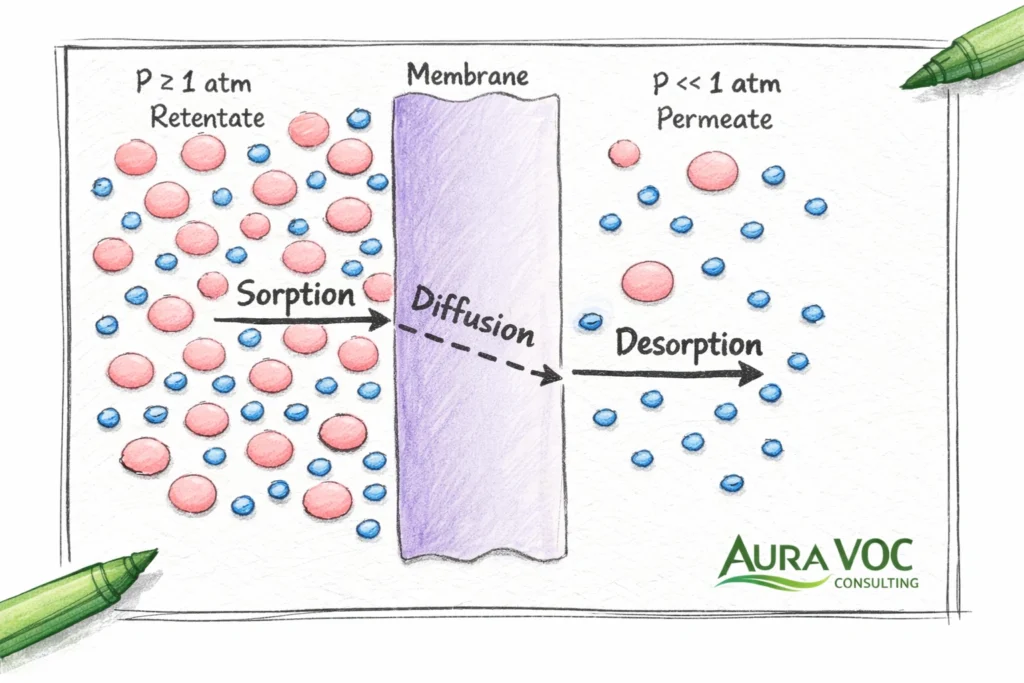
A membrane VOC system separates an inlet gas stream into two outlet streams with different VOC concentrations. One stream is enriched in the more permeable components, while the other is depleted. This is a gas separation step, not a destruction step.
That distinction affects the entire project basis. Thermal oxidizers, catalytic oxidizers, and regenerative thermal oxidizers destroy VOCs by oxidation. EPA provides technical background on thermal oxidizers used for VOC control. Activated carbon transfers VOCs from the gas phase to an adsorbent until regeneration, replacement, or disposal. Condensation transfers VOCs into a liquid phase when vapor pressure, temperature, and pressure conditions are favorable. Scrubbers remove compounds that are soluble or chemically reactive in the selected liquid phase. A membrane system separates components according to membrane selectivity and operating driving force.
The VOC-rich fraction still requires management. It may be routed to a condenser, recovery loop, activated carbon unit, oxidizer, process recycle, or controlled disposal system. If the VOC-depleted fraction remains above the applicable outlet limit, a polishing or destruction step may be required.
For this reason, membrane separation should not be described as guaranteed final abatement. It can form part of a VOC abatement strategy only when the VOC mass balance, safety basis, and final outlet requirement are all addressed.
Main industrial purposes
In industrial VOC projects, membrane-based gas separation is usually considered for four practical purposes.
The first is solvent vapor recovery. A membrane may enrich a VOC-containing stream so that downstream condensation, purification, reuse, recycle, or disposal becomes more practical. This only has value if the VOC-rich stream has a defined destination. A mixed solvent condensate with water or degradation products may not be reusable without further treatment.
The second purpose is VOC concentration before another treatment step. Concentrating VOCs into a smaller stream can support condensation, adsorption, oxidation, or process recycle. This must be balanced against LEL risk, oxygen concentration, temperature control, and safe handling of the enriched stream.
The third purpose is load reduction on existing VOC abatement equipment. A plant may investigate membranes when carbon consumption, oxidizer fuel demand, cooling duty, or solvent loss is high. Any benefit should be demonstrated by mass and energy balance. The power required for compression, vacuum, cooling, heating, recycle, and pressure drop must be included.
The fourth purpose is process gas separation. Some plants need to separate organic vapors from air, nitrogen, or another carrier gas. This may occur in inerted process vents, solvent recovery loops, storage and transfer systems, or closed-loop production operations. In these cases, oxygen ingress, nitrogen balance, recycle composition, and pressure control become part of the design basis.
Across all uses, the same rule applies: membrane separation must create a useful VOC-rich stream and an acceptable VOC-lean stream. If neither stream has a clear technical destination, the membrane unit adds complexity without solving the emission problem.
When plants usually consider membrane separation
Plants usually consider membrane-based VOC gas separation when conventional options create a technical or operating concern. A thermal oxidizer may have high fuel demand on a dilute stream. A condenser may be ineffective because the VOC partial pressure is too low for practical cooling. An activated carbon system may experience rapid breakthrough or difficult regeneration. A process may lose solvent with enough value to justify recovery.
Membrane separation is easier to evaluate when the source is defined: a process vent, purge stream, tank vent, dryer exhaust, or recovery loop with measurable flow and composition. Large diluted ventilation exhausts are more difficult because the VOC partial pressure is often low and the membrane area or energy demand may become excessive.
Batch processes can still be candidates, but the design cannot be based only on daily averages. Peak solvent concentration, peak duration, low-load periods, nitrogen blanketing, startup, shutdown, recipe changes, and cleaning operations may determine the actual system size and control philosophy.
Safety also has to be reviewed early. Enriching VOCs can improve recovery or downstream treatment efficiency, but it can also move the permeate, recycle, condenser inlet, vacuum pump exhaust, or knock-out vessel closer to flammable conditions. LEL monitoring, oxygen concentration, inerting, hazardous area classification, grounding, interlocks, and bypass logic are part of the process design, not later accessories.
Operating Principle: How Membranes Separate VOC-Rich and VOC-Lean Gas Streams
Feed gas, permeate and retentate
A membrane VOC system starts with a feed gas containing VOCs in a carrier gas such as air, nitrogen, or process gas. As the feed passes across the membrane surface, selected components permeate through the membrane at different rates. The stream passing through the membrane is the permeate. The stream remaining on the feed side is the retentate.
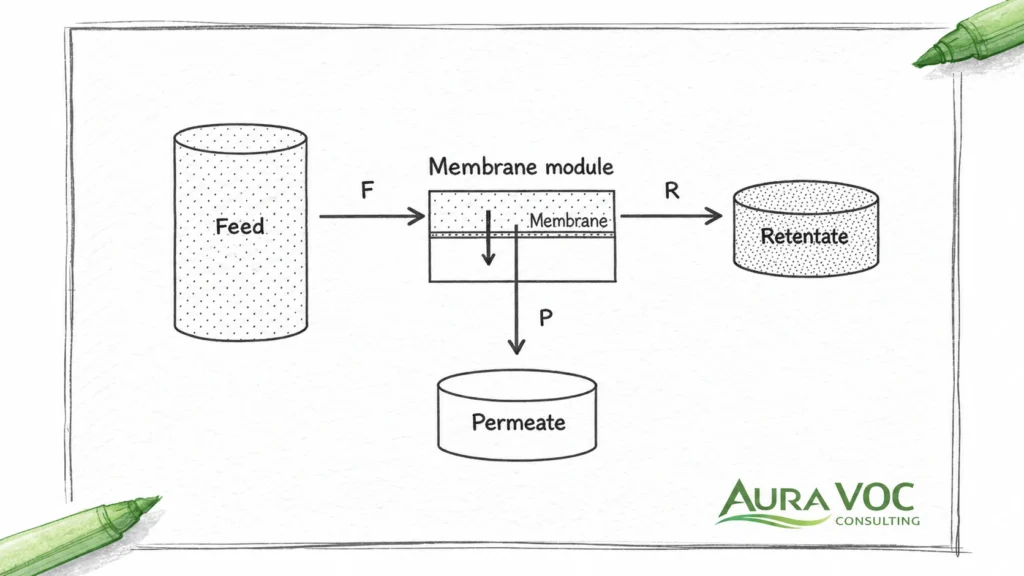
For VOC-selective membrane systems, the permeate is typically designed to be enriched in organic vapors when membrane selectivity, VOC partial pressure, and pressure ratio are favorable. The retentate is depleted in those compounds, but not necessarily clean enough for discharge.
For plant evaluation, the important question is not only whether separation occurs. The key question is whether both outlet streams are usable within the plant’s compliance, safety, and operating constraints. A VOC-rich permeate may still be wet, flammable, mixed, corrosive, or too dilute for direct recovery. A VOC-lean retentate may still require carbon polishing, condensation, oxidation, or another final treatment step.
Pressure ratio, vacuum and compression
Membrane separation needs a driving force. In gas-phase VOC systems, this is usually created by the pressure difference between the feed side and the permeate side. The pressure difference may come from feed compression, permeate-side vacuum, existing process pressure, or a combination of these.
Pressure ratio is not only a design number. It is an operating condition that must remain available during real plant service. Filter loading, fouled coalescers, condensate accumulation, undersized piping, weak vacuum, compressor underperformance, or module fouling can reduce the effective driving force. The system may still pass gas, but VOC enrichment and recovery can decline.
Compression and vacuum also add equipment to maintain. Vacuum pumps may need protection from solvent condensation or liquid carryover. Compressors, fans, and blowers must be checked for solvent compatibility, temperature rise, seal design, classified area requirements, and turndown behavior. A membrane system that appears simple at module level may become more complex once pressure generation and solvent handling are included.
VOC partial pressure and membrane selectivity
VOC concentration should be evaluated as partial pressure and mass load, not only as total VOC concentration. Higher VOC partial pressure can improve the driving force for separation, but it must be reviewed together with membrane selectivity, condensation risk, compatibility, LEL safety, and downstream treatment.
Solvent composition matters. Hydrocarbons, ketones, esters, alcohols, chlorinated solvents, glycol ethers, and high-boiling compounds do not behave as interchangeable VOCs. Their permeability, condensability, flammability, water interaction, and material compatibility may differ significantly.
A mixed solvent stream may be separable but still produce a recovered fraction with poor reuse value. A stream containing sticky aerosols, oils, reactive monomers, or high-boiling compounds may create fouling or condensation problems before separation performance becomes the main limitation.
Membrane material compatibility with solvent vapors
The membrane material and surrounding equipment must tolerate the solvent mixture at expected temperature, humidity, pressure, and concentration. Some organic vapors can swell or plasticize polymeric materials, changing permeability and selectivity over time. Others may attack seals, gaskets, adhesives, housings, instruments, or downstream equipment.
Compatibility should be reviewed for normal operation and credible upset cases. A short solvent peak, a condensation event, or an unplanned temperature excursion can be more damaging than steady operation at average conditions. This is especially relevant in multiproduct chemical and pharmaceutical plants where the solvent envelope changes by campaign.
Why membrane separation usually needs downstream handling
A membrane system separates VOC mass into different streams. It does not eliminate that mass. The VOC-rich stream may require condensation, carbon adsorption, oxidation, recycle, or controlled disposal. The VOC-lean stream may require polishing if the outlet concentration remains above the applicable compliance or internal target.
The design basis should specify what happens to the permeate, retentate, condensate, purge gas, recycle gas, and any residual waste stream. Without that definition, the project is only selecting a membrane module, not designing a working VOC emission control system.
Industrial VOC Sources Where Membrane Separation May Be Considered
Solvent-rich chemical process vents
Chemical process vents can be realistic candidates when the stream is defined and measurable. Reactor vents, evaporation vents, distillation off-gases, solvent recovery vents, and purge streams may have VOC partial pressures high enough to justify membrane evaluation.
Suitability depends on more than concentration. The review should include flow rate, operating pressure, solvent composition, peak loading, corrosive components, condensables, aerosols, and LEL risk. If the stream contains acid gases, halogenated solvents, reactive monomers, or high-boiling compounds, material compatibility and pretreatment may control the design.
Pharmaceutical batch vents with solvent peaks
Pharmaceutical and fine chemical plants can generate intermittent VOC emissions from charging, heating, drying, vacuum transfer, filtration, cleaning, and solvent changeover. These vents may justify evaluation where solvent value and peak concentrations are significant.
The challenge is the batch profile. Peak concentration, duration, nitrogen blanketing, vacuum operation, oxygen content, solvent sequence, and campaign changes all affect membrane area, vacuum duty, condenser load, and polishing requirements. A system designed from average daily emissions may miss the conditions that determine compliance and safety.
Coating, paint, ink and adhesive exhausts
Membrane separation may be considered for selected solvent-rich exhausts from coating, printing, lamination, ink, paint, or adhesive operations, especially where the stream can be isolated from high-flow dilution air and protected from aerosols, coating solids, and condensables.
Drying oven exhaust may be more relevant than general room ventilation, but temperature, humidity, solvent recipe, LEL margin, and particulate carryover still matter. If the stream is highly diluted or contaminated with overspray and mist, activated carbon, zeolite concentration, oxidation, or capture-system improvements may be more practical.
Tank breathing and solvent transfer vents
Tank filling, breathing, and solvent transfer vents may produce intermittent concentrated emissions. Membrane separation may justify evaluation where vapor recovery is required and the venting pattern, tank pressure limits, safety basis, and downstream recovery route are compatible with the system.
The design must not interfere with pressure/vacuum relief, vapor balancing, inerting, or safe venting. Intermittent flow can also create control challenges, with long idle periods followed by short high-concentration events.
Nitrogen-purged or inerted VOC streams
Nitrogen-purged process vents may be candidates when solvent concentration, inert gas balance, oxygen ingress risk, pressure conditions, and recovery or recycle objectives support a controlled separation design.
Low oxygen content can help reduce flammability risk, but it does not remove the need for safety review. Oxygen ingress, solvent accumulation in recycle loops, nitrogen losses, and downstream treatment of VOC-rich gas must be considered.
High-flow dilute ventilation exhausts
High-flow dilute ventilation exhausts are usually difficult membrane candidates unless the stream can be isolated, concentrated, reduced at source, or integrated into a hybrid system with a favorable mass and energy balance.
Low VOC partial pressure weakens the separation driving force. High gas flow increases membrane area, pressure drop, equipment size, and compression or vacuum duty. These streams often require comparison with activated carbon adsorption, zeolite rotor concentrators, thermal oxidation, catalytic oxidation, or process capture improvements.
VOCs and Solvent Families Relevant to Membrane Gas Separation
Hydrocarbon solvents
Aliphatic and aromatic hydrocarbons such as hexane, heptane, toluene, xylene, and solvent naphtha may appear in VOC membrane evaluations. Their suitability depends on membrane material, vapor partial pressure, temperature, flammability, and downstream recovery requirements.
Hydrocarbon enrichment can create significant LEL concerns. The feed line, permeate line, retentate line, recycle loop, condenser inlet, vacuum pump exhaust, knock-out vessels, and bypasses should be included in the safety review.
Ketones, esters, alcohols and glycol ethers
Ketones, esters, alcohols, and glycol ethers are common in coatings, inks, adhesives, pharmaceutical production, and industrial cleaning. Examples include acetone, MEK, MIBK, ethyl acetate, butyl acetate, ethanol, isopropanol, and glycol ether solvents.
These compounds are examples of solvent families that may be evaluated, not automatic candidates. Alcohols may interact differently with water vapor. Glycol ethers and high-boiling solvents may increase condensation or fouling risk. Esters and ketones require compatibility review for membranes, seals, and condensate handling.
Chlorinated or aggressive solvent vapors
Chlorinated and aggressive solvent vapors require specific review. The question is not only whether the membrane separates the compound, but whether the full system can tolerate the chemistry.
Materials of construction, corrosion allowance, condensate composition, vacuum pump compatibility, downstream oxidation by-products, and waste classification may affect technology selection. If oxidation is used downstream, acid gas formation and scrubbing requirements may become part of the treatment train.
Mixed solvent vapors
Mixed solvent vapors are common in real plants. A membrane may enrich the organic fraction, but the recovered liquid may be a mixed solvent stream with limited reuse value.
The evaluation should check whether recovered solvent can return to the process, whether water contamination changes reuse or disposal options, whether the mixture changes by campaign, and whether condensation creates one liquid phase or multiple phases. Solvent recovery should be judged on actual recovered-stream quality, not only VOC mass captured.
Reactive, polymerizing or high-boiling organic compounds
Reactive monomers, sticky vapors, oils, resins, and high-boiling organics can create fouling and reliability problems. They may deposit on filters, coalescers, piping, module surfaces, drains, or vacuum equipment.
These streams require conservative review of temperature control, residence time, filtration, knock-out design, cleaning strategy, and module replacement planning. Where solids, oils, or sticky vapors are normal operating conditions rather than upsets, another VOC control technology may be more robust.
When Membrane VOC Separation Is Technically Suitable
Controlled process vents with measurable VOC composition
Membrane separation is most credible when the VOC source can be characterized with reliable process data. The design basis should include compound-specific VOC concentrations, gas flow range, temperature, humidity, pressure, oxygen content, operating schedule, and peak cases.
A defined process vent gives engineers a realistic basis for membrane area, pressure ratio, pretreatment, downstream handling, and safety review. A poorly characterized plant exhaust does not.
Moderate flow rates with meaningful VOC partial pressure
Membranes are more attractive when the combination of gas flow, VOC partial pressure, pressure ratio, selectivity, and membrane area supports useful enrichment without excessive energy demand or equipment size.
Flow and concentration must be reviewed together. A small solvent-rich stream may be a better candidate than a large diluted stream with the same total VOC mass load. Very low VOC partial pressure may require large membrane area or high vacuum duty, reducing practicality.
Recoverable solvent value or downstream load-reduction objective
The technology is strongest when the separated VOC-rich stream has a defined purpose: condensation, solvent recovery, process recycle, carbon load reduction, or reduced duty to oxidation.
If there is no recovery value and final destruction is still required, membrane separation must be justified by a measurable advantage in the complete treatment train. That may include lower oxidizer flow, improved inlet concentration, reduced carbon loading, or reduced condenser duty, but only if confirmed by mass and energy balance.
Available pressure, vacuum or compression within acceptable energy limits
A practical driving force is essential. Existing process pressure can improve feasibility, but many systems require feed compression, permeate vacuum, or both.
Energy review should include compression, vacuum, cooling, heating, recycle, pressure losses, controls, and auxiliary equipment. Vacuum pumps and compressors also introduce reliability and safety requirements, especially where solvent condensation, flammable gases, or corrosive vapors are possible.
Clean gas streams with manageable aerosols and particulates
VOC membrane systems normally require upstream control of particulates, aerosols, solvent mist, droplets, oils, and condensable materials. These contaminants can foul pretreatment, increase pressure drop, wet membrane surfaces, damage materials, or reduce separation stability.
Pretreatment can reduce these risks but adds pressure loss, inspection points, drainage requirements, and maintenance. A membrane candidate should remain practical after pretreatment is included.
Compatible VOCs and membrane materials
Solvent compatibility should be checked for membrane material and all exposed components. Swelling, plasticization, seal degradation, corrosion, and loss of selectivity can turn a promising concept into a poor operating system.
Compatibility review should cover normal operation, peak loading, campaign changes, cleaning events, and credible upset conditions.
Manageable LEL and enriched-stream safety risks
Membrane separation can concentrate VOCs into a smaller stream. This may improve recovery or downstream treatment, but it can increase flammability risk.
A suitable application requires a credible safety basis for feed, permeate, retentate, recycle, condensate handling, vacuum equipment, and downstream treatment. LEL analyzer placement, oxygen concentration, inerting, dilution, interlocks, emergency shutdown, and hazardous area classification should be defined early.
When Membrane VOC Separation Is a Poor Fit
Very dilute, high-flow exhaust streams
Very dilute, high-flow exhaust streams are usually difficult membrane candidates because the separation driving force is low and membrane area, pressure drop, and energy demand can become excessive.
These streams should usually be compared with source capture improvements, activated carbon adsorption, zeolite concentration, oxidation, or hybrid treatment before membrane separation is selected.
Applications requiring single-stage final VOC destruction
A membrane does not destroy VOCs. If the plant needs a robust single-stage destruction technology for compliance, thermal oxidation, catalytic oxidation, or another final abatement technology may be more appropriate.
Membranes may still have an upstream role, but only if the combined system has a clear compliance basis and does not create excessive safety or control complexity.
Heavy aerosol, mist, droplet or particulate loading
Streams with significant mist, droplets, oils, sticky particles, coating solids, or dust can damage membrane performance. If these contaminants are normal operating conditions and cannot be reliably removed, fouling and pressure drop may dominate the operating cost.
Pretreatment bypass during maintenance, poor filter sealing, or coalescer overload can also expose the membrane to contaminants that were not included in the design basis.
Uncontrolled condensation risk
Uncontrolled condensation inside membrane modules or associated piping can cause unstable operation, fouling, corrosion, liquid carryover, or damage to downstream vacuum equipment. The risk depends on solvent properties, materials, drainage, temperature profile, and exposure time.
Streams near dew point, rich in high-boiling compounds, or subject to cooling during shutdown require careful review. If condensation cannot be controlled, the membrane may be a poor fit.
Highly variable solvent mixtures without a stable design basis
Frequent solvent changes can invalidate membrane selection and performance assumptions. Multiproduct plants can use membrane systems only when the expected solvent envelope is defined and tested against compatibility, selectivity, recovery quality, and safety.
A design based on one favorable solvent case may not work after a production campaign changes.
Recovered solvent has no reuse, recovery or disposal advantage
If the VOC-rich stream cannot be reused, condensed economically, recycled, polished, oxidized more efficiently, or disposed of safely, separation may not add value.
The destination of the concentrated stream should be defined before selecting the membrane. Otherwise, the system may move the emission problem from one gas stream to another.
VOC enrichment creates unacceptable LEL or process safety risk
If enrichment produces flammable conditions that cannot be controlled by inerting, dilution, monitoring, interlocks, or equipment classification, membrane separation may not be acceptable.
Safety limits can override recovery or operating cost benefits. Startup, shutdown, upset, and maintenance states must be included, not only normal steady operation.
Pressure ratio or vacuum requirements make energy demand excessive
Some applications require too much compression or vacuum duty to justify membrane separation. Energy demand should include power for pressure generation, cooling, heating, recycle, pressure losses, and solvent handling.
If existing pressure is unavailable and electricity or maintenance cost is sensitive, another VOC technology may provide a more robust solution.
Key Design and Performance Parameters for VOC Membrane Systems
Gas flow rate and operating schedule
Design should use minimum, normal, maximum, and peak flow rates. Continuous, batch, intermittent, and seasonal operation can lead to different membrane area, controls, and turndown requirements.
Short high-flow or high-concentration events may drive system sizing more than average operation.
VOC concentration, partial pressure and peak loading
Total VOC concentration is not enough. Compound-specific concentration, VOC partial pressure, total VOC mass load, peak duration, and minimum load are all relevant.
Peak loading affects membrane area, LEL risk, condenser duty, carbon polishing capacity, and final outlet compliance.
VOC variability and solvent recipe changes
Recipe changes affect membrane selectivity, compatibility, recovery quality, condensation behavior, and outlet concentration. The design basis should include the expected solvent envelope, not only current production.
For multiproduct plants, a change-control procedure may be needed before new solvents are introduced to the system.
Temperature, dew point and condensation control
Temperature can affect membrane permeability, selectivity, VOC vapor pressure, dew point margin, and material limits. The direction and magnitude of the effect depend on membrane material and solvent composition.
The gas should normally remain within the membrane supplier’s temperature limits and outside uncontrolled condensation conditions. Shutdown cooling and cold spots in piping can be as important as normal operation.
Humidity and water vapor effects
Humidity can affect dew point, corrosion risk, condensate formation, activated carbon polishing, vacuum pump load, and recovered solvent quality. In some cases, water vapor may also affect membrane performance.
Humidity should be reviewed together with temperature, pressure, solvent composition, and downstream treatment. A dry design basis can be misleading if the actual exhaust contains variable water vapor.
Pressure drop through pretreatment and membrane modules
Pressure drop reduces available driving force and increases fan, compressor, or vacuum demand. Rising pressure drop can indicate filter loading, aerosol deposition, condensate accumulation, fouled modules, or blocked drains.
The design should consider clean and dirty conditions. A system that only works with clean filters may not be robust enough for plant operation.
Feed pressure, permeate pressure and vacuum level
Feed and permeate pressures define the practical separation driving force. The specified pressure ratio must be achievable under normal, peak, dirty, hot, cold, and wet conditions.
Operators should track vacuum level, feed pressure, retentate pressure, and pressure drop trends. A loss of pressure ratio can cause lower permeate enrichment or higher outlet VOC without a visible equipment failure.
Energy demand from compression, vacuum, cooling and recycle
Membrane systems should not be described as low-energy without a case-specific energy balance. Compression, vacuum pumps, cooling, heating, recycle, fans, and controls can all contribute to operating cost.
If membrane separation is compared with oxidation, condensation, or adsorption, the comparison should include the full treatment train, not only the membrane module.
LEL, oxygen concentration and explosion protection
Explosion safety should cover every stream that may become enriched: feed, permeate, retentate, recycle, condenser inlet, vacuum pump discharge, knock-out pots, purge lines, and bypasses.
LEL analyzer location, response time, sample conditioning, oxygen monitoring, inerting, dilution, interlocks, emergency shutdown, grounding, and equipment classification should be reviewed against credible operating and upset cases. OSHA provides requirements and guidance relevant to flammable liquid vapor control and lower flammable limit management.
Corrosion and material selection
Material selection applies to the full system: membrane modules, vessels, gaskets, piping, condensers, pumps, drains, analyzers, valves, and instruments.
Corrosion risk increases when aggressive VOCs, chlorinated compounds, acidic components, water vapor, or mixed condensate are present. Materials that are acceptable for dry vapor may not be acceptable where condensation occurs.
Particulates, aerosols, mists and condensables
These contaminants drive pretreatment design and maintenance. The system should include realistic inspection access, differential pressure monitoring, drain checks, and procedures for liquid carryover or fouling events.
Particulates may load upstream filters; if carried into the module, they can contribute to surface fouling, flow maldistribution, or pressure drop increase.
Secondary streams, recovered solvent and waste handling
Membrane separation does not normally generate wastewater as the primary removal mechanism, but integrated systems may create mixed condensate, cleaning liquids, spent filters, spent coalescers, spent adsorbent, scrubber wastewater, or VOC-rich residual gas.
Recovered solvent quality, phase behavior, water contamination, and disposal classification should be included in the operating assessment.
Engineering Tradeoffs in VOC Membrane System Design
VOC recovery versus final emission compliance
A membrane system can improve solvent recovery without necessarily meeting the final permitted outlet concentration. Recovery and compliance are separate design targets.
If the VOC-depleted stream remains above the applicable limit, activated carbon, condensation, oxidation, or another polishing step may be required. A recovery-optimized system is not automatically a compliance-optimized system.
Pressure ratio versus energy consumption
Increasing pressure ratio can increase the driving force for permeation, but the benefit depends on membrane selectivity, stage configuration, VOC partial pressure, condensation limits, and energy cost.
Higher vacuum or compression may improve separation while increasing power demand, solvent condensation risk, noise, heat rejection, and maintenance.
Membrane area versus flow rate and VOC concentration
Large gas flow and low VOC partial pressure increase membrane area requirements. A high membrane area may increase capital cost, footprint, pressure drop, and module replacement cost.
This tradeoff is one of the main reasons diluted ventilation streams are often less attractive than controlled solvent-rich process vents.
VOC enrichment versus LEL safety
Concentrating VOCs can improve recovery or downstream treatment, but it may also create a flammable stream. Enrichment should be reviewed against LEL, oxygen content, inerting reliability, and safe treatment of permeate and recycle streams.
A technically attractive separation may still be rejected if the enriched stream cannot be handled safely.
Pretreatment complexity versus membrane protection
Filters, demisters, coalescers, coolers, heaters, and knock-out pots can protect the membrane, but they add pressure drop, drainage points, inspection tasks, and maintenance cost.
Pretreatment should be designed for the actual contaminant load. Overly simple pretreatment risks membrane fouling; overly complex pretreatment can become the main reliability problem.
Solvent recovery value versus mixed condensate quality
Recovered solvent has value only if it can be reused, recycled, sold, treated, or disposed of under acceptable conditions. Mixed condensate, water contamination, off-spec composition, or campaign variability can reduce recovery value.
The recovery case should be based on recovered-stream quality and destination, not only captured VOC mass.
Hybrid performance versus controls complexity
Hybrid systems may improve overall performance, but they also require stronger controls. Recycle loops, bypasses, condenser load, carbon breakthrough, oxidizer inlet concentration, LEL monitoring, and interlocks must operate as one system.
A hybrid layout is useful only when each unit has a defined role and the controls can manage normal and upset operation.
Pretreatment Requirements for VOC Membrane Systems
Particulate filtration
Particulate filtration protects downstream equipment and reduces module contamination. Filter selection should account for particle size, loading rate, solvent compatibility, temperature, and maintenance access.
Differential pressure monitoring is essential. Rising pressure drop can reduce membrane driving force before operators see a visible failure.
Mist elimination and coalescing
Solvent mist and aerosols are important causes to check when membrane performance declines. Liquid carryover can foul modules, wet surfaces, damage materials, increase pressure drop, or contaminate vacuum equipment.
Coalescers and demisters should be selected for expected droplet size, solvent type, gas velocity, pressure drop, and drainage reliability.
Knock-out pots and condensate drainage
Liquid should be removed before the membrane module. Knock-out pots, low-point drains, drain legs, and traps need inspection access and procedures for routine checks.
Blocked drains can cause intermittent liquid carryover, pressure instability, and sudden performance loss. Drainage design is especially important where temperature varies or high-boiling compounds are present.
Temperature conditioning and dew point control
Temperature conditioning may include heating, cooling, insulation, or controlled condensation upstream of the membrane. The objective is to keep the gas within membrane material limits and prevent uncontrolled liquid formation.
Cooling may help downstream condensation, but cooling in the wrong location can create fouling before the membrane. The temperature profile should be reviewed across the full treatment train.
Protection from corrosive or reactive compounds
Corrosive gases, chlorinated compounds, reactive monomers, or polymerizing vapors may require upstream removal, material changes, or a different VOC control strategy.
Pretreatment should not be assumed to solve every compatibility problem. If the contaminant is part of normal operation rather than an occasional upset, membrane suitability should be reviewed conservatively.
Integration With Other VOC Abatement and Recovery Technologies
Membrane separation plus condensation
Membrane separation plus condensation is a commonly considered recovery-oriented configuration where membrane enrichment can improve the feasibility of solvent condensation.
The condenser must be designed for enriched gas composition, cooling duty, residual non-condensables, water content, freezing or fouling risk, and condensate quality. Residual gas after condensation may still require recycle, polishing, or destruction.
Membrane separation plus activated carbon adsorption
Activated carbon may be used as a polishing step after membrane separation. Carbon loading may be reduced if the membrane removes or diverts sufficient VOC mass before the adsorption stage.
Humidity, fire risk, breakthrough monitoring, regeneration, disposal, and bed temperature should still be assessed. Carbon does not remove the need to understand peak loading.
Membrane separation plus thermal oxidation or RTO
Certain membrane configurations may create a smaller VOC-rich stream for oxidation while sending a VOC-depleted stream to discharge, recycle, or polishing, if outlet requirements and safety constraints are met.
Membranes may reduce oxidizer fuel demand in selected cases where concentration or flow reduction improves the oxidizer energy balance after accounting for membrane compression or vacuum power, pressure losses, safety dilution, and control requirements.
Membrane separation plus catalytic oxidation
Catalytic oxidation may be suitable downstream only if catalyst poisons, halogenated compounds, silicon-containing compounds, particulates, and inlet variability are controlled.
Membrane separation does not automatically protect the catalyst. The complete inlet composition to the catalytic unit should be reviewed.
Membrane separation plus scrubbers
Scrubbers are generally better suited to water-soluble or chemically reactive contaminants. For hydrophobic VOCs, absorption performance depends on compound solubility, absorbent selection, contactor design, and wastewater or spent absorbent management.
If a scrubber is placed upstream of a membrane, mist carryover and humidity increase can create additional membrane risks.
Membrane separation in hybrid VOC recovery systems
A hybrid system should be justified by mass balance, energy balance, compliance basis, safety review, and maintenance requirements. Combining technologies is useful only when the membrane, recovery device, polishing unit, and controls each have a clear role.
Industrial Applications of Membrane-Based VOC Separation
Solvent recovery from coating and drying exhausts
Membrane separation may be evaluated for solvent-rich coating or drying exhausts where dilution air is controlled and the solvent mixture is compatible with the membrane system.
Key constraints include exhaust flow, oven temperature, humidity, solvent recipe changes, LEL margin, aerosols, coating solids, and recovered solvent quality. General ventilation exhaust from the same facility may be a poor candidate even if the drying exhaust is worth evaluating.
Pharmaceutical solvent vapor recovery
Pharmaceutical solvent vents may be candidates when batch profiles, solvent value, nitrogen blanketing, and recovery objectives support a controlled design.
The system should be checked against campaign changes, cleaning solvents, vacuum operation, GMP-related segregation, peak emissions, and the need for final polishing. A single favorable batch should not define the full design basis.
Chemical process vent treatment
Chemical process vents can suit membrane evaluation when flow, composition, pressure, and operating schedule are measurable. Reactor vents, distillation off-gases, evaporator vents, and purge streams may provide better data than plant-wide ventilation.
Corrosive compounds, reactive vapors, high-boiling organics, and variable campaigns should be assessed before considering membranes a viable option.
Tank vent and solvent transfer emission control
Tank vents may produce concentrated vapor during filling, breathing, and transfer. Membrane evaluation should account for pressure/vacuum relief, vapor balancing, intermittent flow, oxygen ingress, inerting, and safe handling of the VOC-rich stream.
Vapor balancing, condensation, activated carbon, or process changes may be simpler in some tank applications.
Printing, lamination and packaging exhausts
Printing, lamination, and packaging exhausts may contain mixed solvents and variable flow. Membrane separation is more plausible where a solvent-rich stream can be captured separately from high-volume ventilation air.
Mixed solvent recovery, humidity, aerosols, web-coating residues, and LEL control are typical design constraints.
Industrial solvent cleaning and degreasing vents
Solvent cleaning and degreasing vents may contain recoverable vapor, but suitability depends on solvent type, concentration, operating cycle, vapor containment, and compatibility.
Chlorinated solvents, oils, water carryover, and intermittent operation require careful review. In some cases, process enclosure or vapor containment may be more important than membrane selection.
High-flow dilute manufacturing ventilation
High-flow dilute manufacturing ventilation is usually difficult for membrane separation. Low VOC partial pressure and large flow can lead to high membrane area and energy demand.
These applications should be compared with capture improvements, activated carbon, zeolite concentration, thermal oxidation, catalytic oxidation, or source reduction before considering membrane recovery.
Operational Problems and Troubleshooting of VOC Membrane Systems
Declining VOC recovery
Declining recovery may result from lower VOC partial pressure, solvent composition change, membrane fouling, reduced pressure ratio, condensation, seal leakage, or downstream limitations.
A practical diagnostic sequence is to check analyzer calibration, feed composition, flow, pressure ratio, vacuum level, temperature, dew point, pretreatment pressure drop, condensate drainage, and downstream equipment performance.
High outlet VOC concentration
High outlet VOC can result from peak emissions above design basis, insufficient membrane area, bypass leakage, module seal problems, analyzer error, sampling line condensation, or saturated polishing equipment.
The first check should confirm the measurement. Sampling location, sample conditioning, analyzer calibration, and condensation in sample lines can all affect apparent outlet concentration.
Low VOC enrichment in the permeate stream
Low permeate enrichment may indicate inadequate pressure ratio, low feed VOC partial pressure, membrane aging, module bypass, recycle dilution, solvent composition changes, or condensation.
Operators should compare current permeate composition with the original performance baseline at similar flow, temperature, and pressure conditions.
Increasing pressure drop
Increasing pressure drop usually points to filter loading, aerosol deposition, condensate accumulation, fouled modules, blocked drains, or incorrect valve positions.
Pressure trend data is more useful than a single reading. A gradual rise may indicate fouling. A sudden rise may indicate liquid accumulation, blockage, or a control valve problem.
Condensation inside membrane modules or piping
Condensation can cause unstable separation, fouling, corrosion, liquid carryover, and vacuum pump damage. It may occur during cold startup, shutdown cooling, high solvent peaks, insulation gaps, or pressure changes.
Dew point, temperature profile, drain operation, high-boiling compounds, and condensate composition should be checked before replacing modules.
LEL alarms in enriched VOC streams
LEL alarms should be treated as process safety events, not nuisance trips. They may indicate higher solvent loading, oxygen ingress, failed dilution, poor recycle control, blocked venting, or incorrect analyzer placement.
The review should include feed, permeate, retentate, recycle, condenser, vacuum pump discharge, and bypass conditions.
Vacuum pump or compressor problems
Rotating equipment problems can directly reduce separation performance. Solvent condensation, seal wear, overheating, corrosion, fouled inlet protection, unstable suction pressure, and discharge restrictions are common checks.
A vacuum pump may still operate mechanically while failing to provide the required permeate-side pressure.
Performance changes after solvent recipe or production changes
If production changes, the membrane system may no longer operate within its original design envelope. New solvents may change permeability, selectivity, swelling risk, condensate quality, or LEL conditions.
Solvent recipe changes should trigger a review before operators compensate by increasing vacuum, changing recycle, or bypassing alarms.
Downstream condenser, carbon bed or oxidizer limiting system performance
Troubleshooting should cover the full treatment train. The membrane may be operating correctly while the condenser is undersized, the carbon bed is at breakthrough, or the oxidizer inlet concentration is outside its stable operating range.
For hybrid systems, final performance depends on the weakest unit and the control strategy connecting the units.
Maintenance Implications
Pretreatment maintenance
Filters, coalescers, demisters, knock-out pots, and drains require scheduled inspection. Poor pretreatment maintenance often appears later as membrane fouling, pressure loss, or liquid carryover.ù
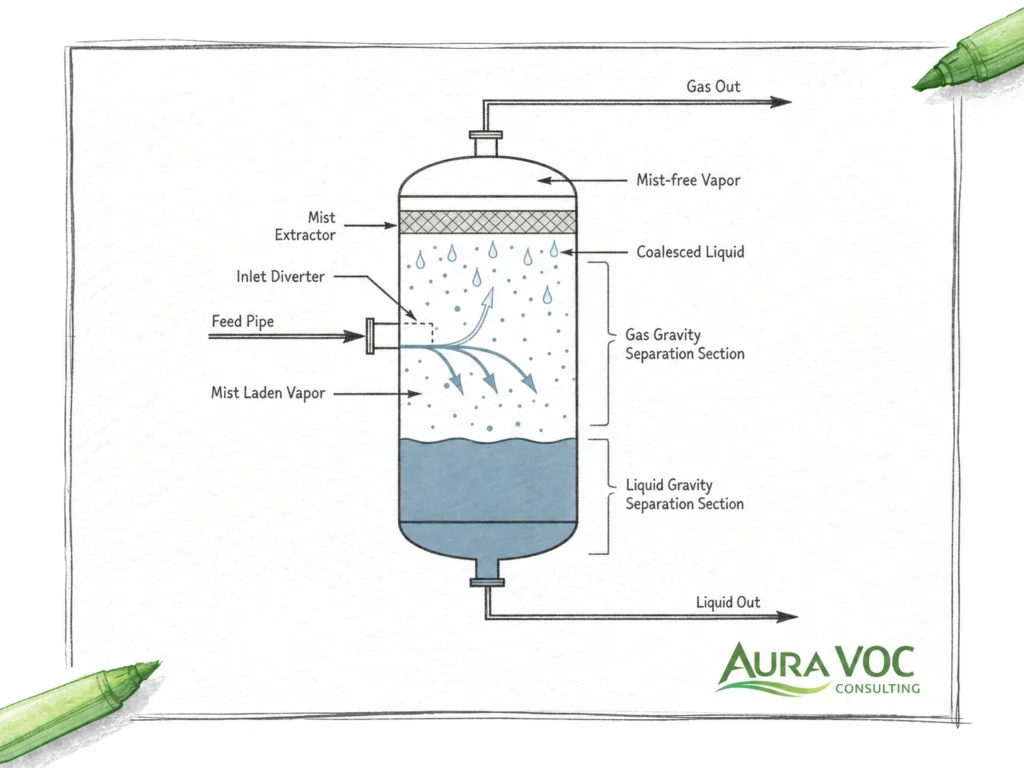
Maintenance plans should include differential pressure limits, replacement intervals, drain checks, and procedures for temporary bypasses.
Membrane module monitoring and replacement planning
Module replacement planning should combine manufacturer guidance with measured indicators such as enrichment, recovery, pressure drop, outlet VOC concentration, and evidence of fouling or material degradation.
A baseline test after commissioning is useful. Without baseline data, it is difficult to distinguish membrane aging from process changes.
Vacuum pump, compressor and fan maintenance
Vacuum and compression equipment should be protected from condensate and solvent attack. Maintenance planning should include seals, bearings, lubrication, cooling, corrosion, vibration, and classified area requirements.
Solvent carryover into rotating equipment can create both reliability and safety concerns.
Instrumentation and safety system checks
VOC analyzers, LEL sensors, oxygen monitors, pressure transmitters, temperature sensors, and interlocks require calibration and functional testing.
Analyzer drift or poor sample conditioning can lead to incorrect troubleshooting. Safety instrument checks should include response time, sample line condition, alarm setpoints, and shutdown actions.
Recovered solvent and secondary waste handling
Recovered solvent, mixed condensate, spent filters, used coalescer elements, spent adsorbent, and residual VOC-rich gas should be included in operating cost and waste management planning.
If recovered solvent quality changes by campaign, reuse or disposal assumptions should be reviewed.
Comparison With Alternative VOC Technologies
Membrane separation vs activated carbon adsorption
Activated carbon is often evaluated for dilute VOC polishing when the VOCs are adsorbable and humidity, temperature, fire risk, breakthrough monitoring, and regeneration or disposal requirements are manageable.
Membranes are more relevant where continuous separation, concentration, or recovery has a defined purpose. Carbon may still be needed as a polishing stage after the membrane.
Membrane separation vs condensation
Condensation is usually more effective when VOC partial pressures are high and the compounds can be condensed at practical temperature and pressure conditions, considering mixture behavior, water content, freezing risk, and residual non-condensable VOCs.
Membranes may improve a condensation case by enriching the VOC stream first, but they add pressure ratio, vacuum, controls, safety, and pretreatment requirements.
Membrane separation vs thermal oxidation and RTO systems
Thermal oxidation and RTO systems destroy VOCs rather than recover them. They are often more direct for compliance when solvent recovery is not required or practical.
Membrane separation may be considered upstream only when concentration or flow redistribution improves the complete system after accounting for LEL safety, pressure losses, energy demand, and outlet requirements.
Membrane separation vs catalytic oxidation
Catalytic oxidation can reduce VOCs at lower temperatures than thermal oxidation in suitable applications, but catalyst compatibility is critical. Catalyst poisons, halogenated compounds, silicon-containing vapors, particulates, and inlet variability can limit suitability.
Membranes may change the inlet concentration to a catalytic unit, but they do not remove the need for catalyst compatibility review.
Membrane separation vs VOC scrubbers
Scrubbers are generally stronger for soluble or chemically reactive contaminants. Many hydrophobic solvent vapors are difficult to remove efficiently with water scrubbing alone.
Scrubbers may create wastewater, spent absorbent, mist carryover, and corrosion issues. If used with membranes, these secondary effects must be considered.
Membrane separation vs zeolite rotor concentrators
Zeolite rotor concentrators are commonly evaluated for selected high-flow, low-concentration VOC exhausts, particularly where concentration before oxidation is feasible and VOC compatibility, humidity, desorption, and fire safety constraints are acceptable.
Membranes are usually easier to evaluate for controlled solvent-rich process streams than for diluted ventilation exhausts, although each case depends on the mass and energy balance.
Membrane separation as a recovery step versus final abatement
Membrane separation should usually be evaluated as a recovery, concentration, or load-reduction step. Final abatement may still require activated carbon, condensation, oxidation, or another technology.
The selection decision should be based on outlet limit, VOC mass balance, solvent destination, safety basis, energy demand, and operational reliability.
Technology Selection Checklist for Membrane VOC Separation
Stream characterization checklist
Collect compound-specific VOC data, total VOC concentration, gas flow range, peak duration, temperature, humidity, pressure, oxygen content, particulates, aerosols, mist, condensables, corrosive components, and expected solvent changes.
Total VOC alone is not enough for technology selection.
Process operation checklist
Define whether operation is continuous, batch, intermittent, seasonal, or campaign-based. Include startup, shutdown, cleaning, idle periods, peak emissions, turndown requirements, and uptime expectations.
The system should be evaluated against the operating envelope, not only normal production.
Safety checklist
Review LEL data, oxygen concentration, inerting, dilution, hazardous area classification, ignition sources, analyzer locations, alarm setpoints, interlocks, bypass logic, and emergency shutdown philosophy.
Include normal operation, peak loading, startup, shutdown, maintenance, and credible upset conditions.
Recovery and downstream handling checklist
Define what will happen to the VOC-rich stream. Options may include condensation, recovery, process recycle, activated carbon, oxidation, controlled disposal, or another treatment step.
Also define the required quality of recovered solvent and whether mixed solvent or water contamination affects reuse.
Decision categories
A VOC stream can be classified into one of four practical categories:
- Proceed to membrane feasibility study: controlled stream, useful VOC partial pressure, manageable safety risks, clear downstream handling.
- Evaluate only as a hybrid system: membrane may help but polishing, condensation, or oxidation is required.
- Prioritize alternative technologies: high-flow dilute exhaust, poor recovery value, difficult safety basis, or severe fouling risk.
- Collect missing data first: insufficient flow, concentration, composition, pressure, humidity, or peak-profile data.
Process Data Required Before Evaluating a VOC Membrane System
Minimum data for initial feasibility screening
Minimum data include VOC compounds, gas flow range, concentration range, temperature, humidity or dew point, pressure conditions, oxygen content, visible aerosols or condensables, outlet target, and recovery objective.
Data needed for vendor proposal review
Vendor proposal review requires peak and minimum cases, solvent variability, operating schedule, pressure basis, safety basis, pretreatment assumptions, downstream treatment duty, utilities, footprint, maintenance access, and expected future process changes.
Measurements that may be required before selection
VOC sampling, flow measurement, dew point measurement, pressure profiling, LEL review, oxygen measurement, aerosol assessment, and condensate characterization may be required before committing to design.
Sampling should capture representative production, not only a convenient operating period.
Why average VOC values are not enough
Average values can hide short peaks, idle periods, solvent changes, startup emissions, and cleaning events. These conditions may determine membrane area, LEL risk, polishing duty, and compliance margin.
Designing from averages alone is one of the main causes of underperforming VOC treatment systems.
Common Design Mistakes to Avoid
Designing from average VOC concentration only
Average concentration can hide short emission peaks that determine membrane area, LEL risk, condenser duty, carbon loading, and outlet compliance. For batch plants, peak duration and solvent sequence may be more important than the daily average.
Ignoring peak emissions and batch variability
Batch variability affects vacuum duty, pressure ratio, membrane staging, downstream polishing, and alarm response. A system that works during steady production may fail during charging, drying, cleaning, or shutdown.
Underestimating pressure ratio and energy demand
A membrane system depends on effective driving force. Energy demand should include compression, vacuum, pressure drop, cooling, heating, recycle, and auxiliary equipment. Ignoring these loads can make operating cost assumptions unreliable.
Treating membrane separation as VOC destruction
Membranes separate VOCs; they do not destroy them. The design must define how both outlet streams are handled and how final compliance is achieved.
Omitting pretreatment for aerosols and condensables
Aerosols, mist, droplets, oils, particulates, and condensables can foul modules and damage vacuum equipment. Pretreatment should be part of the base design, not an optional accessory.
Ignoring LEL risks in enriched streams
VOC enrichment can create flammable conditions in permeate, recycle, condensers, vacuum pump exhaust, or bypass lines. LEL safety must be reviewed before the concentration strategy is accepted.
Assuming recovered solvent is directly reusable
Recovered solvent may be mixed, wet, off-spec, or contaminated. Reuse depends on solvent composition, phase behavior, purity requirements, and plant quality constraints.
Comparing technologies without mass balance and operating cost context
Membrane separation should be compared with condensation, adsorption, oxidation, scrubbing, and hybrid systems using the same gas-flow data, VOC composition, outlet target, utility costs, safety constraints, and maintenance assumptions.
Before Requesting a Vendor Proposal for a VOC Membrane System
Confirm whether the stream is a realistic membrane candidate
Review flow, VOC partial pressure, solvent composition, pressure availability, temperature, humidity, aerosols, condensables, and safety constraints before requesting equipment pricing.
If these data are missing, vendor comparisons may reflect assumptions rather than the actual plant problem.
Identify whether polishing or downstream abatement is required
Clarify whether the VOC-depleted stream can meet the applicable outlet limit. If not, define whether carbon, condensation, oxidation, or another polishing step is required.
Final compliance responsibility should be assigned to the complete treatment train, not only the membrane unit.
Compare membrane recovery with condensation, adsorption and oxidation
A membrane proposal should be compared with alternatives using the same design basis. The comparison should include capital cost, energy, utilities, maintenance, waste streams, safety, control complexity, and compliance margin.
Check the safety basis for enriched VOC streams
Review LEL, oxygen content, inerting, hazardous area classification, grounding, analyzer locations, alarm response, bypasses, and emergency shutdown actions.
The safety basis should include normal operation and credible upset scenarios.
Define what will happen to the VOC-rich stream
The concentrated VOC stream must have a defined destination: recovery, condensation, recycle, polishing, destruction, disposal, or controlled purge.
Without that route, the membrane system does not complete the VOC control function.
Frequently Asked Questions About Membrane VOC Gas Separation
Is membrane separation a VOC abatement technology?
It can be part of a VOC abatement system, but it is primarily a gas separation technology. It separates VOC-rich and VOC-lean streams and usually requires downstream handling of at least one stream.
Does membrane separation destroy VOCs?
No. Membrane separation does not destroy VOCs. It redistributes VOC mass between outlet streams.
Can membrane separation recover solvents from VOC emissions?
It can support solvent recovery in selected cases. Recovery depends on VOC partial pressure, solvent composition, membrane compatibility, condensation or purification requirements, and the final use or disposal route for the recovered stream.
Can membrane separation replace a thermal oxidizer?
Not as a general rule. If the plant requires VOC destruction for compliance, a thermal oxidizer, RTO, catalytic oxidizer, or other final abatement step may still be needed.
Can membranes reduce fuel demand in an existing oxidizer?
Possibly, but only if the membrane configuration improves the oxidizer energy balance after accounting for compression or vacuum power, pressure losses, safety dilution, controls, and downstream treatment.
Is membrane separation suitable for high-flow dilute VOC exhaust?
Often not as a standalone option. High-flow dilute exhaust should usually be compared with source capture improvements, adsorption, zeolite concentration, oxidation, or hybrid systems.
What happens to the VOC-rich permeate stream?
It may be condensed, recovered, recycled, polished, oxidized, or disposed of. The route must be defined before selecting the membrane system.
What pretreatment is required before a VOC membrane unit?
Pretreatment may include particulate filtration, mist elimination, coalescing, knock-out pots, condensate drainage, temperature conditioning, and protection from corrosive or reactive compounds.
Can VOC membrane systems handle aerosols or solvent mist?
They generally require upstream aerosol and mist control. Liquid carryover can foul modules, wet membrane surfaces, increase pressure drop, damage materials, or contaminate vacuum equipment.
What causes low VOC recovery in membrane systems?
Common causes include low VOC partial pressure, reduced pressure ratio, weak vacuum, membrane fouling, condensation, solvent composition changes, seal leakage, recycle dilution, and downstream limitations.
How does pressure ratio affect VOC membrane performance?
Pressure ratio provides the driving force for permeation. If pressure ratio falls due to pressure drop, weak vacuum, compressor issues, or fouling, enrichment and recovery may decline.
How are LEL risks managed in membrane VOC recovery systems?
LEL risks are managed through oxygen control, inerting, dilution, monitoring, interlocks, hazardous area design, grounding, and safe handling of enriched streams.
Is membrane separation suitable for pharmaceutical batch vents?
It may be suitable for selected pharmaceutical batch vents, but the batch profile, solvent changes, nitrogen blanketing, vacuum operation, peak emissions, and polishing requirements must be evaluated.
Is membrane separation suitable for coating oven exhaust?
It may be considered for solvent-rich coating oven exhausts where dilution air, aerosols, coating solids, temperature, humidity, LEL margin, and recipe variability are manageable.
What data is required to evaluate membrane-based VOC separation?
At minimum: VOC compounds, flow range, concentration range, temperature, humidity or dew point, pressure, oxygen content, contaminants, outlet limit, operating schedule, and recovery objective.
Conclusion
Membrane-based VOC gas separation can be useful when it has a defined role in the VOC control system: solvent recovery, VOC concentration, load reduction, or integration with downstream treatment. It should not be treated as a general replacement for oxidation, adsorption, condensation, or scrubbing.
Suitability depends on the actual gas stream. Flow rate, VOC partial pressure, solvent composition, pressure ratio, temperature, humidity, aerosols, condensables, LEL risk, recovered-stream quality, and downstream treatment all affect performance. The system must also be evaluated under real operating conditions, including batch variability, solvent changes, fouling, pressure drop, maintenance, startup, shutdown, and safety interlocks.
For industrial plants, the question is not whether membrane separation works in principle. The question is whether it works for the specific emission source, within the required operating envelope, and as part of a complete VOC abatement or recovery strategy.
Request a VOC Membrane Separation Feasibility Review
When to contact AuraVOC
Contact AuraVOC when you have a defined VOC emission source and need to evaluate whether membrane separation is a realistic option, whether another technology is more appropriate, or whether a hybrid system should be considered.
Typical situations include new abatement projects, solvent recovery evaluations, high operating cost from existing equipment, vendor proposal review, or troubleshooting of unstable VOC control performance.
What process data to provide
Useful data include VOC compounds, gas flow range, concentration range, temperature, humidity or dew point, pressure, oxygen content, aerosols, particulates, condensables, existing abatement equipment, outlet limit, operating schedule, and solvent recovery objective.
Peak and minimum conditions are as important as normal operating values.
What the technical review should clarify
A technical review should define whether the stream is a membrane candidate, whether pretreatment or polishing is required, what design data are missing, how LEL and enriched-stream safety should be addressed, and which alternative technologies should be compared before issuing an RFQ or committing to a vendor proposal.