
Thermal Oxidation for VOC Abatement in Industrial Plants
Introduction: thermal oxidation as an industrial VOC abatement decision
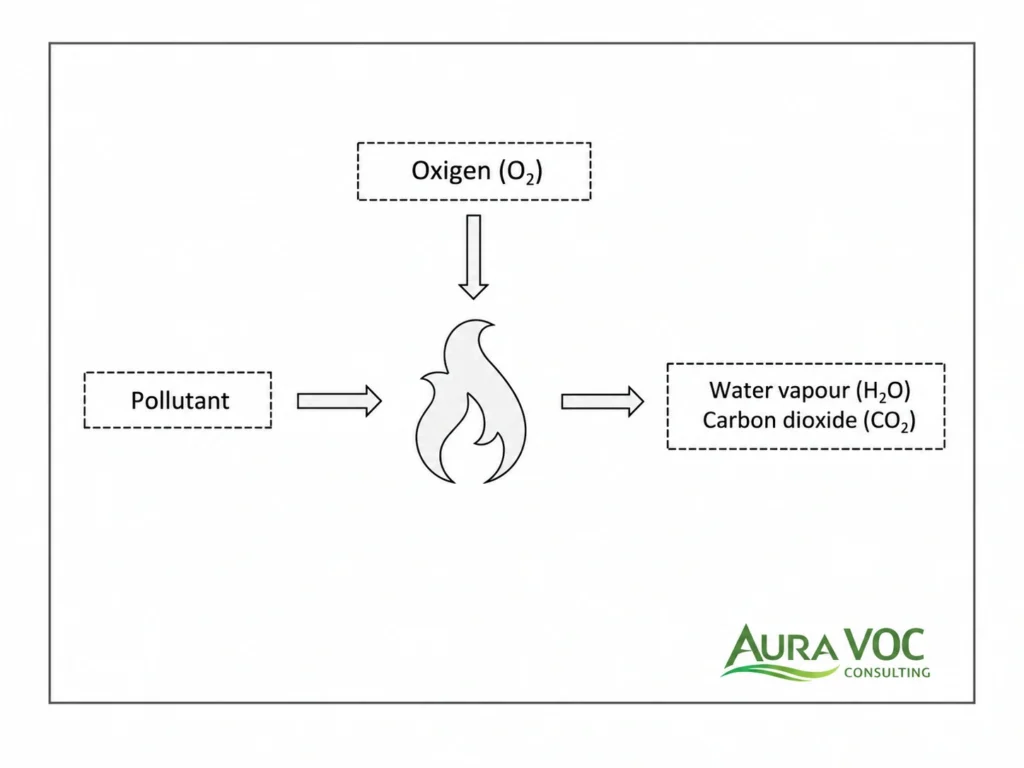
VOC thermal oxidation for VOC abatement is not simply an equipment selection exercise. In an industrial plant, the decision depends on the exhaust profile, the production schedule, the solvent mix, available utilities, pressure limitations in the ventilation system, maintenance access and the consequences of downtime.
A thermal oxidizer may be capable of achieving high VOC destruction under design conditions, but the practical question is whether it can maintain stable performance under the operating conditions of the plant. Airflow variation, solvent peaks, start-up sequences, low-load operation, fouling, burner trips, pressure drop increase and bypass events all affect the real performance of the abatement system.
For plant managers, EHS managers and process engineers, thermal oxidation should be evaluated as part of the complete VOC emission control system: process source, capture arrangement, ductwork, fan, oxidizer, controls, stack and, where required, downstream treatment. A well-selected system can operate as a stable part of production. A poorly matched system can become a source of high fuel consumption, repeated alarms, maintenance shutdowns, poor capture or difficult compliance testing.
Who this guide is for: plant managers, EHS managers and process engineers
This guide is written for industrial teams involved in selecting, reviewing or troubleshooting VOC abatement systems.
Plant managers typically need to understand the impact on production continuity, utility demand, maintenance workload and operating cost. EHS managers need confidence that the system can perform under representative production conditions, not only during controlled test conditions. Process engineers need to assess how exhaust flow, solvent composition, moisture, temperature, pressure drop and operating variability affect system design.
The article assumes familiarity with industrial ventilation, combustion equipment and emission control terminology. The focus is not on generic environmental benefits, but on the engineering checks that determine whether thermal oxidation is suitable for a specific plant, process or retrofit.
What the article covers: selection, design constraints, operation and troubleshooting
The article covers the main technical factors that affect thermal oxidizer selection and operation: VOC concentration, exhaust flow rate, LEL management, heat recovery, fuel consumption, pressure drop, fan performance, maintenance access, by-product formation and troubleshooting.
It also compares direct-fired, recuperative and regenerative thermal oxidizers, including RTO systems. Each configuration has different implications for energy use, fouling sensitivity, valve reliability, pressure drop, control complexity and suitability for variable VOC loads.
For existing installations, the same framework can be used to investigate high fuel use, rising differential pressure, burner trips, odour complaints, bypass events or unstable outlet VOC results. In many cases, the root cause is not limited to the oxidizer itself. It may involve source capture, ductwork, fan operation, solvent loading, valve leakage, heat recovery condition, control settings or changes in production.
Why nominal destruction efficiency is not enough for technology selection
Thermal oxidizers are often discussed in terms of destruction efficiency. This is an important parameter, but it does not define real plant performance by itself.
A quoted destruction efficiency assumes that the equipment is operating inside its design window: correct chamber temperature, sufficient residence time, adequate mixing, stable flow, suitable VOC concentration and functioning safety controls. Industrial plants rarely operate at one fixed condition. Batch processes generate short solvent peaks. Coating lines change speed and formulation. Pharmaceutical production changes campaigns. Food and manufacturing processes may introduce moisture, aerosols, oils or particulates that affect heat recovery surfaces or RTO media.
A practical evaluation must therefore consider emission performance together with availability, pressure drop, fuel demand, safety margin, maintenance frequency and the likelihood of bypass operation. Selection based only on nominal destruction efficiency can miss the main cost and reliability risks.
When VOC thermal oxidation is selected for industrial abatement
Thermal oxidation is usually considered when VOCs are better destroyed than recovered, or when the exhaust stream is too mixed, dilute or variable for practical solvent recovery. It is common in industrial plants where several solvents are used, where VOC composition changes by product or batch, or where the recovered solvent would have limited reuse value.
The decision should be based on process data. Thermal oxidation may be appropriate for one exhaust stream and unsuitable for another within the same plant. Two lines with similar annual VOC mass emissions can require different abatement approaches if their flow rates, concentration profiles, solvent composition, pressure constraints or operating schedules differ.
VOC destruction versus solvent recovery
The first selection question is whether the plant needs VOC destruction or solvent recovery. Thermal oxidation destroys organic compounds through high-temperature oxidation. It is often appropriate when the solvent mixture has low recovery value, when composition changes frequently, or when recovered solvent would require complex purification before reuse.
Solvent recovery may be more appropriate when VOC concentration is high, the solvent is valuable, composition is stable and reuse or resale is practical. Condensation, adsorption with recovery or hybrid systems may need to be compared before selecting thermal oxidation.
This distinction matters because thermal oxidation is not normally selected to preserve material value. It is selected when destruction is the more practical route after considering solvent variability, safety, utility demand, operating cost, waste handling and process integration.
Typical applications in chemical, pharmaceutical, coating, food and manufacturing plants
Thermal oxidation is used in chemical manufacturing, pharmaceutical production, coating and paint lines, food processing and general industrial manufacturing.
In chemical plants, it may treat mixed solvent vents, reactor off-gases or exhaust streams with variable composition. In pharmaceutical plants, batch operations and solvent campaigns create changing VOC loads that must be assessed at both average and peak conditions. In coating and paint applications, the main challenge is often high airflow with low to moderate VOC concentration, especially from ovens and drying zones.
Food processing and some manufacturing applications may involve odorous organic compounds, moisture, oils, aerosols or particulates. These streams require careful review of fouling, condensation and pre-filtration before assuming that thermal oxidation will operate reliably.
Good-fit exhaust profiles for thermal oxidation
Thermal oxidation is generally a stronger candidate when the exhaust contains mixed VOCs that are not practical to recover, the VOC concentration contributes useful heat, and the flow can be collected and controlled within a defined operating range.
Regenerative thermal oxidizers are often considered for large airflow streams with low to moderate VOC concentrations, where heat recovery is needed to control fuel consumption. Recuperative oxidizers may be suitable where flow is smaller, VOC loading is higher, or where a different heat recovery arrangement better fits the process.
A good-fit application is not defined by VOC concentration alone. Moisture, aerosols, halogenated compounds, sulfur-containing compounds, particulates and condensable organics can change the practical suitability of the technology. The exhaust must be compatible with the oxidizer from a fouling, corrosion, safety and maintenance perspective.
Cases where thermal oxidation requires caution or comparison with alternatives
Thermal oxidation requires careful evaluation when exhaust flow is very high and VOC concentration is very low. In these cases, auxiliary fuel demand and fan power can dominate operating cost. Adding dilution air for LEL control can further increase total flow and reduce inlet VOC heat contribution.
Caution is also required with halogenated VOCs, sulfur compounds or nitrogen-containing compounds. Oxidation may form acid gases or other by-products that require downstream treatment and corrosion-resistant materials. In these cases, the oxidizer cannot be evaluated separately from the scrubber, stack, wastewater system and materials of construction.
Streams containing sticky aerosols, oils, powders or condensable organics can create fouling problems in RTO ceramic media or recuperative heat exchangers. If the process cannot control these contaminants upstream, the plant may face rising pressure drop, heat recovery loss, cleaning shutdowns and unstable fan operation.
New installation, retrofit or existing oxidizer troubleshooting: different evaluation paths
A new installation usually starts with emission characterization, technology comparison, utility review and layout constraints. The objective is to select an abatement route before equipment specifications are issued.
A retrofit starts from different constraints. Existing ductwork, fan capacity, stack location, available space, shutdown windows and control system integration may limit the available options. Pressure drop is particularly important because an oxidizer added to an existing ventilation system can reduce source capture if the fan and ductwork are not reassessed.
Troubleshooting an existing oxidizer follows another path. The symptom may be high outlet VOC, excessive fuel consumption, burner trips, odour complaints, rising pressure drop or bypass events. The cause may involve production changes, solvent loading, fouled heat recovery surfaces, valve leakage, air infiltration, poor duct balancing or operation outside the original design basis.
Define the VOC exhaust stream before selecting an oxidizer
Before selecting a thermal oxidizer, the VOC exhaust stream must be defined with enough detail to represent real operation. A single average concentration or nominal airflow is not sufficient for design, comparison or supplier quotation. The exhaust profile should describe normal production, peak loading, low-load operation, start-up, shutdown, cleaning and campaign changes.
The quality of this data directly affects technology selection. If the exhaust stream is poorly defined, the selected system may be oversized, undersized, unnecessarily expensive to operate or unable to handle peak conditions safely. For industrial VOC abatement, the design basis should be treated as an engineering document, not only as an emission estimate.
Exhaust flow rate: average, peak and turndown conditions
Exhaust flow rate determines oxidizer size, residence time, pressure drop and fan power. The design should distinguish between average flow, maximum flow, minimum stable flow and turndown requirements. These values are especially important where multiple process sources are connected to one abatement system.
Oversizing airflow increases fuel consumption, fan power and capital cost. Undersizing can reduce capture performance, shorten residence time or force bypass operation during peak production. For retrofit projects, the existing fan curve, duct losses and available static pressure must be reviewed before adding oxidizer pressure drop to the system.
VOC concentration: average load, peak load and variability
VOC concentration should be described as a range, not a single value. Average concentration is useful for estimating operating cost, but peak concentration is critical for LEL management, burner response and safe operation. Batch processes, solvent charging, cleaning cycles, coating changes and oven temperature changes can create short peaks that are missed by average sampling.
Low VOC concentration increases auxiliary fuel demand. High or variable VOC concentration can create temperature control and safety challenges. The oxidizer must be able to operate across the expected range without excessive bypassing, unstable burner operation or repeated alarms.
LEL assessment and dilution air requirements
LEL assessment is a core design input for VOC exhaust systems. The plant must understand the maximum credible VOC concentration, the solvent mixture, the location of monitoring points and the required safety margin. If dilution air is required, its impact on total airflow, fuel consumption, fan size and residence time must be included in the evaluation.
Dilution air reduces explosion risk when applied correctly, but it is not neutral from an operating perspective. It increases the gas volume handled by the oxidizer, reduces inlet VOC heat contribution per unit of flow and may increase both burner fuel demand and fan power.
Solvent composition and mixed VOC streams
The solvent list should include normal production solvents, cleaning solvents, campaign-specific materials and occasional compounds that may enter the exhaust. Mixed VOC streams can affect heat release, oxidation behavior, materials compatibility and downstream treatment requirements.
A solvent mix that appears manageable on average may still create design issues if one compound dominates during a specific batch step or cleaning operation. The exhaust characterization should therefore include both typical and worst-case operating scenarios.
Halogenated, sulfur-containing and nitrogen-containing compounds
Halogenated, sulfur-containing and nitrogen-containing compounds require specific attention because oxidation may generate acid gases or other by-products that affect material selection and downstream treatment. These compounds can change the project scope from a dry oxidizer installation to a combined oxidizer and scrubbing system.
The presence of these compounds also affects wastewater considerations if a wet scrubber, quench system or neutralization stage is required. This should be identified early, before the oxidizer type has already been selected.
Temperature, moisture and condensation risk
Exhaust temperature and moisture influence duct design, condensation risk, corrosion and fouling. If condensable organics or water vapor drop out in the ductwork, the plant may experience deposits, liquid accumulation, pressure drop increase or unstable VOC loading to the oxidizer.
Temperature also affects gas volume and material selection. Hot exhaust may support heat recovery opportunities, but it may require insulated ductwork, expansion allowances and careful fan selection.
Particulates, aerosols and condensable organics
Particulates, aerosols and condensable organics can be limiting factors for thermal oxidizer reliability. In RTOs, these contaminants may plug ceramic media or increase differential pressure. In recuperative systems, they may foul heat exchanger surfaces and reduce heat recovery.
Where these contaminants are present, pre-filtration, demisting, knock-out separation, source segregation or process modifications may be needed before thermal oxidation is viable. Ignoring fouling risk at the selection stage often leads to recurring maintenance shutdowns and rising operating cost.
Continuous, batch and campaign-based operation
Operating schedule affects fuel consumption, start-up frequency, standby strategy and thermal cycling. Continuous processes may support stable operation and predictable heat balance. Batch or campaign-based processes may create long low-load periods followed by short high-load events.
For pharmaceutical and specialty chemical plants, campaign changes can significantly alter VOC composition and concentration. The oxidizer should be evaluated against the expected operating envelope, not only the current product or solvent campaign.
Data required before sizing or comparing thermal oxidation systems
A practical design basis should include exhaust flow range, VOC species, average and peak concentrations, LEL assessment, temperature, moisture, particulate and aerosol content, operating schedule, source capture arrangement, existing fan limitations, available utilities, space constraints and expected maintenance access.
This information is also needed to compare thermal oxidation with alternatives such as catalytic oxidation, activated carbon adsorption, condensation or solvent recovery. Without a consistent data set, technology comparisons tend to focus on equipment categories rather than the real constraints of the industrial process.
What determines thermal oxidizer performance in real plant operation
Thermal oxidizer performance should be assessed against the operating envelope actually seen by the equipment. The system may be specified around a design airflow, target chamber temperature and nominal destruction efficiency, but day-to-day operation is affected by line speed, batch timing, solvent substitution, cleaning cycles, idle periods, fan control and maintenance condition.
For EHS managers, this means that compliance depends on more than the nameplate efficiency of the oxidizer. For plant managers, nuisance trips, bypass events and high fuel demand can become production issues. For process engineers, the oxidizer must be evaluated together with capture, ductwork, dilution air, fan performance, controls and stack monitoring.
Temperature, residence time and mixing under actual flow conditions
Thermal oxidation depends on the gas reaching the required oxidation temperature, remaining there long enough and mixing adequately with oxygen. In practice, these conditions are not fixed. If exhaust flow increases above the design basis, residence time falls. If duct modifications or damper changes create uneven distribution, parts of the gas stream may pass through the chamber with less effective treatment.
A normal chamber temperature reading does not always prove that every gas path is receiving equivalent treatment. Thermocouple location, burner arrangement and internal flow patterns matter. When outlet VOC concentration increases despite apparently normal chamber temperature, the review should include actual airflow, burner firing rate, temperature profile, chamber condition and any evidence of short-circuiting.
Oxygen availability and combustion stability
Most industrial VOC exhaust streams contain enough oxygen for oxidation, but stable combustion still depends on burner performance, combustion air supply, fuel pressure and predictable exhaust conditions. Burner trips are often investigated as burner faults, but the root cause may be a process-side disturbance: rapid VOC heat release, sudden dilution air changes, unstable fan operation or high LEL alarm response.
Practical checks include fuel gas pressure trend, combustion air pressure switches, flame scanner condition, purge permissives, burner turndown limits and the relationship between trips and production steps. If flame failures occur during specific batch operations or cleaning cycles, the solvent loading profile should be reviewed together with the burner management sequence.
Effect of high flow on residence time and destruction performance
High airflow can reduce effective oxidation performance even when the equipment is mechanically sound. A flow increase reduces residence time and can shift the fan away from its intended operating point. In multi-source systems, adding another duct branch to an existing oxidizer without reassessing total flow, pressure drop and fan capacity can reduce both abatement reliability and source capture.
This issue is common in retrofits. The oxidizer may still reach temperature, but the actual gas residence time may no longer match the original design assumption. If high outlet VOC appears after a process expansion or ventilation modification, actual flow should be compared with the design basis before assuming combustion failure.
Effect of VOC peaks on burner control and safety interlocks
Average VOC concentration is not adequate for evaluating batch or campaign-based operation. Solvent charging, drying, oven temperature changes, cleaning operations and formulation changes can create short concentration peaks. These peaks can affect LEL readings, chamber temperature, burner modulation and dilution air demand.
A thermal oxidizer should be reviewed against the maximum credible VOC concentration, not only the daily or hourly average. If peaks are sharp, the control system may not respond smoothly. The result can be high-temperature alarms, burner cutback, emergency dilution, production interruption or bypass operation.
System availability, bypass events and real operating performance
A high nominal destruction efficiency has limited value if the oxidizer is frequently unavailable. Actual performance depends on uptime, maintenance condition, trip frequency and bypass duration. Bypass logging should include more than event time. Useful records include production status, VOC source in operation, chamber temperature, LEL reading, fan status, differential pressure and alarm sequence.
Repeated bypass events should not be treated as routine operation. They normally indicate a design margin issue, fouling problem, control logic issue, maintenance defect or process condition that was not included in the original design basis.
Stack testing under representative production conditions
Stack testing should be planned around the production conditions that the permit or operating requirement is intended to represent. Testing during a simplified production state can produce clean results but provide limited confidence for normal operation.
Before testing, the plant should define which lines, recipes, solvents, flow rates and production rates will be active. During the test, the operating record should include oxidizer temperature, inlet flow, burner firing rate, pressure drop, LEL readings, valve position where relevant and confirmation that bypass dampers remained closed. For batch operations, the test plan should consider whether solvent peaks must be captured or separately characterized. For general reference on oxidizer operating parameters, use the EPA thermal oxidizer monitoring guidance when defining the minimum monitoring basis.
Thermal oxidizer configurations and selection tradeoffs
Thermal oxidizers are not interchangeable. Direct-fired, recuperative and regenerative systems have different implications for energy demand, pressure drop, maintenance and sensitivity to contaminants. Selection should be based on the exhaust profile and site constraints, not only on thermal efficiency or supplier preference.
The most appropriate configuration depends on flow rate, VOC loading, operating schedule, fouling potential, temperature, solvent chemistry, available utilities and required uptime.
Direct-fired thermal oxidizers: simple configuration, high fuel demand
Direct-fired thermal oxidizers have a relatively simple arrangement and do not rely on major heat recovery components. This can be useful for smaller flows, intermittent operation, difficult contaminants or cases where heat recovery surfaces would foul quickly.
The tradeoff is fuel consumption. Without effective heat recovery, auxiliary fuel demand can be significant, especially for dilute VOC streams. Direct-fired systems are therefore usually less attractive for large continuous airflows unless the VOC load provides substantial heat release or the process conditions make other configurations impractical.
Recuperative thermal oxidizers: heat exchanger recovery and fouling considerations
Recuperative thermal oxidizers use a heat exchanger to preheat incoming exhaust with hot treated gas. This reduces fuel demand compared with direct-fired systems and can be suitable where flow and VOC loading are moderate and the exhaust is reasonably clean.
The heat exchanger is the key design and maintenance item. Fouling reduces heat transfer and increases pressure drop. Corrosive compounds can affect material selection and service life. Cleaning access should be considered during layout because poor access can turn a manageable maintenance task into an extended shutdown.
Regenerative thermal oxidizers, RTOs: high heat recovery with media and valve complexity
RTOs use ceramic media beds to store and release heat as flow direction changes. They are often considered for large airflow streams with low to moderate VOC concentrations because high heat recovery can reduce auxiliary fuel demand.
The tradeoff is mechanical and operational complexity. Ceramic media can foul or plug. Valves must seal and cycle reliably. Purge sequences must be correctly set to limit VOC slip. Pressure drop across the media must be monitored because gradual increase can affect fan power, capture performance and system stability.
Multi-bed and rotary RTOs: purge control, VOC slip and mechanical complexity
Multi-bed and rotary RTOs are used where purge control, flow continuity or outlet stability require more refined operation than a basic two-bed arrangement. These systems can reduce untreated VOC carryover during switching, but they introduce additional mechanical components and control requirements.
Valve timing, rotor sealing, purge flow and actuator reliability become important maintenance points. For EHS managers, short concentration peaks during switching may be relevant during compliance testing or continuous monitoring, even if average outlet performance appears acceptable.
Thermal oxidizer selection matrix by flow, VOC load, variability and fouling risk
A practical selection matrix should compare oxidizer configurations against the real exhaust conditions. High airflow and low VOC concentration often favor regenerative heat recovery, provided fouling risk is manageable. Higher VOC load or smaller flow may justify recuperative oxidation. Difficult particulate, sticky or condensable streams may require pre-treatment or a different technology.
The matrix should also include maintenance access, utility availability, downtime tolerance, pressure drop limits and secondary treatment requirements. These factors often determine whether a configuration is workable on an existing site.
When RTOs are not the best option despite high thermal efficiency
An RTO is not always the correct choice. High thermal efficiency is valuable, but it does not eliminate fouling, pressure drop, valve maintenance or purge-related VOC slip. Streams with heavy aerosols, sticky organics, powders or frequent condensation can create persistent media problems.
RTOs also require careful evaluation where the existing ventilation system has limited static pressure margin. Adding media bed pressure drop to a constrained system may reduce capture performance unless the fan and ductwork are upgraded.
Fuel consumption, heat recovery and operating cost implications
Fuel consumption is one of the main operating concerns for thermal oxidation. It is driven by exhaust flow, VOC concentration, oxidation temperature, heat recovery efficiency, operating schedule, dilution air and system condition. In many plants, energy use becomes the deciding factor between thermal oxidation configurations or between oxidation and alternative technologies.
Operating cost should be evaluated over realistic production patterns, not only at nominal design load.
Auxiliary fuel demand at low VOC concentration
Low VOC concentration means the exhaust contributes limited heat to the oxidation process. The burner must then supply most of the energy required to maintain chamber temperature. This is common in high-volume ventilation streams, coating lines with high dilution or plants where emissions are collected from multiple low-concentration sources.
Reducing unnecessary airflow can have a larger effect on fuel consumption than small changes in burner efficiency. Source capture design and duct balancing are therefore part of the energy evaluation.
Autothermal operation: when it is realistic and when it is not
Autothermal operation is possible only when the heat released by VOC oxidation, combined with heat recovery, is sufficient to maintain operating temperature without continuous auxiliary fuel. This depends on VOC concentration, solvent heating value, flow rate, thermal losses and heat recovery efficiency.
It should not be assumed from average solvent use alone. Low-load periods, product changes, cleaning cycles and standby operation may still require fuel. A system may be autothermal during peak production but fuel-dependent during normal or partial-load operation.
Heat recovery efficiency versus fouling and cleaning requirements
High heat recovery reduces fuel demand, but the heat recovery surfaces or media must remain clean enough to perform. Fouling reduces thermal efficiency, increases pressure drop and may create uneven flow distribution. In RTOs, fouled media can also cause bed channeling and temperature imbalance.
The design tradeoff is between energy recovery and maintainability. A high-efficiency system with poor tolerance for the actual contaminants may cost more to operate than expected because of cleaning shutdowns, fuel increase and fan power penalties.
Dilution air impact on fuel use and fan power
Dilution air may be required to maintain VOC concentration below defined safety limits. However, it increases the gas volume through the oxidizer. This can increase fan power, reduce residence time if not accounted for and increase auxiliary fuel demand by lowering the heat contribution per unit of exhaust volume.
The safety requirement remains primary, but dilution should be designed intentionally. Uncontrolled air infiltration from open dampers, leaking ductwork or poor source isolation can create the same energy penalty without providing reliable LEL control.
Start-up, shutdown and standby fuel consumption
Start-up requires heating the oxidizer to the required operating temperature before VOC-laden air is introduced. Shutdown and purge sequences also consume energy and time. For intermittent production, repeated start-stop cycles can represent a significant share of fuel use.
Standby strategy should be matched to production scheduling. Maintaining temperature during short idle periods may be more practical than full shutdown, while extended idle periods may justify controlled cool-down. The correct approach depends on fuel cost, restart time, thermal cycling limits and production flexibility.
Secondary heat recovery opportunities and limitations
Some plants can recover heat from oxidizer exhaust for process air preheating, hot water generation or other utility loads. This can improve the overall energy balance where continuous heat demand exists near the abatement system.
The limitation is integration. Heat recovery must match a real heat user, operating schedule and temperature level. Fouling, corrosion, pressure drop and controls may limit what is practical. Heat recovery that adds complexity without a stable heat demand provides limited operational value.
Key operating cost drivers for thermal oxidation systems
The main cost drivers are exhaust volume, VOC load, heat recovery condition, auxiliary fuel price, fan power, operating hours, maintenance frequency and downtime impact. In RTO systems, media condition and valve reliability can strongly influence both energy and availability.
For existing systems, trending fuel consumption against production rate and VOC load is useful. A gradual increase in fuel use at similar production conditions often indicates heat recovery loss, air infiltration, fouling, control changes or operation outside the original design basis.
Pressure drop, fan power and capture stability
Pressure drop is a central operating parameter in VOC abatement systems. It affects fan power, duct pressure, extraction rate at the source and the ability to maintain capture under changing production conditions. In many plants, poor abatement performance starts upstream of the oxidizer, when the exhaust system can no longer move the required flow through the added resistance. For capture-side review, OSHA local exhaust ventilation guidance provides a useful reference for hood, duct, fan, air cleaner and stack system checks.
Main sources of pressure drop in thermal oxidizer systems
Pressure loss can occur across ductwork, branch dampers, filters, heat exchangers, RTO ceramic media, isolation valves, silencers and stack components. The total resistance should be compared with the fan curve, not only with the oxidizer supplier’s pressure-drop value. A small increase in one section may be acceptable, but combined losses can move the fan to an unsuitable operating point.
RTO media pressure drop and fouling mechanisms
In RTOs, rising pressure drop is often linked to ceramic media fouling. Particulates, condensed organics, oils, resins, powders or sticky aerosols can accumulate in the bed and restrict flow. The pattern matters. A gradual increase usually indicates progressive fouling or deposition. A sudden increase may indicate process carryover, condensation, a failed pre-filter, damper malfunction or media disturbance.
Pressure drop should be trended against production rate, exhaust temperature and solvent use. A pressure increase that appears only during specific recipes or seasons may point to condensation or formulation-related fouling rather than general media aging.
Recuperative heat exchanger pressure drop and fouling
In recuperative oxidizers, fouling on heat exchanger surfaces increases pressure drop and reduces heat transfer at the same time. This combination can raise fuel consumption while reducing available extraction. If exchanger fouling is suspected, useful indicators include lower inlet preheat temperature, higher stack temperature, increasing burner firing rate and reduced process capture at constant fan speed.
Corrosion should also be considered where acidic compounds or condensation are possible. Leakage between untreated and treated sides can compromise performance and may not be obvious from temperature readings alone.
Pressure drop impact on fan power and process capture
A fan operating against higher resistance may deliver less flow than required. At the process source, this can appear as weak hood capture, fugitive odour, solvent vapour escape, oven imbalance or tank ventilation instability. The oxidizer may still be operating correctly, but the emission system is not capturing all VOCs entering the work area or process enclosure.
This is why pressure drop must be evaluated as both an energy issue and a process control issue. Correcting capture may require fan upgrade, duct rebalancing, damper adjustment, cleaning of fouled sections or reducing unnecessary airflow elsewhere in the system.
Differential pressure monitoring points
Differential pressure should be monitored at locations that support diagnosis: across pre-filters, critical duct branches, heat exchangers, RTO media beds and stack-side restrictions. For RTOs, individual bed pressure readings are more informative than a single overall value because bed imbalance can indicate plugging, media settling or valve problems.
Early warning signs of airflow restriction
Early signs include rising fan load, lower hood velocity, unstable duct pressure, increased oxidizer fuel demand, reduced production flexibility, more frequent high-pressure alarms and increasing differential pressure across media or filters. These trends should be reviewed before they force an unplanned shutdown.
Pressure control problems in retrofitted systems
Retrofit projects often expose pressure limitations in existing ventilation systems. A fan that was adequate before abatement may not have enough static pressure margin after an oxidizer, RTO media bed, scrubber or new stack section is installed. Before installation, the existing fan curve, duct losses, source capture requirements and future expansion plans should be checked together.
Operating thermal oxidizers under real production conditions
Thermal oxidizers should be evaluated against actual production behavior: start-up frequency, batch peaks, idle periods, campaign changes, maintenance shutdowns and abnormal operating scenarios. Stable operation depends on both equipment design and operating discipline.
Start-up, pre-purge and safe introduction of VOC-laden air
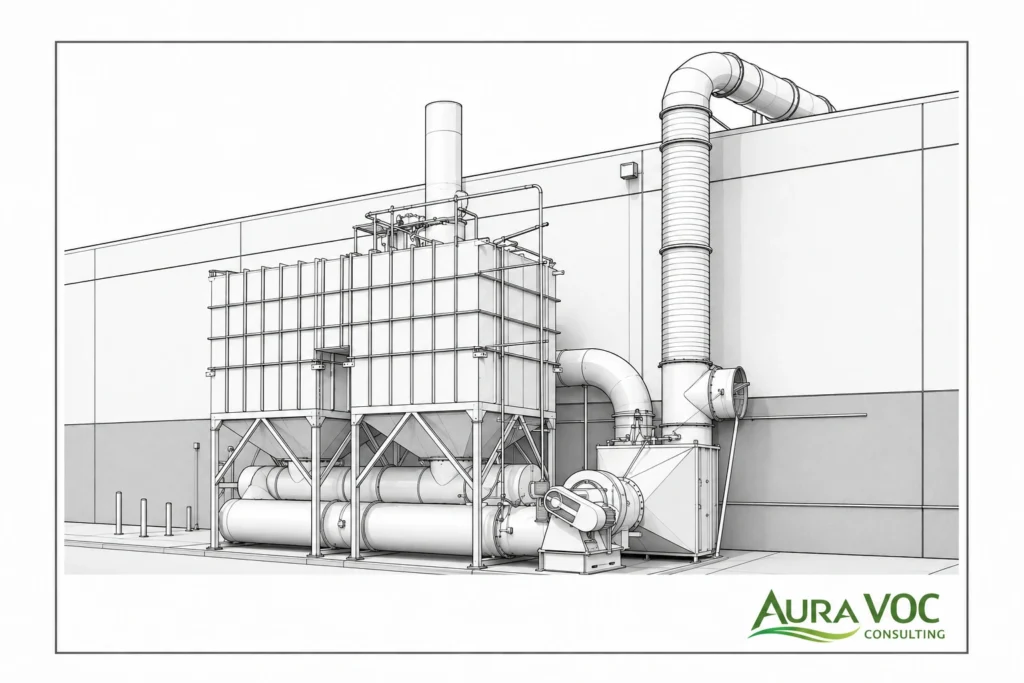
VOC-laden air should only be introduced after the required purge and temperature conditions are met. The pre-purge sequence clears residual combustible gas from the system before burner ignition and process exhaust admission. If production pressure leads operators to shorten or bypass start-up steps, trip risk and unsafe operating conditions increase.
Start-up logic should be clear to operations personnel. Required permissives may include fan operation, damper position, purge completion, burner readiness, chamber temperature and LEL status.
Shutdown, cool-down and purge sequences
Shutdown procedures should protect equipment and clear residual VOCs from the system. Purge timing, damper positions and fan operation should be defined so that untreated vapours are not trapped in ductwork or the oxidation chamber.
Thermal cycling also affects refractory, insulation, expansion joints, heat exchangers and RTO media. Frequent start-stop operation should be considered during design and maintenance planning, especially for intermittent production schedules.
Continuous versus batch VOC loading
Continuous processes usually produce a more stable heat balance and simpler control behavior. Batch processes require closer review of peak concentrations, low-load periods and control response. A batch plant may spend most of its time at low VOC loading but still generate short peaks that define LEL protection and burner response.
For batch applications, the design basis should describe the sequence of operations, not only total daily solvent use.
Operating during low-load or intermittent production
Low-load operation often increases auxiliary fuel demand because the VOC heat contribution is limited. Plants should define idle and standby logic rather than leaving the oxidizer in an inefficient operating state.
The practical choice depends on production schedule, restart time, fuel cost and thermal cycling limits. Short idle periods may justify maintaining temperature. Extended idle periods may justify controlled shutdown.
Burner management and flame safety systems
Burner management systems must be maintained and tested because they control ignition, purge, flame supervision, fuel shutoff and safe shutdown. Flame scanners, gas trains, combustion air switches and purge permissives are common sources of operational trips.
When burner trips occur, the alarm sequence should be reviewed before resetting. Repeated resets without root-cause review can conceal process-side problems such as VOC peaks, unstable fan operation or faulty damper feedback.
LEL monitoring, alarms and shutdown logic
LEL monitoring should be located and maintained according to the risk profile of the process. Alarm and shutdown settings must match credible peak scenarios, not only average operation.
Sensor calibration, response time, sampling location and solvent correction factors affect reliability. Where solvent mixtures change by campaign, the LEL basis should be checked against the current solvent blend.
Damper, fan and valve control strategy
Dampers, fans and RTO valves should be checked for position feedback, leakage and response time. Poor control can create unstable flow, inadequate capture or untreated VOC carryover.
In RTOs, valve sequencing is particularly important. Incorrect timing, worn seals or actuator lag can increase VOC slip during bed switching and may also reduce heat recovery.
Bypass events: causes, logging and investigation
Bypass events should be treated as operating incidents. Cause, duration, production status and oxidizer conditions should be recorded for root-cause review.
Typical initiating conditions include high LEL, burner flame failure, low chamber temperature, high temperature, fan fault, high pressure drop, valve position fault or safety interlock failure. If bypasses occur repeatedly under normal production, the system is operating outside an acceptable reliability envelope.
Maintenance considerations for thermal oxidizers and RTOs
Maintenance determines long-term availability. A system that is difficult to inspect or clean usually shows higher downtime and less predictable performance. Maintenance planning should start during design because access limitations can make routine work costly or impractical.
Routine inspection points for burners, fans, dampers and instrumentation
Routine checks should include burners, flame detection, gas valves, combustion air equipment, fans, bearings, dampers, actuators, temperature probes, pressure transmitters, LEL sensors and safety interlocks.
Instrumentation drift can create both false trips and unsafe operating assumptions. Temperature, pressure and LEL measurements should be calibrated according to their role in control and safety logic.
Refractory, insulation and expansion joint inspection
Thermal stress can damage refractory, insulation and expansion joints. Degradation may create heat loss, air leakage, unsafe surface temperatures or internal flow disturbances.
Cracked refractory, damaged insulation or leaking expansion joints can also affect fuel consumption and chamber temperature distribution. Inspection should be scheduled before failures create unplanned shutdowns.
RTO ceramic media fouling, plugging and settling
RTO media condition should be inspected when pressure drop rises, heat recovery declines or bed temperature profiles become unbalanced. Fouling may be caused by particulates, condensed organics, sticky aerosols, oils or process carryover.
Media settling can affect flow distribution and purge effectiveness. Bed condition should therefore be assessed not only by overall pressure drop but also by bed-to-bed comparison and temperature behavior.
RTO valve sealing, actuator wear and cycle reliability
RTO valves are critical to both heat recovery and emissions performance. Valve leakage can allow untreated gas to pass to the outlet side or reduce purge effectiveness. Actuator wear, seal degradation and timing drift can create intermittent performance issues that are difficult to detect from average readings alone.
Valve condition should be included in maintenance inspections, especially where outlet VOC peaks or unexplained performance changes occur.
Recuperative heat exchanger fouling, corrosion and leakage
Recuperative heat exchangers can foul, corrode or leak. Fouling reduces heat transfer and increases pressure drop. Corrosion may occur where acidic compounds or condensation are present. Leakage between untreated and treated sides can compromise abatement performance even when the chamber temperature remains normal.
Inspection access and cleaning method should be defined before installation. A heat exchanger that cannot be cleaned effectively may lose much of its operating advantage over time.
Cleaning strategies for fouled media or heat exchange surfaces
Cleaning methods should match the contaminant. Mechanical cleaning, media replacement, washing, upstream filtration changes, demisting or process modifications may be required. In some cases, cleaning addresses the symptom but not the cause; fouling will return unless the upstream source is controlled.
Cleaning activities can also create wastewater or solid waste that must be planned for, particularly when deposits contain organics, salts or acidic residues.
Predictive indicators: fuel trend, differential pressure, outlet VOC and trip frequency
Useful predictive indicators include fuel consumption at comparable production rates, differential pressure across filters or media, outlet VOC concentration, bed temperature balance, burner firing rate, bypass frequency and trip history.
Trending these values helps distinguish gradual degradation from sudden process changes. A rising fuel trend with stable production may indicate heat recovery loss or air infiltration. Rising pressure drop may indicate fouling. Increased trip frequency may point to burner, control or process variability issues.
Maintenance access requirements in new installations and retrofits
Access for inspection, lifting, media replacement, heat exchanger cleaning, burner maintenance, valve service and stack testing should be part of layout design. Tight access may reduce the feasibility of routine maintenance and increase downtime.
In retrofit projects, equipment placement should be reviewed with maintenance personnel before finalizing the layout. A technically suitable oxidizer can still become problematic if critical components are inaccessible.
Troubleshooting common thermal oxidizer problems
Troubleshooting should follow the process data. The useful starting point is not “what component failed?” but “what changed in the operating envelope?” Production rate, solvent use, exhaust flow, chamber temperature, pressure drop, fan status, burner firing rate, LEL readings and bypass history should be reviewed on the same timeline.
High outlet VOC concentration
High outlet VOC may result from inadequate oxidation conditions or from untreated gas bypassing the intended path. The first checks are chamber temperature, actual exhaust flow and residence time. If flow is above design, destruction performance can fall even when temperature is normal.
For RTOs, valve leakage, poor purge timing or insufficient purge flow can allow untreated gas to pass during bed switching. For recuperative systems, exchanger leakage between dirty and clean sides should be considered. If high outlet VOC appears only during certain batches or recipes, the solvent profile and peak concentration should be reviewed before assuming a general oxidizer fault.
Excessive fuel consumption
Thermal oxidizer fuel consumption usually increases when the heat balance deteriorates. The cause may be low VOC concentration, excessive dilution air, air infiltration through leaking dampers, reduced heat recovery, fouled media, high idle temperature or frequent start-stop operation.
Diagnosis should compare fuel use against production rate and VOC load. If fuel consumption has increased at similar production conditions, the investigation should focus on heat recovery degradation, air leakage, temperature setpoint changes, media condition or exchanger fouling. If fuel use tracks low production periods, standby strategy may be the main issue.
Rising RTO pressure drop
Rising RTO pressure drop is a strong indicator of media fouling, plugging, condensation or particulate carryover. The trend should be compared with filter condition, process recipe, exhaust temperature and maintenance events. If pressure drop rises after a formulation change, the new solvent, resin or particulate load may be affecting the media.
Corrective actions may include media inspection, cleaning, partial media replacement, upstream filtration, demisting, duct insulation or source segregation. Simply increasing fan speed may restore flow temporarily but can increase energy use and mask the underlying problem.
Frequent burner trips or flame failures
Burner trips can be caused by fuel gas pressure instability, combustion air problems, flame scanner fouling, purge permissive failure, high temperature excursions, low temperature alarms or LEL-related shutdowns. The alarm sequence should be reviewed before resetting and restarting.
If trips occur during predictable production steps, the burner may be reacting to VOC load swings rather than a burner hardware fault. Solvent peaks can push temperature control beyond the burner turndown range or trigger safety logic.
RTO VOC slip during valve switching
RTO VOC slip can occur when untreated gas remains in void spaces and is released during flow reversal, or when valves do not seal properly. In multi-bed systems, the purge bed is intended to reduce this carryover, but purge flow and timing must be maintained.
Short outlet VOC peaks during switching may be missed by low-frequency sampling but can be relevant during compliance testing or continuous monitoring. Valve seal wear, actuator timing drift and purge flow restriction should be included in any RTO performance review.
Odour complaints despite thermal oxidation
Odour complaints do not automatically indicate poor oxidation. They may come from poor source capture, fugitive tank emissions, loading operations, leaking ductwork, bypass events or stack dispersion issues. Some odorous compounds may also be present outside the exhaust stream connected to the oxidizer.
A practical investigation should compare complaint timing with production activity, bypass logs, wind direction, capture conditions and oxidizer operating data. Walking the process area and checking fugitive points is often as important as reviewing stack data.
Repeated bypass events or emergency shutdowns
Repeated bypass events should be investigated as system reliability problems. Review the initiating alarms: high LEL, high pressure drop, fan failure, low chamber temperature, high temperature, burner flame failure or valve position fault. The event log should be tied to production conditions to determine whether the cause is mechanical, control-related or process-driven.
Capture-side problems that appear as oxidizer performance issues
Some apparent oxidizer failures are actually capture failures. Low hood velocity, unbalanced duct branches, leaking ducts, open access doors, fan limitations and poor enclosure design can allow VOCs to escape before they ever reach the oxidizer.
If workplace odour or fugitive emissions persist while stack performance is acceptable, the capture system should be tested directly. Hood face velocity, duct pressure, branch balance and fan operating point may be more relevant than chamber temperature.
Troubleshooting checklist for plant and EHS teams
A useful troubleshooting record should include active process lines, recipes and solvent use, exhaust flow, duct pressure, chamber temperature, burner firing rate, inlet and outlet VOC data where available, LEL readings, alarm history, differential pressure, fan status, damper positions, bypass duration and recent maintenance or process changes.
The value of the checklist is in comparing these data on the same timeline. Many problems only become clear when operating symptoms are aligned with production events.
Acid gas, scrubber and wastewater implications
Dry thermal oxidation does not normally generate process wastewater, but the situation changes when acid-forming compounds, quench systems, wet scrubbers or cleaning operations are involved. For chemical and pharmaceutical plants, this assessment should be made early because it affects materials, utilities, wastewater treatment and operating cost. For chemical-sector BAT context, compare project assumptions with the European Commission BREF for common waste gas management and treatment systems.
When dry thermal oxidation does not generate wastewater
For many hydrocarbon or oxygenated solvent streams, the oxidizer can operate as a dry system. In those cases, wastewater may be limited to occasional maintenance cleaning, if any.
This assumption should not be extended to streams containing halogenated or sulfur-containing compounds without checking expected oxidation by-products. A dry oxidizer may still require downstream treatment if the outlet gas contains acid gases or corrosive compounds.
Halogenated VOCs and acid gas formation
Halogenated VOCs can form acid gases such as HCl or HF during oxidation. These compounds can affect ductwork, heat recovery surfaces, stack materials and downstream treatment. Acid dew point and condensation risk are important because corrosion may occur in cooler zones, especially during start-up, shutdown or low-load operation.
The presence of halogenated compounds can change the project from a simple oxidizer selection to an integrated oxidizer, quench, scrubber, wastewater and materials-of-construction review.
When downstream quench or wet scrubbing is required
A downstream quench or wet scrubber may be required where acid gases must be removed before discharge. The scrubber should be evaluated as part of the abatement system, not as a separate accessory.
A scrubber adds pressure drop, water consumption, chemical dosing, instrumentation, maintenance and wastewater discharge. It also affects fan selection and layout. For retrofit projects, these additional loads can be as important as the oxidizer itself.
Scrubber blowdown and wastewater characteristics
Scrubber blowdown may contain salts, neutralization chemicals, dissolved organics and suspended solids. The wastewater treatment plant must be able to manage hydraulic load, pH, salt concentration and any COD contribution. Batch discharge from scrubber maintenance may require separate handling from continuous blowdown.
If the site wastewater system has limited capacity or strict discharge constraints, the scrubber design and operating strategy should be reviewed before finalizing the air-side system.
Cleaning wastewater from fouled media or heat exchangers
Cleaning RTO media or heat exchangers can generate intermittent wastewater with variable composition. Depending on the contaminant, this stream may contain dissolved organics, solids, acidic or alkaline cleaning chemicals and high COD.
This waste should be considered in maintenance planning, especially where temporary storage, neutralization, off-site disposal or special handling is needed. Cleaning frequency also affects downtime and operating cost.
pH, salt load and COD implications for site wastewater treatment
Neutralizing acid gases transfers part of the treatment burden to the wastewater system. Salt load, pH control and COD must be checked against existing permits and treatment capacity. A VOC abatement project can fail operationally if the air-side solution creates an unmanaged wastewater constraint.
The wastewater review should include both continuous streams, such as scrubber blowdown, and intermittent streams, such as equipment cleaning waste.
Material selection and corrosion considerations
Material selection should account for acid gases, condensation, temperature cycling and cleaning chemicals. Stainless steel may not be sufficient in all sections. Ductwork, quench zones, scrubbers, stacks, drains and access doors should be reviewed according to expected gas composition and operating temperature.
Corrosion risk is often highest where gas cools below the acid dew point or where wet and dry zones meet. These interfaces require particular attention in layout and maintenance planning.
Technology comparison: when thermal oxidation is the right VOC abatement technology
Technology selection should compare the complete operating case, not just destruction efficiency. The same VOC mass flow can lead to different technology choices depending on exhaust volume, concentration, solvent value, fouling risk, pressure limitations and operating schedule.
Thermal oxidation versus regenerative thermal oxidation
Regenerative thermal oxidation is a specific thermal oxidation configuration with ceramic heat recovery. RTOs are often suitable for large airflows with low to moderate VOC concentrations, but they introduce media pressure drop, valve cycling, purge requirements and fouling sensitivity.
The choice is not “thermal oxidizer or RTO”; it is which oxidizer configuration fits the exhaust stream and plant constraints. A recuperative or direct-fired unit may be more practical where flow is lower, VOC load is higher or media fouling risk is unacceptable.
Thermal oxidation versus catalytic oxidation
Catalytic oxidation operates at lower temperature, which can reduce fuel consumption. The tradeoff is catalyst sensitivity. Silicon, sulfur, halogens, phosphorus compounds, heavy metals, particulates and condensable materials can reduce catalyst life or activity. Catalytic systems require careful inlet conditioning and periodic catalyst inspection or replacement.
A catalytic oxidizer should not be selected only because of lower operating temperature. The solvent list, contaminants, maintenance access and catalyst replacement cost must be included in the comparison. For variable industrial streams, catalyst poisoning risk can outweigh the energy advantage.
Thermal oxidation versus activated carbon adsorption
Activated carbon adsorption may be suitable for lower-temperature, lower-flow or recoverable VOC streams. It can be used for capture, polishing or solvent recovery depending on the configuration. However, carbon systems require bed management, fire-risk assessment, breakthrough monitoring and spent carbon handling or regeneration.
Thermal oxidation may be preferred where the solvent mixture is variable, recovery value is low, or destruction is operationally simpler than managing adsorption beds. Carbon adsorption may remain relevant as a polishing stage or for streams where oxidation energy demand would be excessive.
Thermal oxidation versus condensation and solvent recovery
Condensation and solvent recovery require sufficient VOC concentration and a solvent stream with practical reuse or disposal value. Mixed solvents, water content, variable composition and low concentration can reduce recovery feasibility. In some plants, recovery may still require a polishing stage, such as carbon adsorption or oxidation.
Thermal oxidation becomes more attractive where solvent recovery produces an inconsistent or low-value condensate, or where the recovered stream would require complex separation before reuse.
Destruction efficiency, operating cost and maintenance tradeoffs
High destruction efficiency must be evaluated together with fuel demand, fan power, pressure drop, maintenance frequency, uptime and secondary treatment. A system that performs well on paper but requires frequent cleaning, repeated restarts or sustained bypass operation is not a robust industrial solution.
The comparison should include expected operating hours, maintenance intervals, consumables, waste streams, production downtime and availability requirements.
Technology selection for high airflow and low VOC concentration
High airflow and low VOC concentration often create the highest energy penalty. RTOs may be appropriate because of heat recovery, but only if media fouling and pressure drop are manageable.
Reducing unnecessary airflow at the source can sometimes have a larger operating-cost impact than changing oxidizer type. Capture design, enclosure strategy and duct balancing should be reviewed before accepting a high-flow design basis.
Technology selection for batch VOC peaks
Batch peaks require a review of LEL margin, dilution logic, burner response and temperature control. The technology must handle both peak and low-load conditions. Designing only around average emissions can lead to undersized safety controls and inefficient operation during normal production.
Where peak data are uncertain, temporary monitoring or process-step emission estimates may be needed before selecting the abatement route.
Technology selection for mixed or variable solvent streams
Mixed solvent streams often favor destruction, especially when recovery is not practical. The review should still include heat release variability, by-product formation, corrosion risk, fouling potential and whether one occasional solvent changes the entire treatment concept.
A small amount of halogenated or sulfur-containing solvent may introduce requirements for acid gas treatment, corrosion-resistant materials or wastewater handling that are not obvious from the main solvent blend.
Sector-specific engineering considerations
The same oxidizer type can perform differently across industrial sectors because exhaust characteristics and operating schedules differ. Sector-specific review helps identify the failure modes most likely to affect reliability.
Chemical manufacturing: mixed solvents, LEL control and corrosive by-products
Chemical manufacturing often involves variable solvent blends, reactor vents, tank emissions and campaign changes. The design case should include maximum credible VOC peaks, corrosive by-products, inerting interfaces and abnormal operating scenarios.
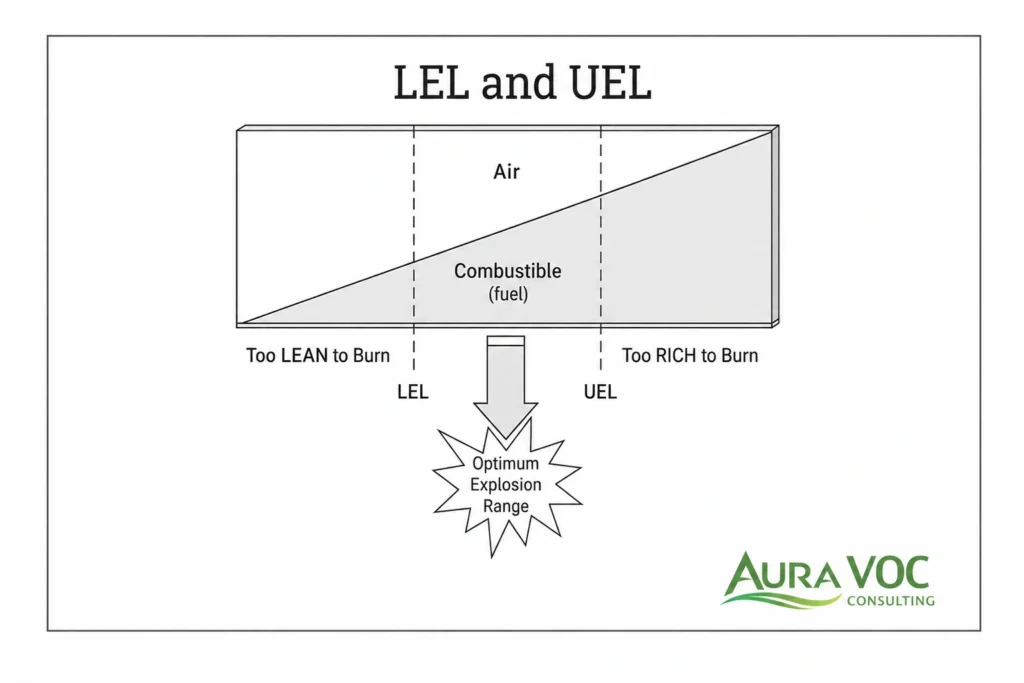
LEL control is often central because solvent releases may occur in defined process steps rather than steady operation. Where halogenated or sulfur-containing compounds are present, acid gas and corrosion review should be included early.
Pharmaceutical manufacturing: batch peaks, solvent campaigns and cleaning operations
Pharmaceutical plants require campaign-based assessment. Cleaning solvents, short emission peaks and recipe changes can dominate the design even if average VOC emissions are moderate. Stack testing plans should reflect representative campaign conditions.
Multiproduct operation also makes future solvent changes relevant. An oxidizer selected around one product campaign may become unsuitable if a later campaign introduces different solvent chemistry, higher peaks or acid-forming compounds.
Coating and paint lines: oven exhaust, high airflow and heat recovery
Coating lines often combine high airflow with low to moderate VOC concentration. Energy use, heat recovery, oven balance and line-speed variation are usually central design issues. Sticky aerosols or resin carryover should be checked before selecting an RTO.
Oven exhaust may offer heat recovery opportunities, but airflow should be optimized before sizing the oxidizer. Over-ventilation can create a long-term fuel and fan power penalty.
Food processing: odorous organics, aerosols and fouling risk
Food processes may generate odorous organics, oils, fats, moisture and sticky residues. These streams can foul media or heat exchangers quickly if upstream separation is not considered. Odour control also depends heavily on capture at the source.
Thermal oxidation may be effective for certain odorous organics, but moisture and aerosol content often determine maintenance frequency and system reliability.
General manufacturing: multiple sources, retrofit constraints and duct balancing
General manufacturing sites often connect multiple emission sources to a shared abatement system. Duct balancing, fan capacity, intermittent source operation and future process changes should be reviewed before finalizing oxidizer size.
Where sources operate independently, control strategy matters. Treating all sources at full flow during partial production can create unnecessary energy cost.
Retrofit considerations for existing industrial plants
Retrofits are often more constrained than new installations. Existing ductwork, fan capacity, stack location, structural support, utilities and shutdown windows can limit technology options. A retrofit assessment should confirm that the abatement system will not reduce capture or create an operating bottleneck.
Space, access and equipment layout constraints
Thermal oxidizers, RTOs and downstream scrubbers require space for the equipment and for maintenance. Media removal, heat exchanger cleaning, burner access, valve replacement and fan maintenance should be considered in the layout. Tight installations may reduce serviceability and increase downtime.
Access routes for cranes, forklifts or lifting equipment should be checked before final layout approval. Maintenance access that looks acceptable on a plan may be impractical once pipework, platforms and adjacent equipment are installed.
Duct routing and stack location
Duct routing affects pressure drop, condensation risk, structural loading and inspection access. Long or poorly insulated duct runs can promote condensation and deposits. Stack location must provide safe access for sampling and maintenance, not only meet discharge height requirements.
Sharp duct turns, low points and poorly drained sections should be avoided where condensables or particulates are present. These details often determine whether the system remains clean enough to operate reliably.
Fan upgrades and pressure control
Existing fans should be checked against the new system resistance. If the fan has no static pressure margin, adding an oxidizer can reduce capture flow at the process source. Fan upgrades may require motor changes, variable-speed control, electrical capacity review and noise assessment.
Fan selection should also consider future fouling allowance. A system that operates at the limit when clean may become unstable after moderate pressure drop increase.
Integration with existing ventilation and capture systems
Capture hoods, enclosures and duct branches should be balanced after the abatement system is installed. Without this step, some sources may be over-extracted while others lose capture. Production areas with manual loading, open tanks or access doors are particularly sensitive to poor capture design.
The objective is not only to move gas to the oxidizer but to capture VOCs at the source without disturbing the process.
Utilities: natural gas, electricity, compressed air and controls
Utility checks should include burner fuel demand, fan motor load, compressed air for valves or dampers, control panel integration, instrumentation signals and emergency shutdown interfaces. Start-up load and peak operating load should both be reviewed.
Control integration is especially important where the oxidizer must interface with process interlocks, LEL systems, fire protection, production permissives or emergency shutdown systems.
Shutdown planning and production continuity
Tie-ins may require production shutdown, duct isolation, crane access, hot work permits and temporary ventilation. For plants with continuous production, the installation plan should define whether temporary abatement or staged tie-ins are required.
The shutdown plan should also include commissioning steps: cold airflow balancing, purge verification, burner commissioning, safety interlock testing and trial operation with VOC-laden exhaust.
Sampling ports, monitoring points and compliance test access
Sampling ports, platforms, straight duct lengths and safe access should be designed before fabrication. Retrofitting test access after installation is often difficult and can compromise test quality.
Monitoring points should support both compliance and troubleshooting. Pressure, temperature, LEL and flow measurements should be placed where they can distinguish process, ductwork, fan and oxidizer problems.
When an existing oxidizer should be modified, replaced or compared with alternatives
Modification may be reasonable when the issue is limited to controls, fouling, valve leakage, burner reliability or fan margin. Replacement should be considered when the system no longer fits the process envelope, consumes excessive fuel, cannot maintain capture, or requires repeated bypass operation under normal production.
Before replacing equipment, the plant should verify whether the original design basis still matches the current process. If production has changed significantly, a like-for-like replacement may repeat the same operating problems.
Practical evaluation checklist before selecting thermal oxidation
A structured checklist helps avoid proposals based on incomplete data. It also allows different abatement technologies to be compared against the same operating basis.
VOC emission data checklist
Prepare measured or defensible data for exhaust flow, VOC species and solvent blend, average and peak VOC concentration, VOC mass loading by process step, temperature, moisture, oxygen content, particulates, aerosols and condensable organics.
Where measured data are limited, the basis of estimates should be documented clearly. Supplier quotations based on uncertain values should be treated as preliminary.
Process and operating schedule checklist
Document continuous, batch, campaign, cleaning, idle, start-up and shutdown conditions. Include expected production changes and future line additions.
The operating schedule affects fuel use, thermal cycling, standby strategy and maintenance windows. It also determines whether average emissions or short peaks dominate the design.
Safety and LEL checklist
Define maximum credible concentration, LEL basis, dilution air requirement, monitoring points, alarm levels, shutdown logic and abnormal scenarios.
The LEL review should reflect the solvent mixture and process sequence. It should not rely only on average concentration or annual solvent consumption.
Energy and pressure drop checklist
Review auxiliary fuel demand, heat recovery, fan power, existing fan margin, expected pressure drop, airflow control and secondary heat recovery opportunities.
For retrofits, compare the added pressure drop with the existing fan curve and source capture requirements. Energy review should include both burner fuel and fan power.
Maintenance and access checklist
Confirm access for burners, fans, dampers, RTO valves, ceramic media, heat exchangers, instrumentation and stack sampling. Define expected cleaning or media replacement requirements.
Maintenance access should be checked against real site constraints, including lifting routes, platforms, adjacent equipment and shutdown availability.
Wastewater and secondary treatment checklist
Check whether halogenated or sulfur-containing compounds may require quench or wet scrubbing. Confirm scrubber blowdown, cleaning wastewater, pH, salt load and COD compatibility with the site wastewater system.
Secondary treatment can change utility demand, pressure drop, maintenance and operating cost. It should be included in the technology comparison from the start.
Retrofit feasibility checklist
Review equipment footprint, duct routing, structural support, stack location, utilities, control integration, shutdown windows and safe maintenance access.
A retrofit should also verify that the abatement system will not compromise existing capture or ventilation requirements.
Questions to resolve before requesting supplier quotations
Before requesting quotations, the plant should define the operating envelope, contaminants, safety requirements, pressure limitations, utilities, maintenance expectations and any downstream treatment requirements. Without these inputs, proposals may not be technically comparable.
Useful questions include: what is the maximum credible VOC peak, can the existing fan handle added pressure drop, are aerosols or condensables present, is acid gas treatment required, and how will the system operate during low-load periods?
FAQ: thermal oxidation for VOC abatement
What is thermal oxidation used for in VOC abatement?
Thermal oxidation is used to destroy VOCs in industrial exhaust streams when recovery is not practical or when the solvent mixture, concentration or variability makes destruction the more robust option.
What data is needed before sizing a thermal oxidizer?
Sizing requires exhaust flow range, VOC species, peak and average concentration, LEL assessment, moisture, temperature, particulate or aerosol content, operating schedule, pressure limits and utility availability.
What is the difference between a thermal oxidizer and an RTO?
An RTO is a regenerative thermal oxidizer. It uses ceramic media beds to recover heat from treated gas and preheat incoming VOC-laden exhaust.
When is an RTO preferred over a recuperative thermal oxidizer?
An RTO is often preferred for large airflow and low to moderate VOC concentration where high heat recovery is required. A recuperative oxidizer may be better where flow is smaller, VOC load is higher or media fouling risk is unacceptable.
Why is my thermal oxidizer using more fuel than expected?
Likely causes include low VOC loading, excess dilution air, air infiltration, heat recovery fouling, incorrect standby strategy, high temperature setpoints or frequent start-stop operation.
What causes pressure drop to increase in an RTO?
RTO pressure drop can increase because of ceramic media fouling, particulate carryover, condensed organics, sticky residues, media settling or poor upstream filtration.
How does dilution air affect thermal oxidizer energy consumption?
Dilution air increases the volume of gas treated by the oxidizer. This can increase fan power, reduce inlet VOC concentration and raise auxiliary fuel demand.
Can thermal oxidation operate without auxiliary fuel?
Only when VOC heat release and heat recovery are sufficient across the actual operating range. Many systems still require fuel during low-load, start-up, standby or product-change conditions.
What causes high outlet VOC concentration after a thermal oxidizer?
Possible causes include excessive flow, insufficient residence time, low effective temperature, poor mixing, burner problems, RTO valve leakage, inadequate purge or heat exchanger leakage.
What causes VOC slip in an RTO?
VOC slip can result from untreated gas remaining in the bed void volume during switching, insufficient purge flow, incorrect purge timing, valve leakage or actuator timing problems.
Are thermal oxidizers suitable for halogenated VOCs?
They may be suitable, but oxidation can form acid gases. Downstream scrubbing, corrosion-resistant materials and wastewater handling should be evaluated before selection.
Does a thermal oxidizer require a wet scrubber?
A wet scrubber is required only when oxidation by-products, such as acid gases, must be removed before discharge.
Do thermal oxidizers create wastewater?
Dry thermal oxidizers normally do not create wastewater. Wastewater may be generated by scrubbers, quench systems, condensate systems or cleaning operations.
Why can odour remain after VOC thermal oxidation?
Odour can remain because of poor source capture, fugitive emissions, bypass operation, duct leakage, stack dispersion issues or odorous compounds not represented in the original design basis.
What should be checked before stack testing a thermal oxidizer?
Check production condition, active solvent use, exhaust flow, chamber temperature, pressure drop, burner firing rate, LEL readings, valve status and bypass position.
Conclusion: selecting thermal oxidation based on operating reality
Thermal oxidation can be an appropriate VOC abatement technology when the exhaust stream, operating profile and plant constraints are properly defined. The decision should not be based only on equipment category or quoted destruction efficiency. It should be based on how the full emission system will operate under real production conditions.
Why selection should be based on exhaust data, not equipment category
Thermal oxidation should be selected from the process exhaust profile. The important question is whether the selected system can handle the actual flow range, VOC variability, safety constraints, fouling risk and operating schedule of the plant.
An RTO, recuperative oxidizer, catalytic oxidizer, carbon system or recovery system may each be suitable under different conditions. Without reliable exhaust data, the comparison becomes a generic equipment discussion rather than an engineering decision.
Key decision factors: VOC profile, LEL, energy, pressure drop, maintenance and secondary treatment
The practical performance of a thermal oxidizer depends on the complete emission system. VOC concentration affects heat balance and LEL control. Airflow affects residence time, pressure drop and fan power. Solvent composition affects by-products, corrosion and downstream treatment. Maintenance condition affects heat recovery, pressure drop and availability.
These factors determine whether the system will remain stable during normal production, batch peaks, low-load periods, maintenance intervals and compliance testing.
When to request an engineering review before committing to thermal oxidation
A technical review is appropriate when VOC data are incomplete, the process is variable, the installation is a retrofit, halogenated compounds are present, energy cost is a concern, or an existing oxidizer shows high fuel use, pressure drop increase, bypass events or unstable outlet performance.
For a new installation, the review should cover VOC exhaust profile, operating schedule, LEL constraints, pressure drop margin, utility demand and secondary treatment requirements before supplier quotations are requested.
For an existing thermal oxidizer or RTO, the review should start from operating evidence: fuel trend, differential pressure, chamber and bed temperatures, fan load, burner trips, bypass history, outlet VOC data, stack test conditions and maintenance records. This approach helps determine whether the issue is technology selection, sizing, fouling, control logic, fan limitation, capture performance or maintenance condition.