
Adsorption for VOC Abatement in Industrial Emission Systems
Adsorption VOC abatement is widely used in industrial plants where solvent vapors must be removed from exhaust air, process vents, or intermittent emission streams. It is applied in chemical production, pharmaceutical manufacturing, coating and painting lines, industrial cleaning, food and flavour production, and other processes where organic vapors are present at concentrations suitable for capture on a solid adsorbent.
In practice, adsorption is not selected simply because a gas stream contains VOCs. Its reliability depends on the relationship between VOC chemistry, airflow, inlet concentration profile, temperature, humidity, particulate loading, pressure drop, adsorbent selection, monitoring strategy, and maintenance access. A system that performs well under one operating profile may become unreliable after a solvent change, production increase, ventilation modification, or shift from intermittent to continuous operation.
For plant managers, EHS managers, and process engineers, the main issue is not whether activated carbon or zeolite can adsorb VOCs under controlled conditions. The relevant question is whether the adsorption system can maintain the required outlet concentration under real plant conditions: batch peaks, humid exhaust, fouled pre-filters, changing solvent blends, bed settling, shutdown and restart cycles, and maintenance constraints.
Adsorption can be a practical and robust technology when the design basis reflects the actual process. It can also become a source of recurring operational problems if the system is undersized, poorly monitored, exposed to unsuitable contaminants, or used outside its intended operating window. Early breakthrough, increasing pressure drop, reduced source capture airflow, abnormal bed temperature, odor complaints, and short adsorbent life are typical signs that the full emission control system needs to be reviewed, not only the carbon bed.
Adsorption VOC Abatement in Industrial Emission Systems
How adsorption works in practical VOC control applications
In an industrial VOC adsorption system, contaminated gas passes through a bed or structured media containing an adsorbent material, typically activated carbon or zeolite. VOC molecules are retained on the internal surface of the adsorbent while treated air exits the vessel or module.
For plant operation, the important point is that adsorption does not destroy the VOCs. It transfers them from the gas phase to the adsorbent until the usable working capacity is consumed. The plant must then replace the adsorbent, send it for reactivation, regenerate it on site, or recover the solvent through a regeneration system.
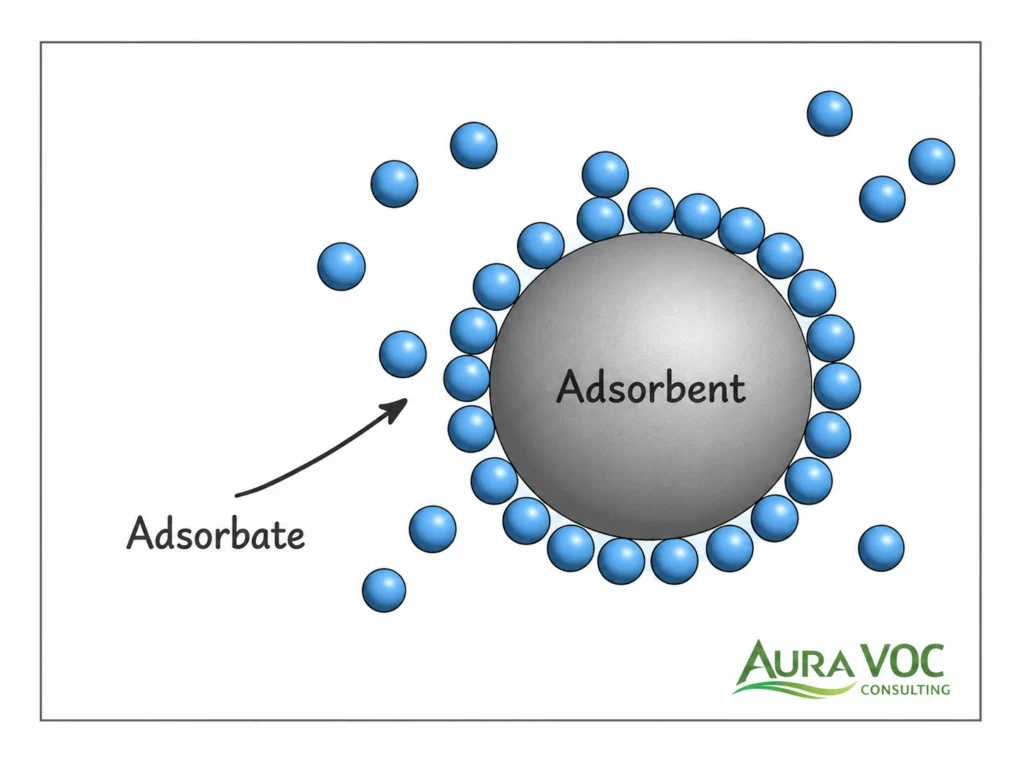
A well-operating adsorber usually shows stable outlet concentration for most of its service cycle. Once the mass transfer zone moves toward the outlet side of the bed, outlet VOC can rise quickly. This is why replacement schedules based only on calendar time are unreliable, especially in batch operations or facilities with changing solvent mixtures.
Mechanical and ventilation details also affect field performance. Poor inlet distribution, bed settling, damaged screens, leaking dampers, or bypass around internal seals can reduce effective bed utilization. Breakthrough may occur even though part of the adsorbent still has unused capacity. Adsorption performance should therefore be evaluated through VOC measurements, pressure drop trends, airflow checks, and inspection findings, not carbon age alone.
Adsorption capacity vs working capacity
Adsorbent capacity values from supplier data or laboratory tests are useful for initial screening, but they should not be treated as the full usable capacity available in an operating plant. Total adsorption capacity is not the same as working capacity.
Working capacity is the portion of the adsorbent capacity that can be reliably used before the outlet concentration reaches the defined breakthrough level. It is affected by VOC composition, inlet concentration, gas temperature, humidity, contact time, bed depth, gas velocity, adsorbent structure, and the required outlet concentration.
This distinction matters when estimating activated carbon replacement frequency or comparing disposable and regenerable systems. A carbon bed may technically hold a certain mass of solvent at equilibrium, but only part of that capacity may be usable before emission limits, odor thresholds, or internal operating limits are reached.
For batch processes, the difference can be substantial. A short high-concentration peak during charging, drying, cleaning, or tank filling can move the mass transfer zone faster than expected, even if the daily average VOC load appears acceptable. Conversely, long periods of clean air or temperature variation may cause redistribution or desorption inside the bed during shutdown and restart.
Why VOC speciation matters more than total VOC concentration
Total VOC concentration is not enough to determine whether adsorption will perform reliably. Two exhaust streams with the same total VOC concentration can behave very differently if the solvent composition is different.
Adsorption affinity depends on compound properties such as volatility, molecular size, polarity, boiling point, and interaction with the adsorbent surface. Heavier, less volatile solvents are often retained more strongly than light, highly volatile compounds. In mixed solvent streams, strongly adsorbed compounds can displace weaker compounds already held in the bed. This can cause early breakthrough of specific VOCs even when the total carbon loading appears lower than expected.
This issue is common in pharmaceutical manufacturing, specialty chemical production, coatings, adhesives, and industrial cleaning, where solvent blends may change between campaigns or product lines. A carbon adsorber that performs acceptably with one solvent mixture may have a much shorter service life after a formulation change.
VOC speciation should therefore be part of the design basis. Where emission limits, odor issues, or health and safety requirements are compound-specific, relying only on a total VOC instrument can mask the breakthrough of individual compounds. Periodic laboratory analysis, targeted sampling, or online monitoring may be required depending on the risk profile of the application.
Typical industrial applications for VOC adsorption
Adsorption is commonly used where VOC emissions are present at low to moderate concentrations and where the gas stream can be conditioned to protect the adsorbent.
Typical applications include coating and painting exhaust, pharmaceutical dryers, granulators, coating pans, solvent handling vents, chemical batch reactor vents, tank breathing emissions, industrial cleaning and degreasing exhaust, printing and laminating lines, adhesive application, food and flavour production vents, and polishing duty downstream of other treatment steps.
In many of these applications, the adsorption system must handle variable conditions rather than a single steady design point. Production campaigns, cleaning cycles, raw material changes, enclosure status, ventilation adjustments, and seasonal humidity can all affect inlet loading. The adsorber should therefore be evaluated as part of the full emission system, including source capture, ductwork, fan capacity, pre-filtration, monitoring, and maintenance access.
When Adsorption Is Suitable for VOC Abatement
Low to moderate VOC concentration streams
Adsorption is often considered for low to moderate VOC concentration streams where direct thermal oxidation would require significant auxiliary fuel or where solvent recovery may be technically relevant. At lower concentrations, the VOC mass load may be manageable with a fixed-bed adsorber, provided the compounds have suitable adsorption affinity and the exhaust conditions are controlled.
The relevant design question is whether the bed can provide sufficient service life between replacement or regeneration events. A low concentration stream operating continuously may still generate a substantial cumulative solvent load. A higher concentration stream operating only occasionally may be manageable if peak emissions are understood and safety margins are maintained.
Intermittent and batch VOC emissions
Adsorption can be a good fit for intermittent and batch emissions because the system can capture VOCs during short operating periods without requiring continuous high-temperature operation. This is relevant for batch chemical production, pharmaceutical processing, tank filling, cleaning cycles, and campaign-based manufacturing.
Batch operation requires careful attention to peak loading. Average daily emissions may understate the actual challenge for the adsorber. A short solvent release during charging, drying, vessel opening, or cleaning can drive localized breakthrough if the adsorber was sized only on average concentration. For batch systems, the emission profile over time is often more important than the daily mass total.
Solvent recovery applications
Adsorption may be suitable where recovered solvent has value or where solvent mass loading justifies a regenerable system. Steam regeneration, hot gas regeneration, vacuum regeneration, or inert gas regeneration can be used depending on the VOC mixture, recovery target, safety requirements, and site utilities. Check the reference article for solvent recovery in flexible packaging printing.
Solvent recovery adds engineering considerations beyond the adsorber vessel. The system may generate solvent-water condensate, mixed solvent streams, emulsions, or aqueous waste containing dissolved VOCs. The recovered solvent may require separation, decanting, distillation, drying, or off-site management. Suitability depends not only on adsorption performance but also on how the plant will handle the regeneration output.
Polishing duty after another abatement technology
Adsorption can be used as a polishing step after another treatment stage. Examples include carbon polishing after condensation, adsorption after mist elimination, or final treatment of residual VOCs downstream of process controls. In these cases, the adsorber is not necessarily designed for the full uncontrolled emission load. It is used to reduce residual concentrations or provide additional protection against intermittent peaks.
Polishing applications still require proper design. If upstream equipment performance deteriorates, the adsorber may receive a higher load than expected and break through quickly. Monitoring upstream and downstream of the polishing bed is useful where the inlet load can vary.
Large airflow, low concentration applications using concentrators
For large airflow and low VOC concentration streams, a fixed-bed adsorber may become impractical due to vessel size, pressure drop, or adsorbent replacement requirements. In these cases, a zeolite rotor concentrator may be evaluated.
A rotor concentrator adsorbs VOCs from a large process air stream and desorbs them into a smaller heated air stream at higher concentration, often upstream of an RTO or catalytic oxidizer. This can reduce downstream oxidizer size and improve the energy balance compared with treating the full airflow directly.
Rotor systems have their own constraints. Selection depends on VOC composition, humidity, particulate control, desorption temperature, concentration ratio, seal leakage, rotor pressure drop, and maintenance of rotating components. They must be integrated with the process ventilation system and downstream abatement equipment, not treated as a simple add-on device.
When Adsorption May Not Be the Right VOC Control Technology
Poorly adsorbed or highly volatile compounds
Adsorption becomes less reliable when the gas stream contains compounds with low affinity for the selected adsorbent. Light, highly volatile compounds can pass through a carbon bed earlier than heavier solvents, particularly when the required outlet concentration is low or when the bed is exposed to variable temperature and humidity.
A stream dominated by toluene will not behave the same as a stream dominated by methanol, acetone, ethanol, or other light solvents. In mixed solvent systems, weakly adsorbed compounds may also be displaced by stronger compounds as the bed loads. Outlet concentration can therefore increase for selected compounds before operators expect full bed saturation.
Total VOC data may be acceptable for an initial screen, but it is not sufficient for final technology selection or carbon life estimation where the solvent mix is variable or compound-specific limits apply.
High humidity or condensation risk
Moisture can reduce adsorption performance by competing for active sites, lowering effective working capacity, or creating liquid accumulation in the bed. The problem is not limited to high relative humidity. Condensation can occur when the exhaust temperature falls below the dew point in ductwork, pre-filters, or the adsorber vessel.
Condensation inside an adsorption bed can cause several operating problems at the same time: reduced VOC capacity, increased pressure drop, uneven flow distribution, media fouling, corrosion of internals, and difficult adsorbent removal during maintenance. In some systems, moisture also increases the risk of biological growth or sticky deposits when organic aerosols are present.
Streams from dryers, washing operations, food processes, or humid production areas should be checked for dew point margin under all operating conditions, including winter operation, startup, shutdown, and low-flow periods. If the gas stream cannot be kept safely above dew point or conditioned before adsorption, another technology or a hybrid arrangement may be more appropriate.
Aerosols, particulates, and sticky contaminants
Adsorption media is designed to retain vapor-phase compounds, not to operate as a dust collector or mist eliminator. If the inlet stream contains paint overspray, oil mist, plasticizer aerosols, resin droplets, powder carryover, or sticky condensables, the bed surface can foul before the adsorbent capacity is used.
Fouling often appears first as increasing pressure drop, reduced airflow, or uneven bed loading. It may also lead to early breakthrough because the gas stream no longer contacts the adsorbent uniformly. In severe cases, deposits on the bed surface create preferential paths, block sections of the media, or complicate carbon removal during maintenance.
Pre-filtration, demisting, and upstream process control are part of the adsorption design, not optional accessories. A coating line exhaust has different inlet protection requirements from a pharmaceutical solvent vent or a tank breathing line.
High VOC loading and bed temperature rise
Adsorption releases heat. Under normal low to moderate loading, this heat can usually be managed through gas flow and bed design. At higher VOC concentrations or during short emission peaks, temperature rise can become a design and safety issue.
The concern is not only adsorbent capacity. A high mass load can generate local hot spots, especially if the flow distribution is poor or reactive compounds are present. Saturated carbon beds can also retain solvent mass during shutdown and release vapors later when temperature or airflow conditions change.
Before selecting adsorption for a higher-load stream, the design should consider inlet concentration peaks, LEL margin, heat release, temperature monitoring, emergency isolation, and whether oxidation, condensation, or solvent recovery would be a more stable primary technology.
Frequent solvent changes and unpredictable breakthrough
Campaign-based plants often change solvents, formulations, or cleaning agents. Each change can alter adsorption behavior. A carbon bed sized for one solvent blend may provide a different service life when the plant switches to another product, even if the total VOC concentration appears similar.
This is especially relevant in pharmaceutical, specialty chemical, coating, adhesive, and contract manufacturing operations. The operating team may see carbon life vary from one campaign to another without an obvious change in total emission rate. The cause is often compound-specific affinity, competitive adsorption, or unrecognized peak loading during cleaning and changeover.
Adsorption can still be suitable in these plants, but it needs a conservative monitoring strategy. Between-bed sampling, compound-specific checks, and operating logs tied to solvent use are more useful than fixed replacement intervals based only on calendar time.
Wastewater constraints for regenerable systems
Regenerable adsorption systems can reduce spent carbon replacement, but they may transfer part of the operating burden to condensate and wastewater handling. Steam regeneration can produce solvent-water mixtures, emulsions, acidic or alkaline condensate, and aqueous streams containing dissolved VOCs.
This must be checked early. If the site wastewater treatment system cannot accept the condensate, or if recovered solvent quality is unsuitable for reuse, the apparent benefit of regeneration may be reduced. Additional decanting, storage, stripping, distillation, or off-site disposal may be required.
The full system boundary includes regeneration utilities, condensate storage, secondary emissions, hazardous area classification, wastewater permit limits, and waste handling procedures.
Main Types of VOC Adsorption Systems
Fixed-bed activated carbon adsorbers
Fixed-bed activated carbon adsorbers are commonly used for intermittent vents, low to moderate concentration streams, polishing duty, and applications where simple operation is preferred. The gas stream passes through a packed bed of carbon, and the carbon is replaced or reactivated once the working capacity is reached.
Their main advantage is mechanical simplicity. Their main limitation is finite capacity and the need for a reliable method to predict or detect breakthrough. Fixed beds are also sensitive to fouling, moisture, poor flow distribution, and incorrect media loading.
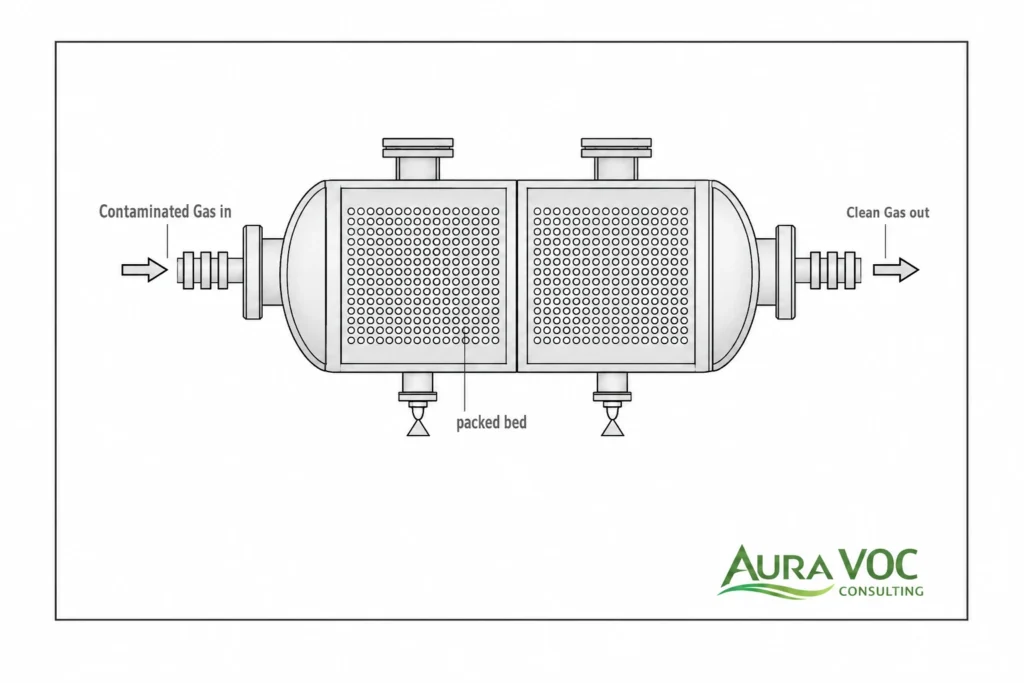
For industrial operation, the design should include adequate access for carbon removal, safe handling of spent media, differential pressure monitoring, representative sampling points, and protection against particulates or aerosols.
Lead-lag carbon adsorption systems
A lead-lag arrangement uses two adsorption beds in series. The first bed carries the main VOC load, while the second bed acts as a polishing and protection stage. A sample point between the beds allows operators to detect breakthrough from the lead bed before VOCs reach the final outlet.
This configuration is useful when emission limits are strict, carbon utilization must be improved, or the plant needs additional protection against variable loading. Once the lead bed approaches breakthrough, it can be replaced or moved to the lag position depending on the operating strategy.
The tradeoff is higher pressure drop, additional footprint, more valves, more instruments, and more maintenance points. Lead-lag systems should be justified by emission risk, carbon cost, operating variability, or compliance requirements.
Disposable activated carbon systems
Disposable carbon systems are often selected where VOC mass loading is relatively low, operation is intermittent, or regeneration infrastructure is not justified. They avoid the complexity of steam, hot gas, vacuum, or inert gas regeneration.
The operating cost depends mainly on carbon life, carbon disposal or reactivation cost, changeout labor, downtime, and waste classification. If solvent loading increases after production changes, a disposable system can become expensive to operate or require frequent shutdowns for media replacement.
A practical evaluation should compare expected carbon life under normal and peak conditions, not only initial capital cost. Handling saturated carbon safely is also part of the operating model.
Regenerable activated carbon systems
Regenerable activated carbon systems are used when VOC loading, solvent value, or operating continuity supports the additional complexity. Regeneration may be performed with steam, hot gas, vacuum, inert gas, or combinations depending on the process and recovery requirements.
These systems require more equipment and controls than disposable beds. Typical additional components include regeneration gas supply, condensers, decanters, solvent storage, wastewater connections, valves, purge systems, and safety interlocks.
The key engineering issue is whether the recovered stream can be managed effectively. A regenerable system may be attractive for a relatively consistent solvent stream but less suitable for highly variable mixed solvents that produce low-quality recovered liquid or problematic wastewater.
Zeolite adsorption systems
Zeolite adsorbents are used where higher thermal stability, structured media, or specific adsorption properties are required. They are common in concentrator systems and some applications where activated carbon is less suitable due to regeneration temperature, fire risk, or process constraints.
Zeolite selection depends on VOC composition, humidity, desorption temperature, and fouling risk. Although zeolites can offer advantages in specific applications, they are not immune to contamination. Particulates, aerosols, high-boiling organics, and sticky compounds can still reduce performance.
The cost and regeneration characteristics of zeolite systems should be evaluated against the full operating profile, not only nominal removal efficiency.
Zeolite rotor concentrators
A zeolite rotor concentrator treats a large low-concentration airflow and transfers the adsorbed VOCs into a smaller heated desorption stream. The concentrated stream is commonly sent to an RTO, catalytic oxidizer, or other destruction device.
This arrangement is typically evaluated when the exhaust volume is large enough that direct oxidation would drive excessive oxidizer size, fan duty, or auxiliary fuel demand. The rotor becomes part of a coupled system: its performance affects the downstream oxidizer, and the oxidizer operating conditions affect the overall reliability of the installation.
Important design checks include concentration ratio, desorption temperature, seal leakage, rotor pressure drop, inlet particulate control, humidity, VOC compatibility, and maintenance access. Rotor systems are not a universal substitute for fixed-bed adsorption; they are most relevant where airflow is large and VOC concentration is low enough to justify concentration before treatment.
Key Design Data Required for VOC Adsorber Selection
Airflow range and operating schedule
Airflow defines vessel size, contact time, pressure drop, and fan requirements. The design should use the actual operating airflow range, not only nominal fan capacity. Many plants operate at different ventilation rates depending on line speed, product, enclosure status, damper position, or seasonal requirements.
For adsorption VOC abatement projects, design data should reflect measured operating conditions rather than nominal ventilation or solvent consumption figures.
The operating schedule is equally important. A system running continuously at low concentration may load the adsorbent more than an intermittent process with higher short-term concentration. For batch plants, the timing and duration of emission events should be mapped against the adsorber’s capacity and monitoring strategy.
VOC concentration range and peak loading
Average concentration is rarely sufficient for adsorber design. Peak concentration, duration of peaks, and cumulative mass loading all affect breakthrough and bed temperature rise.
A short, high-concentration event during vessel charging, drying, cleaning, or tank filling can dominate the design even when the average daily concentration looks manageable. If the inlet data is based only on periodic sampling, the design may miss these events.
For existing systems, comparing carbon replacement history with production records often reveals whether peak loading or process variability is driving early breakthrough.
VOC speciation and solvent mixture behavior
VOC speciation is required to evaluate adsorption affinity, competitive adsorption, regeneration feasibility, safety risk, and recovered solvent quality. The system should not be specified only on total organic carbon or total VOC unless the stream composition is stable and already well understood.
Mixed solvent streams require particular attention. Strongly adsorbed compounds can displace weakly adsorbed compounds. High-boiling components can be difficult to desorb. Reactive or polymerizing compounds may foul the bed. Chlorinated or sulfur-containing compounds may introduce additional material compatibility, safety, or downstream treatment issues.
Temperature, humidity, and dew point
Temperature and humidity directly affect working capacity and operating reliability. Higher gas temperature generally reduces adsorption capacity. High humidity or condensation can reduce capacity, increase pressure drop, and damage performance.
The dew point should be evaluated under realistic operating conditions, including low ambient temperature, partial-load operation, shutdown, and restart. If cooling is used before adsorption, the design must prevent condensation carryover into the bed.
Particulates, aerosols, and condensable compounds
The inlet stream should be assessed for dust, mist, overspray, oil, resin droplets, and condensable organics. These contaminants may require pre-filters, demisters, knockout pots, duct heating, or upstream process modifications.
The cost and maintenance burden of inlet protection should be included in the technology comparison. An adsorption system that appears simple on paper may become maintenance-intensive if it receives a dirty or mist-laden stream.
Emission limits and monitoring requirements
The required outlet concentration affects adsorber sizing, monitoring, and replacement strategy. A system designed for odor control may not be adequate for a strict compound-specific emission limit. Similarly, a total VOC limit may require different monitoring than a limit on a specific solvent.
Monitoring requirements should be considered during layout. Inlet, outlet, and between-bed sample points should be accessible and representative. Poor sampling locations can make troubleshooting difficult and may give misleading performance data.
Available utilities, footprint, and access for maintenance
Adsorption systems require space not only for vessels but also for ductwork, isolation dampers, carbon changeout, filters, instrumentation, and safe access. Regenerable systems add utility and equipment requirements such as steam, nitrogen, hot air, cooling water, condensers, and solvent handling.
Maintenance access is often underestimated. Carbon removal, media loading, confined space controls, lifting arrangements, and waste collection logistics can determine whether the system is practical for routine operation.
Wastewater treatment and solvent recovery constraints
For disposable carbon systems, the main secondary stream is spent adsorbent. For regenerable systems, the main secondary streams may include condensate, separated solvent, wastewater, and regeneration off-gas.
Before selecting a regenerable system, the site should confirm whether recovered solvent can be reused, whether wastewater treatment can handle dissolved VOCs, and whether storage tanks or separators create secondary emission points. These constraints can determine whether regeneration is operationally beneficial or simply transfers the problem to another plant system.
VOC Breakthrough in Adsorption Systems
What breakthrough means in plant operation
Breakthrough occurs when VOC concentration at the outlet rises above the selected operating threshold. The threshold may be based on an emission limit, an internal alarm value, an odor control requirement, or the point at which the lead bed in a lead-lag system should be replaced.
In plant operation, breakthrough is not always visible as a gradual trend. Outlet VOC can remain low for a long period and then increase over a short time once the active adsorption zone reaches the outlet side of the bed. This behavior is especially important where operators rely on periodic sampling rather than continuous monitoring.
Breakthrough should also be interpreted compound by compound. In a mixed solvent stream, one compound may break through before the total VOC reading suggests that the bed is saturated. This can be relevant where specific solvents have lower odor thresholds, stricter emission limits, or different health and safety implications.
Breakthrough curves and mass transfer zone movement
A breakthrough curve shows outlet concentration against operating time or cumulative VOC loading. Early in the cycle, most VOCs are retained near the inlet side of the bed. As loading continues, the active adsorption zone moves through the bed. When that zone approaches the outlet, concentration begins to rise.
The shape of the curve depends on gas velocity, bed depth, adsorbent type, VOC properties, temperature, humidity, and inlet concentration profile. A sharp breakthrough curve gives operators little time to respond once outlet VOC starts increasing. A broader curve provides more warning but still requires a defined action threshold.
For fixed-bed systems, replacement or regeneration should normally be scheduled before final outlet breakthrough. In lead-lag systems, the sample point between the lead and lag beds provides an early warning. The lead bed can be changed or rotated while the lag bed continues to protect the final outlet.
High gas velocity can shorten effective contact time and move the mass transfer zone faster than expected. Poor gas distribution can create localized breakthrough before the full bed is loaded. These effects are often missed if the assessment relies only on total carbon inventory and average VOC concentration.
Compound-specific breakthrough in mixed VOC streams
Mixed VOC streams are more difficult to predict than single-solvent streams. Strongly adsorbed compounds can displace weaker compounds already held in the bed. As a result, a light solvent may appear at the outlet earlier than expected after heavier or more strongly adsorbed compounds accumulate.
This is common in facilities using changing solvent blends, cleaning agents, or campaign-based production. A carbon bed that performs well with one product family may have shorter life with another, even when the total VOC concentration remains similar.
Where solvent composition changes frequently, compound-specific sampling is more valuable than total VOC readings alone. A PID or FID may indicate that the system is still performing within a general range, while laboratory speciation shows early breakthrough of a specific compound.
Common causes of early breakthrough
Early breakthrough usually indicates that the adsorber is seeing different conditions from the design basis, or that the effective bed volume is lower than assumed.
Common causes include higher inlet VOC concentration than expected, short emission peaks during batch operations, increased airflow, higher gas temperature, high humidity or condensation, solvent formulation changes, weakly adsorbed compounds in the mixture, bed channeling or settling, bypass through seals or dampers, adsorbent fouling from mist or dust, incorrect carbon grade, or previous partial loading from earlier campaigns.
Before replacing carbon, the operating team should check whether the breakthrough pattern is consistent with saturation or whether the data points to bypass, fouling, humidity, or process change.
Breakthrough monitoring methods and sampling locations
Monitoring should be designed around the way the adsorber is operated. A single outlet sample point may be sufficient for simple low-risk systems, but it gives limited diagnostic information when breakthrough occurs.
A more useful arrangement includes inlet sampling to confirm actual VOC load, outlet sampling to verify final performance, between-bed sampling for lead-lag systems, pressure drop monitoring across each bed, temperature monitoring at relevant bed locations, and periodic compound-specific analysis where solvent mixtures vary.
Sampling points must be representative and accessible. A sample point too close to a bend, damper, fan discharge, or poorly mixed duct section can give misleading values. For batch operations, sampling during stable low-load periods may miss the events that drive breakthrough. Sampling plans should reflect charging, drying, cleaning, tank filling, or other high-emission steps.
Instrument limitations should also be understood. PID response varies by compound. Total VOC instruments may not distinguish between solvents with different adsorption behavior. Where compliance or process risk is compound-specific, laboratory analysis or calibrated compound-specific monitoring may be required. For additional reference on monitoring parameters, see EPA guidance on activated carbon adsorber monitoring.
Operating response when outlet VOC starts increasing
When outlet VOC starts increasing, the first response should be diagnostic rather than automatic. Carbon saturation is one possible cause, but not the only one.
A practical check sequence includes confirming the outlet reading and sampling location, comparing inlet VOC load with design data, checking recent solvent or formulation changes, reviewing batch records for high-load events, verifying airflow and fan operating point, checking pressure drop against the clean-bed baseline, inspecting pre-filters and demisters, checking temperature and humidity trends, confirming damper positions, and reviewing carbon age and previous loading history.
If breakthrough is confirmed as normal saturation, replacement or regeneration should follow the operating procedure. If the pattern suggests channeling, bypass, or fouling, changing the carbon alone may not correct the problem.
Pressure Drop, Fan Energy, and Airflow Stability
Bed depth, particle size, and gas velocity
Pressure drop through an adsorption bed is influenced by bed depth, adsorbent particle size, gas velocity, media condition, and inlet contamination. A deeper bed can improve contact time and working capacity, but it also increases resistance. Smaller particles may improve mass transfer, but they are more sensitive to dust loading and can increase fan duty.
This is a design tradeoff. A compact adsorber may reduce footprint and capital cost, but higher velocity can reduce adsorption margin and increase pressure drop. A larger vessel can reduce velocity and improve operating stability, but it requires more space, more adsorbent inventory, and higher initial cost.
Clean-bed vs dirty-bed pressure drop
Clean-bed pressure drop should be recorded after commissioning, after carbon replacement, and after major maintenance. This value becomes the baseline for troubleshooting.
A gradual increase over time often indicates dust loading, mist carryover, condensate accumulation, or carbon fines. A rapid increase may indicate filter failure, liquid carryover, collapsed media, or a process upset. An unexpectedly low pressure drop can be just as important because it may indicate bypass, poor media loading, bed settling, or damaged internal screens.
Pressure drop should be trended, not only checked at isolated intervals. Trends are often more useful than single readings because they show whether the bed is fouling progressively or reacting to specific process events.
How pressure drop affects fan energy consumption
Higher pressure drop increases the static pressure that the fan must overcome. If the fan has sufficient margin, energy consumption increases. If the fan does not have enough margin, system airflow falls.
This has two consequences. First, lower airflow may reduce the amount of contaminated air reaching the adsorber. Second, reduced flow can affect capture performance at hoods, enclosures, process vents, or room extraction points. A stack reading may appear acceptable while fugitive VOCs increase around the source because the capture system is no longer operating at the required flow.
Fan curves, damper positions, duct pressure, and measured airflow should therefore be reviewed when adsorber pressure drop changes. Differential pressure alone does not show whether the ventilation system is still capturing emissions effectively.
How adsorber pressure drop can reduce source capture efficiency
An adsorber is part of the process ventilation system. If its resistance increases, the effect can propagate upstream through ductwork and capture points. This is particularly important for coating lines, open tanks, filling stations, drying equipment, and enclosures where capture depends on maintaining a defined airflow.
Symptoms of reduced capture may include local odor complaints, increased fugitive readings near equipment, solvent smell during specific operations, or operator complaints despite acceptable stack monitoring. In these cases, the investigation should include hood face velocity, duct static pressure, fan speed, damper position, filter condition, and adsorber pressure drop.
Pressure drop troubleshooting: fouling, condensation, fines, and bypass
High pressure drop usually points to a blockage or accumulation problem. Likely causes include dust, mist, condensate, sticky organics, carbon fines, or compacted media. The first inspection point should often be the inlet protection system: pre-filters, demisters, knockout pots, and upstream ductwork.
Low pressure drop can indicate a different problem. If resistance is lower than expected, the gas may not be passing through the intended bed volume. Possible causes include bed settling, incorrect carbon loading, internal bypass, damaged screens, failed gaskets, or open bypass dampers.
Pressure drop troubleshooting should be linked with VOC data. High outlet VOC with high pressure drop suggests fouling or reduced effective bed volume. High outlet VOC with low pressure drop suggests bypass or channeling. High pressure drop with acceptable outlet VOC may still require action if airflow and source capture are compromised.
Operating Constraints That Affect Adsorption Performance
Temperature effects on adsorption capacity
Higher gas temperature generally reduces adsorption capacity and shortens service life. Hot exhaust streams may require cooling before adsorption, but cooling must be controlled to avoid condensation carryover into the bed.
Temperature variation can also affect stored VOCs. During shutdown or restart, changes in bed temperature and airflow can cause desorption or redistribution of solvent inside the media. For plants with intermittent operation, temperature history may be as important as average operating temperature.
Humidity and moisture competition
Water vapor can compete with VOCs for adsorption sites and reduce working capacity. The impact depends on adsorbent type, VOC composition, relative humidity, and whether the stream approaches dew point.
High humidity makes breakthrough less predictable, especially for weakly adsorbed solvents. In humid applications, adsorption performance should be checked against actual plant conditions rather than dry laboratory capacity data.
Condensation inside the adsorbent bed
Condensation inside the bed can increase pressure drop, foul media, corrode internals, and create uneven gas distribution. It can also make spent adsorbent removal more difficult and increase the risk of sticky deposits.
Dew point margin should be verified during normal operation, startup, shutdown, low-flow operation, and seasonal ambient temperature changes. If the exhaust is cooled upstream of the adsorber, demisting and condensate removal should be included in the design.
Particulate and mist carryover
Particulates and aerosols can blind the adsorbent surface and reduce usable bed volume. Pre-filters, demisters, and upstream process controls are essential where overspray, oil mist, powders, or condensable droplets are present.
Filter and demister maintenance should be treated as part of adsorber performance management. A failed pre-filter can shorten carbon life quickly and may not be noticed until pressure drop or outlet VOC begins to increase.
Startup, shutdown, and intermittent operation
Adsorbers may release previously retained VOCs during shutdown or restart if temperature and airflow conditions change. Stagnant conditions, warm equipment, or partial bed saturation can create restart concentration peaks.
Intermittent systems should be assessed for desorption during idle periods, residual solvent release, and purge requirements before returning to normal operation. Operating procedures should define fan operation, bypass position, temperature checks, and monitoring requirements during startup and shutdown.
Solvent formulation changes and process variability
A change in solvent blend can alter breakthrough behavior even when total VOC concentration remains similar. This is common in campaign plants, coating lines, industrial cleaning, and multipurpose production units.
Production logs should be reviewed alongside monitoring data when carbon life changes unexpectedly. Solvent consumption, batch sequence, cleaning operations, and product changeovers often explain apparent changes in adsorber performance.
Maintenance Requirements for VOC Adsorption Systems
Activated carbon replacement planning
Activated carbon replacement should be planned from operating data rather than calendar time alone. Useful indicators include cumulative solvent use, measured inlet load, outlet trends, between-bed breakthrough, pressure drop, carbon sampling, and production schedule.
For batch plants, replacement planning should account for campaigns and cleaning operations. A bed may age slowly during normal production and then load rapidly during a short high-emission cleaning or drying step. Replacement records should therefore be linked to production history, not only operating hours.
Adsorbent sampling and laboratory testing
Carbon sampling can help distinguish between true saturation, partial bed utilization, channeling, and upstream fouling. Samples from the inlet side, middle, and outlet side of the bed provide a loading profile. If the inlet section is heavily loaded and the outlet section remains unused, the bed may be operating normally. If only part of the bed is loaded or loading is uneven, distribution or bypass should be investigated.
Laboratory testing is useful when service life changes unexpectedly, when solvent mixtures change, or when carbon supplier data does not match field performance. Sampling should be performed safely because spent carbon may release solvent vapors or generate heat under certain conditions.
Pre-filter and demister maintenance
Pre-filters and demisters protect the adsorbent from material it is not designed to handle. Poor maintenance of these components can shorten carbon life, increase pressure drop, and create uneven flow distribution.
Filter differential pressure should be monitored separately from bed differential pressure. If only total system pressure drop is measured, operators may not know whether resistance is increasing across the filter, the bed, or the ductwork. Where mist is present, demister inspection and drainage are important because liquid carryover can foul the bed quickly.
Inspection of bed internals, screens, seals, and dampers
Many adsorption problems are mechanical rather than chemical. During carbon changeout or shutdown inspection, the team should check support screens, retaining grids, seals, gaskets, access doors, internal coatings, distributors, dampers, and bypass lines.
Bed settling should be documented. Uneven media depth, voids, or damaged screens can allow gas to short-circuit the bed. Damper leakage can also create apparent breakthrough even when the carbon is not fully saturated. These issues are difficult to diagnose from outlet VOC data alone.
Instrument calibration for VOC, pressure, and temperature monitoring
VOC monitors, differential pressure transmitters, and temperature probes should be maintained as critical operating instruments. Drift or poor calibration can delay detection of breakthrough, hide fan performance problems, or give false confidence during abnormal temperature rise.
For VOC instruments, calibration should reflect the compounds being measured where possible. For pressure instruments, zero checks and impulse line condition matter. For temperature probes, location is important; a sensor placed in a low-risk zone may not detect localized heating inside the bed.
Spent adsorbent handling, storage, transport, and disposal
Spent carbon can contain significant solvent mass. Handling procedures should address vapor release, dust generation, heat buildup, waste classification, packaging, transport documentation, and storage conditions before removal from site.
Spent carbon should not be treated as inert material. Depending on the solvent loading and compound type, it may require controlled cooling, sealed containers, hazardous waste management, or direct transfer to a reactivation or disposal facility. Storage near ignition sources, heat sources, or incompatible materials should be avoided.
Safety Considerations for Activated Carbon and VOC Adsorption
Adsorption heat and bed temperature rise
Adsorption is exothermic. In many low-load applications the heat release is modest, but high inlet concentration, poor flow distribution, reactive contaminants, or rapid loading can create localized temperature rise.
Temperature monitoring should be placed where abnormal heating is likely to be detected. A single outlet temperature may not identify a hot spot inside the bed. Where risk is higher, multiple probes at different bed depths or across parallel beds may be justified.
Fire and smoldering risk in saturated carbon beds
Saturated carbon beds can present fire or smoldering risk under certain operating conditions. Risk factors include high VOC loading, reactive or oxidizable compounds, poor heat removal, stagnant air during shutdown, and solvent desorption during restart. OSHA has published technical guidance on fire hazards associated with activated carbon vapor adsorption systems.
Safe operation requires more than a temperature display. The site should define alarm limits, operator actions, isolation steps, emergency ventilation or inerting strategy, and conditions under which the system should be taken out of service. These procedures should be reviewed before high-load operation or major solvent changes.
LEL margin and high VOC concentration events
An adsorber should not be used as a substitute for explosion prevention. Inlet VOC concentration, peak emissions, abnormal releases, purge steps, and batch operations should be checked against lower explosive limit margins and site hazardous area requirements.
The highest-risk periods may not be normal steady operation. Charging, cleaning, tank filling, dryer opening, solvent changeover, or fan restart can produce short concentration peaks. If these events are not included in the design basis, the system may operate outside its intended safety margin.
Reactive VOCs and incompatible contaminants
Some compounds can react, polymerize, oxidize, or generate heat on adsorbent surfaces. Others may degrade the adsorbent, produce corrosive by-products, or create disposal limitations. Compatibility should be reviewed for the full solvent list, including cleaning agents and occasional raw materials.
A change in process chemistry should trigger a review of adsorbent suitability, fire risk, regeneration method, and waste classification. This is especially important in multipurpose chemical and pharmaceutical plants.
Temperature monitoring and emergency response provisions
Temperature monitoring should be linked to clear response procedures. Operators need to know what action is required at alarm level, high-high alarm, or abnormal rate of temperature rise.
Emergency provisions may include stopping the inlet source, isolating the bed, maintaining or stopping airflow depending on the scenario, activating inerting, diverting flow, or contacting emergency response personnel. The correct action depends on system design and site safety procedures, so it should be defined before an event occurs.
Regeneration, Solvent Recovery, and Wastewater Implications
Steam regeneration and condensate generation
Steam regeneration removes adsorbed solvent by heating the bed and carrying VOCs to a condenser. The resulting condensate typically contains water and solvent. Depending on the VOC mixture, it may separate into phases, form emulsions, or remain partly dissolved in the aqueous phase.
The condensate stream must be included in the process evaluation. Its flow rate, composition, storage requirements, venting, phase separation behavior, and wastewater treatment compatibility can determine whether steam regeneration is practical.
Hot gas, inert gas, vacuum, and other regeneration methods
Hot gas, inert gas, and vacuum regeneration can reduce or avoid direct steam condensate, but they add other requirements. These may include nitrogen supply, heaters, vacuum pumps, condensers, purge controls, oxygen monitoring, and additional safety interlocks.
Selection should be based on solvent boiling range, thermal stability, desorption temperature, flammability, recovered solvent quality, and available utilities. A regeneration method that performs well for one solvent may not be suitable for a mixed or variable solvent stream.
Solvent-water separation and recovered solvent quality
Recovered solvent quality is often a limiting factor. Mixed solvent streams may not be reusable without distillation or further treatment. Water content, degradation products, dissolved solids, or contamination from previous campaigns can reduce recovery value.
Before selecting a solvent recovery adsorption system, the plant should confirm whether the recovered material can be reused in the process, sent to another recovery step, or managed off site. If the recovered solvent cannot be used, the system may still reduce emissions but may not provide the expected operating benefit.
Wastewater treatment compatibility
Regeneration can shift part of the VOC management burden from air treatment to wastewater treatment. Aqueous condensate may contain dissolved VOCs, COD load, emulsified solvent, acidity or alkalinity, and compounds that affect biological treatment.
Wastewater compatibility should be reviewed before equipment selection. Issues may include permit limits, stripping from open tanks, odor from drains, fire classification of collection areas, and compatibility with existing treatment plant capacity.
Secondary VOC emissions from condensate handling
Condensate tanks, decanters, sumps, drains, and solvent collection vessels can become secondary VOC emission sources. If these points are not vented, sealed, or connected to appropriate treatment, the regeneration system can create uncontrolled emissions outside the main stack.
This is particularly relevant where condensate is warm, solvent-rich, agitated, or stored for extended periods. Vent routing and tank design should be part of the abatement system boundary.
Disposable carbon vs regenerable adsorption tradeoff
Disposable carbon systems are simpler and often suitable for low-load or intermittent applications. Their main operating burden is media replacement, spent carbon handling, and disposal or reactivation cost.
Regenerable systems reduce replacement frequency and may recover solvent, but they add controls, utilities, regeneration equipment, condensate handling, wastewater implications, and additional maintenance. The tradeoff should be evaluated on lifetime operating conditions, not only initial capital cost or nominal removal efficiency.
Troubleshooting VOC Adsorption System Problems
Outlet VOC concentration increasing
A rising outlet VOC concentration should be treated as a diagnostic event. The cause may be normal carbon saturation, but it may also be higher inlet loading, solvent displacement, bed bypass, poor sampling, elevated temperature, or reduced effective bed volume.
The first checks should confirm the measurement, review inlet concentration, compare airflow with design data, check pressure drop, and review recent production or solvent changes. If the system has a lead-lag arrangement, the between-bed concentration provides valuable information on whether the lead bed is exhausted or whether the issue is occurring downstream.
Carbon breakthrough earlier than expected
Early breakthrough often occurs when the actual operating profile differs from the design basis. Short high-load events, cleaning cycles, dryer peaks, increased production rate, or new solvents can reduce carbon life significantly.
If breakthrough occurs early, the investigation should compare expected and actual VOC mass loading, review compound-specific data, inspect for channeling or bypass, verify humidity and dew point, and check whether pre-filters or demisters are allowing contamination into the bed.
Pressure drop increasing across the adsorber
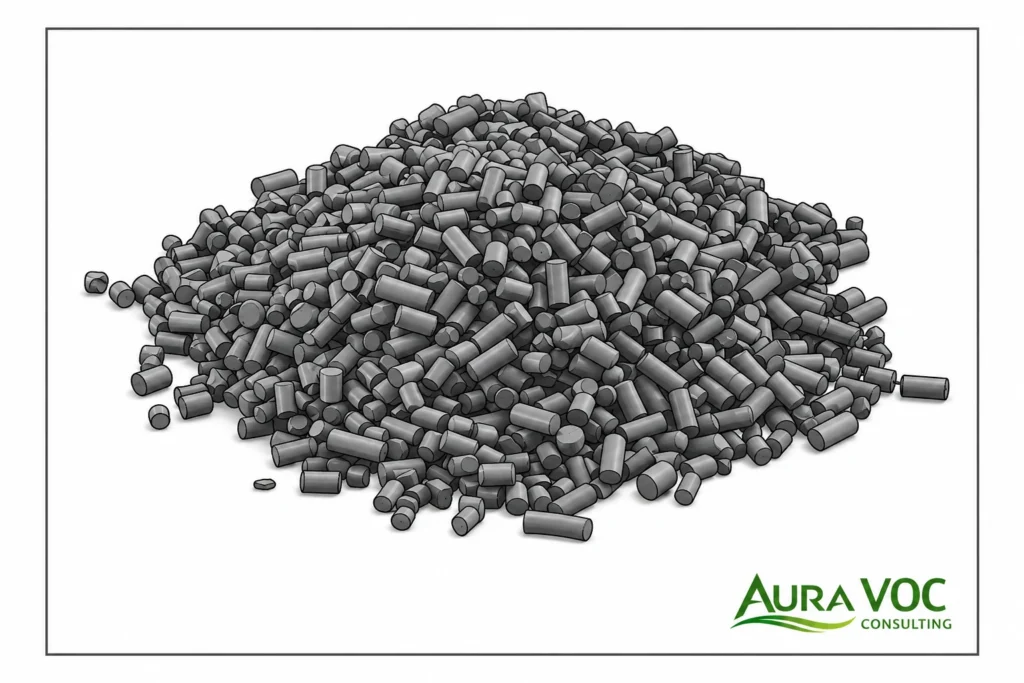
Increasing pressure drop usually indicates that the bed or upstream protection is accumulating material. Common sources include dust, mist, condensate, sticky organics, carbon fines, or compacted media.
The inspection should start upstream. Check filter condition, demister drainage, duct deposits, and liquid carryover. If the bed has been exposed to condensate or sticky aerosols, carbon replacement alone may not be enough; upstream conditioning may need correction.
Odor complaints despite normal VOC readings
Odor complaints can occur even when total VOC readings appear acceptable. Possible causes include compound-specific breakthrough, poor source capture, desorption during shutdown or restart, fugitive leaks, or sampling that misses short peak events.
The investigation should include local area measurements near the source, sampling during the relevant process step, review of fan performance, and compound-specific analysis where odor is linked to trace compounds.
Bed temperature increasing
Rising bed temperature should be investigated promptly. It may indicate high VOC loading, reactive contaminants, poor flow distribution, or the beginning of an abnormal thermal condition.
Checks should include inlet concentration, airflow, LEL margin, recent solvent changes, temperature sensor validity, and whether the temperature rise is localized or general. Operating procedures should define when production must stop and when the bed should be isolated or managed under emergency conditions.
Short activated carbon service life
Short carbon life may result from underestimated loading, high humidity, poor adsorption affinity, fouling, channeling, solvent changes, or excessive airflow. Carbon sampling from different depths can help determine whether the bed is fully used or whether only part of the bed is active.
A useful review compares carbon replacement dates, production campaigns, solvent consumption, airflow, inlet VOC readings, and pressure drop trends. This often identifies the process condition responsible for reduced service life.
Reduced capture airflow at the emission source
Reduced capture airflow may be caused by increased adsorber pressure drop, blocked filters, fan limitations, damper changes, or duct deposits. This can increase fugitive VOC release even if the stack concentration remains within the expected range.
Source capture should be verified through airflow measurements, hood or enclosure checks, duct pressure readings, and fan operating data. Adsorber troubleshooting should not stop at the vessel boundary.
Adsorption Compared with Other VOC Abatement Technologies
Adsorption vs thermal oxidation
Thermal oxidation destroys VOCs by heating the gas stream to the required oxidation temperature. Adsorption stores VOCs on a solid medium or transfers them to a recovery system. The selection depends on VOC concentration, airflow, solvent recovery value, operating schedule, energy demand, and safety constraints. For solvent-using industrial sectors, BAT-based technology comparison should also consider the European Commission STS BREF.
Adsorption is often evaluated where concentrations are low to moderate, operation is intermittent, or solvent recovery is relevant. Thermal oxidation may be more suitable for continuous streams where destruction is required and the VOC load supports stable operation.
Adsorption vs regenerative thermal oxidation
Regenerative thermal oxidizers are commonly applied to large airflows where continuous VOC destruction is required and heat recovery is needed to reduce fuel demand. They are less attractive where the VOC load is very low, highly intermittent, or where the process requires solvent recovery.
For a more detailed comparison between adsorption and thermal oxidation, see: Thermal Oxidizer vs Carbon Adsorption for VOC Abatement
Adsorption may be used instead of an RTO in some low-load applications, or upstream of oxidation as part of a concentrator arrangement. The comparison should include fan power, auxiliary fuel, maintenance access, production schedule, startup time, and the consequences of process variability.
Adsorption vs catalytic oxidation
Catalytic oxidation operates at lower temperatures than thermal oxidation but depends on catalyst compatibility. Catalyst poisoning, particulate fouling, halogenated compounds, sulfur compounds, silicones, and certain metal-containing contaminants can limit applicability.
Adsorption may be preferred where recovery is possible or where the gas stream is not suitable for catalyst exposure. Catalytic oxidation may be preferred where the VOC composition is stable and destruction is required at lower temperature.
Adsorption vs condensation
Condensation is generally more suitable for higher concentration streams where solvents can be recovered by cooling. It becomes less effective at low concentrations because deep cooling may be required to reach low outlet levels.
Adsorption is often used where condensation alone cannot meet the target outlet concentration, or as a polishing stage downstream of a condenser. In solvent recovery systems, the comparison should include recovered solvent quality, cooling demand, residual VOC load, and downstream waste handling.
Adsorption vs wet scrubbing
Wet scrubbing is more suitable for soluble or chemically reactive gases than for many hydrophobic VOCs. Scrubbing organic vapors can create a contaminated liquid stream without achieving reliable VOC removal unless the compounds are soluble or reactive in the scrubbing liquid.
Adsorption is usually more appropriate for vapor-phase organic compounds with suitable adsorption affinity. Scrubbing may still be useful upstream where acid gases, soluble contaminants, or aerosols must be removed before adsorption.
Adsorption as part of a hybrid VOC abatement system
Hybrid systems are common where no single technology fits all operating constraints. Examples include condensation followed by carbon polishing, zeolite concentration followed by oxidation, scrubbing followed by mist elimination and adsorption, or adsorption used for intermittent vents while another technology handles continuous emissions.
Hybrid designs should be evaluated as integrated systems. The outlet of one stage becomes the inlet condition for the next. If upstream performance changes, the adsorber may receive higher loading, higher humidity, or more contaminants than intended.
Engineering Tradeoffs in VOC Adsorption System Selection
Bed size vs replacement frequency
A larger bed can extend service life, increase operating margin, and reduce the frequency of carbon replacement. It also increases footprint, adsorbent inventory, capital cost, and the logistics required during media changeout.
A smaller bed may reduce initial cost and space requirements, but it provides less buffer against process variability. If production increases or solvent loading rises, replacement frequency may become operationally disruptive.
Contact time vs pressure drop
Longer contact time improves adsorption reliability and gives more margin against peak loading. It usually requires lower velocity, greater bed depth, or larger vessel area.
Higher velocity can reduce equipment size, but it may increase pressure drop, shorten effective contact time, and increase the risk of early breakthrough. This tradeoff should be checked against both emission performance and fan capability.
Single-bed vs lead-lag configuration
A single-bed system is simpler, lower cost, and has lower pressure drop. It may be suitable where the emission risk is low, the loading is predictable, and carbon replacement can be scheduled with sufficient margin.
A lead-lag system provides better breakthrough protection and allows better use of the lead bed. It also increases pressure drop, footprint, instrument requirements, valve complexity, and maintenance tasks. The decision should reflect emission risk, carbon cost, operating variability, and the consequences of breakthrough.
Disposable carbon vs regenerable system
Disposable carbon systems are mechanically simpler and often appropriate for intermittent or low-load applications. Their operating burden is media replacement, waste classification, transport, and disposal or reactivation cost.
Regenerable systems may be justified where solvent loading is higher, operation is continuous, or recovered solvent has value. They add utilities, controls, condensers, solvent handling, wastewater considerations, and additional maintenance. The preferred option depends on lifetime operation, not only installed cost.
Solvent recovery value vs system complexity
Solvent recovery is only valuable if the recovered material can be reused, sold, recovered further, or managed more effectively than spent carbon or destruction. Mixed solvent streams may produce recovered liquid with limited reuse value.
The evaluation should include recovered solvent purity, water content, separation requirements, storage, secondary emissions, safety classification, and disposal alternatives. A recovery system that looks attractive on solvent mass alone may be less practical when recovery quality and wastewater handling are included.
Lower capital cost vs higher operating and maintenance cost
A low-capital adsorption system can have high lifetime cost if carbon replacement frequency, downtime, pressure drop, waste handling, or troubleshooting effort is underestimated.
For industrial projects, the comparison should include media life, fan power, labor, access, monitoring, safety provisions, waste management, production interruption, and the cost of operating outside the expected design basis.
When to Request a Technical Review of a VOC Adsorption Application
New VOC abatement system selection
A technical review is useful when adsorption is being compared with oxidation, condensation, scrubbing, or hybrid systems and the design basis is not yet fixed. The review should confirm whether the available process data is sufficient for technology selection.
Key inputs include measured airflow, VOC speciation, concentration profile, peak loads, humidity, temperature, dew point, particulates, operating schedule, emission limits, utilities, footprint, and maintenance constraints.
Existing adsorber breakthrough or odor issues
Breakthrough or odor issues should be reviewed using process data, monitoring results, airflow checks, pressure drop trends, and carbon condition. The cause may be saturation, but it may also be sampling error, fugitive capture loss, bypass, humidity, solvent displacement, or fouling.
A structured review helps avoid repeated carbon replacement when the underlying issue is mechanical, ventilation-related, or process-driven.
Production increase or solvent formulation change
A production increase or solvent change can invalidate the original adsorption design basis. Higher mass loading, altered solvent affinity, changed humidity, longer operating hours, or new cleaning steps can reduce adsorbent life.
Adsorption capacity should be reviewed before the change is implemented, especially if the existing system already operates close to its breakthrough or pressure drop limits.
Carbon replacement frequency increasing
Increasing replacement frequency is a useful warning sign. It may indicate higher VOC loading, media fouling, humidity effects, solvent displacement, poor distribution, or changes in process operation.
The review should compare replacement records with solvent use, production logs, inlet VOC data, pressure drop history, carbon sampling, and any recent ventilation changes.
Pressure drop affecting process ventilation
If pressure drop reduces airflow, the issue affects both abatement and source capture. The review should include fan capacity, duct static pressure, damper position, filter condition, adsorber resistance, and measured airflow at the relevant capture points.
This is especially important where the process depends on enclosure flow, hood capture velocity, or room extraction to prevent fugitive VOC release.
Regeneration creating wastewater or solvent recovery constraints
Regenerable systems should be reviewed when condensate handling, recovered solvent quality, wastewater treatment, or secondary emissions become limiting factors.
The evaluation should include condensate composition, phase separation, dissolved VOCs, storage tank venting, treatment compatibility, solvent reuse potential, and the operating cost of managing the recovered stream.
FAQ: Adsorption for VOC Abatement
When is activated carbon not suitable for VOC abatement?
Activated carbon may be unsuitable for highly volatile compounds with low adsorption affinity, high-humidity streams, gas streams near dew point, aerosol-laden exhaust, high-temperature emissions, or high VOC loads that create heat or fire risk. Suitability should be checked using VOC speciation, inlet loading, temperature, humidity, and operating profile.
How do you determine activated carbon replacement frequency?
Replacement frequency should be based on actual operating data: inlet VOC load, outlet trends, between-bed breakthrough, carbon sampling, pressure drop, solvent use, and production schedule. Calendar-based replacement can be misleading when emissions are batch-based or solvent mixtures change.
What causes early breakthrough in a VOC adsorption system?
Early breakthrough can be caused by higher-than-expected VOC loading, short concentration peaks, weakly adsorbed compounds, high humidity, elevated temperature, poor gas distribution, bed channeling, bypass leakage, fouling, or incorrect adsorbent selection.
How does humidity affect VOC adsorption performance?
Humidity can reduce working capacity by competing with VOCs for adsorption sites. If the stream reaches dew point, condensation can foul the bed, increase pressure drop, and create uneven airflow.
What pressure drop is acceptable across a VOC adsorption bed?
Acceptable pressure drop depends on vessel design, bed depth, adsorbent size, airflow, and fan capacity. The most useful reference is the clean-bed baseline and the dirty-bed operating limit defined during design or commissioning.
Can adsorber pressure drop reduce capture efficiency at the source?
Yes. If adsorber resistance increases and the fan cannot maintain design airflow, capture velocity at hoods, enclosures, or process vents may fall. This can increase fugitive VOC release even if stack concentration appears acceptable.
When should a lead-lag adsorption system be used?
A lead-lag system is useful when the plant needs early breakthrough warning, better carbon utilization, continuous protection of the final outlet, or additional margin for variable VOC loading.
Does VOC adsorption create wastewater?
Disposable carbon systems usually generate spent adsorbent rather than wastewater. Steam-regenerated systems can generate solvent-water condensate, emulsions, and aqueous streams containing dissolved VOCs, which may require separation or wastewater treatment.
What causes temperature rise in an activated carbon bed?
Temperature rise can result from adsorption heat, high VOC loading, reactive compounds, poor airflow distribution, or abnormal process conditions. Temperature rise should be reviewed as both an operating and safety issue.
How do you compare adsorption with thermal oxidation for VOC control?
Compare VOC concentration, airflow, operating schedule, solvent recovery value, energy demand, safety constraints, pressure drop, maintenance requirements, secondary waste, and emission limits. Adsorption stores or recovers VOCs; oxidation destroys them.
What data is required before sizing a VOC adsorption system?
Key data includes airflow range, VOC speciation, concentration profile, peak emissions, operating schedule, temperature, humidity, dew point, particulates, aerosols, emission limits, fan capacity, utilities, maintenance access, and waste or wastewater constraints.
When is a zeolite rotor concentrator used for VOC abatement?
A zeolite rotor concentrator is typically evaluated for large airflow, low concentration VOC streams where direct treatment of the full flow would result in excessive oxidizer size, fan duty, or energy demand.
Conclusion
Adsorption can be a practical VOC abatement technology when the gas stream conditions, adsorbent selection, vessel design, monitoring strategy, and maintenance model are compatible. Its performance cannot be judged from nominal VOC concentration alone. Field reliability depends on VOC speciation, peak loading, contact time, humidity, temperature, pressure drop, airflow stability, fouling risk, and the way the plant operates during startup, shutdown, cleaning, and campaign changes.
For plant managers and EHS teams, many adsorption problems appear as operational symptoms: early breakthrough, short carbon life, increasing pressure drop, odor complaints, reduced capture airflow, or abnormal bed temperature. These symptoms should be investigated using process data, ventilation measurements, sampling results, and mechanical inspection. Replacing carbon without checking the cause can leave the underlying issue unresolved.
For new projects, adsorption should be compared with oxidation, condensation, scrubbing, and hybrid configurations using the full operating profile. For existing systems, troubleshooting should include the adsorber, upstream source capture, ductwork, fan performance, inlet conditioning, monitoring, spent media handling, and, where applicable, regeneration and wastewater treatment.
A reliable VOC adsorption system is not only a correctly sized vessel. It is an operating system with defined limits, inspection points, monitoring logic, and maintenance procedures.
CTA
AuraVOC can review measured airflow, VOC speciation, concentration peaks, humidity, temperature, pressure drop trends, carbon replacement history, solvent recovery options, and wastewater constraints to assess whether adsorption is technically suitable for a specific industrial VOC stream.
A technical review is useful when selecting between adsorption, oxidation, condensation, or a hybrid system, or when an existing adsorber shows early breakthrough, odor issues, short carbon life, pressure drop increase, or ventilation performance problems.