
Scrubber / Washing Tower for VOC Abatement
Principles, Applications and Technology Selection
Wet scrubbing (often called a washing tower or scrubber) is a widely used approach to reduce gaseous pollutants by contacting an exhaust stream with a liquid. For VOC control, scrubbers can be very effective when the target compounds are sufficiently soluble or reactive in the scrubbing liquor, and when the system is designed around the real emission profile (flow, temperature, variability, contaminants).
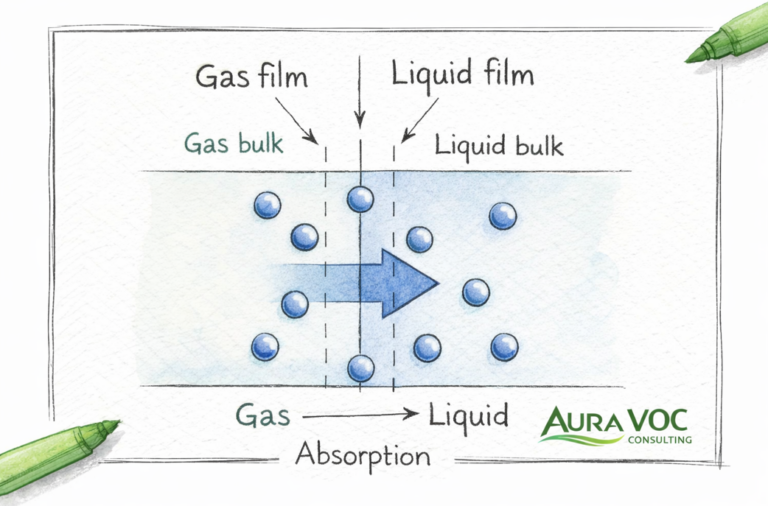
Unlike thermal oxidation, scrubbing does not “destroy” VOCs by default: it transfers VOCs from the gas phase to the liquid phase (absorption), or promotes chemical conversion if a reagent is used. That difference has major implications for operating cost, wastewater management, and overall environmental footprint.
Where Wet Scrubbing Works Best for VOCs
Wet scrubbing is typically most effective for VOC abatement when the compounds to be removed can be readily transferred into the liquid phase—either because they are naturally highly soluble in water, or because an engineered scrubbing solution (for example containing specific solvents or reagents) can significantly improve uptake. In many industrial cases, performance improves further when reactive scrubbing is feasible, meaning that additives or reagents are used to convert absorbed species into more stable forms, reducing equilibrium limitations and improving overall removal.
Scrubbers are also often selected when the project requires multi-pollutant control. In practice, the same system can be designed to address VOCs alongside acid gases, or to combine gas absorption with the capture of aerosols and particulate, which is especially valuable when a single end-of-pipe solution is preferred for simplicity or compliance.
From an operational standpoint, wet scrubbers are generally well suited to warm and humid exhaust streams, and they tend to be appreciated for their robustness under fluctuating process conditions—provided that liquid circulation and controls are properly designed. However, the practical feasibility also depends on having adequate utilities and space: scrubbers require liquid circulation, pumping power, distribution systems, and—often—some form of effluent treatment or blowdown management.
Wet scrubbing can be less attractive when the VOC mixture includes compounds with low solubility and limited reactivity in water. In those cases, removal efficiency may plateau unless the system is supported by tailored chemistry or alternative capture strategies, such as specialized solvents or hybrid solutions.
Operating Principle
The core function of a VOC scrubber is to create intensive gas–liquid contact, enabling VOC molecules to move from the gas stream into the scrubbing liquid. This transfer is driven by the concentration gradient between phases and governed by mass-transfer mechanisms rather than by simple “washing” action. For that reason, scrubber performance is not just a matter of adding more water—it depends on how effectively the system creates and maintains the right contact conditions.
In operation, the contaminated gas enters the tower and passes through a dedicated contact zone, where the scrubbing liquid is introduced through spray nozzles or irrigation headers to ensure uniform wetting. As the gas and liquid interact, VOCs are absorbed into the liquid and may also undergo reaction if chemical additives are present. Before discharge, a demister (mist eliminator) is typically installed to prevent liquid droplets from being carried over with the treated gas, which is important both for compliance and for protecting downstream ducting.
The scrubbing liquid is then recirculated in a loop. Depending on pollutant loading, it may be reused with periodic conditioning, partially purged (blowdown) to control accumulation, or routed to downstream treatment systems. Ultimately, scrubber performance is controlled by three closely linked factors: the available interfacial area (how much gas–liquid surface you create), the contact time (how long the phases interact), and the driving force (which depends on solubility and/or chemical reactivity). Achieving high removal efficiency is therefore an exercise in balancing mass transfer, pressure drop, and liquid management in a stable and maintainable design.
Packing Material: A Real Project Driver
In packed towers, the packing material is not a secondary detail—it is a central engineering choice that directly shapes both performance and lifecycle cost. Packing determines how much effective contact surface is available and how well the liquid spreads across that surface, which in turn influences achievable absorption efficiency. At the same time, packing strongly affects pressure drop, and therefore fan power and operating cost. It also plays a major role in reliability: different materials and geometries vary significantly in their resistance to fouling, abrasion, and mechanical stress, as well as in how they respond to thermal conditions and process upsets.
Because of this, packing selection usually becomes a balancing act between technical performance and practical constraints. Project teams typically evaluate the trade-offs between material type (plastic, metal, ceramic), expected service life in corrosive or high-temperature environments, and the tower’s allowable pressure drop. Geometry matters as well: higher specific surface area can improve mass transfer, but may increase pressure drop or raise fouling sensitivity depending on the stream composition. Structural considerations—such as packing weight, bed support design, and resistance to impacts—also influence the overall configuration. Finally, maintenance strategy must be aligned with the choice: accessibility for inspection, ease of cleaning, and replacement intervals can drive the total cost of ownership as much as the initial packing price.
Practical Constraints and “Hidden” Costs
Wet scrubbing can look attractive on paper, but real-world success depends on managing the full system lifecycle:
-
Wastewater / blowdown management: absorbed VOCs must go somewhere
-
Chemistry control: pH, additives, salt formation, scaling potential
-
Fouling and plugging: especially with particulate, polymers, or sticky condensables
-
Corrosion risk: materials selection and temperature control matter
-
Seasonal effects: cold conditions can shift solubility, condensation, and plume behavior
A scrubber is often a “plant within a plant”: it needs operational discipline, not just installation.
Technology Selection: Why VOC Scrubbing Is Never “One Size Fits All”
There is no single scrubber concept that can be considered universally optimal for all VOC emission scenarios. Effective VOC scrubbing always depends on the specific characteristics of the exhaust stream and on how the abatement system interacts with the broader process and site constraints.
A primary factor is the solubility and chemical reactivity of the VOCs in the available scrubbing liquids. Compounds that dissolve or react readily can often be removed efficiently with relatively compact systems, while poorly soluble VOCs may require specialized solvents, additives, or alternative technologies altogether. At the same time, flow rate variability and operating hours strongly influence design choices, as scrubbers must remain stable and efficient across normal operation, transients, and load changes.
Process conditions such as temperature and humidity also play a key role. These parameters affect absorption efficiency, equilibrium behavior, and the risk of condensation or aerosol formation within the system. In many real installations, the presence of co-contaminants—including acid gases, particulate matter, silicone compounds, or fine aerosols—adds further complexity, influencing material selection, fouling tendency, and overall system layout.
Beyond the emission itself, regulatory requirements and BAT expectations define the performance targets that must be achieved not just on paper, but consistently over time. In parallel, the selected solution must be compatible with downstream considerations, such as effluent treatment or reuse, odour management, and integration with existing plant utilities and infrastructure.
Given this combination of technical, operational, and regulatory factors, a vendor-neutral engineering assessment is often the most efficient way to navigate technology selection. By objectively comparing alternatives, such an approach helps avoid over-designed systems that carry unnecessary capital and operating costs, as well as under-designed solutions that may struggle to meet emission limits reliably under real-world conditions.
