
Biofiltration for Industrial VOC Abatement
VOC biofiltration is considered in industrial VOC abatement when an exhaust stream contains biodegradable organic compounds at conditions that can support stable biological treatment. It is not a general-purpose replacement for oxidation, adsorption, scrubbing, condensation or solvent recovery. Its usefulness depends on the emission profile, the compounds present, process variability, available footprint, fan pressure, gas conditioning requirements and the plant’s ability to maintain the biological bed over time.
For plant managers, the practical question is whether a biofilter can operate reliably within the site’s space, utilities, maintenance resources and production schedule. For EHS managers, the issue is whether biofiltration can support the required VOC or odor objective with enough operating margin for permitting and compliance. For process engineers, the decision depends on airflow, VOC composition, concentration range, peak loading, gas temperature, humidity, particulates, aerosols, LEL constraints, pressure drop and compatibility with upstream or downstream equipment.
A biofilter should be treated as an industrial process unit, not as a passive filter. The media bed contains active biomass, and its performance changes with moisture, pH, temperature, contaminant load, gas distribution and media condition. A system that performs well on a stable, dilute, humid exhaust stream may fail on a batch solvent vent with high concentration peaks, poor biodegradability or long idle periods. The correct selection question is not whether biofiltration works in general. It is whether the specific VOC stream, operating pattern and outlet target fit the biological operating window.
What biofiltration does in industrial VOC abatement
Biofiltration as a biological packed-bed treatment system
In VOC abatement, biofiltration uses a packed bed of biologically active media to treat contaminated air. The exhaust stream is distributed through the bed, where VOCs and odorous compounds transfer from the gas phase into the moist biofilm around the media. Microorganisms then degrade suitable compounds under controlled biological conditions.
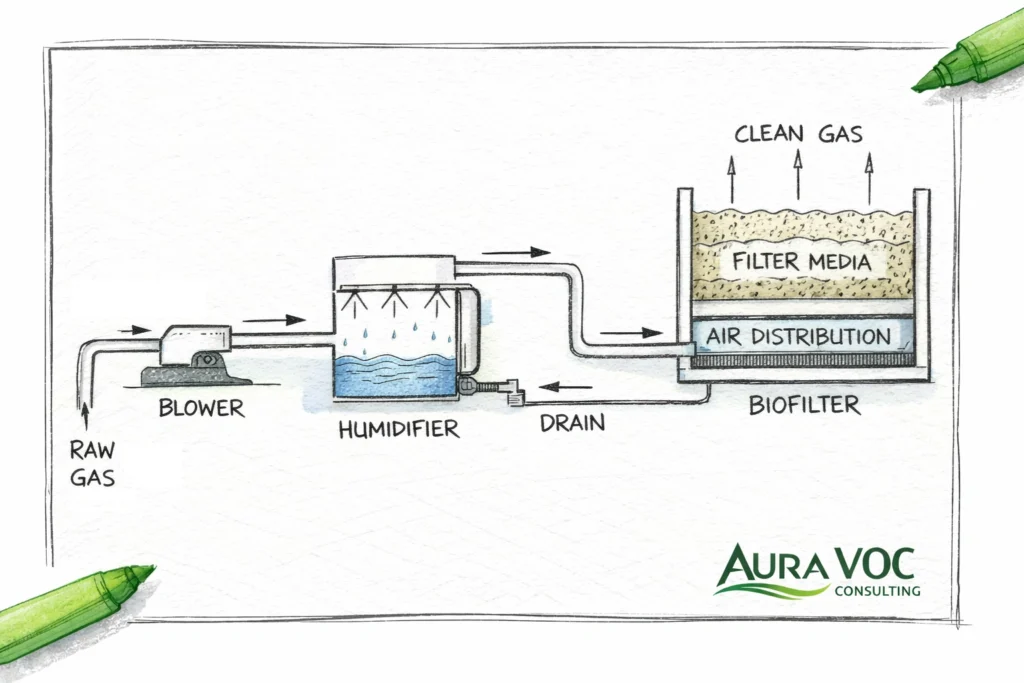
This mechanism creates several engineering constraints. The VOC must transfer from the air into the biofilm. It must be biodegradable at the expected loading. It must not inhibit or poison the microbial population. The gas stream must remain within a suitable temperature and humidity range. The bed must provide enough residence time for removal without creating excessive pressure drop or an impractical footprint.
A biofilter is therefore closer to a gas-phase biological reactor than to a conventional filter. It does not simply trap VOCs. It relies on mass transfer, biological activity and stable operating conditions. This distinction matters when evaluating emissions from batch processes, solvent handling, coating lines, pharmaceutical operations and chemical manufacturing, where concentration peaks and compound changes may determine performance.
Key operating variables include airflow, empty bed residence time, inlet VOC concentration, mass loading, gas temperature, relative humidity, bed moisture, pH, nutrient availability, pressure drop and media condition. If these variables move outside the design basis, removal efficiency can decline even when the system was correctly sized for the original stream. For additional technical background, EPA guidance on biological air treatment discusses biofilters and other bioreactor configurations for air pollution control.
VOC and odor emission problems biofiltration is used to treat
Biofiltration is most often considered for dilute exhaust streams where contaminants are biodegradable and the airflow is too large or too low in solvent load to make thermal treatment attractive without significant supplemental energy. Typical candidates include process building ventilation, wastewater treatment exhausts, food processing odors, organic waste handling air and selected manufacturing ventilation streams with low to moderate VOC loading.
In these applications, biofiltration may provide both VOC reduction and odor control, but the two objectives should not be treated as the same. Odor perception can be driven by trace compounds at very low concentrations, while VOC compliance is normally based on measured mass concentration, total organic carbon or compound-specific limits. A biofilter may improve odor conditions without meeting a VOC mass emission limit, or it may reduce measured VOCs while leaving a residual odor issue.
Biofiltration may also be considered for certain coating, printing, chemical or pharmaceutical ventilation streams, but these cases require more detailed screening. The presence of solvents does not automatically exclude biofiltration, but solvent family, concentration variability, peak duration, water solubility, biodegradability and toxicity must be reviewed. A stream containing mostly biodegradable, low-concentration organics may be a candidate. A stream with high solvent peaks, chlorinated compounds, poorly biodegradable aromatics or frequent product changes may require a different abatement strategy.
From an operating perspective, the most relevant use cases are those where the plant can maintain stable biological conditions. This includes sufficient humidity, controlled temperature, low particulate loading, limited aerosol carryover, acceptable pressure drop and routine inspection access. If production frequently changes the VOC mixture or produces short high-load events, biofiltration may still have a role, but often only as part of a broader treatment arrangement.
Why biofiltration is not suitable for every VOC stream
Biofiltration has a narrower operating window than many oxidation-based systems. It is sensitive to the chemical and physical properties of the contaminants. VOCs that are poorly biodegradable, poorly soluble, hydrophobic, toxic to biomass or present in high peak concentrations can lead to low removal efficiency, slow acclimation, biological inhibition or breakthrough.
High variability is a common problem. Many industrial emission profiles are not steady. Pharmaceutical batch vents, coating-line cleaning events, solvent tank operations and campaign-based chemical production can generate short peaks much higher than the average concentration. Designing a biofilter on average VOC concentration alone can underestimate the required bed volume and residence time, and may fail to identify shock-loading risk.
Hot, dry exhaust streams are also problematic unless conditioning is provided. A dry bed loses biological activity and can develop channeling. Excessive irrigation, on the other hand, can create waterlogging, increased pressure drop and leachate management problems. Particulates, aerosols and condensable compounds can foul the media, block air distribution, coat the biofilm or increase fan load.
For these reasons, biofiltration should not be presented as a low-maintenance or universally low-cost alternative to other VOC abatement systems. It may reduce fuel demand compared with thermal oxidation for suitable dilute streams, but it introduces other operating responsibilities: moisture control, media management, drainage, pH monitoring, pressure drop tracking and biological stability.
When biofiltration should be considered in a VOC abatement study
Best-fit emission profile for biofiltration
Biofiltration should be considered when the exhaust stream has a favorable combination of low to moderate VOC concentration, biodegradable compounds, stable or slowly varying load, suitable temperature, controllable humidity and limited particulate or aerosol content. The technology is strongest when the process can provide a reasonably continuous feed to the biomass without frequent toxic shocks, long starvation periods or abrupt solvent changes.
The best-fit profile is usually a high-volume, dilute air stream where the VOC mass load is manageable and the plant has enough footprint for the required bed volume. The system must also be compatible with available fan pressure and the pressure drop expected over the life of the media. Initial pressure drop is not enough; the evaluation should consider how pressure drop may increase due to media compaction, biomass growth, particulate accumulation or over-wetting.
A suitable stream is not defined by airflow alone. Two exhaust streams with the same flow rate and average VOC concentration can behave very differently if one contains stable biodegradable alcohols and the other contains intermittent peaks of mixed solvents. Treatability depends on compound properties, loading pattern and operating control.
Low-concentration, high-airflow VOC streams
Low-concentration, high-airflow exhaust streams are often where biofiltration is most relevant. In these cases, thermal oxidation may require supplemental fuel because the solvent load is too low to support efficient heat balance, while adsorption may generate significant media replacement or regeneration considerations. Biofiltration can be considered if the compounds are biologically treatable and the plant can accommodate the required footprint and pressure drop.
Large airflow does not automatically make biofiltration suitable. A larger flow increases bed area, ductwork size, fan requirements and distribution challenges. Poor gas distribution can leave part of the media underused while other areas become overloaded. For retrofit projects, the existing fan may not have enough pressure availability once the biofilter, humidifier, mist eliminator, ductwork and dampers are included.
A biofiltration assessment must therefore include actual airflow range, not only nominal design flow. Minimum, normal and maximum flow conditions affect residence time, pressure drop and biological stability. Seasonal ventilation changes or production expansion can shift the system outside the original design basis.
Odor control versus VOC compliance
Biofiltration is frequently used for odor control, but odor reduction and VOC compliance should be evaluated separately. Odor problems may be driven by compounds that are detectable at very low concentrations, while VOC regulations may focus on total organic carbon, specific compounds or mass emission rates. The sampling method, target metric and performance guarantee should be clear before selecting the technology.
For an EHS manager, this distinction is critical. A plant may need to reduce community odor complaints, comply with a permit limit, or demonstrate control of specific VOCs. These are different objectives. A biofilter designed mainly for odor reduction may not provide the level of quantified VOC removal required for a strict emission limit, especially under variable process conditions.
The article should therefore avoid language implying that odor improvement proves VOC compliance. Proper evaluation requires inlet and outlet measurements, process operating data, and a defined performance target. For chemical-sector waste gas treatment, European BAT documentation provides a useful regulatory reference for evaluating abatement systems and monitoring expectations.
Biofiltration as standalone treatment or part of a hybrid system
Biofiltration can be used as a standalone system when the emission stream fits its operating window. In more complex cases, it may be more appropriate as part of a hybrid configuration. Upstream equipment may be required to remove particulates, aerosols, condensables, acid gases or high solvent loads. Downstream polishing may be required if outlet limits are tight or if odor residuals remain.
Common hybrid arrangements include scrubber plus biofilter, condenser plus biofilter, biofilter plus activated carbon polishing, or biofiltration for baseline ventilation with thermal oxidation for concentrated process vents. These configurations recognize that many industrial streams are not ideal for a single technology.
The decision should be based on the actual emission profile and operating objective. If the biofilter would need to handle both stable ventilation air and short high-concentration solvent peaks, separating the streams or applying different technologies may be more reliable than oversizing one biological system for all conditions.
Industrial emission sources where biofiltration may apply
Process building ventilation with dilute VOCs
Process building ventilation is one of the more realistic applications for biofiltration when the air volume is high and the VOC concentration is relatively low. These streams often contain fugitive emissions from open equipment, material handling, tanks, process rooms, packaging areas or transfer operations. The first screening step is to confirm whether the contaminant mix is stable, biodegradable and present at a loading rate the bed can absorb without breakthrough.
For these sources, the challenge is usually not only removal efficiency. It is also air distribution, fan capacity, footprint and seasonal variation. Ventilation rates may change with production mode, ambient temperature or building pressure control. If the biofilter is retrofitted to an existing exhaust system, the additional pressure drop may reduce capture efficiency unless the fan and ductwork are reviewed.
Food and beverage exhausts with biodegradable odor compounds
Food and beverage exhausts can be suitable for biofiltration when the odor load is driven by biodegradable organic compounds and the stream has manageable temperature and moisture conditions. Typical concerns include process odors, fermentation-related emissions, cooking or drying exhausts, and organic material handling air.
These streams may appear straightforward because many compounds are biologically degradable, but operating details still matter. High humidity can be favorable for biological activity, but it may also contribute to condensation in ducts, corrosion, drainage load or uneven bed wetting. Fatty aerosols, oil mist, particulates or sticky organic residues can foul upstream ductwork and biofilter media. Pretreatment may be required if the exhaust contains grease, dust or condensable compounds.
Wastewater treatment and sludge handling exhaust air
Wastewater treatment and sludge handling exhaust air is commonly associated with odor control, but the pollutant mix can include sulfur compounds, nitrogen compounds, organic acids and biodegradable VOCs. Biofiltration may be technically relevant, especially when airflows are continuous and humidity is high.
The main risk is that acid-forming compounds can reduce bed pH and inhibit biological activity. Corrosion risk also needs attention because these systems operate with wet air, condensate and potentially aggressive compounds. Materials of construction, drainage, irrigation water quality and pH monitoring should be considered during design. A biofilter treating wastewater exhaust should not be evaluated only on odor reduction; pressure drop, media life, leachate handling and access for media replacement are also important.
Coating, painting and printing exhaust with controlled solvent peaks
Coating, painting and printing applications require careful screening. Biofiltration may be considered for dilute exhaust streams where solvent concentration is low, the solvent family is compatible with biological treatment, and overspray or aerosols are controlled before the biofilter.
These processes often produce variable emissions. Cleaning operations, color changes, coating changes, drying cycles and production peaks can generate short solvent loads that are much higher than the average concentration. Paint overspray, resin aerosols or condensable organics can coat the media and increase pressure drop. In many cases, biofiltration is more credible for baseline ventilation than for direct treatment of concentrated dryer or cleaning vents.
Chemical manufacturing exhausts with biodegradable compounds
Chemical manufacturing exhausts may be suitable for biofiltration only when the compound mix is well characterized and compatible with biological treatment. Some low-concentration biodegradable compounds may be treatable, particularly where the stream is continuous and does not contain inhibitory substances.
Chemical plants often have complex emission profiles. Multiple products, campaign operation, cleaning steps, vent header mixing, corrosive components and occasional process upsets can all affect biofilter stability. The evaluation should identify each relevant compound, not only total VOC concentration. A low total VOC value can still be unsuitable if the stream contains toxic, chlorinated or poorly biodegradable compounds.
Pharmaceutical solvent emissions: why batch variability creates risk
Pharmaceutical solvent emissions are often high-risk for standalone biofiltration because many plants operate in batches, campaigns or multiproduct schedules. The same vent system may see different solvents, different concentrations and different idle periods depending on production.
Even if some compounds are biodegradable, a biofilter may struggle with sudden solvent peaks, long starvation periods, cleaning emissions or changes in solvent family. Biomass acclimation takes time, and a biological system designed around one emission pattern may not respond well to a different campaign. For pharmaceutical sites, biofiltration should usually be evaluated alongside activated carbon, condensation, oxidation or hybrid systems rather than assumed as a default solution.
Organic waste, composting and rendering exhaust streams
Organic waste, composting and rendering exhaust streams can be relevant for biofiltration because they often contain biodegradable odorous compounds. These applications are usually odor-driven, but the design still requires a disciplined assessment of airflow, humidity, temperature, particulates, pH and pressure drop.
The operating burden can be significant. Organic dust, variable moisture, biological aerosols, sulfur compounds and seasonal loading changes can affect bed condition. Media selection and access for maintenance are important because these applications can experience compaction, biomass accumulation and uneven air distribution over time.
Which VOCs are suitable for biofiltration — and which are high-risk
VOCs with favorable biodegradability and mass transfer
The most suitable compounds are those that can transfer from the gas phase into the moist biofilm and be biodegraded without inhibiting the microbial population. Good treatability is not determined by biodegradability alone. The compound must also be available to the biomass at the required rate, and the system must provide enough residence time for degradation.
For this reason, VOC suitability should be assessed as a combination of chemistry, concentration, residence time and operating stability. A compound that is biodegradable at low concentration may become inhibitory at higher load or during short peaks. A dilute ethanol or acetone ventilation stream may behave very differently from a mixed aromatic solvent stream at the same total VOC concentration because solubility, degradation rate and biomass inhibition are not equivalent.
Alcohols, ketones, aldehydes, esters and organic acids
Alcohols, some ketones, some aldehydes, esters and organic acids are often considered more favorable candidates for biological treatment, depending on concentration and process conditions. These compounds are commonly found in food processing, fermentation, coating, cleaning, printing and manufacturing exhausts.
These families should not be treated as automatically suitable. A dilute and steady alcohol-containing ventilation stream may be a reasonable biofiltration candidate, while a batch vent with high solvent peaks may require another technology or a hybrid arrangement. Concentration, peak duration and operating schedule can be more important than the broad solvent family name.
Odorous sulfur, nitrogen and organic compounds
Biofiltration is often used for odorous compounds, including some reduced sulfur compounds, amines, ammonia-related streams and organic odorants. These applications require attention to pH, corrosion and media chemistry. Sulfur oxidation products, for example, can acidify the bed and reduce biological performance if buffering or irrigation control is inadequate.
Odor applications should also be evaluated against the correct performance target. Reducing odor complaints is not the same as demonstrating VOC mass removal or meeting a specific outlet concentration limit.
Hydrophobic VOCs and gas-to-biofilm transfer limits
Hydrophobic VOCs are challenging because their removal may be limited by transfer from the gas phase into the wet biofilm. Even if a compound can be biodegraded under laboratory conditions, poor mass transfer can reduce practical removal in a full-scale biofilter.
This is relevant for certain hydrocarbons, terpenes, aromatics and mixed solvent streams. Design responses may include longer residence time, specialized media, improved moisture control or alternative biological configurations, but in some cases adsorption, oxidation or concentration technology may be more reliable.
Chlorinated, toxic or poorly biodegradable VOCs
Chlorinated solvents, toxic compounds and poorly biodegradable VOCs are high-risk for biofiltration. They may inhibit biomass, degrade slowly or create acidic by-products. A biological system should not be selected for these streams without compound-specific treatability assessment and a realistic view of outlet requirements.
For these cases, the evaluation should direct attention toward technology comparison rather than forcing biofiltration into an unsuitable application. RTOs, catalytic oxidizers, activated carbon, condensation or solvent recovery may be more appropriate depending on concentration, flow, recoverability and compliance target.
Mixed solvent streams and changing production campaigns
Mixed solvent streams are difficult because each compound has different solubility, biodegradability, toxicity and mass-transfer behavior. Changing campaigns add another layer of risk. A biofilter acclimated to one solvent mix may not maintain performance when the production schedule changes.
For multiproduct sites, the evaluation should include the full solvent list, expected concentration ranges, campaign duration, cleaning events, shutdown periods and any future planned production changes. Designing from a short sampling campaign may miss operating cases that determine actual risk.
VOC biofiltration design and operating parameters that determine performance
Gas flow rate and empty bed residence time
Gas flow rate sets the size of the system and directly affects empty bed residence time. Higher flow reduces contact time unless bed volume increases. Longer residence time may improve removal, particularly for slower compounds, but it increases footprint, media volume, ductwork and capital cost.
For retrofits, actual flow should be measured rather than assumed from fan nameplate data. Dampers, duct losses, hood capture requirements and existing pressure limitations can all affect the true operating point. A flow increase after production expansion can reduce residence time and move the biofilter outside its original design basis.
VOC concentration, mass loading and peak load duration
Biofilter design should consider mass loading, not only concentration. A moderate concentration at high flow can produce a significant pollutant load, while a low average value can hide short high peaks. Peak duration matters because a brief solvent release may pass through the bed before the biomass can respond.
The design basis should include normal, maximum and upset conditions. If peaks dominate the emission profile, a separate peak-control strategy may be required. For batch operations, time-based emission data is more useful than daily averages because short solvent releases often determine breakthrough risk.
VOC variability in batch and campaign-based production
Variable production can create alternating periods of overload and starvation. Both can affect biological stability. High loads may inhibit biomass or cause breakthrough. Long idle periods may reduce activity and require reacclimation after restart.
Batch and campaign-based sites should evaluate whether the biofilter will see a stable enough feed to maintain performance. Where this is not possible, stream segregation, buffering, activated carbon, oxidation or hybrid control may be more appropriate.
Temperature limits and thermal conditioning
Biofilters require a temperature range compatible with biological activity and media stability. Hot exhaust can dry the bed, reduce microbial activity or require cooling before treatment. Cooling can also create condensate, which must be managed in ducts, drains and pretreatment equipment.
Temperature variation should be reviewed over seasons and production modes. A system that performs during moderate conditions may lose stability during hot process operation or cold-weather startup. Thermal conditioning should be evaluated together with humidity control and corrosion risk.
Humidity control and media moisture balance
Moisture control is one of the main operating requirements for biofiltration. Dry media reduces biological activity and can create channeling. Excess moisture can cause waterlogging, pressure drop increase, anaerobic zones and leachate problems.
The design should include humidification or irrigation where needed, but also drainage and monitoring. The objective is not simply to add water; it is to maintain a stable moisture profile across the bed. Uneven irrigation can leave wet and dry zones in the same system, leading to inconsistent treatment and difficult troubleshooting.
pH control and acid-forming compounds
pH control is important when compounds degrade into acidic or alkaline products. Sulfur compounds, nitrogen compounds, chlorinated compounds and organic acids can shift bed chemistry and reduce microbial activity.
A credible design should allow pH monitoring and correction. Depending on the stream, this may influence media selection, irrigation strategy, buffering and maintenance frequency. Low pH can develop gradually, so periodic checks are more useful than reacting only after odor breakthrough or VOC removal loss.
Pressure drop, fan capacity and energy demand
Pressure drop affects energy demand and process capture. A biofilter that starts with acceptable pressure drop may become restrictive as media compacts, biomass grows or particulates accumulate. If the fan cannot maintain the required flow, emissions capture upstream may deteriorate.
Pressure drop should be evaluated over the expected media life, not only at startup. Increased pressure drop can reduce extraction flow at hoods, enclosures or process vents, causing fugitive emissions before the gas even reaches the biofilter. Trending differential pressure across the bed is therefore a basic operating requirement, especially where the system is connected to production ventilation.
Particulates, aerosols and condensable compounds
Particulates, aerosols and condensable compounds can foul the media, block gas pathways and reduce mass transfer. Coating overspray, oil mist, organic dust and sticky condensables are common causes of biofilter underperformance.
Pretreatment may include filters, mist eliminators, knockout vessels, cooling control or scrubbers. The tradeoff is added complexity and pressure drop, but without pretreatment the biofilter may become a fouling device rather than a stable treatment system.
LEL, solvent peaks and explosion safety considerations
Biofiltration is normally evaluated for dilute streams. Solvent-rich vents require LEL assessment and appropriate safety controls before any abatement technology is selected. A stream that is usually dilute may still generate flammable conditions during cleaning, filling, dumping or batch transfer operations.
Explosion safety should be based on maximum credible concentration, not average VOC data. If streams are manifolded, the combined vent behavior should be assessed. LEL monitoring, dilution, isolation, inerting or alternative treatment may be required depending on the process. OSHA guidance on flammable atmospheres is a relevant reference when reviewing lower explosive limit conditions and solvent vapor safety.
Corrosion risks in wet exhaust systems
Biofilters operate with moisture, and associated ductwork, plenums, drains and fans may be exposed to condensate or acidic compounds. Corrosion risk increases where sulfur, nitrogen, halogenated compounds or acidic aerosols are present.
Material selection should be reviewed together with pH, condensate composition and maintenance access. Ignoring corrosion can shorten equipment life and create leakage, bypass or structural problems.
Wastewater, leachate and spent media implications
Biofiltration can generate secondary streams that require management. These may include irrigation drainage, leachate, condensate, humidifier blowdown, scrubber blowdown and spent media. The plant must have a route for collection, treatment or disposal.
Leachate may contain absorbed organics, acids, suspended solids or biological material. The evaluation should check whether drainage is continuous or intermittent, whether pH control is needed, and whether the site wastewater treatment system can accept the flow and composition. Biofiltration may reduce fuel demand compared with thermal oxidation in suitable cases, but it can increase water handling, drainage and media maintenance requirements.
Engineering tradeoffs in biofilter selection
Residence time versus footprint
Empty bed residence time is one of the main sizing variables in biofiltration. A longer residence time can improve removal for slower-degrading or less soluble compounds, but it increases bed volume, plot space, ducting length and civil work. On greenfield sites this may be manageable; on existing industrial sites it can become the limiting constraint.
This tradeoff should be assessed early. A biofilter that looks technically feasible from a removal standpoint may be impractical if the required bed area interferes with production access, truck movement, fire routes, future expansion or maintenance lifting zones.
Removal efficiency versus pressure drop
Increasing media depth or selecting denser media can improve contact between the gas stream and the biological surface, but it can also increase pressure drop. Higher pressure drop increases fan energy demand and may reduce extraction flow if the existing fan cannot maintain the required operating point.
This is especially important in retrofit projects. If the biofilter causes the ventilation system to operate below design flow, the plant may reduce emissions at the stack while losing capture at the source. Pressure drop should therefore be evaluated across the expected media life, not only at startup.
Moisture control versus wastewater generation
Moisture is essential for biological activity, but water addition must be controlled. Insufficient moisture leads to dry zones, loss of biomass activity and channeling. Excessive irrigation can cause waterlogging, anaerobic zones, higher pressure drop and contaminated leachate.
The water balance should be part of the design basis. The plant needs to know where irrigation drainage, condensate and leachate will go, whether pH adjustment is required, and whether the site wastewater system can accept the flow and composition.
Pretreatment complexity versus biofilter reliability
Pretreatment adds equipment, controls, maintenance and pressure drop, but it often determines whether the biofilter remains stable. Particulate filters, mist eliminators, scrubbers, condensate traps or gas cooling may be required before the biological bed.
The practical question is whether pretreatment prevents a more expensive operating problem. Removing aerosols, dust or acidic components upstream may be less costly than frequent media replacement, rising fan load, recurring odor breakthrough or unplanned shutdowns.
Biological stability versus production variability
Biofilters perform best when the microbial population receives a relatively stable feed. Batch production, cleaning cycles, campaign changes and weekend shutdowns can create alternating periods of overload and starvation. Both affect biological stability.
For variable processes, the design should consider the peak-to-average ratio, solvent family changes, idle periods and restart behavior. A system that is stable during continuous operation may become unreliable when exposed to short solvent peaks or long no-load periods.
Biofiltration fuel savings versus performance certainty
Biofiltration may reduce or avoid combustion fuel demand compared with thermal oxidation in suitable dilute streams. That advantage should be weighed against the certainty required by the permit, the variability of the VOC stream and the plant’s ability to maintain biological conditions.
Where the outlet limit is strict and the inlet stream is variable, oxidation, adsorption, recovery or a hybrid configuration may provide a more predictable compliance basis. Biofiltration should be selected for technical fit, not only for lower fuel consumption.
Conditions where biofiltration is technically suitable
Stable or slowly varying emissions
Biofiltration is most suitable where VOC concentration and airflow change gradually. Stable loading allows the biomass to remain acclimated and reduces the risk of breakthrough.
A suitable stream does not need to be perfectly constant, but large short-duration peaks should be understood before selection. Normal operating data should be supplemented with information from cleaning, filling, dumping, startup, shutdown and product-change events.
Biodegradable and non-inhibitory VOCs
The VOCs must be biodegradable at the expected loading and must not inhibit the microbial population. Treatability depends on the specific compound mix, not only total VOC concentration.
A dilute stream containing readily biodegradable alcohols or ketones may be technically reasonable. The same total VOC concentration made up of poorly biodegradable aromatics, chlorinated solvents or toxic intermediates may be unsuitable.
Controllable humidity and temperature
The inlet gas must remain within a range that supports biological activity. Hot, dry gas can desiccate the bed. Cold or highly variable gas can reduce biological activity or create condensation problems.
Humidity control should be designed with both wetting and drainage in mind. The objective is a stable moisture profile through the bed, not simply adding water to the inlet duct.
Low particulate, aerosol and condensable loading
Particulates, mist, overspray and condensable organics can foul the media and reduce gas-to-biofilm transfer. They can also increase pressure drop and create uneven airflow distribution.
Biofiltration is more credible where these contaminants are absent or can be removed upstream. This is a major screening point for coating, painting, food processing, resin handling and other aerosol-generating operations.
Sufficient footprint and fan pressure availability
The site must have space for the required bed volume, access for media handling and enough fan pressure to overcome the complete system resistance. This includes ductwork, dampers, pretreatment, humidification, distribution plenums, media bed and stack losses.
Fan capacity should be checked against the expected operating pressure drop over time. A biofilter that works only with clean new media may become unstable after media compaction, biomass growth or particulate loading.
Plant capability for biological system monitoring
Biofiltration requires routine operating discipline. The plant should be able to monitor pressure drop, airflow, humidity, pH, irrigation, drainage, media condition and treatment performance.
Sites without the ability to inspect and maintain the biological bed may struggle with long-term reliability, even if the inlet stream is technically suitable.
Conditions where biofiltration may be unsuitable
High solvent concentrations or frequent VOC peaks
High solvent concentrations can overload the bed, inhibit biomass or create safety concerns. Short peaks are especially important because they may not appear in average concentration data but can still determine breakthrough risk.
Batch vents, solvent cleaning operations, tank filling, coating-line changes and pharmaceutical campaigns should be reviewed for maximum credible concentration and peak duration before biofiltration is selected.
Poorly biodegradable, chlorinated or toxic VOCs
Biofiltration is high-risk where compounds degrade slowly, transfer poorly into the biofilm, or inhibit microbial activity. Chlorinated solvents, toxic intermediates and poorly biodegradable aromatics often require alternative treatment or detailed treatability testing.
For these streams, the evaluation should compare biofiltration against oxidation, activated carbon, condensation, solvent recovery or hybrid systems rather than forcing a biological design.
Hot, dry or highly variable exhaust streams
Hot and dry exhaust can reduce biological activity and cause media shrinkage or channeling. Highly variable gas conditions can also disturb the bed, especially if humidity and temperature are not controlled.
Gas conditioning may make some streams treatable, but the additional equipment, water use, condensate management and pressure drop must be included in the feasibility review.
Aerosol-heavy or particulate-laden emissions
Aerosols and particulates can block media pores, coat the biological surface and raise pressure drop. Once fouling develops, performance may decline even if the VOC chemistry is otherwise suitable.
Paint overspray, oil mist, resin aerosols, dust and sticky organic residues should be treated as major design risks. Pretreatment may be required, and in some cases another technology may be more practical.
Limited footprint or insufficient fan pressure
Biofiltration may be technically plausible but physically impractical where space is limited. Bed volume, access lanes, drainage systems and media replacement logistics require more area than many compact oxidation or adsorption systems.
Insufficient fan pressure is another common constraint. If the fan cannot maintain capture flow after the biofilter is installed, the system may create upstream ventilation problems.
Strict outlet limits under variable process conditions
Where compliance depends on a tight outlet concentration under changing production conditions, biofiltration may be difficult to justify as a standalone system. Biological performance can vary with inlet composition, pH, moisture, temperature and media condition.
In these cases, a more robust technology or a hybrid arrangement may be needed to provide the required operating margin.
When RTO, activated carbon, condensation or hybrid systems should be evaluated instead
Alternative technologies should be evaluated when the stream contains high solvent loads, recoverable solvents, poorly biodegradable compounds, frequent peaks, flammable mixtures or strict outlet guarantees.
Biofiltration may still have a role for baseline ventilation or odor polishing, but it should not automatically be assigned to all VOC-bearing streams at the site.
Common biofilter design mistakes
Designing from average VOC concentration only
Average concentration can hide short solvent peaks that dominate performance. A biofilter sized on average data may appear adequate during design but experience recurring breakthrough during cleaning, filling, transfer or campaign-change events.
The design basis should include maximum concentration, peak duration, frequency and compound composition during non-routine operations.
Ignoring VOC peak loads and batch events
Batch events can shock the biomass or exceed the bed’s temporary loading capacity. The result may be outlet breakthrough, odor complaints or a slow recovery period after the event.
For batch plants, the assessment should review time-based emissions rather than only daily or shift averages.
Underestimating residence time and bed volume
Insufficient bed volume reduces contact time and limits the ability of the biomass to remove less soluble or slower-degrading compounds. This is a frequent issue where footprint is constrained and the design is compressed to fit available space.
If the required residence time is incompatible with the site layout, another technology or a hybrid design should be evaluated.
Poor gas distribution through the media bed
Uneven gas distribution causes localized overloading and unused media volume. Some zones may dry out or become overloaded while others contribute little to treatment.
Distribution plenums, inlet geometry, bed support, media settling and pressure balance should be reviewed as part of the design, not treated as mechanical details after sizing.
Inadequate humidity, irrigation or drainage design
Water management failures are a common cause of biofilter underperformance. Dry media reduces biological activity and encourages channeling. Excess water creates waterlogged zones, high pressure drop and leachate issues.
The system should include a practical method for controlling inlet humidity, inspecting irrigation coverage and draining excess water.
No pretreatment for particulates, aerosols or condensables
Particulates, mist and condensables can foul the bed and increase pressure drop. Once the media is coated or plugged, biological performance may not recover without partial or full media replacement.
Pretreatment should be evaluated whenever the exhaust contains overspray, dust, oil mist, sticky organics or condensable vapors.
Underestimating pressure drop in retrofit installations
A retrofit biofilter changes the ventilation system resistance. If fan performance is not reviewed, the plant may lose capture velocity at hoods, enclosures or process vents.
The design should include a fan curve review, pressure drop allowance for aged media and checks on upstream capture requirements.
No plan for media inspection, settling or replacement
Biofilter media changes over time. It may settle, compact, degrade, acidify or lose moisture retention capacity. Without access for inspection and replacement, maintenance becomes disruptive and expensive.
The layout should include access for media handling, safe isolation, drainage cleaning and inspection of the support structure.
Biofilter operation and maintenance requirements
Routine monitoring of airflow, pressure drop, temperature and humidity
Airflow and pressure drop should be trended, not checked only after complaints occur. A gradual pressure increase can indicate biomass growth, compaction or particulate loading. A falling airflow can indicate that the fan is moving away from its intended operating point.
Temperature and humidity measurements help identify drying risk, condensation risk and seasonal operating changes. These values should be reviewed alongside production data so that performance changes can be linked to operating conditions rather than treated as isolated equipment problems.
Monitoring VOC removal, odor performance and outlet compliance
VOC removal and odor performance should be monitored separately. Odor complaints may continue even when total VOC removal appears acceptable, and a reduction in odor does not prove compliance with a mass emission limit.
Sampling should be tied to production conditions. A stack test performed during low-load operation may not represent cleaning cycles, product changes or peak solvent use. Where total VOC is used as the main metric, compound-specific data may still be required if the inlet solvent mix changes.
Media moisture, pH and nutrient management
Media condition is central to performance. Dry zones, low pH, nutrient imbalance or biological inhibition can reduce removal efficiency without any obvious external equipment failure.
pH should be checked where sulfur, nitrogen, acid-forming or chlorinated compounds are present. Nutrient requirements depend on media type and contaminant load. Some media systems provide nutrients initially but may require monitoring or supplementation over time.
Irrigation, humidification and drainage maintenance
Nozzles, pumps, strainers, humidifiers and drains require routine attention. Blocked nozzles can create dry areas, while blocked drains can create waterlogging and pressure drop increase.
Drainage should be inspected for solids accumulation, biological growth, low pH and signs of contaminated leachate. In cold climates or outdoor installations, freezing, condensate accumulation and drain blockage may need specific design and operating checks.
Fan, ductwork and instrumentation checks
Fan performance, damper position, duct corrosion, condensate accumulation and sensor condition all affect operation. A biofilter may be blamed for poor performance when the actual issue is reduced extraction flow, bypass leakage or faulty pressure measurement.
Instrumentation should be checked periodically, especially differential pressure taps, humidity sensors, flow indicators and sampling ports. Plugged or poorly located pressure taps can lead to misleading pressure drop readings.
Media aging, compaction and replacement planning
Media aging is a normal operating issue. Over time, media can compact, lose structure, reduce porosity or develop preferential pathways. These changes affect both pressure drop and biological contact.
Replacement planning should consider production downtime, disposal route, access equipment, confined space requirements and whether partial replacement is practical. Spent media may require characterization before disposal, depending on contaminants and site procedures.
Operating biofilters during shutdowns, restarts and production changes
Extended shutdowns can reduce biomass activity. Restarting at full load may cause breakthrough until the bed reacclimates. A controlled restart plan may be needed after long idle periods, maintenance shutdowns or changes in solvent use.
Production change management should include a review of new solvents or altered emission profiles before they are routed to the biofilter. A change in solvent mix can affect biodegradability, toxicity, pH behavior and mass transfer even if total VOC concentration remains similar.
Biofilter troubleshooting: pressure drop, odor breakthrough and removal loss
Odor breakthrough: likely causes and checks
Odor breakthrough can result from overload, dry media, low pH, channeling, media aging or a change in inlet composition. The first check should be whether the odor event corresponds to a production change, cleaning cycle, shutdown restart or abnormal inlet load.
Field checks should include inlet and outlet sampling, bed moisture, pH, pressure drop trend, airflow distribution and visual media condition. Odor complaints should also be compared with weather, stack discharge conditions and operating schedule, because perceived odor may not align with average VOC measurements.
VOC removal efficiency decline: likely causes and checks
Declining VOC removal may indicate a change in solvent composition, excessive loading, low residence time, biomass inhibition, poor moisture control or loss of acclimation. Sampling should confirm whether the inlet stream has changed before assuming media failure.
Where total VOC is measured, compound-specific data may still be needed. A constant total VOC concentration can conceal a shift from readily biodegradable compounds to poorly biodegradable ones. If removal loss follows a solvent change, weekend shutdown or cleaning campaign, the root cause is likely process-related rather than a simple media-age issue.
Increasing pressure drop: biomass, media and particulate causes
Increasing pressure drop is usually a mechanical or biological symptom. Common causes include biomass overgrowth, media compaction, particulate accumulation, waterlogging, plugged support layers or uneven irrigation.
The pressure trend is more useful than a single reading. A gradual increase may suggest compaction or biomass growth; a rapid increase may indicate waterlogging, fouling or blockage. If pressure drop increases while airflow falls, the fan operating point and upstream capture performance should be checked.
Media drying and uneven moisture distribution
Drying can occur from hot inlet gas, low humidity, excessive airflow, poor irrigation coverage or seasonal changes. Dry media reduces biological activity and can create cracks or bypass paths.
Inspection should look for dry zones, shrinkage, uneven wetting, blocked nozzles and temperature gradients across the bed. A bed can have dry and wet zones at the same time if air distribution or irrigation coverage is poor.
Low pH, acidification and biological inhibition
Low pH can occur when sulfur, nitrogen, chlorinated or acid-forming compounds are treated without adequate buffering or irrigation control. Acidification can suppress microbial activity and reduce removal efficiency.
Corrective action depends on the cause. It may involve irrigation adjustment, buffering, media replacement, upstream scrubbing or reassessment of the contaminant mix. If low pH returns repeatedly, the inlet chemistry or design basis may not be compatible with the current operating approach.
Channeling, bed settling and poor airflow distribution
Channeling allows part of the gas stream to bypass active media. It may be caused by media shrinkage, settling, cracks, poor packing, plenum design issues or uneven moisture.
Signs include localized dry areas, uneven temperature, inconsistent odor control and performance loss without a proportional pressure drop increase. Channeling is especially important in older beds or after drying events.
Performance loss after shutdown or solvent change
After shutdown, the biomass may lose activity because of starvation, drying or temperature changes. After a solvent change, the existing microbial population may not be acclimated to the new compound mix.
Restart should be controlled where possible. Gradual loading, close outlet monitoring and review of the solvent list can reduce the risk of immediate breakthrough. If the plant operates in campaigns, the biofilter may need a defined operating strategy for idle periods and transitions.
Integration with other VOC abatement technologies
Upstream cooling, humidification and gas conditioning
Gas conditioning may be required before biofiltration if the exhaust is too hot, too dry or prone to condensation. Cooling and humidification must be evaluated together because cooling can increase relative humidity and produce condensate, while humidification can increase drainage and corrosion risk.
Conditioning equipment should be included in the pressure drop and maintenance assessment. A biofilter cannot be evaluated separately from the equipment required to make the inlet gas biologically treatable.
Particulate filters, mist eliminators and knockout vessels
Particulate filters, mist eliminators and knockout vessels protect the bed from solids, droplets and condensable material. These devices are especially relevant for coating, food processing, resin handling, oil mist, dusty processes and exhaust streams near saturation.
The tradeoff is added equipment resistance and maintenance. Filter blinding or mist eliminator fouling can affect airflow just as much as biofilter pressure drop, so these devices should be included in operating checks.
Wet scrubbers before biofiltration
Wet scrubbers may be used upstream to remove acid gases, ammonia, soluble contaminants or compounds that would destabilize the biofilter. They may also help condition humidity and temperature.
The downstream consequences must be considered. Scrubbers create blowdown, chemical use, corrosion risk and additional pressure drop. They may improve biological stability, but they also add a wet system that requires operation and maintenance.
Condensation or solvent recovery before biofiltration
Condensation or solvent recovery may be appropriate where the inlet stream contains higher solvent concentrations or recoverable solvent value. Reducing the load upstream can make a downstream biofilter more realistic for residual biodegradable compounds.
This arrangement should be evaluated carefully for variability. A condenser may perform differently across solvent mixtures, temperatures and flow rates, and the residual stream still needs assessment for biodegradability, safety and odor potential.
Activated carbon polishing after biofiltration
Activated carbon may be used after biofiltration for residual VOCs, odor polishing or backup duty during temporary biological instability. It can also provide an additional safety margin where outlet requirements are tight.
Carbon polishing must be designed with breakthrough monitoring and media management. It should not be used to mask a biofilter that is consistently overloaded or unsuitable for the inlet chemistry.
Biofiltration for baseline ventilation with RTO for concentrated process vents
Separating baseline ventilation from concentrated process vents can be more reliable than combining all emissions into one treatment system. Biofiltration may treat dilute, continuous ventilation air, while an RTO or other technology handles concentrated batch vents, cleaning emissions or solvent-rich streams.
This approach requires careful duct segregation and control logic. The plant must avoid routing high-concentration events into the biofilter by default unless they were included in the design basis.
When hybrid VOC abatement systems are more reliable than standalone biofiltration
Hybrid systems are appropriate when one stream contains both biologically suitable baseline emissions and unsuitable peaks or contaminants. They may also be appropriate where pretreatment is required to control aerosols, acid gases, temperature, humidity or solvent load.
A hybrid configuration should be selected because it improves reliability, not because it adds complexity. The practical test is whether each unit operation handles the part of the emission profile it is best suited to treat.
Biofiltration vs RTO, activated carbon, scrubbers and condensation
Biofiltration vs regenerative thermal oxidation
A regenerative thermal oxidizer is generally more robust for mixed VOC streams, poorly biodegradable compounds and strict destruction requirements. It also handles many variable solvent mixtures better than a biological system, provided LEL and operating requirements are addressed.
Biofiltration is more relevant for dilute, biodegradable, high-airflow streams where thermal treatment would require significant supplemental fuel. The tradeoff is that biofiltration needs biological stability, more footprint and closer attention to moisture, pH and media condition.
Biofiltration vs catalytic oxidation
Catalytic oxidation can reduce oxidation temperature compared with direct thermal treatment, but catalyst compatibility is critical. Catalyst poisons, particulates, halogenated compounds or silicon-containing compounds can create reliability issues.
Biofiltration avoids catalyst poisoning but is limited by biodegradability, mass transfer and biological operating conditions. The selection depends on the compound list, concentration, variability and required outlet performance.
Biofiltration vs activated carbon adsorption
Activated carbon adsorbs VOCs and transfers them to a solid phase. It can be useful for intermittent emissions, polishing duty or low-concentration streams, but it requires breakthrough management, regeneration or disposal.
Biofiltration destroys suitable compounds biologically, but only within its operating window. Carbon may be preferable for intermittent low loads, backup duty or compounds that are not biologically treatable. Biofiltration may be preferable where the stream is continuous, biodegradable and stable.
Biofiltration vs wet scrubbing
Wet scrubbing is effective for soluble gases, acid gases or alkaline compounds, but many VOCs have poor scrubber removal unless the chemistry is favorable. Scrubbers also generate liquid waste and may require chemicals, blowdown treatment and corrosion control.
Biofiltration may be better for biodegradable organic odorants or dilute VOCs, but it also needs water management and biological control. In some cases, a scrubber is used upstream of a biofilter to remove acid gases, ammonia or soluble contaminants that would destabilize the bed.
Biofiltration vs condensation and solvent recovery
Condensation and solvent recovery are more relevant for concentrated streams where solvent value, concentration and dew point make recovery practical. They are usually less effective for very dilute ventilation air without large cooling demand.
Biofiltration is generally more relevant for dilute biodegradable exhausts. It should not be used where solvent recovery is technically and economically preferable or where residual emissions after recovery require a more predictable polishing stage.
Biofilter vs biotrickling filter
A conventional biofilter uses moist media with limited liquid-phase process control. A biotrickling filter uses a packed bed with recirculating liquid, allowing more direct control of pH, nutrients and soluble degradation products.
Biotrickling filters may be more suitable where acidification, nutrient control or higher loading rates are important, but they add pumps, recirculation, blowdown, liquid treatment and instrumentation. The choice depends on contaminant chemistry, loading, pH behavior and the plant’s ability to manage a more controlled wet biological system.
How to select between biological, adsorption, recovery and oxidation systems
Technology selection should start with the emission profile: compound list, flow, concentration, peak behavior, temperature, humidity, safety limits and required outlet performance. The next step is to compare how each technology handles the actual operating envelope, not only the average case.
A suitable technology must treat the normal stream, remain safe during peaks, fit the site layout, operate within utility constraints, and produce secondary waste streams the plant can manage. Selection should also consider maintenance resources, monitoring requirements, uptime expectations and the consequence of underperformance.
Process data required before selecting biofiltration
Airflow, operating hours and production schedule
Measured airflow should be provided for minimum, normal and maximum conditions. Operating hours, shift patterns, weekend shutdowns, cleaning cycles and seasonal ventilation changes should also be included.
Nominal fan capacity is not enough. The relevant airflow is the actual flow through the source capture system and future biofilter under operating pressure drop.
VOC composition, concentration range and mass loading
Compound-specific VOC data is required. Total VOC alone is not enough because biodegradability, toxicity and mass transfer vary by compound.
Mass loading should be calculated for normal and maximum cases. The biofilter should not be assessed from concentration without flow. Where solvent blends are used, the composition during each production mode should be documented.
Peak concentration, peak duration and batch events
Peak concentration and duration are critical. Short events from cleaning, tank filling, batch transfer or product changeover may define the design risk.
Where peaks are uncertain, additional sampling or temporary monitoring may be needed before technology selection. A short stack test under stable operation may miss the events that determine whether biofiltration is viable.
Temperature, humidity, dew point and condensation risk
Temperature and humidity define whether the gas can support biological treatment or needs conditioning. Dew point review helps identify condensation risks in ducts, plenums and the bed.
Condensation is not only a nuisance issue. It can create corrosion, drainage load, biological imbalance and pressure drop problems. If cooling is required, the condensate route and materials of construction should be reviewed.
Particulates, aerosols, acid gases and corrosive compounds
Particulates and aerosols determine whether pretreatment is needed. Acid gases and corrosive compounds influence media selection, pH control, materials of construction and drainage design.
These contaminants should be included in the inlet characterization, especially for coating, food, wastewater, chemical and pharmaceutical applications.
LEL assessment and solvent safety constraints
LEL assessment should use maximum credible concentration, not average concentration. Cleaning events, abnormal operations and manifolded vent behavior should be reviewed.
Where solvent peaks are possible, the evaluation should define whether monitoring, dilution, segregation, explosion protection or another abatement technology is required.
Existing fans, pressure availability and duct layout
Retrofit feasibility depends on the existing ventilation system. Fan curves, current operating point, duct losses, damper positions, capture requirements and available pressure should be reviewed before assuming the biofilter can be added.
A fan that is adequate for the current exhaust system may be inadequate once pretreatment, humidification, distribution plenums and aged media pressure drop are included.
Footprint, drainage and wastewater handling capacity
The site must accommodate bed area, maintenance access, media replacement, drainage, pumps and any upstream conditioning equipment. Wastewater handling capacity should be confirmed if irrigation, scrubbing or condensate collection is required.
Drainage should be assessed as a practical operating issue, not only as a civil design detail. Poor drainage can create waterlogging, pressure drop increase, low pH zones and contaminated standing water.
Emission limits, odor objectives and monitoring requirements
The performance target should be defined before technology selection. Odor reduction, total VOC reduction, compound-specific limits and permit monitoring requirements may lead to different design decisions.
The required level of certainty matters. A system designed for odor improvement may not be appropriate for strict outlet concentration limits under variable production.
Practical industrial scenarios
Suitable case: food processing odor exhaust
A food processing facility has a stable, humid, dilute exhaust stream containing biodegradable odor compounds. The main design checks are airflow, odor load, particulate or grease carryover, bed moisture control, drainage and corrosion risk.
Biofiltration may be technically suitable if aerosols and condensables are controlled upstream and the plant can monitor moisture, pH and pressure drop. The outlet target should distinguish odor reduction from any formal VOC limit.
Caution case: coating line ventilation with solvent peaks
A coating line has large ventilation flow with low average solvent concentration, but cleaning and product-change events create short solvent peaks. Baseline ventilation may be compatible with biofiltration, while cleaning peaks may overload the bed or create safety concerns.
A credible design would evaluate peak duration, overspray control, aerosol carryover, solvent composition and whether carbon, oxidation, bypass control or stream segregation is needed for non-routine events.
High-risk case: pharmaceutical batch solvent vent
A pharmaceutical facility operates in campaigns with different solvents, idle periods and cleaning steps. Total VOC values may be moderate during some campaigns, but peak events and solvent changes create biological instability.
Standalone biofiltration is high-risk unless the stream is well characterized and the operating envelope is narrow. Activated carbon, condensation, oxidation or hybrid systems should be evaluated alongside any biological option.
Troubleshooting case: existing biofilter with rising pressure drop
An existing biofilter shows rising fan load and intermittent odor breakthrough. The investigation should check media compaction, biomass growth, particulate carryover, over-irrigation, plugged drainage, support layer blockage and airflow reduction.
Corrective action may require irrigation adjustment, media turning or replacement, upstream filtration, drainage cleaning or fan review. Treating the symptom without identifying the cause can lead to repeated failures.
Unsuitable case: chlorinated or poorly biodegradable VOC stream
A chemical process emits chlorinated or poorly biodegradable VOCs at variable concentration. Even if the average VOC load is low, biological treatment may be unreliable because of poor degradation, inhibition or acid-forming behavior.
Alternative technologies such as oxidation, adsorption, condensation, solvent recovery or hybrid treatment should normally be evaluated first.
How AuraVOC evaluates biofiltration suitability
Technical screening of VOC chemistry and process conditions
A suitability review starts with the compound list, concentration range, airflow, humidity, temperature and process schedule. The screening should identify whether the VOCs are biologically treatable and whether the gas stream can be conditioned without creating unacceptable pressure, water or maintenance burdens.
This step should also identify data gaps. If the process has variable emissions or unknown peaks, additional monitoring may be required before a credible technology decision can be made.
Review of operating variability and peak emissions
The review should examine peak-to-average ratio, peak duration, batch events, cleaning emissions, weekend shutdowns and campaign changes. These factors often determine whether biofiltration is viable as a standalone system.
Average VOC concentration can be useful for initial screening, but maximum credible load and operating variability determine the risk of breakthrough, inhibition and safety constraints.
Assessment of pretreatment, polishing or hybrid system needs
The review should identify whether particulate removal, mist elimination, humidification, cooling, scrubbing, carbon polishing or peak-load treatment is required. In some cases, the technically correct answer is not a larger biofilter but a separated or hybrid treatment train.
Pretreatment and polishing should be assessed with their operating consequences: pressure drop, wastewater, maintenance, controls and space requirements.
Comparison with RTO, activated carbon, condensation and scrubbing
Biofiltration should be compared with practical alternatives using the same inlet data and performance target. The comparison should include energy demand, pressure drop, footprint, secondary waste, maintenance burden, safety constraints and compliance certainty.
A useful comparison does not rank technologies in general terms. It identifies which system fits the specific emission profile and operating constraints.
Output of a biofiltration suitability review
The output should provide a clear technical position: suitable, unsuitable, suitable with pretreatment, suitable only for part of the emission profile, or requiring additional sampling before selection. It should also identify the main design risks and the data gaps that must be closed before vendor specification or capital approval.
The useful outcome is an engineering decision, not a generic recommendation. The review should define whether biofiltration can be relied on, where it needs support from other technologies, and when it should be rejected.
FAQ: Biofiltration for industrial VOC abatement
Is biofiltration suitable for all VOC emissions?
No. Biofiltration is suitable only where the compounds can transfer into the biofilm and be biologically degraded without inhibiting the microbial population. Concentration, peak loading, humidity, temperature and residence time also affect performance.
How do I know if my VOC stream is suitable for biofiltration?
Suitability depends on VOC composition, biodegradability, concentration range, peak duration, operating schedule, temperature, humidity, particulates, aerosols, available footprint and pressure drop allowance. A proper assessment should use compound-specific data rather than total VOC alone.
Can biofiltration handle solvent peaks from batch production?
Sometimes, but frequent or high solvent peaks are a major risk. Batch emissions may require buffering, stream segregation, activated carbon, oxidation or a hybrid system. Maximum credible concentration and peak duration should be reviewed before selection.
What causes odor breakthrough in a biofilter?
Odor breakthrough can be caused by inlet overload, dry media, low pH, channeling, media aging, poor gas distribution, shock loading or a change in the odor compound mix. Troubleshooting should start by checking whether the event aligns with a process change or abnormal inlet load.
What causes pressure drop increase in a biofilter?
Common causes include biomass growth, media compaction, particulate accumulation, waterlogging, plugged support layers or uneven irrigation. Pressure drop should be trended because the rate of increase often helps distinguish compaction, fouling and water management problems.
Does biofiltration require wastewater handling?
Often yes. Irrigation drainage, leachate, condensate, humidifier blowdown or scrubber blowdown may require collection, pH control and treatment. Spent media may also require disposal planning.
Can biofiltration treat hydrophobic VOCs?
Hydrophobic VOCs are more difficult because transfer from the gas phase into the biofilm may limit removal. They require compound-specific assessment and may need longer residence time, a different biological configuration, adsorption or oxidation.
Is biofiltration suitable for chlorinated solvents?
Usually it is high-risk. Chlorinated solvents may be poorly biodegradable, inhibitory or acid-forming. Oxidation, adsorption, recovery or hybrid systems should normally be evaluated.
Can biofiltration replace an RTO?
Only if the emission stream fits biological treatment and the required outlet performance can be achieved reliably. Variable solvent streams, poorly biodegradable compounds or strict limits often favor RTOs or hybrid systems.
Can biofiltration replace activated carbon?
In some continuous biodegradable streams, biofiltration may reduce reliance on carbon. However, activated carbon may still be better for intermittent loads, polishing, backup duty or compounds unsuitable for biological treatment.
What is the difference between a biofilter and a biotrickling filter?
A biofilter uses moist media with biological activity in the bed. A biotrickling filter uses a packed bed with recirculating liquid, giving more control of pH, nutrients and soluble by-products but adding hydraulic complexity, blowdown and additional maintenance.
What data is required before selecting a biofilter?
Provide airflow, VOC composition, concentration range, peak loads, operating schedule, temperature, humidity, particulates, aerosols, LEL assessment, fan capacity, footprint, drainage route and required emission or odor target.
Biofiltration can be a credible VOC and odor abatement option when the emission stream is dilute, biodegradable, relatively stable and compatible with biological operating conditions. Its performance depends on more than the presence of VOCs in air. Compound treatability, mass loading, peak behavior, residence time, humidity, pH, media condition, pressure drop and fan capacity all influence whether the system will operate reliably.
The main engineering risk is selecting biofiltration from average concentration data or from general assumptions about low energy use. A biological bed must be treated as an industrial process unit with defined inlet conditions, operating limits, monitoring requirements and maintenance tasks. Water management, leachate handling, media aging and pressure drop trends are part of the real operating cost.
For plant managers, the practical question is whether the system can remain stable under normal production, shutdowns and process changes. For EHS managers, the issue is whether the technology can support the required odor or emission objective with enough operating margin. For process engineers, the decision depends on whether the gas stream can be conditioned, distributed and treated without creating unacceptable pressure, safety, corrosion or wastewater problems.
Biofiltration should therefore be evaluated against oxidation, adsorption, scrubbing, condensation, recovery and hybrid configurations. In some applications it is the appropriate primary treatment. In others, it is better used for baseline ventilation, biological polishing or not used at all.
Request a biofiltration suitability review
When to contact AuraVOC
A technical review is appropriate when a plant is considering biofiltration for a new emission source, comparing it with an RTO or activated carbon system, troubleshooting an existing biofilter, or reviewing a vendor proposal that depends on biological treatment assumptions.
It is also useful when the plant has odor complaints, rising pressure drop, uncertain VOC peaks, changing solvent use, wastewater constraints or limited fan pressure availability. These issues often determine whether biofiltration is technically appropriate or whether another abatement strategy should be evaluated.
Data to provide for a technical review
Provide measured airflow, VOC composition, concentration range, peak concentration and duration, operating schedule, temperature, humidity, particulates, aerosols, LEL considerations, fan data, available footprint, drainage route, existing abatement equipment and the required emission or odor target.
Where data is incomplete, the first step may be to define the sampling or monitoring needed before technology selection. Airflow and total VOC alone are not enough for a reliable biofiltration assessment.
What the review should determine: suitable, unsuitable, pretreatment required or alternative technology recommended
The review should determine whether biofiltration is technically appropriate for the full operating envelope. It should also define whether pretreatment, polishing, stream segregation or a hybrid system is required.
The useful outcome is a clear engineering decision: biofiltration is suitable, suitable with conditions, suitable only for part of the emission profile, not recommended, or not yet assessable without additional process