
Solvent Recovery in Flexible Packaging Printing
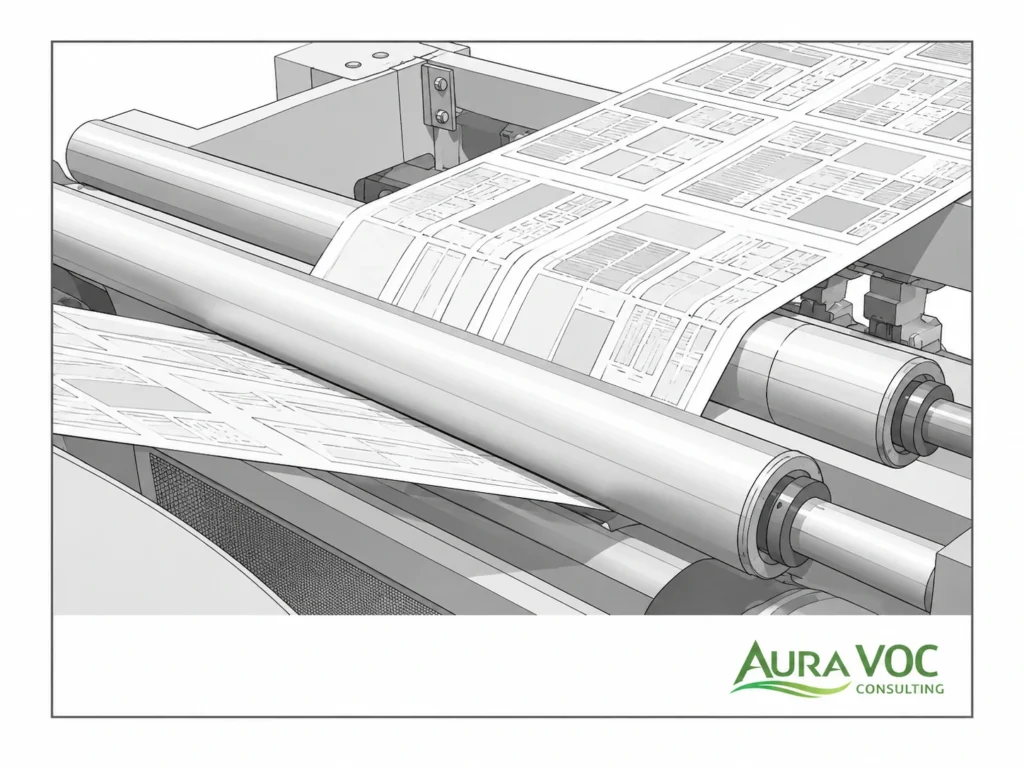
Solvent recovery in flexible packaging printing is not only an emissions-control decision. It affects press exhaust design, solvent handling, utility demand, wastewater generation, recovered solvent quality, maintenance planning, and the operating stability of the printing line. For plants using solvent-based inks, coatings, adhesives, or cleaning agents, the technical question is whether the exhaust stream can be captured, treated, regenerated, and managed in a way that fits the production process and site infrastructure.
Flexible packaging operations can generate solvent-laden exhaust from several points: press dryers, coating or laminating sections, ink circulation systems, cleaning stations, ink kitchens, and local solvent handling areas. The exhaust is often high in airflow and variable in VOC concentration. This makes solvent recovery more complex than treating a steady process vent from a storage tank or reactor. Printing lines operate with changing web speeds, job changes, formulation changes, cleaning peaks, and intermittent production. These conditions influence adsorption loading, regeneration timing, solvent quality, and breakthrough risk.
For plant managers, EHS managers, and process engineers, solvent recovery feasibility should be assessed from measured process data rather than from annual solvent consumption alone. A solvent recovery system may be appropriate where the exhaust is well captured, the solvent mix is reasonably consistent, the recovered solvent has a defined route, and the site has suitable utilities and maintenance capability. Where exhaust is highly diluted, solvent mixtures change frequently, or wastewater handling is constrained, regenerative thermal oxidation, condensation, concentration, or a hybrid VOC abatement system may be more suitable.
How Solvent Recovery Fits Flexible Packaging Printing VOC Control
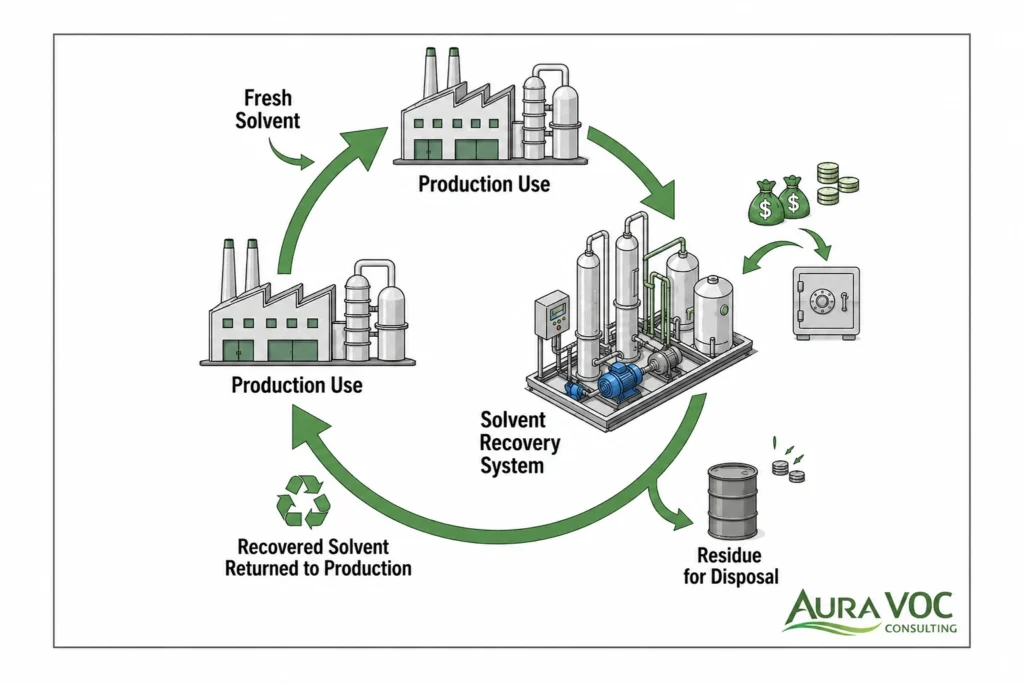
Solvent recovery is one option within a broader VOC control strategy for solvent-based flexible packaging production. It is most relevant where solvent use is significant and where the recovered stream has practical value. Unlike thermal oxidation, which destroys VOCs, a recovery system concentrates and separates solvent from the exhaust so it can potentially be reused, further purified, externally recovered, or handled as a concentrated waste stream.
In printing applications, the most common recovery approach involves activated carbon adsorption followed by regeneration. During production, solvent vapours are adsorbed from the exhaust stream. Once the bed approaches its working capacity, it is isolated and regenerated using steam, hot gas, or inert gas, depending on the system design. The desorbed vapours are then condensed and separated. This sequence introduces operating dependencies that must be considered early: bed cycle time, condenser duty, pressure drop, wastewater load, valve reliability, recovered solvent quality, and safe purge logic.
A recovery system also has to be integrated without compromising the printing process itself. Dryer exhaust rates are not arbitrary; they influence solvent evaporation, drying stability, web temperature, and safe solvent concentration inside the dryer. Reducing airflow may improve recovery economics by increasing VOC concentration, but it also affects LEL safety margins and dryer performance. Increasing extraction may improve capture but can dilute the exhaust, increase fan energy, and enlarge the treatment system.
VOC Sources in Solvent-Based Flexible Packaging Printing
VOC emissions in flexible packaging printing are typically distributed across several process areas. The main load often comes from flexographic or rotogravure press dryers, where solvent evaporates from inks and coatings as the web passes through heated drying zones. Additional sources may include coating stations, laminating sections, adhesive application, ink pans, doctor blade systems, solvent dilution, cleaning operations, and the ink kitchen.
The relative contribution of each source depends on the plant layout and operating practice. A press running long campaigns with stable ink systems may generate a relatively predictable solvent load. A plant with frequent job changes, multiple short runs, and intensive cleaning may experience sharp VOC peaks that are not visible from average daily solvent consumption. These peaks matter because adsorption systems are designed around loading profiles, not only annual solvent use.
Fugitive emissions also need attention. Poorly enclosed ink handling areas, open containers, inadequate local extraction, or unbalanced dryer exhaust can reduce the fraction of solvent available for recovery. If a significant share of solvent loss occurs outside the controlled exhaust network, the recovery system may perform correctly at the stack while the plant still experiences solvent odour, operator exposure concerns, or incomplete solvent mass balance closure.
Why Printing Exhaust Streams Are Difficult to Recover
Printing exhaust streams are challenging because they often combine high air volume with variable solvent concentration. A recovery system performs best when the VOC load is sufficiently concentrated and stable. In many packaging plants, however, exhaust flow is driven by dryer design, safety requirements, and production speed rather than by recovery system optimization.
The solvent mixture can also change from one job to another. Ethanol, ethyl acetate, isopropanol, MEK, toluene, and other solvents may be present depending on the ink, coating, adhesive, and cleaning practice. Mixed solvent recovery is not automatically suitable for reuse. Water content, ink additives, degradation products, and cleaning chemicals can affect recovered solvent quality. Where solvent specifications are tight, additional separation or distillation may be required.
Humidity and temperature add further constraints. Moisture can reduce activated carbon working capacity for some solvent mixtures and can complicate condensation and phase separation. Exhaust temperature affects adsorption performance and may require cooling or process control adjustments. Ink mist, resin particles, and aerosols can foul pre-filters, ductwork, and carbon beds, leading to rising pressure drop and shorter carbon life.
These characteristics make measured operating data essential. Average VOC concentration alone is insufficient. The design basis should include normal production, peak solvent loading, cleaning cycles, start-up, shutdown, and abnormal operating conditions.
Solvent Recovery vs VOC Destruction
The choice between solvent recovery and VOC destruction should be based on process conditions, solvent management objectives, and site constraints. A solvent recovery system can be attractive when the plant uses significant volumes of recoverable solvent, the exhaust stream is well captured, and the recovered solvent has an identified route for reuse, blending, distillation, external recovery, or controlled disposal.
Thermal oxidation or regenerative thermal oxidation may be more suitable where exhaust is dilute, solvent mixtures are inconsistent, recovered solvent has low practical value, or wastewater generated by steam regeneration would create a new site constraint. RTO systems do not recover solvent, but they are often tolerant of mixed VOC streams and can be robust where the priority is consistent emissions control rather than solvent reuse.
Hybrid configurations may also be relevant. A concentrator may reduce airflow before oxidation, or an adsorption system may be used for recovery with a polishing stage for residual VOC. In some plants, solvent recovery may be applied only to selected high-value or high-concentration streams, while other dilute or intermittent exhausts are routed to oxidation or another abatement system. For BAT context, the European Commission STS BREF covers surface treatment activities using organic solvents, including printing and coating.
The comparison should include more than capital cost. Fan power, steam demand, cooling duty, wastewater treatment, carbon replacement, recovered solvent quality, uptime, maintenance access, and safety controls all affect lifecycle performance.
Process Data Required Before Evaluating Solvent Recovery
A solvent recovery feasibility review should begin with plant-specific process data. Generic solvent consumption figures are useful for initial screening, but they do not define the adsorption system, regeneration cycle, condenser duty, pressure drop, or recovered solvent quality. The design basis must reflect how the printing lines actually operate.
The most useful data usually comes from a combination of plant measurements, solvent purchase records, ink and coating formulation data, production schedules, exhaust system drawings, and operating logs. Where existing VOC measurements are limited, temporary monitoring may be required to capture concentration variability across representative operating conditions.
Exhaust Airflow and VOC Concentration Profile
Airflow and VOC concentration are primary inputs for sizing and comparing solvent recovery options. Both should be measured at relevant operating points, including normal production, maximum press speed, job changes, cleaning periods, start-up, shutdown, and idle ventilation.
A single average concentration can be misleading. Activated carbon beds respond to solvent loading over time, while breakthrough risk is affected by peak concentrations and cycle duration. High short-term peaks during cleaning or solvent changeover may require additional design margin, revised operating procedures, or separate capture and treatment logic.
Airflow stability is equally important. If multiple presses are connected to a common recovery system, the number of lines operating at any given time can significantly change total airflow and VOC load. Duct balancing, damper position, fan control, and bypass arrangements should be reviewed before assuming that the exhaust stream is suitable for recovery.
Solvent Composition and Recovery Potential
The solvent composition determines adsorption behaviour, regeneration requirements, condensation performance, wastewater impact, and recovered solvent value. In flexible packaging printing, solvent mixtures may include alcohols, esters, ketones, aromatics, and cleaning solvents. Their relative proportions may change between products, inks, coatings, and suppliers.
Recoverability is not only a question of whether the solvent can be adsorbed. The recovered stream must be assessed for water content, phase separation behaviour, boiling point range, contamination, odour, and reuse tolerance. Some solvent-water mixtures separate cleanly after condensation. Others form emulsions or partially soluble aqueous phases that increase wastewater load or require distillation.
If recovered solvent is intended for reuse in ink dilution or cleaning, the quality requirements should be defined before selecting the recovery system. Without a defined reuse specification, solvent recovery may produce a concentrated waste stream rather than a usable process input.
Production Schedule and Operating Hours
Operating hours and production pattern affect system economics and reliability. A plant running long, stable campaigns provides more predictable adsorption loading and regeneration scheduling. A plant with frequent short runs, multiple job changes, or irregular shutdowns may require more conservative control logic and greater operating flexibility.
Weekend shutdowns, idle ventilation, cleaning shifts, and partial-line operation should be included in the assessment. These periods can influence bed loading, moisture accumulation, start-up emissions, and regeneration timing. For multi-line facilities, the recovery system should be evaluated against realistic combinations of operating presses rather than nameplate maximums only.
Exhaust Temperature, Humidity, and Particulate Carryover
Exhaust temperature influences adsorption capacity, condensation potential, and material selection. High-temperature exhaust may reduce adsorption performance or require cooling before the carbon beds. Temperature fluctuations can also affect VOC measurement accuracy and condensation behaviour.
Humidity is especially relevant for steam-regenerated systems and for solvent mixtures with water affinity. Moisture can reduce effective adsorption capacity, increase condensate volume, and complicate phase separation. The wastewater impact should be assessed together with solvent recovery performance, not as a secondary issue.
Particulate and aerosol carryover from ink mist, resins, or coating materials can foul filters and carbon beds. Rising pressure drop is often one of the first operating signs of fouling. Effective pre-filtration protects the adsorption media but adds maintenance demand and fan resistance.
Reuse, Disposal, or Further Separation of Recovered Solvent
The destination of recovered solvent should be defined early. Direct reuse may be possible in some applications, but it depends on composition, purity, water content, and contamination control. In other cases, recovered solvent may require distillation, blending, off-site recovery, or disposal.
This decision has a direct effect on the value of the recovery system. A technically efficient recovery unit may still be unattractive if the recovered solvent cannot be reused and creates additional handling or disposal cost. Conversely, a moderate recovery rate may be valuable if it produces a consistent stream suitable for internal reuse.
A practical feasibility study should therefore connect emissions control with solvent management. The system should be evaluated as part of the printing plant’s material balance, utility balance, and maintenance strategy, not as a standalone piece of abatement equipment.
Solvent Recovery Technologies for Printing Press Exhaust Streams
Technology selection should start from the exhaust profile and solvent management objective, not from nominal VOC removal efficiency. In flexible packaging plants, the same solvent recovery technology can perform well on one press line and poorly on another if the airflow, solvent mix, cleaning frequency, humidity, or particulate carryover differs significantly.
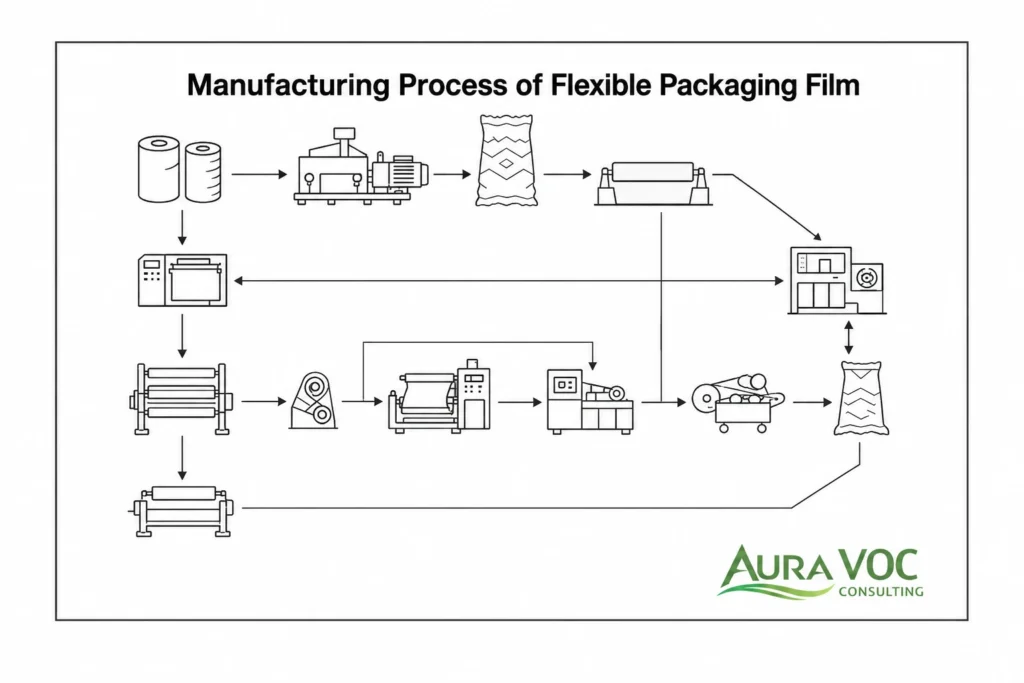
For printing applications, the main questions are operational: can the system handle peak solvent loading without early breakthrough, can regeneration be completed before the bed is needed again, can the condenser manage peak desorption flow, and does the recovered solvent have a usable destination? These questions should be resolved before comparing capital cost.
Activated Carbon Adsorption with Steam Regeneration
Activated carbon adsorption with steam regeneration is commonly used where solvent vapours can be captured at sufficient concentration and where the recovered solvent-water mixture can be separated or further treated.
During production, solvent-laden exhaust passes through one or more activated carbon beds. VOCs are retained on the carbon while treated air is discharged to stack or routed to a polishing stage. Once the working capacity of a bed is reached, the bed is isolated and regenerated with steam. The steam strips solvent from the carbon, and the solvent-water vapour is condensed and sent to separation.
The key design point is working capacity, not total adsorption capacity. Working capacity depends on inlet solvent concentration, temperature, humidity, solvent type, residual loading after regeneration, and carbon condition. If regeneration is incomplete, the next adsorption cycle starts with less available capacity and breakthrough occurs earlier. EPA guidance identifies outlet VOC concentration, regeneration parameters, and carbon bed activity sampling as key indicators for carbon adsorber monitoring.
Steam regeneration also creates an aqueous condensate stream. For solvents that separate cleanly, a decanter may be sufficient. For partially water-soluble solvents, mixed solvent systems, or emulsions containing ink and cleaning residues, the aqueous phase may carry a significant organic load. This affects wastewater treatment, recovered solvent quality, and operating cost.
Operators should monitor bed temperature, differential pressure, inlet VOC, outlet VOC, steam flow, condensate flow, and recovery volume per cycle. A gradual reduction in cycle time is often a better indicator of carbon condition than a single outlet VOC reading.
Activated Carbon Adsorption with Hot Gas or Inert Gas Regeneration
Hot gas or inert gas regeneration may be considered where steam introduces too much water into the recovered solvent or where the site has limited wastewater capacity. These systems regenerate the carbon using heated air, nitrogen, or another controlled gas stream, then condense solvent from the regeneration loop.
The advantage is lower water addition compared with steam. The tradeoff is greater control complexity. Oxygen concentration, regeneration temperature, purge timing, flammability limits, and cooling sequence must be controlled carefully. Nitrogen demand, heater capacity, and condenser duty should be reviewed against the full regeneration cycle, not only average solvent load.
This option is more relevant when recovered solvent quality is important, when water contamination reduces reuse value, or when steam condensate would create a disposal problem. It should not be selected only to avoid wastewater unless the plant can support the inerting, temperature control, and safety requirements.
Condensation and Cryogenic Recovery
Condensation is most effective on higher-concentration, lower-flow solvent streams. Large printing dryer exhaust flows are often too diluted for direct condensation to be efficient without prior concentration. However, condensation can be useful for localized solvent handling vents, cleaning stations, high-concentration exhausts, or streams leaving a regeneration system.
Cryogenic recovery can recover more volatile compounds but adds refrigeration or cryogen consumption, insulation, defrosting considerations, and higher maintenance demand. It should be evaluated against actual solvent concentration and flow variability. If the process produces short solvent peaks rather than steady loading, condenser capacity must be checked against those peaks.
Condenser underperformance usually appears as increased VOC in the regeneration vent, reduced recovered solvent volume, or higher downstream vapour load. Fouling, poor cooling-water temperature, non-condensable gases, and poor condensate drainage are common causes.
Hybrid Systems: Concentration, Recovery, and Oxidation
Hybrid systems are useful when exhaust streams are not uniform. A plant may have one or two high-solvent dryer exhaust streams suitable for recovery and several lower-concentration ventilation or cleaning streams better suited to oxidation or polishing. Treating all streams with one technology can increase cost and reduce reliability.
Typical hybrid approaches include rotor concentration followed by oxidation, activated carbon recovery followed by polishing, or recovery for selected high-value solvent streams with RTO treatment for the remaining exhaust. The tradeoff is added control complexity: dampers, bypass logic, interlocks, monitoring points, and maintenance routines must all be clearly defined.
A hybrid system should be justified by a measured mass balance. Without clear separation between high-value streams and dilute streams, the plant can end up with a complex system that is difficult to operate and only marginally better than a simpler VOC abatement arrangement.
When RTO or Thermal Oxidation May Be More Suitable
Regenerative thermal oxidation is often more suitable where exhaust is dilute, solvent composition changes frequently, or recovered solvent has limited reuse value. RTO does not recover solvent, but it avoids solvent-water condensate from steam regeneration and can handle mixed VOC streams that would be difficult to separate.
The comparison should include fan power, auxiliary fuel or heat recovery, pressure drop, maintenance access, solvent value, wastewater capacity, and expected uptime. A recovery system may be technically attractive on solvent value but poor from an operating standpoint if it creates off-spec recovered solvent, high wastewater COD, or frequent bypass operation.
Typical Solvent Recovery System Layout in a Printing Plant
A solvent recovery system in a flexible packaging plant must be treated as part of the printing process infrastructure. The system starts at the capture points, not at the abatement equipment inlet. Poor duct design, uncontrolled fugitive emissions, inadequate filtration, or unstable airflow can limit recovery performance before the solvent reaches the carbon beds or condenser.
The layout should be reviewed against production requirements, safety requirements, and maintenance access. Retrofitting a recovery system onto existing presses often requires fan curve checks, duct balancing, hazardous area review, structural assessment, and evaluation of downtime windows for installation.
Capture from Press Dryers and Local Extraction Points
The main solvent load usually comes from press dryers, where solvent evaporation is part of normal ink or coating drying. Capture design must maintain adequate removal of solvent vapour without disturbing drying performance. Insufficient extraction can increase solvent concentration inside the dryer, while excessive extraction can increase airflow, reduce recovery efficiency, and increase fan energy demand.
Additional capture points may include ink pans, coating heads, laminating sections, solvent mixing areas, cleaning stations, and ink kitchens. These sources may not all justify recovery individually, but they can influence the plant solvent balance. Where fugitive solvent losses are significant, the recovery system may appear underloaded compared with solvent purchase records.
Ductwork, Dampers, and Airflow Balancing
Ductwork and damper control are critical in multi-press installations. A common header serving several printing lines must handle variable operating combinations without starving one dryer or over-extracting another. Poor balancing can create unstable capture, uneven solvent loading, or operating conditions outside the design basis of the recovery system.
Pressure drop should be reviewed across the full network, including ducts, dampers, filters, adsorption beds, stack, and any heat exchangers. A recovery retrofit may require fan upgrades or control modifications if the existing exhaust system was not designed for the additional resistance.
Pre-Filtration for Ink Mist, Resin, and Particulate Control
Pre-filtration protects the adsorption media and downstream equipment from ink mist, aerosols, resin particles, dust, and other contaminants. Without effective filtration, fouling can increase carbon bed pressure drop, reduce adsorption capacity, shorten carbon life, and create uneven flow distribution through the bed.
Filter selection involves a tradeoff. Higher-efficiency filtration improves protection but adds pressure drop and maintenance demand. Low-cost or undersized filtration may reduce initial cost but increase carbon replacement frequency and unplanned shutdowns. Differential pressure monitoring should be included so that filter loading is managed before it affects capture or bed performance.
Adsorption Beds and Valve Sequencing
Most carbon recovery systems use multiple beds so that one bed can adsorb while another regenerates, cools, or remains on standby. The sequencing must match the VOC loading profile and production schedule. If regeneration takes longer than expected, the available adsorption capacity may be insufficient during peak production.
Valve reliability is central to system performance. Leakage between beds or between adsorption and regeneration circuits can cause emissions during regeneration, steam ingress into the exhaust path, solvent losses, or unstable outlet VOC readings. Actuators, seals, limit switches, and interlocks should be included in routine maintenance planning.
Regeneration, Condensation, and Decanting
During regeneration, solvent is desorbed from the carbon and transferred to the condensation system. Condenser duty must be sufficient for the peak desorption load, not only the average solvent recovery rate. Fouled heat exchangers, inadequate cooling water temperature, poor condensate drainage, or non-condensable gases can reduce recovery efficiency.
After condensation, the solvent-water mixture requires separation. A decanter may be sufficient for solvents that phase-separate clearly. Where emulsions or partial solubility occur, additional treatment, longer residence time, temperature control, chemical separation, or distillation may be needed. This part of the system often determines whether recovered solvent is usable or becomes a waste stream.
Recovered Solvent Storage and Quality Control
Recovered solvent should be managed as a process material with defined quality checks. Sampling may include water content, composition, density, suspended material, odour, and suitability for reuse. Cross-contamination between different solvent campaigns can reduce reuse value and may require segregation or blending rules.
Storage tanks, transfer pumps, vents, bunding, grounding, hazardous area classification, and vapour control should be reviewed as part of the recovery system. Off-spec solvent requires a defined route, otherwise recovered material can accumulate and create operational or compliance problems.
Engineering Tradeoffs in Solvent Recovery System Design
Solvent recovery design is a set of tradeoffs between capture efficiency, solvent quality, utility demand, safety margins, and maintainability. Increasing one performance metric can create constraints elsewhere. A sound design makes these tradeoffs explicit before equipment selection.
Recovery Efficiency vs System Complexity
Higher recovery efficiency may require larger adsorption beds, tighter breakthrough control, more frequent regeneration, better filtration, improved instrumentation, and additional polishing stages. These features can improve performance but also increase maintenance workload and control complexity.
For printing plants, an extremely high recovery target may not be practical if solvent loading changes rapidly or if recovered solvent quality does not support reuse. The design should match the plant’s operating objectives rather than applying a generic recovery target.
Airflow Reduction vs LEL Safety Margin
Reducing exhaust airflow can increase VOC concentration and improve recovery feasibility. However, dryer exhaust rates are constrained by flammability control, drying requirements, heat removal, and equipment design. Any airflow reduction must be assessed against LEL margins, solvent peaks, instrumentation reliability, and purge procedures.
This tradeoff is especially important during start-up, cleaning, and job changes, when short-term solvent release may exceed normal production levels.
Carbon Bed Size vs Regeneration Frequency
Larger carbon beds provide more working capacity and may reduce regeneration frequency, but they increase footprint, capital cost, pressure drop, and carbon inventory. Smaller beds reduce space requirements but may require more frequent cycling, increasing valve wear and operational sensitivity.
The correct balance depends on VOC load variability, available space, production hours, and allowable downtime. Bed sizing should be based on measured loading profiles and realistic regeneration time.
Steam Use vs Wastewater Load
Steam regeneration can be effective but introduces water into the recovery process. More steam may improve desorption, but it also increases condensate volume and the load on separation or wastewater systems. Insufficient steam can leave solvent in the bed and cause early breakthrough in the next adsorption cycle.
Optimization requires monitoring both emissions performance and condensate quality. Steam flow should not be adjusted only to minimize utility use if it compromises bed regeneration.
Pressure Drop vs Fan Energy and Capture Stability
Filters, ducts, dampers, and carbon beds all contribute to pressure drop. As pressure drop rises, fan energy increases and capture stability can deteriorate if the fan cannot maintain required flow. In existing installations, added pressure drop may shift the operating point of the exhaust fan and reduce dryer extraction.
Pressure drop monitoring should be used as an operating diagnostic. A rising trend often indicates filter loading, carbon fouling, duct contamination, or damper malfunction before emissions performance is visibly affected.
Recovered Solvent Value vs Separation Cost
The value of recovered solvent depends on its actual usability. A mixed solvent stream with water, ink additives, or cleaning contaminants may require distillation or off-site processing. If separation cost is high, the economic and operating case for recovery weakens.
Before selecting recovery equipment, the plant should define whether recovered solvent will be reused in printing, reused for cleaning, blended into lower-spec applications, sent for external recovery, or disposed of. This route determines how much solvent quality control and separation capacity is required.
Operational Implications for Flexible Packaging Plants
Once connected to press exhaust, solvent recovery becomes part of the production constraint. The system must be available when the presses operate, and its control logic must be understood by production, EHS, and maintenance teams. Problems in regeneration, filtration, condensation, or valve sequencing can affect printing operations before they appear as formal emissions exceedances.
Effects on Printing Line Availability
If the recovery system trips, reaches high pressure drop, or cannot complete regeneration in time, the plant must know whether the presses can continue, reduce speed, switch to bypass, or shut down. This should be defined in the operating philosophy before the system is commissioned.
Important questions include whether bypass operation is permitted by the site permit, whether there is spare adsorption capacity if one bed is offline, whether the condenser can handle peak desorption from back-to-back regeneration cycles, and whether maintenance can be performed without stopping all connected lines.
For multi-press systems, one unavailable bed may not stop production immediately but may reduce treatment capacity. The control system should make this visible to operators before outlet VOC or LEL alarms become the first indication of reduced capacity.
Managing Job Changes and Solvent Mix Variation
Job changes affect both solvent loading and recovered solvent quality. A cleaning cycle may generate a short high-concentration peak, while a formulation change may alter adsorption behaviour or solvent-water separation. If different solvent families are recovered into the same tank, the recovered stream may no longer be suitable for reuse.
Plants intending to reuse recovered solvent should define campaign rules: which solvent mixtures can be combined, when recovered solvent must be sampled, and when a tank should be segregated. Without these rules, recovery can create an inventory of mixed solvent that cannot be returned to production.
Start-Up, Shutdown, and Purge Sequences
Start-up and shutdown are not low-risk conditions. Solvent can accumulate in dryers, ducts, adsorption beds, and regeneration circuits if purge sequences are incomplete or shortened. Beds left partially loaded over a shutdown may also behave differently at restart, especially if humidity has accumulated.
Purge timing should be verified against actual duct volume, fan performance, damper position, and solvent release during cleaning. The plant should also define whether beds are regenerated before long shutdowns and how the system returns to service after a trip.
Integration with Existing Dryers and Exhaust Fans
A solvent recovery retrofit adds resistance to the exhaust system. Filters, carbon beds, dampers, and duct modifications can shift the fan operating point and change airflow through individual dryer zones. This can affect drying performance, solvent concentration, and capture efficiency.
Before retrofit, the fan curve should be checked against clean and dirty pressure drop conditions. After installation, dryer flows should be rebalanced and verified under representative production conditions, not only during commissioning at no load.
Monitoring Parameters Operators Should Track
Operators need trend data that links emissions performance with equipment condition. The most useful parameters include inlet VOC, outlet VOC, LEL, airflow, bed temperature, pressure drop, steam use, cooling temperature, condensate flow, and recovered solvent volume.
A slowly increasing pressure drop, shortening adsorption cycle, or declining solvent recovery per cycle often gives earlier warning than stack readings alone. Rising pressure drop with stable inlet VOC usually points toward fouling or filter loading. Shorter adsorption cycles after apparently normal regeneration may indicate carbon capacity loss or incomplete desorption. Higher solvent in the aqueous condensate can indicate phase separation problems or a change in solvent composition.
Monitoring should support decisions by operators, not only reporting by EHS. Data trends should be reviewed against production campaigns, cleaning cycles, regeneration records, and maintenance history.
Troubleshooting Solvent Recovery System Problems
Troubleshooting should start with the symptom and then work back through the process, capture system, adsorption bed, regeneration sequence, condenser, decanter, and storage route. Many apparent equipment faults are caused by upstream changes in solvent load, airflow, cleaning practice, or solvent composition.
Early VOC Breakthrough from Activated Carbon Beds
Early breakthrough should be investigated as a loading, regeneration, or media problem. Common causes include higher-than-expected inlet VOC, high humidity, incomplete regeneration, fouled carbon, bed channeling, valve leakage, or heavy compounds accumulating on the carbon.
First checks should include inlet VOC trend, outlet VOC trend, bed temperature profile, regeneration duration, steam or gas flow, condensate volume, and recent production changes. If breakthrough occurs sooner after each regeneration cycle, the carbon may be losing working capacity or regeneration may be incomplete. If breakthrough appears suddenly on one bed, check valve position, bed bypass, channeling, or instrument error.
Rising Pressure Drop Across Filters or Carbon Beds
Rising pressure drop is usually an early warning of fouling. In printing plants, common sources include ink mist, resin aerosols, coating residues, dust, degraded filter seals, or carbon bed compaction. Pressure drop should be measured by section: pre-filter, carbon bed, duct header, damper section, and stack connection.
If only total system pressure drop is measured, the plant may replace filters unnecessarily while the real restriction is in the bed or ductwork. Rising pressure drop can reduce dryer extraction before outlet VOC increases, so it should be treated as a production and safety issue, not only an energy issue.
Low Solvent Recovery Rate
Low recovery rate does not always mean the recovery unit is underperforming. Solvent may be escaping through fugitive emissions, open solvent handling, bypass dampers, poor dryer capture, or dissolved solvent in the aqueous phase.
The first step is a solvent mass balance: solvent purchased, solvent used in inks and cleaning, solvent retained in product or waste ink, solvent recovered, solvent discharged to stack, solvent in wastewater, and estimated fugitive loss. Without this balance, the plant may adjust the recovery unit while the main loss occurs upstream.
Poor Recovered Solvent Quality
Poor recovered solvent quality may result from water carryover, mixed campaigns, ink additives, cleaning chemicals, degradation products, or emulsions in the decanter. The problem should be linked to production history. Sampling by campaign is more useful than random tank sampling after several solvent mixtures have been combined.
Important checks include water content, solvent composition, suspended material, odour, density, and suitability for the intended reuse. If recovered solvent is used for ink dilution, quality limits will be tighter than for cleaning reuse. If off-spec solvent accumulates, the site needs a clear route for distillation, external recovery, or disposal.
Condenser or Decanter Performance Problems
Condenser problems often appear during regeneration rather than normal adsorption. Symptoms include low solvent recovery per cycle, high VOC in the regeneration vent, high non-condensable flow, or unstable condensate temperature. Causes may include fouled heat transfer surfaces, inadequate cooling water, high seasonal cooling temperature, poor drainage, or regeneration flow above design.
Decanter problems appear as water in the organic phase, solvent in the aqueous phase, or persistent emulsions. Residence time, interface control, temperature, solvent composition, and contamination from ink or cleaning agents should be reviewed.
VOC Emissions During Regeneration
VOC emissions during regeneration are usually caused by valve leakage, insufficient condensation, poor vent treatment, incorrect sequencing, or excessive regeneration flow. The regeneration vent can carry concentrated solvent vapour, so it should not be treated as a minor auxiliary stream.
Operators should check valve position feedback, condenser inlet and outlet temperatures, condensate flow, vent VOC, and the timing of steam or gas introduction. If emissions occur only during bed changeover, sequencing and isolation valves should be reviewed.
Maintenance Requirements for Reliable Solvent Recovery
Maintenance has a direct effect on solvent recovery performance. Carbon condition, filter integrity, valve sealing, condenser cleanliness, and instrumentation accuracy all influence emissions, pressure drop, recovered solvent quality, and production availability.
Activated Carbon Testing and Replacement Planning
Carbon replacement should be based on operating history, loading, fouling, and laboratory testing rather than calendar time alone. Loss of working capacity may appear as shorter cycles, early breakthrough, higher pressure drop, or reduced regeneration effectiveness.
Carbon sampling can help distinguish normal saturation from fouling or irreversible capacity loss. Heavy compounds, resin aerosols, and contaminants that are poorly desorbed may accumulate over time. If breakthrough occurs earlier after each regeneration cycle, replacement or deeper investigation of regeneration performance may be required.
Filter Inspection and Differential Pressure Monitoring
Filters protect the carbon beds from ink mist and particulate contamination. Change-out criteria should be based on measured pressure drop and process risk, not only routine intervals. Filter bypass, poor sealing, or damaged media can shorten carbon life significantly.
Differential pressure should be measured across the filter stage separately from the carbon bed. Without segmented pressure data, maintenance teams may not know whether the restriction is caused by filter loading, bed fouling, duct deposits, or damper position.
Valve, Damper, and Seal Maintenance
Valves and dampers control the separation between adsorption, regeneration, cooling, and standby modes. Seal leakage can cause solvent losses, steam carryover, emissions during regeneration, or unstable outlet VOC readings.
Actuators, limit switches, valve seats, seals, and interlocks should be included in preventive maintenance. Position feedback should be checked against actual valve movement, not only control system status. In multi-bed systems, a single leaking valve can affect recovery rate, emissions, and safety logic.
Condenser, Heat Exchanger, and Decanter Maintenance
Heat transfer surfaces, cooling water circuits, condensate drains, and decanter internals require periodic inspection. Fouling or drainage restrictions can reduce solvent recovery before stack emissions indicate a problem.
Condenser maintenance should include checking cooling-water temperature and flow, heat exchanger fouling, condensate drainage, non-condensable venting, and seasonal performance. Decanter maintenance should include interface control, sludge or residue removal, and checks for emulsion formation.
Instrumentation Calibration and Functional Testing
VOC analyzers, LEL sensors, pressure transmitters, temperature sensors, flow meters, and steam meters should be calibrated and function-tested. Incorrect readings can lead to wrong cycle timing, unsafe purge assumptions, or poor troubleshooting decisions.
Functional testing should include alarm actions and trip logic where relevant. An analyzer that reads correctly during calibration but is poorly located, slow to respond, or frequently out of service can still create operating risk.
Wastewater and Condensate Implications
Steam-regenerated solvent recovery creates a liquid management issue as well as an air treatment system. The condensate stream should be characterized early because it can influence technology selection, solvent reuse, wastewater treatment load, and operating cost.
Solvent-Water Condensate from Steam Regeneration
Steam regeneration produces a condensate containing water and solvent. This stream should be segregated and sampled before being routed to general wastewater. Its composition can vary with solvent mix, regeneration conditions, carbon condition, and cleaning practices.
The organic phase may be recovered for reuse or further purification. The aqueous phase may still contain dissolved solvent and may require treatment, distillation, or off-site disposal. Assuming clean phase separation without testing can lead to underdesigned wastewater handling.
Solvent Solubility, Emulsions, and Phase Separation Limits
Some solvents separate clearly from water. Others remain partially dissolved or form emulsions, especially when surfactants, ink additives, resins, or cleaning chemicals are present. These properties affect decanter design, residence time, interface control, solvent losses, and recovered solvent purity.
Persistent emulsions may require longer settling time, temperature control, chemical treatment, or distillation. Solvent dissolved in the aqueous phase can become a hidden loss from the recovery system and a load on wastewater treatment.
COD Load and Impact on Site Wastewater Treatment
The aqueous phase from steam regeneration can carry significant COD. Depending on solvent composition, it may also inhibit biological treatment or create discharge compliance problems. Wastewater capacity should be evaluated before committing to steam-regenerated recovery.
The review should include condensate volume per regeneration cycle, solvent concentration in the aqueous phase, expected daily COD load, available treatment capacity, segregation requirements, and disposal options for off-spec streams.
Distillation or Additional Separation Requirements
Where recovered solvent does not meet reuse requirements, distillation or external recovery may be needed. This can change the economics and maintenance burden of the recovery system.
The need for further separation should be identified before equipment selection. If recovered solvent requires frequent off-site handling or produces difficult wastewater, the plant should compare recovery against RTO, condensation, or hybrid VOC abatement using realistic operating costs.
Energy and Utility Requirements
Energy and utility requirements should be evaluated as operating constraints, not only as cost items. Fan power, steam capacity, cooling water temperature, compressed air reliability, and nitrogen availability can all limit system performance.
Fan Energy and Pressure Drop
Fan energy depends on the total resistance of the exhaust system, including ducts, filters, dampers, carbon beds, and stack. In retrofit projects, the added resistance from filtration and adsorption beds can move the fan away from its original operating point.
Clean and dirty pressure drop conditions should both be evaluated. A system that operates correctly with clean filters may fail to maintain dryer flow once filters load or carbon beds foul. Segment differential pressure monitoring helps identify whether resistance is increasing in the filtration stage, bed, ductwork, or damper section.
Steam or Thermal Energy for Regeneration
Regeneration energy must be sufficient to desorb solvent and restore working capacity. Reducing steam flow or shortening regeneration time may lower utility use temporarily but can cause earlier breakthrough and lower recovery over the next cycle.
Steam capacity should be checked against peak regeneration demand, especially where multiple beds may require regeneration close together. Condensate return, steam pressure stability, trap performance, and insulation condition can all affect regeneration consistency.
Cooling Water, Chilled Water, or Refrigeration Duty
Condensers should be sized for peak desorption flow, not only average solvent recovery. Summer cooling-water temperature can reduce condensation efficiency, increase vent losses, and lower recovered solvent volume.
Cooling limitations are often visible as higher condenser outlet temperature, increased VOC in the regeneration vent, or reduced solvent recovery per cycle. Heat exchanger fouling should be considered before assuming the solvent load has changed.
Compressed Air, Nitrogen, and Auxiliary Utilities
Dampers, actuators, purge valves, inerting systems, and control instruments depend on auxiliary utilities. Loss of compressed air or nitrogen can leave valves in fail positions, interrupt regeneration, or prevent safe restart.
Utility failure modes should be part of the safety and operating review. The plant should know whether valves fail open or closed, whether the system trips safely, and whether press operation is allowed during auxiliary utility loss.
Safety Controls for Solvent Recovery in Printing Operations
Solvent recovery systems handle flammable vapours, concentrated regeneration streams, loaded carbon beds, recovered solvent tanks, and solvent-water condensate. Safety design should cover normal operation, regeneration, start-up, shutdown, bypass, and emergency response.
LEL Monitoring and Explosion Prevention
LEL control should be evaluated at dryers, duct headers, recovery system inlet, and relevant regeneration circuits. Airflow reduction can improve recovery conditions but reduces dilution margin. Cleaning and start-up peaks should be included in the review. OSHA ventilation guidance for solvent vapours references maintaining concentrations below a fraction of the lower explosive limit in relevant operations.
Alarm and trip setpoints should be tied to specific actions: increase ventilation, stop solvent feed, isolate a bed, purge the duct, trip the press, or route to a safe mode. Sensor location, calibration, response time, and maintenance access are as important as the setpoint itself.
Fire Risk in Activated Carbon Beds
Activated carbon beds require temperature monitoring and clear response procedures. Fire risk can increase with excessive solvent loading, poor regeneration, contaminants outside the design basis, poor cooling, or abnormal airflow distribution.
The system should define high-temperature alarms, trip actions, emergency isolation, inerting or suppression provisions where applicable, and inspection requirements after an event. Beds should not be returned to service after a temperature excursion without checking carbon condition and possible internal damage.
Hazardous Area Classification and Solvent Storage
Recovered solvent handling should be reviewed like any other flammable solvent operation. Tanks, pumps, vents, sampling points, drains, bunds, grounding, and transfer lines should match the solvent properties and site hazardous area classification.
Storage design should also consider off-spec solvent. If recovered solvent cannot be reused immediately, the plant needs tank capacity, segregation rules, labelling, and an approved disposal or external recovery route.
Bypass, Trip, and Emergency Shutdown Logic
Bypass logic should be defined before operation. If the recovery system trips, the plant must know whether emissions limits, LEL control, and production requirements allow continued operation. Bypass should not become the normal response to nuisance alarms.
Trip logic should include fan failure, high LEL, high bed temperature, high pressure drop, valve position mismatch, condenser failure, loss of utilities, and analyzer failure where relevant. Operators should be trained on the operating consequence of each trip, not only the alarm text.
When Solvent Recovery Is Technically Suitable for Flexible Packaging Plants
Solvent recovery is strongest where the process produces a recoverable solvent stream and the plant can manage the additional operating requirements. Suitability should be confirmed against measured exhaust data, solvent composition, recovered solvent destination, utilities, wastewater, and maintenance capability.
High Solvent Consumption and Stable Solvent Use
Recovery is more attractive where solvent consumption is significant and solvent formulations are reasonably consistent. Stable campaigns simplify adsorption loading, regeneration scheduling, recovered solvent segregation, and quality control.
Frequent solvent changes do not automatically rule out recovery, but they increase the need for sampling, tank segregation, and possibly distillation. The plant should evaluate whether recovered solvent will be returned to process use or handled as a mixed solvent stream.
Concentrated and Well-Captured Exhaust Streams
Good capture and moderate-to-high VOC concentration improve recovery feasibility. Highly diluted exhaust increases equipment size, pressure drop, fan energy, and regeneration demand.
The capture system should be reviewed before the recovery system is sized. If solvent is lost through fugitive emissions, open handling, or poor local extraction, the recovery unit may be correctly designed but still recover less solvent than expected.
Clear Reuse or Disposal Route for Recovered Solvent
Recovered solvent must have a defined destination. Reuse, blending, distillation, external recovery, or disposal should be evaluated before equipment selection.
The quality requirement depends on use. Solvent reused for cleaning may tolerate different impurities than solvent used for ink dilution. If the plant cannot use the recovered solvent directly, the cost and logistics of further purification or off-site handling must be included.
Available Utilities and Wastewater Capacity
Steam, cooling, power, compressed air, nitrogen, space, maintenance access, and wastewater handling capacity can determine whether recovery is workable at a given site.
Utility constraints should be checked during peak production and peak regeneration demand. A system that appears suitable on average flows may be limited by summer cooling-water temperature, steam pressure drop during regeneration, or insufficient wastewater capacity during intensive production periods.
When Alternative VOC Abatement May Be More Practical
Alternative VOC abatement may be more practical where recovery creates more operating problems than it solves. This does not mean recovery is technically weak; it means the exhaust stream, solvent route, or site infrastructure may not match the technology.
Dilute Exhaust with High Airflow
Large volumes of dilute exhaust may be better suited to oxidation or concentration plus oxidation, depending on operating hours and energy balance. Direct recovery from very dilute streams can require large adsorption beds, high fan power, and frequent regeneration without producing a valuable recovered solvent stream.
Before selecting recovery, the plant should determine whether airflow can be reduced safely, whether capture can be improved, or whether only selected high-concentration streams should be routed to recovery.
Highly Variable or Contaminated Solvent Mixtures
Frequent solvent changes or contamination by additives and cleaning chemicals can reduce recovered solvent value and increase separation burden. Mixed solvent recovery may still be useful if the stream can be externally recovered or used for cleaning, but it may be unsuitable for direct reuse in ink dilution.
The evaluation should include real campaign history, not only current formulations. Supplier changes, cleaning practices, and occasional specialty jobs can affect recovered solvent quality.
Limited Wastewater Handling Capacity
Where steam regeneration would overload wastewater treatment or create difficult aqueous streams, non-steam regeneration, oxidation, or a hybrid system may be more reliable. Wastewater limitations should be identified early because they can determine the technology choice.
The assessment should include condensate volume, solvent solubility, COD load, emulsion potential, segregation requirements, and off-site disposal options.
Retrofit Constraints on Existing Printing Lines
Limited space, duct routing, fan capacity, hazardous area constraints, structural support, and production downtime may restrict recovery system installation. A recovery system that is technically suitable on paper may be difficult to install without major production disruption.
Retrofit studies should include equipment layout, maintenance access, carbon replacement logistics, utility tie-ins, drainage, solvent tank location, and access for cranes or lifting equipment where needed.
Solvent Recovery Feasibility Checklist
A feasibility review should convert the operating questions into measurable data. The purpose is not only to size equipment, but to determine whether solvent recovery will fit the plant’s production, utility, maintenance, and solvent management requirements.
Process Measurements Required
The minimum process dataset should include exhaust flow per press or header, VOC concentration during production and cleaning, solvent composition by campaign, exhaust temperature, humidity, operating hours, solvent consumption, and cleaning solvent use.
Where possible, data should include time-based profiles rather than averages. Adsorption bed loading, breakthrough risk, and condenser sizing depend on peaks and cycle duration.
Utility and Infrastructure Data Required
Review available steam pressure and capacity, cooling water temperature and flow, chilled water or refrigeration availability, electrical power, compressed air, nitrogen, drains, wastewater treatment capacity, footprint, and maintenance access.
For retrofit projects, fan curves, duct drawings, damper positions, and space around presses are as important as the recovery equipment specification.
Operating and Maintenance Data Required
Document job change frequency, cleaning procedures, current filter maintenance, downtime windows, operator coverage, instrumentation reliability, spare parts strategy, and existing VOC system problems.
A solvent recovery system with good design margins can still perform poorly if maintenance access is limited or if regeneration cycles conflict with production schedules.
Performance Criteria for Technology Selection
Define outlet VOC limits, expected recovery rate, recovered solvent quality, pressure drop, fan energy, steam demand, cooling duty, wastewater load, uptime requirement, alarm philosophy, and safety interlocks.
Performance guarantees should be measurable under defined production conditions. A guarantee based only on average operation may not address cleaning peaks, multi-line operation, high-humidity periods, or partially loaded operating modes.
Questions to Review Before Requesting a Technical Assessment
Before comparing solvent recovery with RTO, condensation, or hybrid VOC abatement, confirm which exhaust streams carry most of the solvent load, what VOC concentration occurs during production and cleaning, which solvent mixtures are used by campaign, whether recovered solvent can be reused or externally recovered, what wastewater capacity exists, whether existing fans can handle added pressure drop, and what happens if the recovery system trips during production.
FAQ
Is solvent recovery always preferable to thermal oxidation?
No. Solvent recovery is preferable only when the exhaust is well captured, solvent concentration is sufficient, solvent composition is manageable, and the recovered stream has a defined reuse or recovery route. RTO may be more reliable for dilute, variable, or contaminated exhausts.
Can solvent recovery be retrofitted to an existing printing line?
Yes, but retrofit feasibility depends on duct routing, fan capacity, dryer airflow requirements, available footprint, hazardous area classification, utility availability, and permitted bypass operation. Fan curves and dryer balance should be checked before installation.
What causes early breakthrough in activated carbon beds?
Typical causes include high inlet VOC peaks, humidity, incomplete regeneration, carbon fouling, channeling, valve leakage, carbon aging, or incorrect cycle timing. Trend data from inlet VOC, outlet VOC, bed temperature, and regeneration flow is needed to identify the cause.
What causes high pressure drop in a carbon adsorption solvent recovery system?
High pressure drop can result from blocked filters, ink mist carryover, resin deposits, carbon bed compaction, duct contamination, or damper malfunction. Pressure should be measured across individual sections to locate the restriction.
Can recovered solvent from flexible packaging printing be reused directly?
Sometimes. Direct reuse depends on solvent composition, water content, contamination, and the intended use. Solvent suitable for cleaning may not meet the quality needed for ink dilution. Sampling and segregation by campaign may be required.
Why does steam regeneration create wastewater problems?
Steam regeneration condenses into a solvent-water mixture. If solvent dissolves in the aqueous phase or forms emulsions, the wastewater may have high COD or require distillation, dedicated treatment, or off-site disposal.
How does solvent recovery affect printing dryer airflow?
Solvent recovery equipment adds pressure drop through filters, ducts, dampers, and carbon beds. If fan capacity is limited, dryer extraction may fall, affecting drying performance, solvent concentration, and capture reliability.
What happens if the solvent recovery system trips during production?
The response depends on the plant’s operating philosophy and permit conditions. Options may include press shutdown, reduced production, emergency bypass, routing to an alternative VOC system, or controlled purge. This logic should be defined before operation.
When is a hybrid VOC abatement system better than full solvent recovery?
A hybrid system may be better when the plant has a mix of concentrated recoverable streams and dilute or variable streams. Recovery can be applied to selected solvent-rich exhausts while oxidation or polishing treats the remaining VOC load.
What process data is needed before evaluating solvent recovery?
The first review should include exhaust flow per press, VOC concentration profiles during production and cleaning, solvent composition by campaign, operating schedule, solvent consumption, exhaust temperature, humidity, available utilities, pressure drop constraints, wastewater capacity, and the intended route for recovered solvent.
Conclusion
Solvent recovery in flexible packaging printing should be evaluated through the same operating lens used for other process equipment. The system affects dryer extraction, fan performance, solvent handling, regeneration utilities, wastewater load, carbon maintenance, recovered solvent quality, and safety interlocks.
The strongest candidates are plants with well-captured exhaust, measurable solvent loading, stable solvent use, sufficient utilities, and a realistic route for recovered solvent. Plants with highly diluted exhaust, frequent solvent changes, difficult wastewater constraints, or limited retrofit space may require RTO, condensation, concentration, or a hybrid VOC abatement system instead.
A credible evaluation depends on measured exhaust flow, VOC concentration profiles, solvent composition, production schedule, utility capacity, wastewater limits, and maintenance capability. These data points determine whether solvent recovery is an operating asset or an added constraint on the printing line.
CTA
AuraVOC can review press exhaust measurements, solvent mass balance, adsorption feasibility, regeneration utilities, wastewater constraints, retrofit limits, and alternative VOC abatement options for flexible packaging plants.
The first review should confirm actual exhaust flow per press, VOC concentration during production and cleaning, solvent composition by campaign, available steam and cooling capacity, pressure drop constraints, wastewater capacity, and whether recovered solvent can be reused, distilled, externally recovered, or handled as waste.