
Activated Carbon Bed Fire Risk in VOC Systems
Activated carbon adsorbers are widely used in industrial VOC abatement systems because they can provide effective removal for many solvent vapors at moderate temperatures and concentrations. In practice, however, a carbon bed is not a passive component that can be installed and left to operate without close attention to process conditions. The same adsorption mechanism that captures VOCs also releases heat, and under certain operating conditions that heat can accumulate inside the bed.
A moderate temperature rise during adsorption may be normal. The operational concern is uncontrolled or localized heat accumulation, especially when it is not visible from average inlet and outlet temperature readings. A hot zone can develop inside the bed while external vessel temperature and stack VOC concentration still appear acceptable.
For plant managers, EHS managers, and process engineers, the practical question is whether the system is operating inside the safe operating window for the actual exhaust stream it receives. That requires looking beyond the original equipment specification. Peak solvent concentration, airflow margin, inlet temperature, humidity, oxygen content, aerosol carryover, carbon age, fan performance, pressure drop, and upstream filtration all influence the risk profile.
Carbon bed fire risk often changes after routine production decisions: a new cleaning solvent, a longer batch campaign, a higher coating-line speed, a dryer temperature adjustment, or a change in filter maintenance. These changes may not appear significant from a production perspective, but they can alter heat release, breakthrough time, pressure drop, and carbon service life.
A technically sound review of activated carbon bed fire risk should therefore start with operating data. The key questions are what is entering the bed, how the bed temperature responds, whether airflow is maintained under dirty-system conditions, whether the carbon is still compatible with the solvent mix, and whether pressure drop, breakthrough, or odor trends indicate a developing operating problem.
Why Carbon Bed Fire Risk Affects VOC System Reliability
Operational Consequences for Industrial Plants
An activated carbon bed fire, overheating event, or suspected hot spot can affect much more than the adsorber vessel. In many plants, the VOC abatement system is directly tied to production availability. If the carbon unit must be isolated, bypassed, flooded, inerted, or emptied, the affected process may need to slow down or stop completely.
The operational impact can include unplanned shutdowns, emergency bypass operation, loss of emission control capacity, urgent carbon replacement, fan instability, contaminated waste generation, and delayed restart. Even where no open flame occurs, an unexplained temperature rise inside the bed can require inspection before the unit is returned to service. That inspection may involve cooling time, gas testing, carbon removal, vessel entry controls, and waste classification.
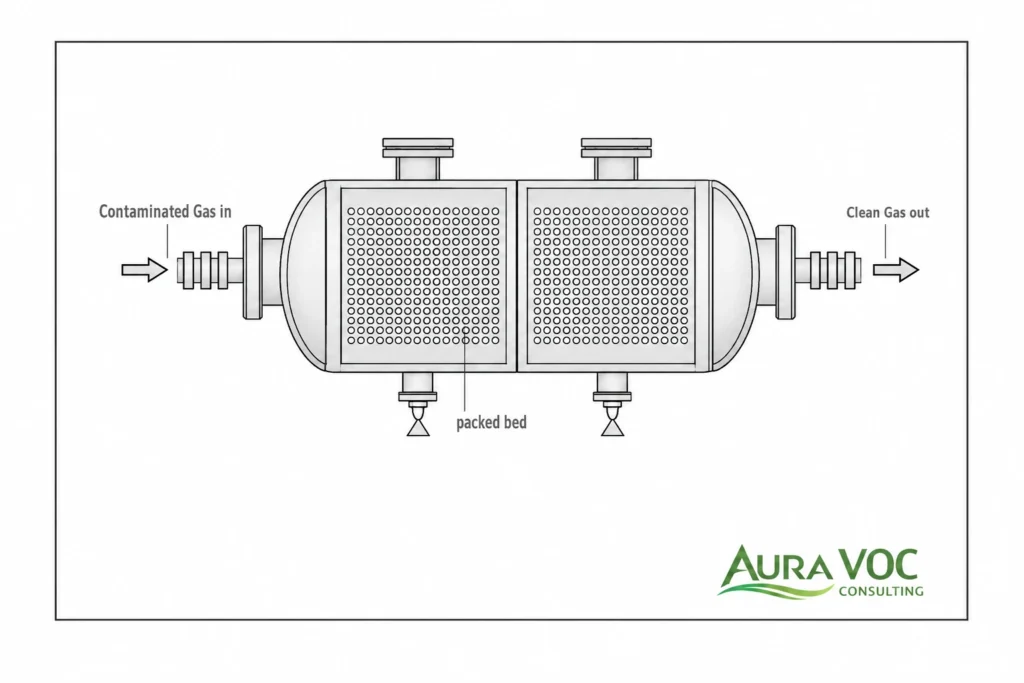
From an EHS perspective, carbon bed fire risk also affects how abnormal operation is managed. A carbon adsorber close to breakthrough or showing a rising internal temperature trend may not provide a reliable control barrier during high-load production periods. Odor complaints, stack concentration excursions, and repeated early carbon replacement are often treated as separate issues, but they may point to the same underlying problem: the system is operating outside the conditions assumed during design.
For process engineers, the concern is often related to process flexibility. A carbon system designed around one solvent mix and production rate may not remain suitable after changes to formulations, batch duration, cleaning frequency, exhaust temperature, or duct routing. The adsorber may still remove VOCs during normal operation, but with a smaller margin against overheating, breakthrough, or excessive pressure drop.
Where Activated Carbon Beds Are Commonly Used
Activated carbon beds are commonly applied where VOC concentrations are moderate, temperatures are controlled, and the exhaust stream is reasonably free from aerosols, particulate, and condensable material. Typical applications include solvent tank vents, reactor vents, drum filling areas, pharmaceutical manufacturing exhaust, coating and paint line ventilation, food manufacturing odor streams, and general industrial solvent extraction systems.
The fire-risk drivers differ by sector. In pharmaceutical production, batch campaigns can generate short solvent peaks during charging, drying, cleaning, or vessel opening. A design based only on daily average concentration may underestimate the heat release during these peaks. In coatings and paint applications, the issue may be less about vapor concentration alone and more about overspray, resin droplets, or solvent-laden mist reaching the bed and fouling the carbon surface.
Chemical manufacturing plants may face changing VOC composition, especially where multiple products or campaigns share the same abatement system. A solvent that adsorbs predictably under one campaign may be replaced by a more reactive, more strongly adsorbed, or less suitable compound in another. Food and flavor applications often introduce high humidity, organic aerosols, and odor compounds that can reduce carbon capacity or create unstable breakthrough behavior.
General industrial manufacturing can present a different challenge: intermittent operation. Exhaust systems used for cleaning, degreasing, adhesive application, or occasional solvent handling may not run continuously. Startup, shutdown, and idle conditions can leave residual VOCs in the bed, change airflow patterns, or allow heat to remain in localized zones if the system is not properly purged.
Why Fire Risk Is Usually Linked to Operating Conditions
Carbon bed fire risk is rarely explained by a single factor. It is normally the result of several operating conditions occurring together. High VOC loading increases heat generation. Low airflow reduces heat removal. Elevated inlet temperature reduces the available margin before desorption, oxidation, or accelerated carbon degradation becomes relevant. Humidity can reduce adsorption capacity and cause earlier breakthrough. Aerosol or particulate carryover can create fouled zones, channeling, and uneven flow distribution.
Oxygen content is also important. Most industrial VOC exhaust streams are air-based, which means oxygen is present throughout the bed. Under normal controlled conditions this is expected. Under elevated temperature, stagnant airflow, or localized hot spot conditions, oxygen availability becomes a more important part of the risk assessment.
For this reason, activated carbon systems should be evaluated against their actual operating envelope, not only their nominal design case. A system may perform acceptably at average concentration and design flow but become unstable during short solvent peaks, blocked-filter operation, abnormal humidity, or process startup. The practical engineering task is to identify which combinations of VOC load, airflow, temperature, and bed condition reduce the available margin.
How Activated Carbon Beds Overheat in VOC Service
Heat Generation from High VOC Loading
VOC adsorption on activated carbon is exothermic. In plant terms, the carbon bed releases heat as solvent vapor is captured. Under stable load and adequate airflow, this heat is normally carried away by the exhaust stream. Problems begin when solvent loading increases faster than heat can be removed, particularly in the inlet zone of the bed where adsorption is most active.
This is why peak concentration matters more than daily average concentration for activated carbon bed overheating. A dryer exhaust, vessel-cleaning step, coating-line surge, reactor charging event, or solvent transfer operation may generate a short solvent pulse that heavily loads the first section of carbon. The total daily VOC mass may look acceptable, but the instantaneous load can create a localized temperature rise.
For batch and intermittent processes, the design basis should include peak concentration, peak duration, frequency of events, purge time between events, and expected carbon loading before replacement or regeneration. A repeated sequence of solvent peaks with limited cooling time between them can create a different risk profile from a continuous low-concentration stream with the same daily mass load.
A temperature rise during a known solvent-loading step is not automatically abnormal. It should be compared against historical cycles for the same process phase. A faster rate of increase, a higher peak than previous batches, or a temperature rise during purge, standby, or shutdown deserves closer investigation.
Hot Spots Inside the Carbon Bed
A carbon adsorber hot spot is a localized zone of elevated temperature inside the bed. Hot spots can form when VOC loading, airflow, or bed condition is not uniform. Common causes include poor inlet gas distribution, channeling, carbon settling, wet areas, carbon fines, fouled sections, bed compaction, or partially blocked support screens.
Inlet and outlet temperature readings may not detect a developing hot spot. The bed has limited thermal conductivity, the gas stream may bypass the affected area, and the outlet reading is an average across the full flow. A hot zone near the inlet face or along a preferential flow path can therefore remain hidden until the condition has progressed.
For higher-risk systems, internal temperature probes should be located where heat generation is most likely: near the inlet adsorption zone, at multiple bed depths, and across representative areas of the vessel. Probe placement should reflect the actual vessel geometry and flow pattern, not only convenient nozzle locations.
Carbon Oxidation Under Hot or Oxygen-Rich Conditions
Activated carbon can oxidize when elevated temperature, oxygen availability, and time combine under unfavorable conditions. Most VOC exhaust systems are air-based, so oxygen is normally present. The control strategy is not to eliminate oxygen in every case, but to keep bed temperature, solvent loading, and airflow within a defined operating window.
Oxidation risk can increase when the fan is stopped while the bed still contains residual solvent and retained heat. It can also increase where purge flow is inadequate, where a fouled section retains heat, or where high inlet temperature coincides with high solvent loading. A stagnant bed after shutdown may be more concerning than a bed under normal ventilated operation, because heat removal is reduced.
Shutdown and restart procedures should therefore be part of the fire-risk assessment. Where the duty justifies it, procedures should define minimum purge time, acceptable bed temperature before isolation, airflow confirmation before restart, and actions after any high-temperature alarm.
Reactive, Polymerizable, or High-Risk VOC Compounds
Not all VOCs are suitable for routine activated carbon service without further review. Some compounds adsorb strongly and release more heat. Others may react, polymerize, degrade, or form unstable deposits under certain conditions. Solvent families that often require compound-specific evaluation include ketones, aldehydes, sulfur-containing compounds, nitrogen-containing compounds, organic peroxides, and polymerizable vapors.
The presence of these compounds does not automatically exclude activated carbon, but it changes the engineering review. The plant should confirm carbon compatibility with the supplier or system designer, review heat of adsorption where data are available, check whether inhibitors are required for polymerizable vapors, and avoid relying on previous solvent approvals after a formulation change.
For uncertain or variable streams, a pilot test, temporary monitoring campaign, or alternative abatement review may be more appropriate than assuming the existing carbon bed can accept the new duty.
Solvent Mixtures, Cleaning Agents, and Campaign Variability
Many industrial VOC systems do not handle a single pure compound. They handle solvent mixtures, changing formulations, cleaning agents, trace contaminants, or campaign-dependent exhaust streams. This variability can affect adsorption capacity, heat release, breakthrough time, carbon replacement frequency, and waste classification.
A common failure mode is treating a carbon adsorber as suitable because it performed acceptably under a previous solvent mix. A new cleaning procedure, higher-boiling solvent, reactive component, or increased batch frequency can change the bed loading profile. These changes may not be visible in the permit basis or general equipment description, but they can be critical for fire-risk assessment.
Solvent changes and production changes should trigger a management-of-change review for the VOC abatement system. The review should include carbon compatibility, expected peak load, bed temperature monitoring, pressure drop trend, airflow capacity, carbon replacement interval, and expected breakthrough behavior.
Operating Conditions That Increase Carbon Bed Fire Risk
VOC Concentration Peaks in Batch or Intermittent Processes
Carbon adsorbers are often designed using expected average VOC concentration, total flow rate, and operating hours. For fire-risk assessment, the peak concentration profile is usually more important than the average. A batch process that discharges a short, high-concentration solvent pulse can load the first section of the carbon bed much more aggressively than a steady exhaust stream with the same daily mass flow.
This is common in pharmaceutical production, reactor charging, solvent transfer, vessel cleaning, drying, and coating operations. During these phases, the exhaust composition can change quickly. The carbon bed may see a brief solvent front with higher heat release, followed by lower concentration ventilation air. If these events are repeated throughout a shift, the bed may not have sufficient time to dissipate heat before the next loading cycle.
For process engineers, this means the design basis should include realistic peak concentrations, event duration, and frequency. For EHS and operations teams, it means that production changes can affect risk even when the permitted annual VOC mass does not change significantly.
Low Airflow or Poor Flow Distribution
Airflow through the carbon bed performs two functions: it transports VOCs to the adsorbent and removes heat from the bed. When airflow is lower than expected, the bed may receive a less diluted VOC stream and have reduced convective cooling. This combination can be significant during high-load operation.
Low airflow may result from fan underperformance, closed or partially closed dampers, loaded filters, fouled mist eliminators, duct restrictions, or excessive pressure drop across the carbon vessel. In some cases, the total system flow may appear acceptable, but distribution through the adsorber is uneven. Maldistribution can create sections of high local loading, while other areas of the bed are underused.
Flow distribution should be reviewed when temperature trends, early breakthrough, or abnormal pressure drop occur. A carbon adsorber is not only a vessel filled with media; it is part of an airflow system. Fan curves, damper positions, duct configuration, inlet plenums, support screens, and bed loading practices all affect how the gas actually moves through the carbon.
High Inlet Gas Temperature
Activated carbon systems have a more limited operating window when inlet gas temperature is elevated. Warm exhaust reduces the margin between normal adsorption temperature rise and conditions where desorption, oxidation, or accelerated degradation may become relevant.
High inlet temperature can come from dryers, ovens, heated process equipment, poorly cooled ventilation streams, thermal carryover from upstream equipment, or seasonal changes in ambient conditions. In coating and drying applications, the exhaust may vary with production rate, oven zone temperature, and ventilation balance. In chemical and pharmaceutical plants, heated process vessels or vacuum systems can produce warmer-than-expected vent streams during certain operating steps.
Temperature should be evaluated as a trend, not only as a maximum value. A single maximum temperature is less useful than the rate of increase, the location of the increase, and whether the rise occurs during production, purge, standby, or shutdown. A small increase in inlet temperature may be acceptable under low VOC loading but problematic during solvent peaks or reduced airflow.
High Humidity, Condensation, or Wet Carbon
Humidity affects activated carbon bed performance in several different ways. Water vapor can compete with VOCs for adsorption capacity, especially for certain solvent classes and carbon types. Condensation can create wet zones, increase pressure drop, promote corrosion, and change the flow path through the bed. Humid operation can also produce unstable breakthrough patterns, where outlet VOC concentration changes with temperature and moisture conditions rather than carbon loading alone.
Wet carbon is particularly difficult to troubleshoot because it can look like several different problems at once: reduced capacity, rising differential pressure, odor complaints, and inconsistent outlet VOC readings. If the bed has been exposed to high humidity or condensate, pressure drop should be checked against the clean-bed baseline and the vessel should be inspected during the next changeout for wet areas, caking, corrosion, or channeling.
Engineering controls may include upstream cooling control, duct insulation, condensate separation, demisting, heat tracing, drainage improvements, or selection of another abatement technology. Simply increasing the carbon inventory may not solve the problem if the bed is receiving a mixed vapor, mist, and condensate load rather than a stable vapor-phase VOC stream.
Aerosol, Mist, Overspray, or Particulate Carryover
Activated carbon beds are intended for vapor-phase adsorption. They are not designed to act as primary filters for overspray, resin droplets, oil mist, sticky condensables, or process dust. When these materials reach the bed, they can foul the carbon surface, block pore structure, create localized resistance, and interfere with normal flow distribution.
Coating and paint processes are especially sensitive to this issue. Even small quantities of overspray or resin mist can accumulate over time, particularly if pre-filtration is undersized, poorly maintained, or bypassed. Similar problems can occur with oil mist from mechanical processes, condensable organic vapors, or particulate carryover from upstream handling equipment.
Fouled carbon may still show partial VOC removal, but its operating behavior becomes less predictable. Rising pressure drop, early breakthrough, odor complaints, and uneven temperature response should prompt a review of upstream protection. Pre-filters, mist eliminators, knock-out pots, and drainage points should be treated as part of the carbon system, not optional accessories.
Oxygen Content and Inerting Constraints
Most industrial carbon adsorbers treating ventilation exhaust operate in air, so oxygen is normally present. This is acceptable when temperature, solvent loading, and airflow remain within the intended operating range. The risk changes when elevated temperature, high VOC loading, stagnant conditions, or reactive compounds are present.
Some process vents may be inerted upstream, but the abatement system may still introduce air through dilution, leakage, purge steps, or shared ductwork. Conversely, fully inerted operation may introduce design and operational constraints related to oxygen monitoring, nitrogen supply, confined space entry, and safe maintenance.
Oxygen content should be reviewed in the context of the whole system. It is not enough to classify the process as “air-based” or “inerted.” The relevant questions are where oxygen may enter, how oxygen concentration changes during startup or shutdown, and whether the carbon bed can be isolated, purged, or cooled safely if abnormal temperature is detected. Fire and explosion risk assessment should also consider applicable dangerous substances and explosive atmosphere requirements.
Warning Signs of Carbon Bed Overheating or Fire Risk
Abnormal Bed Temperature Trend
A gradual temperature increase across a carbon bed may be more useful than a single high-temperature alarm. Operators should compare inlet, outlet, and internal bed temperature trends against production activity, solvent use, airflow, and ambient conditions. A temperature increase that coincides with a known solvent peak may be expected within limits; a rise during idle operation, purge, or after fan shutdown requires closer review.
Internal bed probes are particularly important where VOC loading is variable, bed depth is significant, or solvent compatibility is uncertain. Inlet and outlet temperatures can miss localized heating. If a probe at one bed depth or one side of the vessel consistently rises faster than the others, this may indicate maldistribution, channeling, localized fouling, or a developing hot zone.
Temperature trends should be reviewed by operating mode. A bed that behaves normally during steady production may show abnormal temperature behavior during startup, product changeover, cleaning, or shutdown. These transitional phases often reveal risks that are not visible from daily averages.
Early VOC Breakthrough
Early breakthrough is a practical indicator that the carbon bed is no longer performing as expected. It may result from exhausted carbon, high humidity, incorrect carbon selection, higher-than-expected VOC loading, channeling, or insufficient bed depth. It may also occur when a new solvent mixture behaves differently from the original design basis.
Outlet VOC monitoring should be interpreted with operating context. A spike during a batch step may indicate peak overload. A gradual upward trend may indicate normal exhaustion or reduced capacity. Intermittent odor events may point to bypass leakage, uneven flow, or desorption during changing temperature conditions.
Breakthrough and overheating are not the same condition, but they can be related. A bed that is heavily loaded, fouled, or poorly distributed may show both reduced adsorption performance and increased thermal risk.
Rising Pressure Drop Across the Adsorber
Differential pressure is one of the most useful routine indicators of carbon bed condition. A rising pressure drop can indicate particulate loading, mist fouling, wet carbon, bed compaction, carbon fines, or overloaded pre-filtration. It can also reduce actual airflow if the fan does not have adequate capacity margin.
The operational concern is that pressure drop does not only affect energy use. It can create two process problems: lower total exhaust flow if the fan cannot maintain design duty, and uneven bed flow if fouling or wetting is localized. The bed may then experience less heat removal at the same time that part of the carbon receives higher local VOC loading.
A pressure drop increase should be compared against the clean-bed baseline, dirty-system design limit, filter condition, and fan curve. A value that is still below an alarm setpoint may still be significant if the trend is rising faster than normal.
Shorter Than Expected Carbon Service Life
Frequent carbon replacement should not be treated only as a consumable cost issue. If carbon life is consistently shorter than expected, the system may be seeing higher VOC load, different solvent composition, humidity interference, aerosol fouling, channeling, or inaccurate assumptions about operating hours.
Replacement history should be reviewed against production logs, solvent consumption, pressure drop trends, and outlet VOC readings. A change in carbon life often reveals a process change that was not captured in the original abatement system design basis.
Short carbon life can also indicate poor use of the bed. If channeling is present, a portion of the carbon may remain underused while another portion reaches breakthrough early. Carbon sampling during changeout can help distinguish uniform exhaustion from maldistribution.
Odor Events, Smoke, or Heat During Shutdown
Odor, visible smoke, or abnormal heat during shutdown should be treated as an operating deviation requiring investigation before restart. Shutdown can create unfavorable conditions if airflow stops while the bed contains residual VOC loading or retained heat. Depending on the process, a controlled purge or cooldown step may be needed before isolation.
Restart after a suspected hot spot should not rely only on external vessel temperature. The bed may retain heat internally. Temperature readings, VOC concentration, airflow confirmation, and inspection criteria should be defined in site procedures for higher-risk systems.
If odor or heat is observed during shutdown, the plant should review the preceding operating period: solvent peaks, fan status, pressure drop, filter condition, inlet temperature, and any recent solvent or production change.
Troubleshooting Carbon Bed Temperature, Breakthrough, and Pressure Drop Problems
First Checks When Bed Temperature Rises
When bed temperature rises unexpectedly, the first step is to compare the temperature trend with the production sequence. The operator should confirm whether the rise occurred during solvent charging, dryer operation, cleaning, purge, standby, or after fan shutdown. The timing often indicates whether the event is driven by normal solvent loading, abnormal solvent concentration, reduced heat removal, or residual heat in the bed.
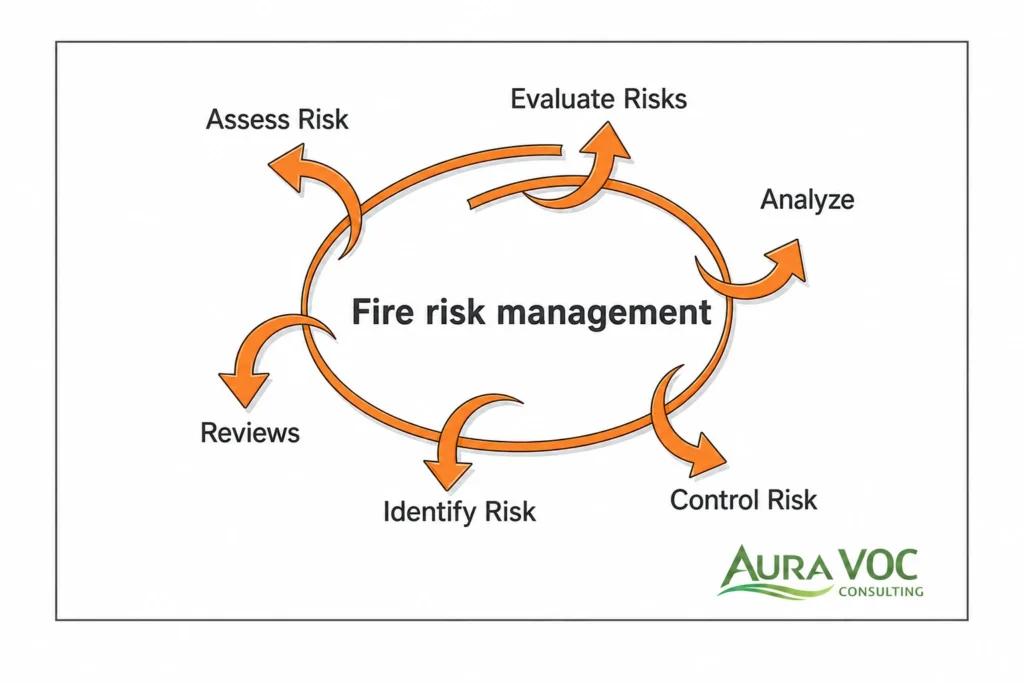
The immediate checks should include current airflow versus design airflow, fan speed, damper position, filter differential pressure, mist eliminator condition, inlet gas temperature, recent solvent use, and whether any solvent or cleaning-agent change has occurred. Temperature probe accuracy should be verified, but a faulty probe should not be assumed until process and airflow causes have been ruled out.
Where only inlet and outlet temperature readings are available, the plant may not have enough information to locate an internal hot spot. A repeated unexplained temperature rise is a strong reason to evaluate internal temperature monitoring.
First Checks When VOC Breakthrough Occurs Early
Early VOC breakthrough should be investigated against the original adsorber design basis. The plant should compare actual solvent use, peak concentration, operating hours, humidity, flow rate, and carbon age against the assumptions used for sizing. If current production includes a new solvent mix, longer campaign, or higher cleaning frequency, the expected carbon life may no longer be valid.
Early breakthrough can also indicate channeling. A bed may contain enough carbon mass but still break through early if gas bypasses part of the media. During changeout, inspection should check for uneven settling, cracks in the bed surface, wet or caked regions, carbon fines, damaged retainers, or poor loading practices.
Carbon sampling can help distinguish between true exhaustion and maldistribution. Comparing carbon from the inlet zone, middle zone, and outlet zone can show whether the bed was uniformly loaded or whether a portion of the media was underused.
First Checks When Pressure Drop Increases
A carbon bed pressure drop increase should be traced section by section. Check upstream filters, mist eliminators, ductwork, the carbon vessel, and downstream components separately where differential pressure taps are available. This prevents a loaded filter from being misdiagnosed as a carbon problem, or a wet carbon bed from being hidden by a general system pressure reading.
A pressure drop increase creates two operational concerns. First, total exhaust flow may fall if the fan cannot maintain design duty at the higher resistance. Second, localized fouling or wetting can create uneven flow distribution through the bed. The result can be less heat removal at the same time that part of the bed receives higher local VOC loading.
Increasing fan speed or opening a damper may restore flow temporarily, but it does not remove the cause of fouling, wetting, or particulate carryover. Maintenance should identify whether the resistance increase is caused by filter loading, condensate, carbon fines, bed compaction, aerosol deposition, or mechanical restriction.
How to Use Operating Trends Instead of Single Readings
Carbon adsorber troubleshooting is strongest when temperature, differential pressure, airflow, outlet VOC concentration, solvent use, and production schedule are reviewed together. A single differential pressure value may still be within the design limit, but a steady increase over several weeks can indicate progressive fouling. A temperature rise may be acceptable during a known solvent peak but abnormal if it occurs during purge, idle operation, or after fan shutdown.
Plants should trend data by operating mode, not only by calendar time. Batch plants should compare similar process steps across campaigns. Coating lines should compare temperature and pressure drop against line speed, oven temperature, and filter condition. Chemical plants should separate data by product campaign where solvent composition changes.
Trend review also helps separate process-driven issues from equipment deterioration. This is especially important in multi-product plants, where each campaign may create a different VOC loading profile.
When to Stop Operation and Inspect the Bed
Stop-and-inspect triggers should be defined before an abnormal event occurs. Practical triggers include unexplained internal temperature rise, visible smoke, unusual external vessel heat, persistent outlet VOC breakthrough, rapid pressure drop increase, suspected hot spot, abnormal odor during shutdown, or operation outside the approved solvent list.
Inspection should not be limited to replacing the carbon. The plant should verify cooldown, isolate the system safely, check for residual VOCs, inspect the vessel internals, review probe function, check ductwork and drains, and document the condition of the removed carbon. Restart should be based on identified cause and corrective action.
For higher-risk systems, the stop-and-inspect procedure should also define who authorizes restart, what operating data must be reviewed, and whether additional carbon sampling, waste characterization, or supplier consultation is required.
Design Tradeoffs That Influence Fire Risk
Bed Sizing Based on Peak Load Versus Average Load
A carbon bed sized only on average VOC concentration may perform acceptably during steady operation but still be vulnerable during short solvent peaks. Peak concentration, duration, frequency, and solvent heat release determine where the adsorption front forms and how much heat is generated near the inlet section of the bed.
More carbon inventory can increase capacity, but it is not a complete solution if the inlet zone is overloaded, airflow distribution is poor, or the stream contains mist and condensables. The design basis should include both mass loading and thermal behavior under the most demanding operating phase.
For batch processes, this means reviewing the highest-load steps, not only the daily or annual VOC mass. Reactor charging, dryer unloading, solvent cleaning, tank filling, and coating-line speed changes can create peak loading events that dominate carbon bed risk.
Empty Bed Contact Time, Bed Depth, and Vessel Size
Increasing empty bed contact time can improve removal efficiency and delay breakthrough, but it usually increases vessel size and carbon inventory. Increasing bed depth may improve capacity, but it also increases pressure drop and can make internal temperature monitoring more important.
The practical tradeoff is between removal performance, fan energy, maintenance access, pressure drop allowance, and hot spot detection. A deeper bed without internal probes may provide more carbon mass but less visibility into the temperature profile. A larger vessel may reduce superficial velocity but increase capital cost and footprint.
These tradeoffs should be evaluated against the operating duty rather than selected from a generic design range. For a stable low-load stream, a simpler configuration may be adequate. For a variable solvent stream, the same design margin may be insufficient without additional monitoring, airflow control, or upstream conditioning.
Superficial Velocity and Flow Distribution
High superficial velocity can reduce contact time and increase the risk of breakthrough. Very low or poorly distributed flow can also be problematic if it allows uneven loading, stagnant areas, or inadequate heat removal in parts of the bed.
Flow distribution depends on duct entry geometry, inlet plenum design, support screens, bed loading practices, vessel orientation, and the condition of the carbon surface. If the plant sees repeated early breakthrough or one temperature probe consistently responds faster than others, the issue may be maldistribution rather than insufficient carbon quantity.
Flow distribution should be considered during both design and maintenance. Bed settling, damaged retainers, poor carbon loading, or uneven fouling can change gas distribution after the system has been in service.
Activated Carbon Type and VOC Compatibility
Granular, pelletized, impregnated, and specialty carbons do not behave identically. Carbon selection should consider VOC composition, adsorption capacity, heat of adsorption, humidity tolerance, mechanical strength, dust generation, and compatibility with trace compounds.
A carbon grade that performs acceptably for one solvent mixture may not be appropriate after a formulation or cleaning-agent change. Plants should avoid assuming interchangeability between carbon products based only on general activated carbon terminology. Particle size, pore structure, impregnation, ash content, and mechanical durability can affect pressure drop, adsorption performance, and service life.
For streams with variable composition, supplier review or testing may be needed before changing carbon type or accepting a new solvent into the same abatement system.
Temperature Probe Location and Alarm Strategy
Temperature monitoring should reflect the likely risk zones inside the adsorber, not only the inlet and outlet duct conditions. Higher-risk systems may require multiple internal probes at different depths or positions. Probe placement should consider inlet gas distribution, bed depth, expected adsorption front, and locations where channeling or fouling may occur.
Alarm setpoints should be linked to operating action. A high-temperature alarm is only useful if operators know whether to investigate, reduce load, increase purge flow, isolate the unit, or stop production. The alarm strategy should also distinguish between normal temperature rise during a known loading event and abnormal temperature rise during idle, purge, or shutdown.
Where multiple probes are installed, the relative trend between probes can be more useful than a single value. A localized temperature increase on one side of the bed may indicate a distribution or fouling problem before the average outlet temperature changes significantly.
Pre-Filtration, Mist Elimination, and Knock-Out Protection
Pre-filtration protects the bed from particulates, aerosols, overspray, and condensable material. However, each upstream protection stage adds pressure drop and maintenance requirements. The design question is how to protect the carbon without creating a filter-loading problem that reduces airflow and heat removal.
In coating lines, mist eliminators and filters may be critical to prevent overspray and resin material from reaching the carbon. In food or flavor applications, organic aerosols and moisture may require upstream separation. In chemical or pharmaceutical plants, condensable solvent or entrained droplets may require a knock-out pot, demister, or temperature control before adsorption.
Differential pressure across each protection stage should be monitored where practical. A single total system pressure reading may not show whether the problem is a loaded filter, fouled demister, wet carbon bed, or downstream restriction.
Fan Capacity, Pressure Drop Allowance, and Energy Use
Carbon beds become less reliable when the fan cannot maintain design airflow as filters load or bed resistance increases. Fan selection should include allowance for clean and dirty conditions, including pressure drop across pre-filters, mist eliminators, the carbon bed, ductwork, dampers, and the stack.
Rising pressure drop affects energy use, but it can also reduce dilution and cooling through the bed. If actual flow falls below the design basis, VOC concentration entering the bed may increase and heat removal may decrease. This combination can reduce the operating margin during solvent peaks.
Fan performance should be checked against the current system resistance, not only the original design duty. A fan that was adequate at startup may no longer maintain required flow after filter additions, duct modifications, higher carbon depth, or progressive fouling.
Fire Suppression or Inerting Provisions
Fire suppression and inerting provisions should be evaluated as part of the operating and recovery plan, not only as equipment accessories. Water can cool the bed but may flood the vessel, mobilize carbon fines, damage the media, and generate contaminated runoff. Steam can reduce oxygen and cool parts of the system, but it can also produce solvent-laden condensate requiring collection and treatment. Nitrogen or CO₂ can reduce oxygen concentration, but both require attention to vessel isolation, leakage, oxygen monitoring, and asphyxiation hazards during maintenance.
Any suppression activation should trigger a defined post-event procedure. At minimum, this should address bed cooldown, residual VOC testing, inspection requirements, carbon replacement or sampling, wastewater containment, and approval criteria before restart.
The suppression method should be compatible with the adsorber design, duct arrangement, drainage system, and site emergency response procedure. A suppression concept that is technically effective in the vessel may still create operational problems if contaminated water, steam condensate, or oxygen-displacement hazards are not addressed.
Maintenance Practices That Reduce Carbon Bed Fire Risk
Defining the Safe Operating Window
A carbon adsorber should have defined operating limits for VOC concentration, airflow, inlet temperature, humidity, oxygen content, pressure drop, and bed temperature. These limits should be based on the actual process duty, not only the original equipment specification.
The operating window should identify normal ranges, warning ranges, and action limits. For example, a gradual pressure drop increase may trigger filter inspection, while a rapid increase may require load reduction or shutdown. A temperature rise during a known solvent peak may be acceptable within historical limits, while a rise during standby may require immediate review.
Operating limits should be visible to operations and maintenance teams. If the allowable range exists only in a design file, it will not support routine decision-making during abnormal conditions.
Carbon Replacement Criteria
Calendar-based replacement is often insufficient for variable processes. Replacement criteria should consider outlet VOC trend, calculated loading, operating hours, solvent consumption, pressure drop, humidity exposure, and any abnormal temperature event.
A plant that replaces carbon early without investigating the reason may miss a process or design problem. Shortened carbon life can indicate higher solvent load, solvent substitution, wet operation, channeling, fouling, or incorrect carbon selection. Replacement should be treated as both a maintenance activity and a diagnostic opportunity.
For critical systems, carbon loading calculations should be updated when production rate, solvent use, or operating schedule changes. This is especially important for batch plants where the number and frequency of high-load events can change without a proportional change in annual VOC totals.
Inspection During Carbon Changeout
Carbon changeout is one of the best opportunities to inspect the real condition of the system. The maintenance team should document the carbon surface, bed level, evidence of settling, wet or caked areas, discoloration, abnormal odor, carbon fines, corrosion, damaged screens, and any signs of preferential flow.
The location of abnormal findings matters. Wet carbon near the inlet may indicate condensation or mist carryover. Uneven loading or cracks in the bed surface may indicate channeling. Corrosion below wet zones may indicate recurring condensation. Excessive fines may indicate carbon degradation, high velocity, poor handling, or vibration.
If the bed was removed after a temperature alarm, carbon temperature should be verified before unloading, ignition sources should be controlled, and the waste classification should reflect the recent operating history.
Pre-Filter and Mist Eliminator Maintenance
Loaded filters and fouled mist eliminators can reduce airflow and increase system resistance. Their maintenance condition directly affects carbon bed reliability. Differential pressure across each protection stage should be trended separately where possible.
Maintenance intervals should reflect actual loading, not only calendar frequency. Coating overspray, seasonal humidity, production changes, or process upsets can load filters faster than expected. A pre-filter that protects the carbon bed only works if it is maintained before it becomes a flow restriction or bypass point.
Poor upstream maintenance can shift the problem into the carbon bed. Once aerosols, particulate, or sticky condensables enter the carbon, pressure drop and capacity problems may persist even after the filter is replaced.
Startup, Shutdown, and Idle Conditions
Startup and shutdown procedures should address residual VOCs, retained heat, purge requirements, fan operation, and restart checks. Idle conditions can be relevant when solvent remains adsorbed in the bed and airflow is reduced or stopped.
A controlled shutdown may require continued airflow until the bed temperature stabilizes. Restart may require confirmation that airflow is available, dampers are in the correct position, outlet VOC readings are acceptable, and no temperature alarm remains active. These steps are especially important after abnormal temperature trends, high-load operation, or solvent changes.
Plants should avoid assuming that risk ends when production stops. In some cases, the transition from operating flow to stagnant conditions can reduce heat removal at the wrong time.
Contractor and Waste Handling Considerations
Carbon removal can involve confined space entry, combustible dust, residual VOCs, hot material, contaminated solids, and waste documentation. Contractors should be informed of the solvent exposure, recent alarms, suppression events, and any suspected hot spot before work begins.
Spent carbon should be handled according to the compounds adsorbed and the condition of the bed. Carbon removed after abnormal heating may require additional sampling before disposal or reactivation. Drums or containers should be compatible with the waste, properly labeled, and managed to prevent heat buildup, vapor release, or dust exposure.
During unloading, the work plan should address carbon temperature verification, ignition source control, ventilation, dust housekeeping, gas testing, vessel access, and emergency response. These requirements are not administrative details; they are part of returning the VOC system to service safely.
Wastewater, Spent Carbon, and Post-Event Implications
Water-Based Suppression and Contaminated Runoff
If water is used during a carbon bed overheating or fire event, the resulting runoff may contain VOCs, carbon fines, dissolved organics, combustion residues, and solids from the vessel. The plant should know where this water will drain before an incident occurs.
Containment volume, floor drains, sumps, wastewater treatment compatibility, sampling points, and disposal routes should be reviewed as part of emergency planning. Firewater from a carbon adsorber should not be assumed equivalent to ordinary washdown water.
Water may also affect the adsorber mechanically. It can flood the bed, mobilize fines, damage internals, accelerate corrosion, and complicate carbon removal. Post-event planning should include both wastewater handling and equipment recovery.
Steam Use and Condensate Management
Steam use can generate condensate containing dissolved VOCs, separated solvent phases, and carbon fines. If the system is connected to solvent recovery or regeneration, condensate handling should account for batch variability and solvent mixture behavior.
Treatment capacity is not the only issue. Phase separation, temporary storage, corrosion, odor release, and waste classification may also be relevant. These details should be resolved before steam is relied on as a routine control or emergency response method.
Where steam regeneration is used, the transition between adsorption, regeneration, cooling, and standby should be reviewed. Valve leakage, incomplete cooling, or unexpected solvent carryover can affect the next adsorption cycle.
Spent Carbon Characterization and Disposal
Spent carbon classification depends on the compounds adsorbed, local waste rules, and acceptance criteria for disposal or reactivation. Carbon exposed to abnormal heating or suppression may require additional characterization before handling.
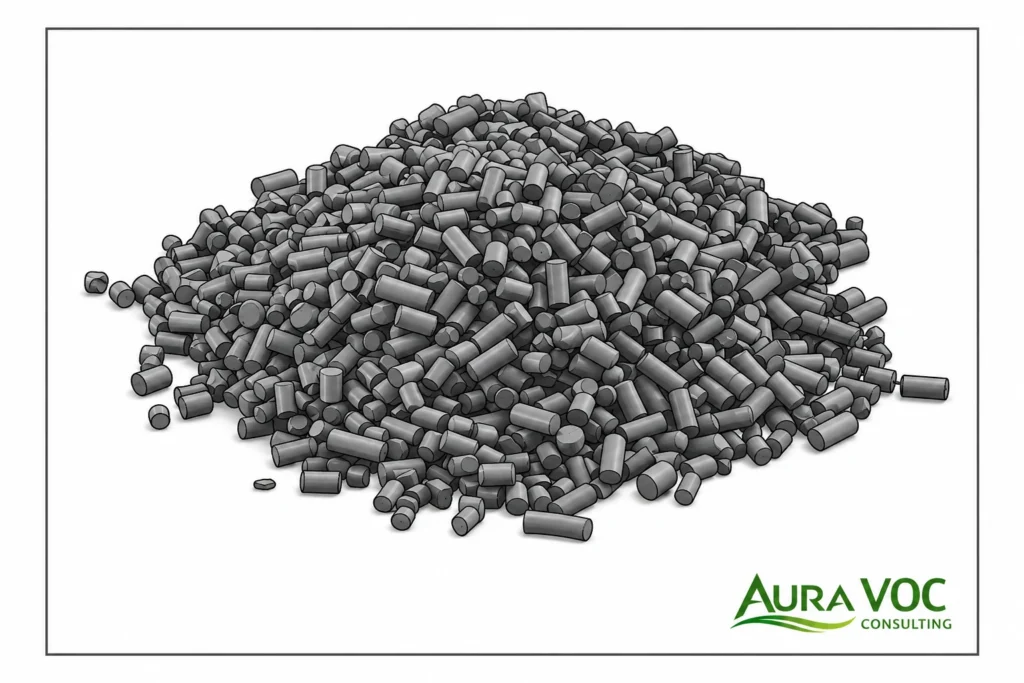
Waste evaluation should consider the solvent mixture, process history, presence of reactive or hazardous compounds, moisture content, carbon fines, and any combustion or degradation products. Carbon from the inlet zone may have different loading than carbon from the outlet zone, which can be relevant when investigating breakthrough or hot spots.
Documentation from carbon changeout should be retained with maintenance and operating records. This helps link waste handling, system performance, and future design reviews.
Cleaning and Restart After an Overheating Event
Restart should follow inspection and cause identification. Vessel internals, ductwork, drains, support screens, dampers, and instrumentation may need to be checked before new carbon is loaded. Simply replacing the carbon without correcting the cause can repeat the same failure mode.
The restart review should include the operating data before the event, temperature history, pressure drop trend, solvent use, recent process changes, and condition of the removed carbon. If water or steam was used, the review should also address contaminated liquids, corrosion risk, and whether any residues remain in the vessel or ductwork.
Approval to restart should be based on a defined technical basis, not only on the absence of smoke or external heat. For higher-risk duties, the first restart should be monitored closely for temperature, outlet VOC concentration, airflow, and pressure drop.
Management of Change: When VOC System Risk Must Be Rechecked
New Solvents or Cleaning Agents
A new solvent or cleaning agent can change adsorption capacity, heat release, carbon compatibility, breakthrough time, odor threshold, and waste classification. Intermittent cleaning operations deserve particular attention because they can create short high-concentration events that are not visible in average emissions data.
Before approval, the plant should compare the new material against the carbon supplier’s compatibility data, the adsorber design basis, temperature limits, LEL considerations, and expected carbon service life.
Cleaning agents are often introduced through maintenance or sanitation procedures rather than core production changes. They should still be included in the VOC system management-of-change process if vapors are routed to the carbon bed.
Increased Production Rate or Longer Batch Campaigns
Higher production rate can increase both peak and cumulative VOC loading. Longer campaigns may reduce cooling time between solvent-loading events. If carbon replacement frequency shortens after a production increase, the issue should be treated as a design-basis change, not only a maintenance cost increase.
The review should compare new solvent mass load, event duration, airflow margin, pressure drop allowance, and available carbon capacity against historical operation.
Production increases may also affect upstream filters, mist eliminators, and fans. A carbon bed that was acceptable at a lower production rate may become marginal if higher throughput increases solvent peaks, aerosol loading, or exhaust temperature.
Process Temperature or Airflow Changes
Dryer temperature adjustments, fan replacement, damper changes, duct modifications, and ventilation rebalancing can all affect carbon bed performance. A small temperature increase may be acceptable at low VOC loading but significant during solvent peaks. A small airflow reduction may be acceptable for capture velocity but reduce heat removal through the adsorber.
Any airflow change should be checked against the fan curve, clean-bed and dirty-bed pressure drop, minimum ventilation requirements, and adsorber residence time.
Plants should also verify whether airflow changes affect dilution. A lower flow rate can increase VOC concentration entering the bed even when solvent mass flow remains the same.
Changes to Pre-Filtration or Upstream Equipment
Removing, bypassing, or overloading upstream filtration can send aerosols or particulates into the bed. A carbon adsorber should not be used to compensate for failed mist elimination or poor particulate control.
Changes to filter type, filter efficiency, maintenance interval, demister design, or duct drainage can all affect the carbon bed. If upstream equipment is modified to reduce pressure drop, the plant should verify that the carbon bed remains protected from mist, overspray, condensables, and particulate carryover.
Upstream equipment changes should be reviewed with the same discipline as changes to the adsorber itself because they directly affect bed condition and service life.
New Odor, Emission, or Safety Complaints
Odor events, outlet VOC excursions, or operator reports of unusual heat should trigger technical review. These signals may indicate breakthrough, bypass, fouling, desorption, or abnormal loading.
Complaints should be linked to operating conditions at the time of the event. Useful information includes production step, solvent in use, fan status, damper position, pressure drop, temperature trend, filter condition, and whether the system was starting up, shutting down, or operating at steady load.
A single odor event may not indicate fire risk, but repeated events combined with rising pressure drop, early breakthrough, or abnormal temperature trends should not be dismissed as nuisance observations.
When Activated Carbon Is Not the Right VOC Abatement Technology
High or Highly Variable VOC Concentrations
Activated carbon may become difficult to control when VOC concentration is high, variable, or strongly influenced by batch events. Frequent carbon replacement, rapid temperature rise, early breakthrough, or repeated high-load alarms are signs that adsorption may not be the most stable approach.
In these cases, the plant should compare carbon adsorption with thermal oxidation, condensation, solvent recovery, or a hybrid arrangement. The comparison should include uptime, utilities, carbon consumption, waste handling, fan energy, safety controls, and the ability to handle peak load.
The comparison should use real operating data where possible. Average concentration, annual emissions, and nameplate flow are usually not enough to decide whether carbon remains suitable.
Hot, Humid, or Aerosol-Laden Exhaust Streams
Hot, humid, or aerosol-laden exhaust can reduce carbon capacity, increase pressure drop, and create fouled or wet zones. Pretreatment may solve the problem in some cases, but only if the added filters, knock-out equipment, cooling, or demisting can be maintained without reducing airflow below the required level.
If the stream cannot be delivered to the carbon bed as a stable vapor-phase load, another abatement technology may provide a more reliable operating basis.
This is especially relevant for coating lines, food applications, heated exhaust, and processes with condensable organics. In these cases, the pretreatment system may become as important as the carbon vessel itself.
Reactive or Poorly Adsorbed Compounds
Streams containing reactive, polymerizable, or poorly adsorbed compounds need compound-specific evaluation. Carbon may be unsuitable or may require specialty media, upstream conditioning, additional monitoring, or alternative control equipment.
Poor adsorption performance can lead to early breakthrough. Reactive or unstable behavior can create additional concerns around heat generation, deposits, carbon compatibility, and waste handling. The correct response depends on the compound mix, concentration profile, temperature, oxygen content, and operating pattern.
A change in solvent supplier, cleaning agent, formulation, or trace impurity profile can be enough to require review if the carbon bed is already operating near its limits.
When Thermal Oxidation Should Be Considered
Thermal oxidation may be more appropriate for high-load, variable, or poorly adsorbed VOC streams, especially where solvent recovery is not required and continuous destruction is preferred. Regenerative thermal oxidizers, recuperative oxidizers, and catalytic oxidizers each have different suitability depending on VOC concentration, flow rate, temperature, energy balance, and catalyst compatibility.
Thermal oxidation is not automatically the best answer, and it introduces its own design constraints. However, it may provide a more stable basis where carbon replacement is frequent, breakthrough is difficult to control, or solvent peaks create unacceptable thermal loading in the adsorber.
The decision should compare capital cost, operating energy, pressure drop, maintenance capability, uptime requirements, and the variability of the VOC stream.
When Condensation or Solvent Recovery Should Be Considered
Condensation or solvent recovery may be suitable for concentrated solvent streams, valuable solvents, or processes where reducing the load before polishing improves system stability. A condensation stage can reduce the mass load to a downstream carbon bed, which may lower breakthrough frequency and reduce thermal stress during peak events.
This approach is most relevant where solvent concentrations are high enough to recover meaningful quantities and where condensate handling is practical. The recovered liquid must be compatible with plant handling, storage, reuse, or disposal practices.
Condensation may not remove all VOCs to the required level, so carbon polishing or another final control stage may still be needed.
When Scrubbing or Hybrid Systems May Be Better
Scrubbing may be appropriate where the target compounds are water-soluble or where acid gases, alkaline gases, or other reactive pollutants are present with the VOC stream. It may also serve as a pretreatment step before carbon where humidity, soluble contaminants, or reactive gases would otherwise reduce carbon life.
Hybrid systems are often considered when no single technology handles the full duty well. Examples include condensation followed by carbon polishing, mist elimination followed by adsorption, scrubbing followed by carbon, or carbon polishing downstream of a primary control unit.
The tradeoff is additional equipment, pressure drop, maintenance, wastewater, and controls complexity. A hybrid system should be selected because it solves a defined process problem, not because more treatment stages appear more conservative.
Practical Carbon Bed Fire Risk Review Checklist
VOC Stream Data to Collect
A practical review starts with the stream entering the adsorber. Required data include VOC composition, average concentration, peak concentration, peak duration, event frequency, LEL data, inlet temperature, humidity, oxygen content, particulate loading, aerosol content, and condensable material.
Where the process is batch or campaign-based, the data should be separated by operating phase. Charging, drying, cleaning, purging, filling, and shutdown can produce different VOC profiles.
Solvent safety data sheets alone are not enough. The review should use actual operating concentrations, process timing, ventilation rate, and solvent use where available.
Operating Data to Review
Operating data should include airflow, fan status, damper position, pressure drop, temperature trends, outlet VOC readings, operating hours, carbon age, solvent use, and production schedule. Data should be reviewed as trends, not isolated values.
For troubleshooting, the most useful records are those that connect process events to adsorber response. For example, a temperature trend during a cleaning step or a pressure drop trend after a filter change may reveal more than monthly averages.
Where monitoring is limited, temporary measurements may be needed to confirm actual airflow, peak VOC concentration, or internal bed temperature behavior.
Maintenance Data to Review
Maintenance records should include carbon replacement history, pre-filter changes, mist eliminator cleaning, fan issues, odor complaints, shutdowns, abnormal temperature events, inspection findings, and waste handling notes.
Short carbon life, repeated filter loading, rising pressure drop, or recurring odor events should be treated as diagnostic information. They may indicate that the carbon bed is seeing a different duty from the one assumed during design.
Changeout observations are especially useful. Wet carbon, caking, discoloration, high fines content, corrosion, or uneven bed levels can identify problems that instrumentation may not show directly.
Design Data to Review
Design data should include bed depth, vessel size, carbon type, empty bed contact time, superficial velocity, flow distribution design, temperature probe locations, pressure drop allowance, damper arrangement, suppression provisions, and fan capacity.
The review should compare design assumptions against current operation. This includes current solvent mix, actual flow, dirty-system pressure drop, filter configuration, production rate, and temperature profile.
If the system has been modified since installation, the original design basis may no longer represent current conditions. Duct changes, fan changes, filter additions, production increases, or solvent substitutions can all affect the adsorber.
Decision Points for Technical Reassessment
A technical reassessment is appropriate before increasing production, changing solvents, modifying airflow, changing filters or mist eliminators, restarting after overheating, or continuing operation with repeated breakthrough, rising pressure drop, abnormal temperature trends, or shortened carbon life.
Reassessment should also occur after any smoke event, suppression activation, unexplained odor complaint, or suspected hot spot. The review should identify whether the issue is related to process load, carbon selection, airflow, fouling, humidity, instrumentation, maintenance, or technology suitability.
The objective is not only to determine whether the carbon should be replaced. It is to confirm whether the VOC abatement system still has a reliable operating margin for the current process. For broader waste gas treatment context, plant teams can also reference the European Commission’s BAT reference document for chemical-sector waste gas management.
FAQ: Activated Carbon Bed Fire Risk in VOC Systems
Can an activated carbon bed catch fire in a VOC abatement system?
Yes. Fire risk can occur when VOC loading, heat generation, airflow, temperature, oxygen availability, and bed condition create conditions that allow overheating or localized hot spots. The risk is usually linked to the operating envelope, not simply the presence of activated carbon.
Why is my activated carbon bed temperature increasing?
Common causes include higher solvent loading, reduced airflow, elevated inlet temperature, fouling, channeling, wet carbon, or a recent process change. The timing of the increase matters. A rise during a solvent-loading step has a different meaning from a rise during purge, standby, or after fan shutdown.
Can VOC concentration peaks cause carbon bed overheating?
Yes. Short high-concentration peaks can create localized heat release even when daily average VOC loading appears acceptable. Batch processes, cleaning operations, coating-line surges, and solvent transfers should be reviewed for peak concentration, duration, and frequency.
Does low airflow increase carbon bed fire risk?
Low airflow can reduce dilution and heat removal. It can also indicate filter loading, fan limitations, damper changes, duct restriction, or excessive pressure drop. Actual airflow should be compared with the design basis and current system resistance.
Why is my carbon bed breaking through earlier than expected?
Early breakthrough may result from exhausted carbon, high humidity, higher VOC load, poor carbon selection, channeling, solvent changes, or wet/fouled carbon. Carbon sampling during changeout can help determine whether the bed was uniformly loaded or bypassed by channeling.
Does high humidity affect activated carbon bed safety?
Humidity can reduce effective VOC capacity and contribute to unstable breakthrough. Condensation can also create wet zones, increase pressure drop, promote corrosion, and change flow distribution through the bed.
Can paint overspray, oil mist, or aerosols create carbon bed problems?
Yes. Aerosols and sticky materials can foul the carbon, increase pressure drop, reduce capacity, and create uneven flow paths. Activated carbon beds should receive vapor-phase VOC loads, not untreated mist, overspray, or particulate-laden exhaust.
What pressure drop across a carbon bed is abnormal?
There is no universal value. Abnormal pressure drop should be judged against the clean-bed baseline, dirty-system design limit, fan capacity, and rate of change. A rising trend can be significant even before a formal alarm point is reached.
Where should temperature probes be installed in a carbon adsorber?
Higher-risk beds often need internal probes at multiple depths or locations, not only inlet and outlet duct temperature readings. Probe placement should reflect the expected adsorption zone, vessel geometry, and flow distribution.
Should activated carbon be replaced after an overheating event?
Often yes, but replacement alone is not enough. The cause of overheating should be identified before restart. The plant should review temperature history, airflow, pressure drop, solvent loading, carbon condition, and any recent process changes.
Can changing solvents increase carbon bed fire risk?
Yes. A new solvent can change adsorption capacity, heat release, breakthrough behavior, carbon compatibility, and waste classification. Solvent changes should trigger a management-of-change review for the VOC abatement system.
What should be checked before restarting a carbon adsorber after shutdown?
Check bed temperature, airflow, VOC concentration, recent alarms, pressure drop, purge status, damper position, and any evidence of smoke, odor, or abnormal heat. Restart after a suspected hot spot should be based on inspection and cause identification.
What happens if water is used to suppress a carbon bed fire?
Water may generate contaminated runoff containing VOCs, carbon fines, dissolved organics, and combustion residues. It can also damage the bed, mobilize fines, and complicate vessel cleaning. Containment and wastewater handling should be planned before an event occurs.
When should a plant consider thermal oxidation instead of activated carbon?
Thermal oxidation should be evaluated for high-load, highly variable, hot, reactive, or poorly adsorbed VOC streams where carbon operation is difficult to control. The comparison should include uptime, energy use, pressure drop, maintenance, waste handling, and ability to handle peak load.
What information is needed to evaluate carbon bed fire risk?
A review should include VOC composition, peak loading, airflow, fan capacity, inlet temperature, humidity, oxygen content, pressure drop, bed design, carbon type, temperature monitoring, breakthrough history, carbon replacement records, and recent process changes.
Conclusion
Activated carbon can be a suitable VOC abatement technology when the exhaust stream and operating conditions are well understood. Fire risk is usually not a question of the adsorber alone. It is linked to how the system is loaded, how airflow is maintained, how heat is monitored, how the bed is protected from fouling, and how process changes are managed.
For industrial plants, the most useful approach is to treat the carbon adsorber as an operating system rather than a static vessel. Temperature trends, pressure drop, breakthrough behavior, solvent use, carbon replacement history, fan performance, and upstream filtration condition should be reviewed together.
This operating perspective gives plant managers, EHS managers, and process engineers a more reliable basis for deciding whether the existing system is operating within a controlled range or requires technical reassessment. It also helps distinguish between routine carbon replacement, correctable maintenance issues, and cases where activated carbon may no longer be the most suitable VOC abatement technology.
Technical Review of Activated Carbon VOC System Risk
AuraVOC can review an activated carbon adsorber design basis against actual operating data: solvent composition, peak concentration profile, airflow, fan capacity, pressure drop trend, bed temperature history, breakthrough records, carbon replacement frequency, upstream filtration condition, and recent process changes.
This review is most relevant when a plant has seen abnormal temperature trends, early VOC breakthrough, rising pressure drop, shortened carbon life, solvent substitutions, increased production rate, or restart concerns after a suspected overheating event.