
Solvent Recovery from Pharmaceutical Dryer Exhaust
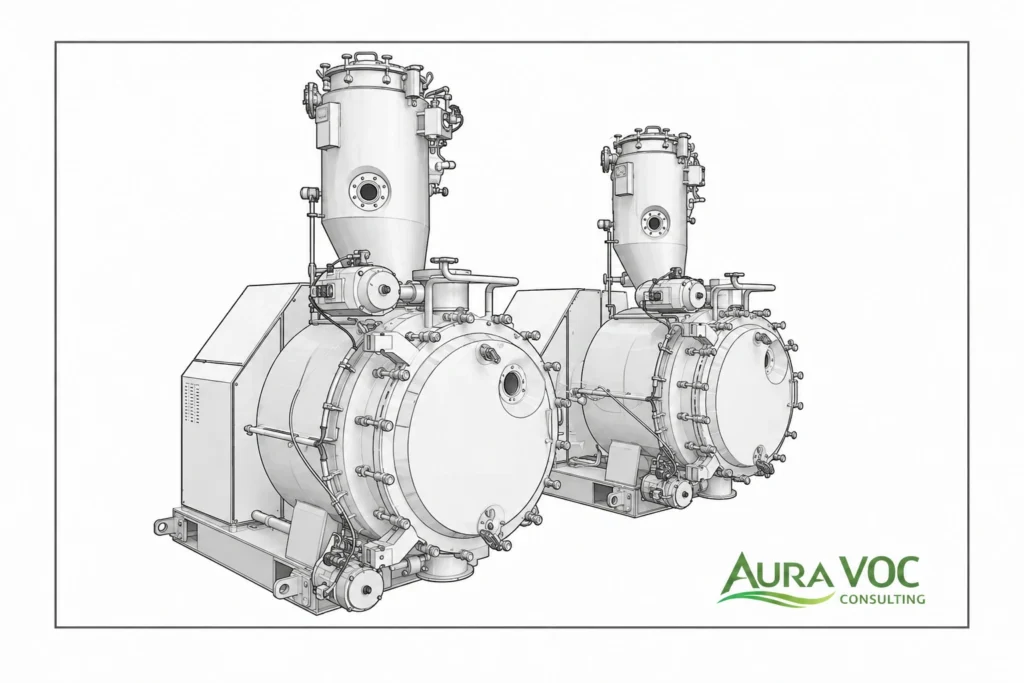
Solvent recovery from pharmaceutical dryer exhaust is not a standard vent treatment problem. Dryer exhaust from API, intermediate, and solvent-based pharmaceutical operations often behaves as a variable batch emission source, with solvent release rates changing significantly during the drying cycle. The exhaust stream may move from a high solvent peak to a long low-concentration tail, while flowrate, temperature, moisture load, and pressure conditions also vary.
For plant managers, EHS managers, and process engineers, the key question is not simply whether VOCs are present. The practical question is whether the exhaust stream can be recovered reliably, whether the recovered solvent has a usable or manageable destination, and whether the selected system can operate without disturbing the dryer, vacuum system, production schedule, or existing VOC abatement equipment.
A pharmaceutical dryer exhaust recovery system must be evaluated against real process conditions: solvent mass per batch, exhaust flowrate, drying temperature, humidity, oxygen content, pressure regime, solids carryover, solvent mixture, batch duration, and campaign variability. The assessment also needs to include secondary effects such as condensate handling, steam or nitrogen demand, refrigeration duty, fan power, hazardous area classification, wastewater load, and access for maintenance.
Condensation may be suitable for bulk solvent recovery when concentrations are high and the solvent can be condensed at practical temperatures. Activated carbon may be used for polishing or recovery from lower-concentration streams, but its performance depends strongly on humidity, gas temperature, solvent type, regeneration quality, and bed pressure drop. Hybrid systems are common where the dryer produces both short high-load solvent peaks and extended low-concentration tail gas.
The engineering basis should start with the dryer exhaust profile, not with a preferred technology. The following sections address the practical constraints that determine whether solvent recovery, polishing, final VOC abatement, or a hybrid configuration is the most reliable option.
Why Pharmaceutical Dryer Exhaust Is Difficult to Treat with Standard VOC Systems
Pharmaceutical dryer exhaust is often grouped with other process vents during early project screening. That can lead to incorrect assumptions. A dryer does not usually produce a stable VOC concentration at a fixed flowrate. Solvent release depends on product loading, residual solvent content, drying temperature, heat transfer, vacuum level, purge gas rate, moisture, and the endpoint specification.
This dynamic behavior creates several design risks. A condenser sized only on average VOC load may be unable to control the peak solvent release. A carbon bed sized without the batch profile may break through before the expected switching time. A fan or vacuum system selected without sufficient pressure margin may affect airflow, vacuum stability, or drying time once filters, condensers, demisters, and adsorbers accumulate pressure drop.
In dryer exhaust service, VOC recovery is not only an emission control issue. It can become a production reliability issue if the recovery system affects batch cycle time, cleaning schedules, common header pressure, or maintenance access.
Batch operation and variable solvent release
Batch drying produces a VOC profile that changes over time. At the beginning of the cycle, free solvent may evaporate rapidly from particle surfaces, filter cakes, wet granules, or product pores. As drying progresses, solvent removal slows because residual solvent must diffuse from less accessible locations in the product matrix.
This variation has direct consequences for solvent recovery system design. Equipment selected on daily solvent mass or average concentration may appear adequate during a design review but fail during the highest release period. A condenser may exceed its intended outlet VOC concentration. A carbon adsorber may reach breakthrough before the next bed is ready. A downstream oxidizer may see short-duration load peaks that were not visible in average emission calculations.
The situation becomes more complex when several dryers discharge to a common VOC header. Two or three batches that overlap during early drying can create a combined peak much higher than the single-dryer case. For this reason, the design basis should define credible simultaneous operation, not only one nominal batch.
Dryer types and exhaust configurations
Dryer type has a major effect on exhaust conditions. Vacuum dryers, tray dryers, fluid bed dryers, rotary dryers, filter dryers, and agitated Nutsche filter dryers can all generate solvent-laden exhaust, but they do not behave in the same way.
Vacuum dryers require careful integration with condensers, knock-out pots, vacuum pumps, and downstream VOC abatement systems. The recovery system must not create unstable vacuum conditions or allow solvent vapors to condense in ductwork, pumps, silencers, or common headers. Fluid bed dryers may have higher gas flows and greater solids carryover, making filtration, demisting, and pressure drop more important. Filter dryers and agitated Nutsche filter dryers can produce solvent vapors under changing cake conditions, with possible product carryover during agitation, discharge, or cleaning.
The exhaust configuration also matters. Some dryers discharge directly to a condenser. Others pass through vacuum pumps, ejectors, knock-out pots, or common collection headers before reaching VOC treatment equipment. Each arrangement changes condensation risk, leakage potential, pressure control, materials of construction, and safety requirements.
Process factors that affect VOC recovery
Solvent recovery performance depends on more than solvent boiling point. Batch size, solvent loading, drying temperature, residual solvent target, exhaust flowrate, vacuum level, purge gas rate, humidity, and cycle duration all affect recovery performance.
Higher purge gas flow can dilute solvent concentration while increasing total gas volume. This may reduce condensation efficiency and increase fan or vacuum system load. Higher humidity can reduce adsorption capacity, increase condensate volume, and complicate phase separation. Lower dryer pressure can improve solvent removal from the product but may complicate condenser selection and vacuum pump protection. Higher drying temperature can increase solvent release rate and shift the peak VOC load earlier in the batch.
These variables can change between products, campaigns, cleaning procedures, or batch sizes. A recovery system should therefore be checked against credible operating cases: maximum solvent charge, high-moisture batches, short drying cycles, solvent changes, and overlapping dryer operation.
Contamination risks in dryer exhaust
Pharmaceutical dryer exhaust may contain more than solvent vapor and carrier gas. API dust, excipient particles, filter cake fines, cleaning residues, product traces, and entrained droplets may enter the exhaust system depending on dryer design and upstream separation.
Solids carryover can foul heat exchanger surfaces, block demisters, increase pressure drop, contaminate carbon beds, or reduce adsorbent life. Cleaning vapors and residues can change condensate composition or reduce recovered solvent quality. Product traces may prevent recovered solvent from being reused without further treatment or quality review.
Pre-filtration, demisting, drainage design, sampling points, and maintenance access are therefore part of the solvent recovery discussion. A system that performs well on a clean test stream may become unreliable if the real dryer exhaust carries dust, droplets, or campaign-related residues.
Batch VOC Load Profile: Why Peak Solvent Release Matters
The batch VOC load profile is one of the most important inputs for selecting and sizing a pharmaceutical dryer exhaust recovery system. It affects condenser duty, adsorber loading, bed switching time, regeneration demand, fan capacity, LEL management, downstream abatement load, and expected solvent recovery.
A useful profile combines VOC concentration and exhaust flowrate over the complete drying cycle. Concentration alone is not enough if flow changes. Flowrate alone is not enough if solvent release varies. Recovery equipment responds to mass load, temperature, moisture, pressure, and solvent composition, not to a single VOC reading.
VOC concentration over the drying cycle
During early drying, VOC concentration may rise quickly as free solvent evaporates from the product or cake surface. This phase often defines condenser duty, LEL margin, and the first major loading period for an adsorber.
As drying continues, solvent concentration typically declines. The rate of decline depends on product structure, heat transfer, vacuum level, purge gas, and the residual solvent specification. The final part of the cycle may run for a long time at lower VOC concentration. This low-concentration tail may contribute less solvent recovery value but may still determine whether polishing or final abatement is required.
Peak load versus average load
Average VOC concentration is often misleading for batch dryer exhaust. A batch may release a large fraction of its solvent during a short peak, followed by a longer tail at lower concentration. If equipment is sized only on average values, the recovery system may be undersized exactly when it needs the most capacity.
For condensers, peak load affects heat transfer area, refrigeration duty, outlet vapor concentration, and condensate drainage. For carbon adsorbers, peak load affects working capacity, breakthrough time, bed temperature rise, and regeneration frequency. For common headers and downstream oxidizers, simultaneous batch peaks can overload equipment that appears adequate under average daily emissions.
Peak load evaluation is also relevant for safety. LEL monitoring, dilution, inerting, oxygen control, and interlocks must be based on credible high-load conditions, not only normal readings.
Tail-gas treatment after bulk solvent recovery
After bulk solvent recovery, the remaining exhaust may still contain VOCs at concentrations requiring polishing or final treatment. This is common where condensation removes the main solvent load but cannot achieve the required outlet concentration at practical refrigeration temperatures.
Activated carbon is often used for tail-gas polishing, especially where the residual VOC concentration is moderate or low. However, the carbon bed must be protected from humidity, condensate droplets, high temperature, and particulate carryover. In other cases, tail gas may be routed to a thermal oxidizer, catalytic oxidizer, or existing plant VOC abatement system.
The correct tail-gas strategy depends on the objective. A plant trying to reduce solvent loss may accept a different configuration than a plant trying to meet a stack limit or protect an existing oxidizer from batch peaks.
Measurement data needed for design
A practical design assessment should start with measured or well-estimated data across the full drying cycle. Minimum useful inputs include exhaust flowrate, exhaust temperature, humidity or water load, solvent composition, VOC concentration versus time, oxygen concentration, operating pressure, LEL percentage, and batch duration.
The solvent mass balance should also be checked. Solvent charged, solvent retained in the product, solvent recovered as condensate, solvent routed to wastewater, and solvent emitted to the VOC treatment system should be compared. Large gaps usually indicate missing data, unmeasured losses, or incorrect assumptions about the exhaust profile.
For existing systems, useful operating data include condenser inlet and outlet temperatures, refrigeration load, differential pressure across filters and carbon beds, carbon breakthrough history, regeneration conditions, condensate composition, and stack monitoring results.
Solvent Recovery Technologies Used on Pharmaceutical Dryer Exhaust
The recovery technology must fit the way the dryer releases solvent. Pharmaceutical dryer exhaust may require bulk recovery during peak-load periods, polishing during low-load periods, and stable operation across cleaning, purge, and changeover conditions. In practice, this often leads to a staged system rather than one item of equipment.
Condensation for bulk solvent recovery
Condensation is usually considered first when the exhaust contains relatively high solvent concentration and the solvent can be condensed at a practical temperature. In dryer applications, the condenser is often used to remove the bulk solvent load before the gas reaches an adsorber, oxidizer, vacuum pump, or common VOC header.
Condenser selection depends on vapor load, exhaust temperature, water content, solvent vapor pressure, non-condensable gas flow, required outlet concentration, and available refrigeration level. Chilled water may be adequate for higher-boiling solvents or preliminary cooling. Glycol, brine, mechanical refrigeration, or cryogenic systems may be required for lower outlet vapor concentrations.
Condensation efficiency changes during the batch. At high inlet concentration, the condenser may recover solvent effectively. During the low-concentration tail, recovery may fall even if outlet temperature remains stable. This is why condensation is often used for bulk recovery rather than as the only VOC control step.
Activated carbon adsorption for VOC polishing and recovery
Activated carbon is commonly applied where residual VOC concentration is too low for efficient condensation or where a polishing step is required after bulk recovery. For pharmaceutical dryer exhaust, carbon systems may be designed as once-through polishing beds or regenerable recovery units.
A typical regenerable system uses multiple beds so one bed can adsorb while another is regenerated, cooled, or placed on standby. EPA technical guidance provides additional design background on carbon adsorbers used for VOC control. Steam regeneration is widely used but creates solvent-water condensate. Nitrogen, hot inert gas, or vacuum regeneration may reduce direct water addition, but these methods introduce utility, inerting, and solvent recovery considerations.
Carbon performance should not be judged only from equilibrium capacity data. Real working capacity is affected by humidity, gas temperature, solvent mixture, bed velocity, inlet concentration swings, regeneration effectiveness, and contamination. A bed that performs well on a dry, single-solvent stream may break through earlier when exposed to humid dryer exhaust containing cleaning residues or product fines.
Specialty adsorbents and zeolite systems
Specialty adsorbents or zeolite systems may be relevant where activated carbon has compatibility limitations, high fire risk, poor selectivity, or reduced performance under humid conditions. These systems can be useful for certain solvent mixtures or where higher thermal stability is required.
The same practical questions still apply: working capacity, regeneration method, pressure drop, sensitivity to water, fouling risk, and recovered solvent quality. Specialty adsorbents can improve performance in specific cases, but they do not eliminate the need for proper pre-filtration, condensate control, and full-cycle VOC profiling.
Hybrid recovery and VOC abatement systems
Hybrid systems are common in pharmaceutical dryer exhaust because one technology rarely performs equally well across the full batch profile. A condenser may recover most of the solvent during the peak-load period, while activated carbon handles residual VOCs during falling-rate drying and tail-gas operation. In other cases, recovery is followed by thermal oxidation or catalytic oxidation for final treatment.
The design sequence matters. A condenser upstream of a carbon bed can reduce carbon loading, but poor drainage or demisting can send droplets and humidity to the adsorber. A carbon bed upstream of an oxidizer can reduce fuel demand or smooth VOC load, but poor regeneration or breakthrough can still create emission peaks. Hybrid design should be based on mass load, operating sequence, and failure modes, not only nominal removal efficiency.
How to Select a Solvent Recovery System for Dryer Exhaust
Technology selection should start from the dryer duty and the batch emission profile, not from a preferred equipment type. A condenser, carbon adsorber, hybrid recovery system, or oxidizer can all be technically valid in the right operating window. The issue is whether the system can handle actual VOC mass release, moisture load, pressure regime, safety basis, and maintenance conditions without creating new constraints in the drying process.
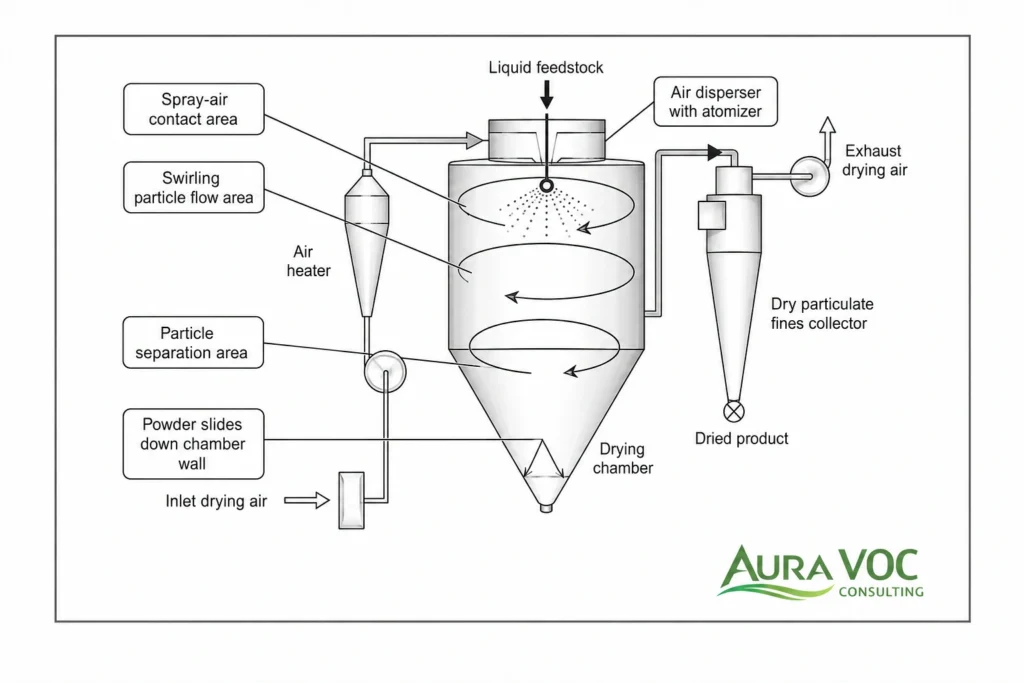
For pharmaceutical dryer VOC abatement, the selection process should compare recovery potential with operability. A system that performs well under one design case may still create problems if it increases dryer backpressure, generates condensate that cannot be handled, requires regeneration time that does not fit the batch schedule, or produces recovered solvent that cannot be reused.
Solvent properties that affect technology selection
Solvent properties must be translated into equipment consequences. A higher-boiling solvent may be suitable for chilled water or moderate refrigeration. A low-boiling solvent may require deeper refrigeration, adsorption polishing, or final VOC abatement. A water-miscible solvent may be recoverable as condensate, but the liquid stream may still require distillation or wastewater treatment before it has practical value.
Solvent blends require particular attention. Different components can condense at different points in the batch, and adsorbents may retain some components more strongly than others. This can change both outlet emissions and recovered solvent composition. A mixed-solvent dryer exhaust stream should therefore be evaluated using composition data, not only total VOC concentration.
Flammability and adsorption heat are also design constraints. Some ketones and reactive solvent systems require closer review of activated carbon compatibility, bed temperature monitoring, oxygen concentration, and emergency response logic.
Exhaust conditions that affect equipment design
Flowrate, temperature, humidity, particulate load, oxygen content, and pressure regime determine the physical design of the recovery system. High gas flow increases condenser size, carbon bed diameter, fan power, and pressure drop. High humidity can reduce adsorption capacity and increase condensate volume. Dust or API carryover can foul exchangers, block demisters, wet carbon beds, and create frequent maintenance interventions.
Vacuum dryer exhaust should not be treated as a simple atmospheric vent. Condenser location, vacuum pump protection, leakage control, and downstream pressure losses can affect the dryer’s ability to reach the required pressure profile. If the recovery system adds excessive resistance, the result may be longer drying time, unstable vacuum control, or inconsistent residual solvent removal.
Recovery objective versus emission control objective
The design target must be defined early. A system intended to recover solvent for reuse is different from a system intended to reduce load on an existing oxidizer or meet a stack emission limit.
For solvent reuse, recovered liquid quality and segregation are central. For reducing downstream VOC load, the priority may be removing the bulk solvent peak before it reaches a common header. For compliance, the final outlet concentration and reliability of the polishing or abatement step may matter more than the amount of liquid solvent recovered.
This distinction avoids a common design error: optimizing for recovery percentage while overlooking emission stability, wastewater impact, or dryer operation.
Recovered solvent quality and reuse limitations
Recovered solvent from pharmaceutical dryer exhaust may contain water, API traces, cleaning solvents, degradation products, or residues from previous campaigns. Even when the solvent has value, direct reuse may not be acceptable without analytical confirmation and quality review.
The design should include sampling points, batch segregation where required, and a defined destination for off-spec condensate. In many plants, recovered solvent is routed to a waste solvent tank, internal distillation, or external recovery rather than directly back to production. That routing decision affects storage, ATEX classification, tank venting, drainage, and operator handling.
Safety basis and LEL management
LEL management must be based on credible peak solvent release, not average concentration. Early drying, heating ramps, vacuum changes, purge steps, and overlapping dryers on a common header can all create short-duration VOC peaks. OSHA guidance on flammable vapor control can be used as a reference when reviewing LEL monitoring and ventilation assumptions.
Practical controls may include LEL analyzers, oxygen monitoring, inerting, dilution control, high-temperature shutdowns, bed temperature alarms, purge-before-regeneration sequences, and interlocks that prevent unsafe bed switching or regeneration. Analyzer location is important. A sensor placed too far downstream may not detect a short high-concentration event in time to protect the relevant equipment.
For activated carbon systems, the safety basis should include solvent compatibility, maximum inlet concentration, maximum bed temperature, oxygen limits, emergency isolation, and response to loss of regeneration flow or cooling.
Condensation Systems for Pharmaceutical Dryer Solvent Recovery
Condensation is often the first recovery step considered for pharmaceutical dryer exhaust because it can remove bulk solvent load before downstream adsorption or VOC abatement. Its performance depends on solvent partial pressure, non-condensable gas flow, cooling temperature, water load, and drainage stability across the batch cycle.
A condenser that removes a large quantity of solvent during the peak phase may remove very little during the tail phase. This does not automatically indicate poor equipment performance. It may simply reflect that condensation is no longer efficient at the lower solvent partial pressure. The design question is whether residual VOC after condensation needs carbon polishing, oxidation, or another treatment step.
When condensation is suitable
Condensation is most suitable when the dryer exhaust has high solvent concentration, moderate gas flow, and a solvent that condenses at achievable temperatures. It is also useful upstream of carbon beds, vacuum pumps, or oxidizers to reduce peak loading.
In vacuum dryer service, condensers can also protect vacuum pumps from solvent vapor carryover. This requires careful placement of knock-out pots, drains, and temperature controls so that condensation occurs in controlled equipment rather than in ductwork, pumps, or downstream headers.
Condenser temperature, recovery efficiency, and refrigeration load
Lower condenser temperatures can improve recovery, but the gain may become progressively smaller as outlet vapor concentration decreases. Deeper refrigeration also increases power demand, defrost risk, maintenance requirements, and system complexity.
When the exhaust contains water, low-temperature operation can create ice or blockage if moisture is underestimated. The design should consider the full operating envelope: wet batches, cleaning vapors, purge operation, low-flow conditions, and ambient conditions affecting refrigeration performance.
Multi-stage condensation design
A multi-stage system can improve reliability by separating sensible cooling, bulk solvent recovery, and low-temperature polishing. A first stage may remove heat and part of the solvent load. A colder second stage may recover additional solvent. Downstream separation and demisting are needed to prevent droplets from reaching carbon beds, fans, or final abatement equipment.
Drainage is a frequent source of operating problems. If condensate does not leave the exchanger and separator reliably, the system may flood, increase pressure drop, lose heat transfer capacity, or carry liquid downstream. Receivers should be sized for batch peaks rather than average hourly recovery.
Condenser operating problems
Low recovery can result from fouled heat transfer surfaces, excessive non-condensable gas, unstable refrigeration control, bypass leakage, incorrect solvent load assumptions, or poor condensate drainage. Ice formation, solvent-water emulsions, demister flooding, and undersized receivers can also create intermittent problems that only appear during certain products or cleaning cycles.
Troubleshooting should compare solvent charged, condensate recovered, VOC outlet concentration, condenser outlet temperature, and batch timing. Without this comparison, condenser performance is often misdiagnosed as a refrigeration issue when the actual cause is bypassing, fouling, phase separation loss, or a changed process load.
Condenser maintenance requirements
Maintenance planning should include heat exchanger cleaning, demister inspection, drain testing, refrigeration checks, leak testing, receiver inspection, and calibration of temperature and pressure instruments. Differential pressure trending is useful because fouling or flooding often appears as a gradual increase before recovery performance visibly declines.
For pharmaceutical sites, access for cleaning and inspection should be addressed during layout. A condenser that cannot be isolated, drained, or opened without extended downtime can become a production constraint during campaign changes.
Activated Carbon Adsorption on Pharmaceutical Dryer Exhaust
Activated carbon adsorption is commonly used for tail-gas polishing, solvent recovery, or protection of downstream VOC abatement systems. In pharmaceutical dryer service, carbon performance is strongly affected by batch peaks, humidity, temperature, solvent mixture, regeneration quality, and contamination from product or cleaning residues.
A carbon bed should be treated as a process unit with a loading cycle, breakthrough risk, regeneration sequence, cooling requirement, and pressure drop profile. It is not a static filter.
When activated carbon is suitable
Activated carbon is suitable when VOC concentrations are moderate or low enough for practical adsorption, and when the solvent is compatible with the carbon and regeneration method. It is often used downstream of condensation, where it handles residual VOC after bulk recovery.
It may also be used as the primary recovery method for streams where condensation is inefficient. In that case, batch peak loading, working capacity, regeneration time, and bed switching logic become critical design inputs.
Factors that reduce adsorption capacity
Humidity reduces effective working capacity and can cause bed wetting, especially when gas temperature drops or droplets carry over from upstream equipment. High inlet temperature also reduces adsorption capacity and can shorten breakthrough time.
Solvent mixtures can cause competitive adsorption. One solvent may displace another, leading to unexpected outlet VOC spikes even when total bed loading appears acceptable. Dust and droplets can block bed voids, increase pressure drop, and interfere with regeneration.
For this reason, filtration, demisting, and condensate control are not secondary accessories. They directly affect carbon bed life and breakthrough reliability.
Regeneration method selection
Steam regeneration is common, but it creates aqueous solvent condensate. This can be acceptable for immiscible solvents with good phase separation, but it can create wastewater or distillation demand for water-miscible solvents.
Nitrogen or hot inert gas regeneration can reduce water addition, but it requires inert gas supply, heating, solvent recovery from the desorption stream, and suitable controls for oxygen exclusion. Vacuum regeneration may be useful in selected cases but requires careful review of solvent vapor handling and downstream condensation.
Regeneration must also fit the production schedule. If the dryer batch cycle is shorter than the adsorption-regeneration-cooling cycle, spare bed capacity or additional adsorbers may be required. Incomplete cooling after regeneration is a common cause of early breakthrough because warm carbon has reduced adsorption capacity.
Carbon bed breakthrough troubleshooting
Early breakthrough should be reviewed against the batch timeline. If breakthrough occurs during the same drying phase, the cause is often peak solvent loading, bed switching logic, or an underestimated VOC profile. If breakthrough becomes progressively earlier over several campaigns, fouling, carbon ageing, wet bed conditions, or incomplete regeneration are more likely.
Useful checks include bed inlet and outlet VOC trends, bed temperature profile, regeneration condensate volume, regeneration flow and temperature, cooling duration, and differential pressure. Valve leakage should also be considered, especially on multi-bed systems where an offline or regenerating bed may not be fully isolated.
Fire, exotherm, and solvent compatibility risks
Adsorption releases heat. For solvent-laden dryer exhaust, bed temperature monitoring is a safety and operability requirement, not only a diagnostic tool. Ketones, reactive solvents, high oxygen levels, and poor regeneration sequences require careful review.
The safety basis should define maximum inlet VOC concentration, oxygen limits, bed temperature alarm and trip points, inerting requirements, and emergency isolation logic. It should also address abnormal cases such as loss of cooling, blocked regeneration flow, high inlet concentration, or unexpected solvent changes during a campaign.
Carbon system maintenance requirements
Maintenance should include carbon sampling, bed replacement planning, valve inspection, actuator testing, demister checks, condensate drain verification, and calibration of VOC analyzers, temperature sensors, and differential pressure instruments.
Differential pressure should be trended by batch. A gradual increase may indicate dust loading or bed wetting, while a sudden increase may indicate liquid carryover, blocked demister, or abnormal process release. Carbon condition should be evaluated before repeated breakthrough becomes a production or compliance issue.
Wastewater and Condensate Handling from Solvent Recovery
Solvent recovery can reduce air-side VOC load while creating a liquid stream that must be managed correctly. In pharmaceutical dryer applications, condensate quality can vary by product, solvent system, cleaning procedure, and phase of the drying cycle.
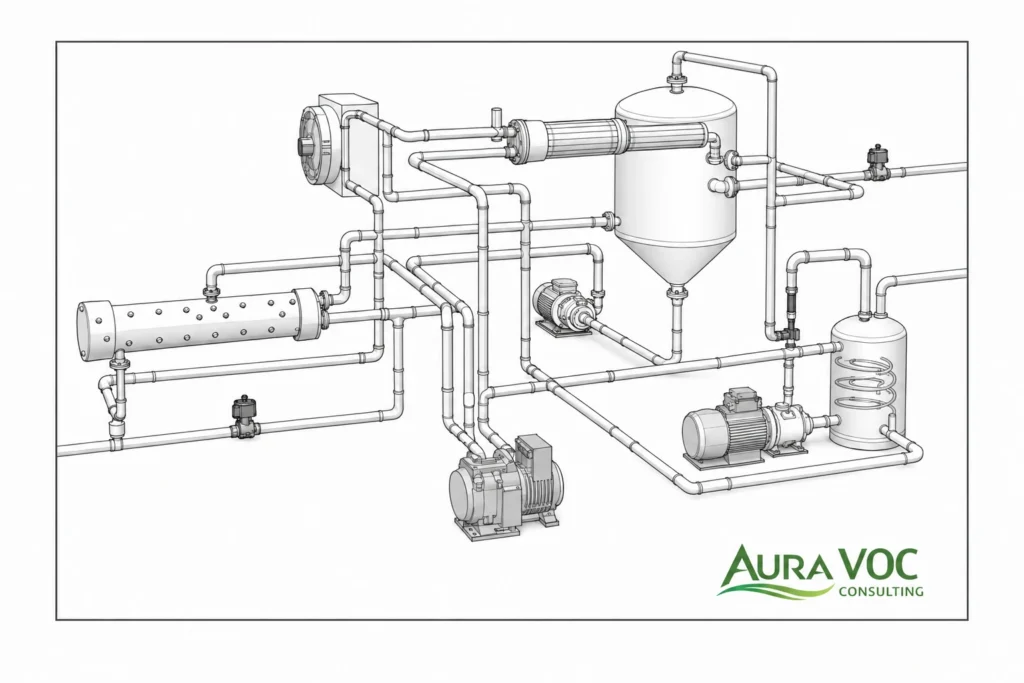
This section should be reviewed early in the project. A recovery system that produces condensate without a reliable storage, separation, sampling, or disposal route can become difficult to operate even if the air treatment equipment performs as designed.
What is in the recovered condensate
Recovered condensate may contain solvent, water, dissolved VOCs, API traces, cleaning residues, fines, degradation products, and small quantities of other campaign solvents. The composition may change within a single batch. Early condensate may be solvent-rich, while later condensate may contain more water or lower-boiling components.
Condensate from steam-regenerated carbon systems is different from direct condenser condensate because steam adds water to the recovery stream. This can increase the liquid volume and change the solvent-water split.
Solvent-water separation constraints
Some solvents form a separate organic phase and can be decanted. Others are fully or partially miscible with water and may require distillation, waste solvent handling, or wastewater treatment. Emulsions can occur when cleaning agents, surfactants, product fines, or agitation are present.
Phase separation should not be assumed from solvent identity alone. Residence time, temperature, solvent concentration, fines, and cleaning residues can change separation behavior. Sampling and jar testing are often useful before finalizing receiver design or reuse assumptions.
Wastewater load from recovery systems
Recovery systems may shift part of the treatment burden from air emissions to liquid waste. Steam regeneration can increase wastewater volume, while condensation of humid exhaust can create solvent-containing aqueous streams. For water-miscible solvents, COD and VOC loading to wastewater treatment may become a limiting factor.
This tradeoff should be considered when comparing condensation, carbon recovery, and thermal oxidation. A system with attractive air-side performance may be less practical if the plant lacks capacity for solvent-water treatment, distillation, or waste storage.
Practical condensate system design
Condensate handling should include closed drains, correctly sized receivers, high-level protection, sampling points, suitable venting, nitrogen blanketing where required, and clear routing to waste solvent, wastewater, or solvent recovery.
Receiver sizing should consider peak batch recovery, not only average flow. The design should also allow draining and cleaning during campaign changes. Where flammable solvent is present, hazardous area classification, grounding, vent treatment, and overfill protection should be reviewed with the same discipline applied to the air-side equipment.
Pressure Drop, Utilities, and Energy Impact on Dryer Operation
Pressure drop and utility demand are often underestimated during early VOC recovery screening. In dryer service, they are not only operating cost factors. They can affect dryer performance, vacuum stability, drying time, and batch repeatability.
Pressure drop across recovery equipment
Filters, condensers, demisters, carbon beds, valves, silencers, ductwork, and stack connections all contribute to total pressure drop. This value changes over time as filters load, demisters foul, carbon beds wet, or condensate accumulates.
For pharmaceutical dryers, clean-system pressure drop is not sufficient for design. The fan or vacuum system should be checked against fouled filters, wet demisters, loaded carbon beds, and maximum batch flow.
Impact on dryer airflow, vacuum, and drying time
Excessive downstream resistance can reduce purge flow, affect solvent removal rate, destabilize vacuum control, or increase drying time. In vacuum dryer service, added pressure losses can alter vacuum pump performance or create condensation in unintended locations.
If drying time increases after installing a recovery or abatement system, the VOC equipment should be checked as part of process troubleshooting. Differential pressure across filters, condensers, demisters, and adsorbers can identify whether the exhaust path is restricting the dryer.
Fan and blower design considerations
Fan location should be selected based on pressure regime, leakage risk, solvent compatibility, hazardous area classification, and maintenance access. A fan upstream of recovery equipment may introduce ignition and materials concerns. A fan downstream may operate on a cleaner stream but must handle total system pressure drop.
Variable frequency drives can help stabilize flow, but the control philosophy must avoid upsetting vacuum dryers or common headers. Redundancy may be required where dryer availability depends on continuous exhaust handling.
Utility tradeoffs
Refrigeration power, steam for regeneration, nitrogen consumption, fan power, compressed air, and wastewater treatment all affect the practical feasibility of solvent recovery. The lowest possible outlet VOC concentration is not always the most robust target if it requires excessive refrigeration, frequent defrosting, high nitrogen use, or condensate treatment beyond site capacity.
Utility availability should be checked under realistic production conditions, including simultaneous dryer operation, cleaning cycles, summer cooling limits, and regeneration overlap.
Integration with Pharmaceutical Dryer Operation
The recovery system should be integrated into the dryer sequence, not treated as a separate end-of-pipe device. Dryer operation, solvent release, vacuum control, purge flow, regeneration, and cleaning cycles all affect recovery performance.
Batch cycle control and recovery system sequencing
The recovery system must follow the drying cycle: start-up, heat ramp, peak solvent release, falling-rate drying, purge, bed switching, regeneration, cooling, and standby. Incorrect sequencing can cause breakthrough, liquid carryover, high bed temperature, or pressure instability.
For multi-bed carbon systems, bed switching should be timed against actual VOC loading and regeneration status. Switching too late risks breakthrough. Switching too early may waste capacity and increase regeneration frequency.
Vacuum dryer integration
Vacuum dryer systems require special attention to condenser placement, knock-out pots, vacuum pump protection, and downstream abatement connection. Solvent should condense in controlled equipment, not in ductwork, vacuum pumps, silencers, or common headers.
The system should also account for leakage. Air ingress can change oxygen concentration, reduce vacuum performance, increase non-condensable load, and affect LEL calculations. Pressure instruments should be placed where they support both process control and diagnosis of recovery system restrictions.
Cleaning, changeover, and cross-contamination
CIP, SIP, solvent flushes, detergent residues, and campaign changeovers can introduce vapors or residues not present during normal drying. These streams may affect condenser fouling, carbon capacity, recovered solvent quality, and condensate separation.
Cleaning steps should be included in the operating basis. A recovery system designed only for production drying may experience unexpected loading or contamination during cleaning if those vapors are routed through the same equipment.
Instrumentation and control points
Instrumentation should support both safe operation and troubleshooting. Useful signals include VOC concentration, LEL, oxygen, flowrate, dryer pressure, system pressure drop, condenser inlet and outlet temperature, carbon bed temperature, bed differential pressure, regeneration temperature, and condensate level.
Analyzer drift should be considered in maintenance planning. VOC and LEL instruments exposed to solvent mixtures, humidity, or particulates may require regular calibration and validation against process data.
Troubleshooting Solvent Recovery from Dryer Exhaust
Troubleshooting should start with the batch timeline. Many problems occur only during a specific phase: early solvent peak, low-flow tail drying, bed switching, regeneration, cooling, or cleaning. Reviewing symptoms against the operating sequence is usually more useful than looking only at daily average emissions.
Low solvent recovery rate
Low recovery may result from condenser outlet temperature being too high, fouled heat transfer surfaces, excessive non-condensable gas, bypass leakage, underestimated solvent load, poor condensate drainage, or solvent losses to wastewater or vacuum equipment.
Operating checks should include solvent mass balance, condensate volume per batch, condenser inlet and outlet temperature, VOC outlet concentration, drain performance, and comparison between expected and actual batch solvent release.
VOC odor or emissions downstream
Downstream VOC odor may indicate carbon breakthrough, condenser underperformance, leaking valves, incomplete bed cooling, analyzer drift, or low-boiling components not included in the original solvent basis.
If the odor appears after bed switching or regeneration, check valve sequence, regeneration completeness, bed cooling time, and bed outlet VOC. If the odor appears during early drying, review peak loading and condenser performance.
High pressure drop
High pressure drop can be caused by dust-loaded filters, wet carbon, blocked demisters, fouled heat exchangers, flooded condensers, undersized ductwork, or partially closed dampers.
Differential pressure should be trended across each major component. A pressure rise after cleaning may point to wet equipment or drainage problems. A gradual rise across campaigns usually indicates fouling or solids accumulation.
Wet carbon bed or poor regeneration
Wet carbon may result from steam condensation, inadequate drying after regeneration, poor condensate drainage, high inlet humidity, or droplet carryover from an upstream condenser. Wet beds reduce adsorption capacity and can increase pressure drop.
Checks should include regeneration steam or inert gas flow, bed outlet temperature, cooling time, drain function, demister condition, and moisture in the gas leaving the condenser.
Condensate carryover or poor phase separation
Condensate carryover may result from high gas velocity, inadequate demisting, foaming, flooded separators, unstable cooling control, or insufficient residence time. Carryover into carbon beds can reduce adsorption capacity and create pressure drop problems.
Poor phase separation may result from water-miscible solvents, emulsions, cleaning agents, fines, or temperature changes. Condensate samples should be reviewed by batch phase and campaign, not only as a combined daily sample.
Engineering Tradeoffs in Solvent Recovery System Design
Solvent recovery system design involves tradeoffs between recovery, reliability, safety, utilities, and maintainability. These tradeoffs should be documented because they often explain why the highest theoretical recovery option is not always the most practical plant solution.
Recovery efficiency versus energy consumption
Deep refrigeration and larger adsorption systems can improve recovery, but they increase power demand, defrost risk, regeneration energy, instrumentation, and maintenance. For low-concentration tail gas, the additional recovery may be small compared with the extra refrigeration or regeneration duty.
A staged system may be more practical: condensation for bulk recovery, followed by carbon adsorption or final abatement for residual VOC.
Peak-load design versus capital cost
Batch peaks can dictate equipment size. Designing for average VOC load reduces capital cost but increases the risk of breakthrough, high outlet concentration, or overload of downstream abatement. The design basis should include credible peak cases, such as maximum solvent charge, shortened drying cycle, or overlapping dryers on a common header.
Solvent reuse versus waste handling
Recovered solvent has value only if it can be reused, recovered, or disposed of through an acceptable route. Water content, API traces, cleaning residues, mixed solvents, and degradation products can prevent direct reuse.
Where reuse is not practical, the comparison should include waste solvent storage, external recovery cost, distillation demand, and wastewater treatment load.
Carbon bed size versus pressure drop
Larger carbon beds can increase capacity and contact time, but geometry and gas velocity affect pressure drop, footprint, and fan duty. Very conservative bed sizing may reduce breakthrough risk but create space, cost, and pressure control issues.
The design should consider both adsorption capacity and hydraulic performance under clean and fouled conditions.
Recovery versus thermal oxidation
Solvent recovery is typically more attractive when VOC concentration is significant, solvent value is meaningful, and condensate handling is manageable. Thermal oxidation may be more practical for dilute, contaminated, variable, or low-value solvent streams.
For some pharmaceutical dryers, a hybrid system is the most stable option: recovery for peak solvent load and oxidation or adsorption polishing for residual VOC.
When Solvent Recovery Is Not the Right VOC Control Strategy
Solvent recovery should not be assumed to be the preferred option for every dryer exhaust stream. Some cases are better handled by direct VOC abatement, polishing, or integration with an existing treatment system.
Very dilute dryer exhaust
Very dilute exhaust may require large gas handling equipment and significant energy to recover a small quantity of solvent. In these cases, adsorption polishing or oxidation may be more practical than deep recovery.
Complex or contaminated solvent mixtures
Mixed solvents, azeotropes, water-miscible components, API carryover, and cleaning residues can make recovered solvent difficult to separate or reuse. If the recovered liquid is consistently off-spec or costly to treat, recovery may not be justified.
Limited utilities or wastewater capacity
Recovery systems may require refrigeration, steam, nitrogen, power, compressed air, condensate storage, and wastewater treatment. If these utilities are constrained, a simpler VOC abatement route may be more reliable.
High reliability or low-maintenance requirements
Some recovery systems require frequent inspection, regeneration, cleaning, or solvent handling. Where production availability is the dominant constraint, a lower-maintenance abatement approach may be more suitable than a recovery system with high operator involvement.
Data Required for a Solvent Recovery Assessment
A solvent recovery assessment should use process data, not only equipment nameplate data. Dryer exhaust conditions can vary significantly between products, campaigns, and operating modes, so the data set should represent normal operation and credible high-load cases.
Dryer and process data
Required dryer data include dryer type, batch size, drying time, solvent mass per batch, operating temperature, pressure or vacuum condition, purge gas flow, and residual solvent target.
The assessment should also include campaign information: product family, expected batch frequency, cleaning sequence, solvent changes, and whether several dryers can operate on the same header at the same time.
Exhaust and VOC data
Useful exhaust data include flowrate, VOC concentration profile, peak and average VOC load, humidity, oxygen level, LEL percentage, solvent composition, and exhaust temperature.
The VOC profile should cover the full batch cycle rather than a single measurement point. For common headers, simultaneous operating scenarios should be included to avoid underestimating combined VOC peaks.
Site and utility data
Cooling water, chilled water, refrigeration capacity, steam, nitrogen, electricity, compressed air, wastewater capacity, hazardous area classification, and available footprint all affect feasible technology choices.
Utility availability should be checked against production schedules. A recovery system that requires regeneration during peak plant steam demand or deep refrigeration during summer operation may have a different operating limit than the design sheet suggests.
Existing emission control equipment
Existing condensers, scrubbers, carbon beds, oxidizers, fans, stacks, dampers, and monitoring systems should be reviewed before adding new equipment. The new recovery system may reduce load on existing abatement equipment, but it may also change pressure drop, flow distribution, control logic, or wastewater routing.
Existing operating problems should be documented before modification. Stack odor, repeated carbon breakthrough, condenser flooding, high pressure drop, or vacuum instability can indicate that the current design basis is already incomplete.
Practical Evaluation Workflow for Dryer Exhaust VOC Recovery
A practical evaluation should connect solvent mass balance, measured VOC data, technology screening, and operational constraints. The objective is to define a treatment configuration that can operate through real batch conditions, not only satisfy a steady-state calculation.
Step 1 — Build the solvent mass balance
The first step is to compare solvent charged, solvent retained in product, solvent recovered as condensate, solvent routed to wastewater, and solvent emitted to the VOC treatment system. This identifies whether the main loss route is air-side emissions, liquid waste, vacuum equipment carryover, or incomplete recovery.
A mass balance also helps detect unrealistic assumptions. If recovered solvent is much lower than expected, the issue may be poor condensation, unmeasured wastewater losses, bypass leakage, or an incorrect estimate of solvent retained in the product.
Step 2 — Measure the full batch VOC profile
Single-point measurements are not enough for batch dryers. Time-based concentration and flow data are needed to identify peak release, declining load, and tail-gas behavior.
Where direct measurement is difficult, process data and solvent mass balance can be used to estimate the profile, but the uncertainty should be recognized. Critical equipment such as carbon beds, condensers, and LEL controls should not be sized only on average daily emissions.
Step 3 — Screen condensation, adsorption, hybrid recovery, and abatement
Each option should be compared against VOC load, solvent properties, utility demand, safety basis, pressure drop, and condensate handling. Condensation may be strong for peak recovery but weak for tail gas. Carbon may be effective for polishing but sensitive to humidity and regeneration limits. Oxidation may be more robust for dilute or contaminated streams but does not recover solvent.
The screening should include normal operation, high-load operation, cleaning steps, and credible abnormal conditions. The European Commission BREF on common waste gas management provides a useful technical reference for comparing waste gas treatment options in chemical-sector applications.
Step 4 — Check operability and maintenance impact
Fouling, regeneration, cleaning access, spare parts, downtime, instrumentation, and operator workload should be included in the assessment. These issues often determine whether a recovery system remains reliable after commissioning.
Maintenance access is particularly important for condensers, demisters, filters, valves, carbon beds, drains, and analyzers. Equipment that is difficult to isolate, inspect, or clean can become a recurring production constraint.
Step 5 — Define the recommended treatment configuration
The final configuration may be recovery, polishing, destruction, or a hybrid system. The selection should reflect process constraints and plant priorities: solvent value, emission limit, batch reliability, utility availability, condensate route, safety basis, and maintenance capability.
The recommended design should also define monitoring points, alarm logic, sampling requirements, and performance checks so that future troubleshooting can be based on operating data rather than assumptions.
When to Request an Engineering Review
An engineering review is useful when dryer exhaust behavior, recovery performance, or VOC abatement reliability cannot be explained by routine operation. It is also appropriate before changes in solvent, product, dryer configuration, or batch size.
Repeated VOC breakthrough or odor after drying batches
Repeated breakthrough or odor indicates that the recovery or polishing system is not matching the batch VOC profile. Possible causes include adsorber saturation, poor regeneration, condenser limitations, valve leakage, peak loading, or incorrect bed switching.
Solvent recovery is lower than expected
Low recovery may result from incorrect load assumptions, inadequate condensation, bypassing, fouled heat transfer surfaces, poor phase separation, or unmeasured losses to wastewater or vacuum equipment. A solvent mass balance should be reviewed before changing equipment settings.
Dryer performance changes after abatement system installation
If drying time increases, vacuum becomes unstable, or airflow changes after installing recovery or abatement equipment, the exhaust system may be affecting the process. Pressure drop, fan control, condenser flooding, filter loading, and common header operation should be checked.
Wastewater or condensate handling becomes a bottleneck
Recovery may shift part of the VOC control problem into liquid waste management. High solvent content in wastewater, poor phase separation, receiver limitations, or frequent off-spec condensate can indicate that the condensate system needs review.
A solvent, product, dryer, or batch size is changing
Process changes can invalidate the original VOC recovery or abatement design basis. A different solvent, higher batch size, new cleaning procedure, shorter drying cycle, or additional dryer on a common header can change VOC load, safety basis, pressure drop, and condensate composition.
FAQ
Can solvent from pharmaceutical dryer exhaust be reused?
Solvent can be reused only if recovered solvent quality meets site process and quality requirements. Water content, API traces, mixed solvents, degradation products, cleaning residues, and cross-contamination risk must be evaluated before reuse.
Is condensation enough for pharmaceutical dryer VOC control?
Condensation may be sufficient for bulk solvent recovery when VOC concentration is high and the solvent condenses at practical temperatures. Low-concentration tail gas often requires carbon adsorption, thermal oxidation, catalytic oxidation, or another final treatment step.
Why does activated carbon break through early on dryer exhaust?
Common causes include peak VOC loading, high humidity, high inlet temperature, incomplete regeneration, wet carbon, valve leakage, bed channeling, or unexpected solvent composition. Breakthrough should be reviewed against the batch timeline, not only operating hours.
How does a condenser affect downstream activated carbon performance?
A condenser can reduce solvent load on the carbon bed, but poor demisting or drainage can send droplets and humidity downstream. This can wet the bed, reduce adsorption capacity, increase pressure drop, and shorten breakthrough time.
Can solvent recovery affect dryer vacuum or drying time?
Yes. Added pressure drop, flooded condensers, fouled filters, wet carbon beds, or poor fan control can affect airflow, vacuum stability, and drying time. This is especially relevant for vacuum dryers and dryers connected to common exhaust headers.
What causes high pressure drop in a condenser and carbon bed system?
Typical causes include dust-loaded filters, fouled heat exchangers, blocked demisters, flooded separators, wet carbon, undersized ductwork, partially closed dampers, or condensate accumulation.
Can steam regeneration create wastewater problems?
Yes. Steam regeneration creates solvent-water condensate. For water-miscible solvents or poor phase separation, this can increase wastewater VOC or COD load and may require distillation, solvent recovery, or special waste handling.
How should solvent recovery be evaluated for multiple dryers on one header?
The assessment should consider overlapping batch peaks, combined flowrate, common header pressure drop, bed switching capacity, oxidizer loading, and safety controls based on simultaneous operating cases.
What data are needed to size a carbon bed for batch dryer exhaust?
Useful data include VOC concentration versus time, exhaust flowrate, temperature, humidity, solvent composition, oxygen content, LEL percentage, batch duration, regeneration window, and expected campaign variability.
When should dryer exhaust be sent to thermal oxidation instead of recovery?
Thermal oxidation may be more practical for dilute, contaminated, variable, or low-value solvent streams where recovered solvent cannot be reused, condensate handling is not feasible, or recovery equipment would create excessive maintenance or utility demand.
Conclusion
Solvent recovery from pharmaceutical dryer exhaust should be evaluated as an integrated process and VOC abatement problem. The key design inputs are not limited to solvent type and average exhaust flowrate. Batch VOC peaks, tail-gas concentration, humidity, pressure drop, vacuum stability, regeneration timing, condensate routing, safety controls, and maintenance access all affect whether the system will operate reliably.
Condensers, activated carbon beds, hybrid recovery systems, and oxidation units each have practical operating limits. These limits become most visible during real production conditions: overlapping dryer batches, cleaning cycles, wet exhaust, dust carryover, solvent changes, and common header operation.
A sound evaluation should combine solvent mass balance, full-cycle VOC measurement, utility review, condensate handling assessment, and operational troubleshooting. The objective is not simply to recover the highest theoretical quantity of solvent, but to define a VOC treatment configuration that fits the dryer, the plant utilities, the safety basis, and the maintenance capability.
CTA
For plants reviewing solvent recovery from pharmaceutical dryer exhaust, the most useful starting point is a technical assessment of the actual operating data: solvent mass per batch, VOC concentration profile, exhaust flowrate, humidity, dryer pressure condition, existing abatement equipment, utility limits, and condensate handling route.
AuraVOC can review dryer exhaust data, batch solvent mass balance, existing VOC abatement configuration, and site constraints to compare feasible options such as condensation, activated carbon adsorption, hybrid recovery, and final VOC abatement.