
Solvent Recovery vs Thermal Oxidation for VOC Abatement: Engineering Selection Guide
Selecting between solvent recovery and thermal oxidation is a process engineering decision, not only an emissions-control decision. The selected system affects extraction airflow, fan static pressure, utility demand, wastewater load, solvent logistics, safety interlocks, maintenance planning and production availability.
Solvent recovery and thermal oxidation manage VOC mass in different ways. Recovery transfers VOCs from the gas phase into a liquid stream that must be stored, sampled, separated, reused, purified or disposed of. Thermal oxidation destroys VOCs through controlled oxidation, but introduces fuel demand, heat recovery requirements, combustion safety controls and, for some compounds, downstream treatment of oxidation products.
For plant managers, EHS managers and process engineers, the comparison should start with measured process data rather than preferred equipment type. VOC speciation, concentration range, airflow, batch peaks, humidity, aerosols, LEL profile, fan capacity, utility availability and wastewater constraints all influence the final selection.
A solvent recovery system may look attractive when the solvent has high purchase value. However, if the recovered stream contains water, mixed solvents, cleaning residues or reaction by-products, it may not be reusable without further treatment. A thermal oxidizer may be more robust for variable or contaminated streams, but high airflow and low VOC loading can result in high auxiliary fuel use and increased fan power.
In operating plants, the correct question is not simply whether VOCs can be removed. The better question is whether the selected abatement route can operate reliably across normal production, batch peaks, start-up, shutdown, maintenance conditions and future campaign changes.
Solvent Recovery vs Thermal Oxidation: The Practical Selection Problem
Recovery and destruction solve different VOC abatement problems
Solvent recovery and thermal oxidation should not be treated as equivalent alternatives. They create different outputs and different operating responsibilities.
A solvent recovery system captures VOCs and returns them as a liquid stream. That liquid stream may be a reusable solvent, a solvent-water mixture, an off-spec solvent blend or a waste stream requiring further handling. The plant must therefore have a route for storage, quality control, separation, reuse, distillation or disposal.
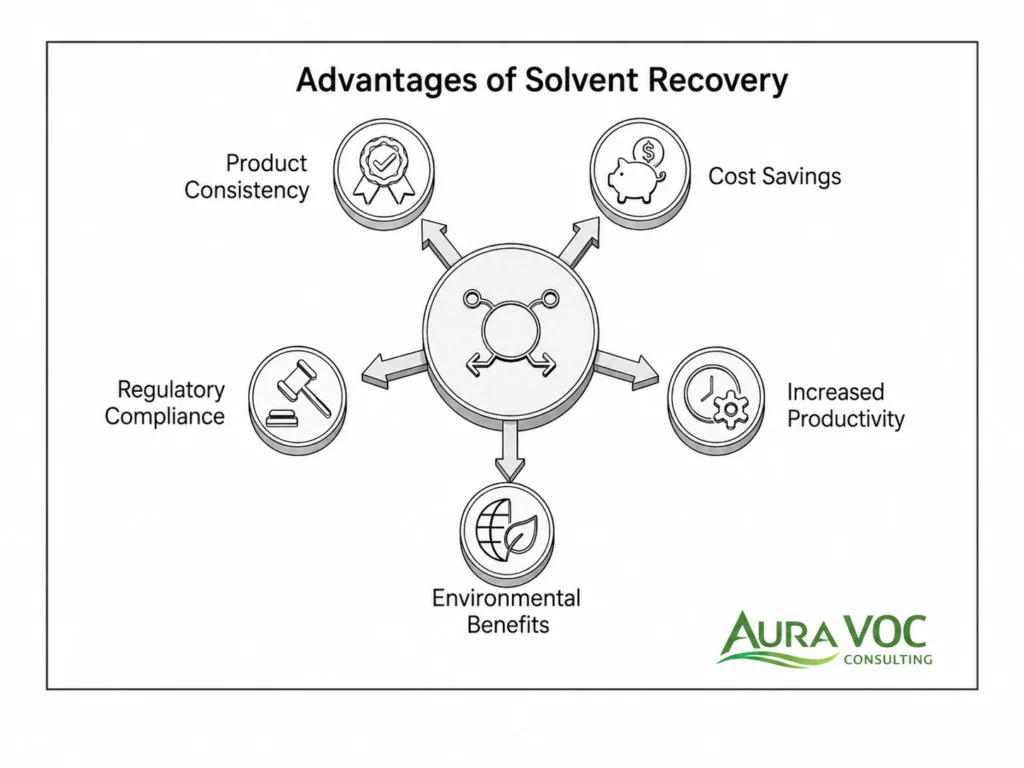
A thermal oxidation system destroys VOCs instead of recovering them. The treated gas leaves through the stack, but the plant must manage fuel use, heat recovery, combustion controls, pressure drop and possible acid gas treatment. For chlorinated, fluorinated, brominated or sulfur-containing VOCs, oxidation may require downstream scrubbing and corrosion-resistant materials.
The selection depends on what the site can control more reliably: recovered liquid handling or thermal destruction. A plant with consistent single-solvent emissions and reuse capacity may favour recovery. A plant with mixed, variable or contaminated VOC streams may favour oxidation, provided energy use and safety controls are acceptable.
Why incorrect technology selection creates operating issues
Poor technology selection often becomes visible after commissioning, when the system is exposed to real production conditions. The problem is not always the equipment itself. It is often an incomplete design basis.
A solvent recovery unit may be sized using average VOC loading while actual batch peaks cause early carbon breakthrough. A condensation system may be selected without fully considering water content, solvent-water equilibrium or refrigeration demand. A steam-regenerated carbon system may recover solvent but produce more aqueous condensate than the wastewater plant can handle. Recovered solvent may also fail reuse specifications because multiple campaigns or cleaning operations have been combined into one recovery train.
Thermal oxidation systems can also be affected by process mismatch. An RTO may operate efficiently at one VOC loading but require continuous auxiliary fuel during low-load campaigns. A high-airflow exhaust stream may create excessive fan power demand. Resin aerosols, dust or condensables may foul ceramic media, heat exchangers or catalyst surfaces. In some installations, the added pressure drop from the abatement system can reduce extraction performance at hoods, ovens or enclosures.
These issues create practical operating consequences: higher fuel use, unstable ventilation balance, reduced source capture, frequent trips, shorter maintenance intervals, off-spec recovered solvent, wastewater overload or production restrictions during abatement downtime.
Where this comparison matters in industrial plants
The recovery-versus-oxidation decision is common in plants using solvent-based operations, but the correct answer varies by sector and process arrangement.
In pharmaceutical manufacturing, VOC streams are often batch-based, with solvent composition changing by campaign. Recovery may be possible for defined solvent streams, but mixed solvent vents, cleaning operations and product-quality restrictions can limit reuse. Thermal oxidation may handle variability better, but turndown, low-load operation and LEL peaks must be evaluated carefully.
In coatings, paint, printing and drying lines, exhaust flows are often large and dilute. Thermal oxidation with heat recovery is frequently considered, especially where dryer exhaust is continuous. However, resin carryover, plasticizers, aerosols and oven balance can create fouling and pressure drop issues. Recovery may be practical only where solvent concentration and composition support it.
In chemical manufacturing, the decision is strongly influenced by VOC speciation, corrosive compounds, reaction by-products and safety classification. Halogenated or sulfur-containing VOCs can change the oxidation design because of acid gas formation and downstream scrubbing requirements. Recovery may be attractive for high-value solvents but becomes more complex with mixed or reactive streams.
In food, flavour and ethanol-containing processes, moisture content and odour-active compounds are often important. Ethanol recovery can be relevant in some cases, but humidity and hygiene-related constraints may affect system selection and maintenance requirements.
In general industrial manufacturing and solvent cleaning, emissions may be intermittent and ventilation-driven. In these cases, the abatement technology must be evaluated against actual operating hours, capture airflow, solvent use patterns and the plant’s ability to maintain the system.
Key selection factors: airflow, VOC load, solvent value, utilities and wastewater capacity
A practical comparison should begin with five primary factors.
Airflow determines equipment size, fan energy and pressure drop impact. High airflow with low VOC concentration often creates poor recovery economics and higher thermal oxidation fuel demand unless heat recovery, source separation or concentration is feasible.
VOC loading determines recoverable solvent mass, oxidizer heat contribution and safety limits. Average concentration is not enough. The design must account for peaks, minimum loads, start-up conditions and batch transitions.
Solvent value and reuse potential determine whether recovery is useful. The relevant measure is not only captured VOC mass, but usable recovered solvent after separation, purification and quality checks.
Utilities influence operating cost and feasibility. Thermal oxidation depends on fuel, electricity and sometimes heat integration. Solvent recovery may require steam, cooling water, chilled water, vacuum, nitrogen, distillation or additional solvent storage.
Wastewater and liquid waste capacity must be reviewed early. Steam-regenerated recovery systems can produce solvent-water condensate. Oxidation systems may avoid recovered solvent wastewater, but acid gas scrubbing can create blowdown requiring treatment.
Process Data Required Before Comparing Technologies
VOC species, concentration range and mass flow
Technology comparison should start with VOC speciation and mass flow, not only concentration expressed in ppm. The same concentration can represent very different VOC mass loads depending on molecular weight and airflow. Speciation also determines solvent recoverability, heating value, adsorption behaviour, corrosion risk and oxidation by-products.
Time-resolved data is more useful than monthly averages. Batch operations, cleaning cycles, dryer warm-up and vessel venting can create short peaks that dominate equipment sizing and safety design.
Airflow rate, temperature, humidity and oxygen content
Airflow defines the scale of the abatement system and the pressure drop imposed on the ventilation network. Temperature and humidity affect adsorption capacity, condensation performance, corrosion risk and material selection.
Oxygen content is relevant for oxidation performance and for safe operation in solvent-rich streams. Where inerting is used upstream, the control philosophy must account for oxygen concentration, purge sequences and analyzer response time.
Batch, campaign or continuous operating profile
A continuous coating line and a multi-product batch reactor can have similar annual VOC emissions but very different design requirements. Batch peaks, idle periods, cleaning steps and campaign changes affect bed sizing, oxidizer turndown, purge sequences, LEL control and utility demand.
The design basis should define minimum, normal and maximum operating cases. A system sized only for peak operation may perform inefficiently for long periods. A system sized around average conditions may fail during short but repeatable emission peaks.
Solvent value, reuse specification and contamination limits
Solvent recovery should be assessed against actual reuse requirements. A recovered solvent stream may contain water, mixed solvents, degradation products or trace contaminants. If the plant cannot reuse it without distillation or external processing, recovery economics and logistics change significantly.
In pharmaceutical and specialty chemical operations, even low contamination levels may make recovered solvent unsuitable for direct reuse. In coatings or industrial cleaning, reuse limits may be more flexible, but viscosity, odour, drying behaviour and formulation stability still matter.
Particulate, aerosols, condensables and fouling risk
Fouling risk is a common reason for underperforming VOC systems. Carbon beds, condensers, RTO ceramic media, catalysts and heat exchangers can all be affected by dust, resin mist, sticky organics, high-boiling compounds or polymerizing vapours.
Pre-treatment may solve part of the problem but adds pressure drop and maintenance. The review should consider clean and dirty operating conditions, not only the new-equipment pressure drop.
LEL profile, safety limits and control requirements
VOC concentration must be evaluated against LEL limits during normal operation, batch peaks, start-up, shutdown and abnormal conditions. Dilution air, purge cycles, shutdown logic, bypass dampers and alarm thresholds should be designed around credible operating scenarios.
LEL sensor location, calibration gas, correction factors, response time and maintenance frequency are practical design details. A sensor placed after dilution may not identify a high-concentration branch upstream. A slow response time can be significant during short batch peaks.
Available utilities: fuel, steam, cooling, electricity and compressed air
Each option transfers load to different utilities. Thermal oxidation requires fuel and electrical power for fans and controls. Solvent recovery may require steam, cooling water, chilled water, nitrogen, compressed air, vacuum or distillation capacity.
Utility availability should be checked at peak and normal operation. A recovery system that fits average production may exceed steam or cooling capacity during peak desorption. An oxidizer that is acceptable during steady production may have high start-up fuel demand or require electrical upgrades for larger fans.
Existing fan capacity, ductwork and static pressure limits
Adding abatement equipment changes the pressure profile of the ventilation system. If existing fans cannot overcome the added static pressure, capture efficiency can fall at the process source.
Fan curves, duct losses, damper positions and required capture points should be reviewed before selecting equipment. Reusing an existing ventilation system is only practical if it can maintain design airflow under loaded operating conditions.
Wastewater treatment capacity and liquid waste constraints
Solvent recovery can move VOC load from air emissions into condensate, recovered solvent or aqueous waste. The wastewater plant may need to handle COD load, solvent toxicity, phase separation issues or variable discharge quality.
Thermal oxidation may reduce liquid solvent handling, but some VOCs can require downstream scrubbing. In those cases, scrubber blowdown, salts, corrosion products and wastewater compatibility become part of the technology comparison.
When Solvent Recovery Is a Practical VOC Abatement Option
High-value or reusable solvents
Solvent recovery becomes practical when the recovered VOC stream has a defined use or disposal value. The question is not simply whether solvent can be captured, but whether the recovered material can be handled as a useful process stream.
If the recovered solvent can be reused in the same process, sent to a solvent management system or purified with existing distillation capacity, recovery may reduce raw solvent demand and waste handling. If the recovered liquid is mixed, contaminated, unstable or not acceptable for process reuse, it may become another waste stream requiring storage, analysis, transport or treatment.
This distinction is important in pharmaceutical, chemical, coating and cleaning operations. A single-solvent process with predictable loading is very different from a campaign-based plant where vents from multiple products are combined.
Stable solvent composition and predictable VOC loading
Solvent recovery systems operate best when the inlet composition and VOC loading remain within a controlled range. Activated carbon systems, condensation units and hybrid recovery arrangements all depend on predictable mass loading for stable operation.
In a continuous coating or drying process, solvent loading may be relatively steady once production conditions are established. In batch production, emissions may occur during charging, heating, vacuum drying, cleaning or vessel opening. These short peaks can define the design.
Average concentration values are often insufficient. A recovery system designed around average load may experience early breakthrough during batch peaks. Conversely, equipment sized for peak emissions may operate inefficiently for long periods at low loading. This creates a tradeoff between capture margin, bed size, regeneration frequency, utility demand and capital cost.
Activated carbon adsorption with regeneration
Activated carbon adsorption is commonly used for solvent vapour capture where the VOC is adsorbable and the stream is compatible with carbon bed operation. In recovery applications, the carbon is regenerated rather than discarded, typically using steam, hot gas, inert gas, vacuum or a combination of methods.
The main operating variables include inlet VOC concentration, humidity, temperature, bed residence time, carbon working capacity, regeneration effectiveness and pressure drop. High humidity can reduce adsorption capacity for some compounds and increase condensate volume during steam regeneration. Elevated inlet temperature can also reduce adsorption capacity and increase breakthrough risk.
Carbon beds require regular monitoring for breakthrough, bed temperature, pressure drop, valve condition and regeneration performance. Channeling, carbon fouling, bed compaction or incomplete regeneration can reduce effective capacity before the theoretical carbon life is reached. Plants should also consider carbon replacement logistics, spent carbon handling and fire-risk controls.
Condensation-based solvent recovery
Condensation can be practical when solvent concentration and vapour pressure allow recovery at achievable cooling temperatures. It is generally more suitable for concentrated solvent streams than for large dilute ventilation flows.
The key design question is the cooling level required to condense a useful fraction of VOC mass. Cooling water may be sufficient for some streams, while others require chilled water, glycol, brine or mechanical refrigeration. Lower condensation temperatures can improve recovery, but they increase energy demand and may create freezing, fouling or condensate management issues.
Condensation systems are sensitive to water vapour, high-boiling compounds, aerosols and fluctuating flow rates. Condensed phases may separate cleanly, form emulsions or produce a mixed solvent-water stream requiring downstream treatment.
Hybrid recovery systems for concentrated solvent streams
Hybrid systems are used when one recovery mechanism cannot provide the required performance or operational flexibility. Examples include condensation followed by adsorption polishing, adsorption followed by distillation, or concentration followed by recovery.
These arrangements can be useful when solvent loading varies across operating phases. A condenser may remove bulk solvent during high-load periods, while an adsorption stage controls residual VOC at lower concentrations. This can reduce load on the polishing stage and improve overall stability.
The added complexity must be justified. Hybrid systems require additional controls, more instrumentation, more maintenance points and clearer operating procedures. They may also create multiple recovered or waste streams that need separate handling.
Solvent purity, reuse limits and off-spec recovered solvent
Recovered solvent should be evaluated against the plant’s actual reuse specification. In many cases, solvent recovery fails economically not because the abatement device underperforms, but because the recovered solvent cannot be reused without further processing.
Potential contaminants include water, other solvents, monomers, plasticizers, oils, reaction by-products, odour compounds, degradation products and cleaning residues. Even small contamination levels may be unacceptable in pharmaceutical or high-specification chemical processes. Coating and printing operations may tolerate wider solvent quality ranges, but viscosity, drying behaviour, odour and formulation limits still matter.
Where reuse is not possible, the recovered solvent may need distillation, blending, off-site recovery or disposal. These downstream costs should be included in the technology comparison.
Operating risks: breakthrough, bed heating, poor regeneration and corrosion
Common solvent recovery problems include early breakthrough, reduced recovery rate, excessive water in recovered solvent, elevated bed temperature, poor phase separation and corrosion in condensate handling areas.
Breakthrough can result from high inlet loading, poor regeneration, high humidity, elevated temperature, carbon aging or channeling. Bed heating may indicate excessive adsorption heat, reactive compounds or insufficient temperature monitoring. Poor regeneration may be caused by inadequate steam flow, blocked condensate removal, valve leakage, short regeneration time or incorrect sequencing.
Corrosion risk is often concentrated in wet areas: condensers, separators, condensate piping, tanks and drains. Material selection should consider solvent-water mixtures, acidic contaminants and cleaning chemicals, not only the dry vapour composition.
When Thermal Oxidation Is a Practical VOC Abatement Option
Mixed, variable or low-value VOC streams
Thermal oxidation is often considered where the VOC stream is not suitable for recovery. This includes mixed solvent vents, contaminated vapours, low-value solvents, odour-active compounds or streams where recovered liquid would not meet reuse criteria.
The strength of thermal oxidation is that it does not require solvent segregation or recovery quality management. The VOC mass is converted in a controlled oxidation process, subject to correct temperature, residence time, mixing, oxygen availability and safety controls.
The tradeoff is energy and equipment stress. Low VOC concentration and high airflow can create significant auxiliary fuel demand. Variable loading can create control instability or temperature swings. Contaminants such as particulates, aerosols, silicone compounds, phosphorus compounds, halogens, sulfur or metals may create fouling, corrosion or catalyst deactivation issues.
RTO, recuperative oxidizer and catalytic oxidizer selection
The oxidizer type should be selected against the operating profile, not only the required destruction efficiency.
A regenerative thermal oxidizer is usually considered where airflow is relatively high and operating hours are sufficient to make regenerative heat recovery useful. The main operational risks are ceramic media fouling, valve leakage, pressure drop increase and temperature imbalance between beds. These risks are more relevant when the exhaust contains resin mist, particulate, condensables or sticky organic compounds.
A recuperative oxidizer may be more appropriate for smaller flows, higher VOC loading or applications where a simpler flow path is preferred. Heat exchanger fouling and thermal stress must be considered, especially where the exhaust contains high-boiling compounds or particulate carryover.
A catalytic oxidizer can reduce fuel demand by operating at a lower temperature, but only if the VOC stream is compatible with the catalyst. Silicones, phosphorus compounds, sulfur compounds, halogenated compounds, heavy metals and particulate masking can reduce catalyst activity. Catalyst selection should be based on actual VOC speciation and contaminant review, not only the solvent name on the safety data sheet.
Fuel demand, VOC heating value and autothermal operation
Thermal oxidizer fuel consumption should be evaluated at minimum, average and peak VOC load. Annual average emissions are not enough for design or operating cost estimates.
Autothermal operation occurs only when VOC heat release is sufficient to offset the heat required to raise the process air to oxidation temperature, plus system heat losses. A batch peak may temporarily reduce burner firing, but it does not mean the oxidizer will be fuel-efficient over a full operating cycle. Long low-load periods, idle ventilation, cold inlet air or excessive dilution can keep auxiliary fuel demand high.
For RTOs, heat recovery performance also depends on clean media, correct valve sequencing and balanced airflow through the beds. Fouled media or leaking valves can increase fuel use even when VOC loading has not changed.
Heat recovery opportunities and practical limitations
Heat recovery can improve thermal oxidation economics, particularly where recovered heat can be used in dryers, ovens, process air preheating or utility systems. The practical value depends on matching the heat source with a consistent heat demand.
Distance between the oxidizer and the heat user, contamination risks, variable production schedules, duct losses, control complexity and maintenance access can limit heat integration. In some cases, adding heat recovery improves the energy balance but increases pressure drop, fouling risk and downtime exposure.
Acid gas formation from halogenated or sulfur-containing VOCs
The composition of the VOC stream determines whether oxidation products create additional treatment requirements. Chlorinated, fluorinated, brominated, sulfur-containing or nitrogen-containing compounds may form acid gases or other combustion by-products. These can require downstream scrubbing, corrosion-resistant materials, quench systems and liquid waste handling. For chemical-sector BAT context, the European Commission WGC BREF covers channelled and diffuse waste gas management in chemical production.
This can change the comparison with solvent recovery. A thermal oxidizer may destroy the VOC, but the plant may still need to manage scrubber blowdown, corrosion risk, salt loading and wastewater treatment impact. Speciation is essential before selecting equipment.
Operating risks: high fuel use, VOC slip, media fouling, catalyst poisoning and trips
Thermal oxidation problems usually appear as excessive fuel use, unstable temperature control, high outlet VOC, rising pressure drop, frequent trips or failed performance testing.
High fuel use may be caused by low VOC loading, excessive airflow, poor heat recovery, leaking dampers, fouled media, poor burner tuning or incorrect operating setpoints. VOC slip may indicate inadequate chamber temperature, poor mixing, insufficient residence time, valve leakage, catalyst degradation or bypass leakage.
RTO media fouling can result from particulate, sticky organic carryover, condensables or process aerosols. Catalytic systems can be affected by poisoning or masking contaminants. Frequent trips may be linked to LEL excursions, airflow faults, burner management alarms, high temperature limits or pressure imbalance. These issues should be reviewed against process data before assuming the oxidizer itself is the root cause. For thermal oxidizer monitoring parameters, refer to EPA guidance on outlet VOC concentration, combustion chamber temperature, CO, exhaust flow, fan current and auxiliary fuel pressure.
VOC Concentration, Airflow and LEL Constraints
Low-concentration, high-airflow VOC streams
Low-concentration, high-airflow streams are common in coating lines, room ventilation systems, drying exhaust and solvent cleaning areas. These streams can be difficult for solvent recovery because the VOC mass per unit of air is low, while equipment size and fan power are driven by total airflow.
Thermal oxidation can handle dilute streams, but fuel demand may be high unless heat recovery or concentration is effective. In some cases, reducing unnecessary dilution air, improving local capture or separating high-strength vents from general ventilation can change the technology comparison more than the abatement unit itself.
Medium- and high-concentration solvent vapour streams
Medium- and high-concentration streams may be more suitable for recovery, particularly when solvent composition is consistent and reuse is possible. Higher VOC concentration can also reduce thermal oxidizer fuel demand because the VOC contributes heat to the oxidation process.
However, higher concentration increases LEL management requirements. The design must account for normal operation, batch peaks, equipment failure and abnormal ventilation conditions. Concentration should be beneficial only within a controlled safety envelope.
Batch concentration peaks and campaign variability
Batch operations often create short VOC peaks that do not appear clearly in daily or monthly emission averages. These peaks can drive carbon bed sizing, regeneration frequency, oxidizer temperature control, fan design and LEL interlocks.
Campaign variability adds another layer. A system that performs well for one solvent may be less suitable for another due to adsorption capacity, condensation temperature, heating value, corrosion risk or catalyst compatibility. Multi-product plants should evaluate expected future campaigns, not only current production.
LEL monitoring, dilution air and interlock philosophy
LEL monitoring is central to the safe handling of solvent vapours in both recovery and oxidation systems. Dilution air, purge sequences, shutdown logic, bypass dampers and alarm thresholds should be designed around credible operating scenarios. For combustible atmosphere monitoring, OSHA notes that instrument response may require gas-specific correction factors when calibration gas differs from the measured vapour.
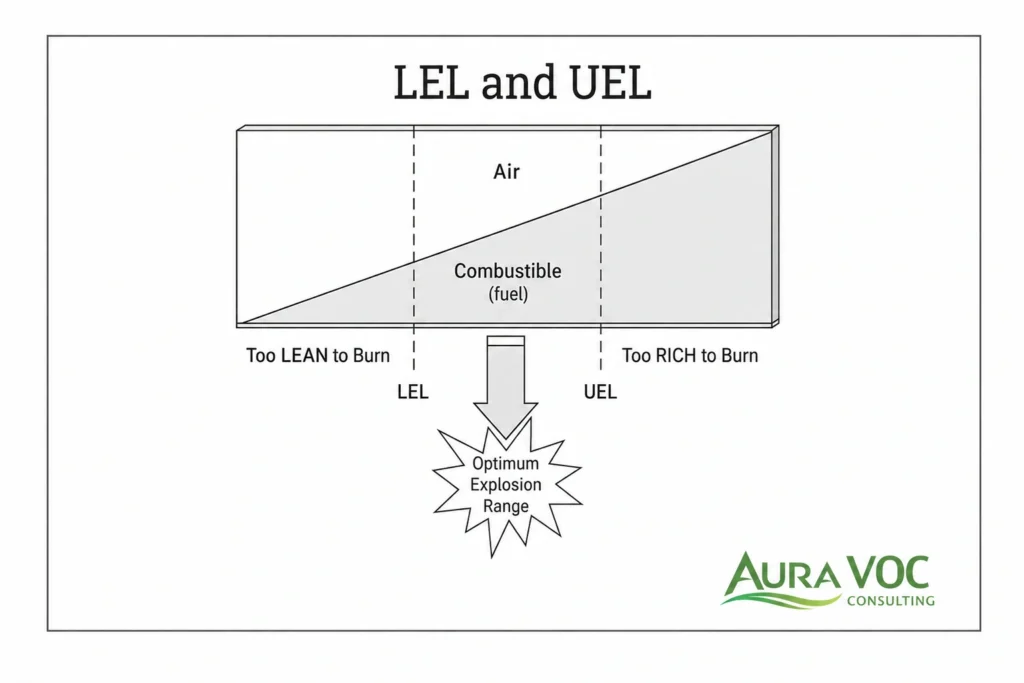
Adding dilution air can reduce LEL percentage but increases airflow, equipment size, pressure drop and thermal load. Concentrating a stream can improve recovery or energy balance but increases safety-control complexity. These tradeoffs should be resolved during process design, not left to commissioning adjustments.
Concentrator, recovery or oxidation: when hybrid treatment is needed
Hybrid treatment should be evaluated when the VOC stream does not fit cleanly into a recovery-only or oxidation-only approach. A concentrator may reduce the airflow sent to an oxidizer. Condensation may remove bulk solvent before polishing. Adsorption may smooth batch peaks before downstream treatment.
Hybrid systems can improve performance but add control complexity and maintenance requirements. They are most useful where the plant has enough process understanding and operational discipline to manage multiple treatment stages reliably.
Energy and Utility Tradeoffs
Thermal oxidizer fuel consumption and heat recovery
Fuel demand is driven mainly by airflow, inlet temperature, VOC heating value, heat recovery efficiency and operating schedule. A high-airflow, low-concentration stream can be expensive to oxidize because most of the energy is used to heat air rather than VOC mass.
RTOs can reduce this penalty through regenerative heat recovery, but only when the unit operates consistently and the media remains clean. Frequent start-stop operation, long idle periods, leaking valves, fouled media or poor bed balance can increase fuel consumption. Recuperative systems face similar issues when heat exchanger surfaces foul or bypass dampers leak.
Heat recovery should be evaluated against real heat demand. Recovering heat to a dryer, oven or process air system is useful only when the heat user operates at the same time and can tolerate the control response, contamination risk and added pressure drop.
Solvent recovery steam, cooling and regeneration demand
Solvent recovery shifts utility demand away from combustion and toward regeneration and condensation. Steam-regenerated carbon systems require steam supply, condensate collection, condenser duty and solvent-water separation. Hot gas or inert gas regeneration may require heaters, nitrogen, recirculation blowers or oxygen control.
Condensation-based recovery depends on the cooling temperature required to remove a useful fraction of VOC mass. Cooling water may be adequate for some concentrated streams. Other applications require chilled water, glycol, brine or mechanical refrigeration. Lower condensation temperatures can improve recovery, but they increase energy use and may create freezing, fouling or condensate management issues.
Utility demand should be checked at peak and normal operation. A recovery system that is acceptable at average load may exceed steam, chilled water or condenser capacity during batch peaks.
Fan power and electrical load
Both recovery and oxidation systems add static pressure to the ventilation network. Carbon beds, filters, condensers, mist eliminators, RTO media, switching valves, heat exchangers and dampers all contribute to total pressure drop.
Fan energy should be reviewed using the actual operating point on the fan curve. A clean-system pressure drop estimate is not enough. Loaded filters, fouled media, wet mist eliminators or partially blocked condensers can shift the fan operating point and reduce process capture airflow. This can create a situation where the abatement unit performs correctly, but source capture deteriorates upstream.
Low-load and intermittent operation
Intermittent operation is a common source of poor lifecycle performance. Thermal oxidizers may require fuel during warm-up, purge, idle ventilation and low-load production. Solvent recovery systems may still require regeneration, condenser operation and solvent handling even when VOC loading is irregular.
For batch plants, the design should account for charging, heating, drying, cleaning and vessel-opening phases separately. The peak phase may define safety and equipment sizing, while the low-load phase may define operating cost.
Heat integration with dryers, ovens or process air systems
Heat integration can reduce fuel use, but it should not be assumed to be available. The review should check distance between units, duct routing, contamination risk, pressure drop, control stability, production schedules and maintenance access.
Where heat recovery is tied to a critical production process, failure modes must be considered. Fouling, damper malfunction or oxidizer trips can affect both the abatement system and the heat user.
Pressure Drop, Fan Capacity and Ventilation Performance
Pressure drop across carbon beds, filters and condensers
Solvent recovery systems can impose significant pressure drop through carbon beds, pre-filters, condensers, mist eliminators and duct transitions. The design should consider both clean and dirty pressure drop.
Carbon bed pressure drop may increase due to carbon fines, bed compaction, particulate carryover or condensable deposition. Filters and mist eliminators can load quickly if aerosols or resin mist are present. Condensers may foul on the gas side or liquid side, reducing heat transfer and increasing resistance.
Pressure drop across RTO media, valves and heat exchangers
RTO systems introduce pressure drop through ceramic media, switching valves, dampers, inlet distribution chambers and stack components. Fouled media increases fan load and may create flow imbalance between beds. Valve leakage can reduce destruction performance and heat recovery while also disturbing pressure balance.
Recuperative oxidizers can experience pressure drop increase when heat exchanger passages foul or when deposits form from high-boiling organics. Catalytic systems may be affected by catalyst masking or plugged support structures.
Impact on capture efficiency and process ventilation balance
VOC abatement performance depends on capture as well as treatment. Adding an abatement unit to an existing ventilation system can reduce hood face velocity, oven exhaust rate or enclosure negative pressure if the fan cannot overcome the added static pressure.
This is especially relevant where an existing fan is reused. A plant may meet stack outlet performance during testing but still experience increased fugitive emissions if process capture is reduced. Before procurement, the fan curve, duct losses, damper positions and required capture points should be reviewed together.
Rising pressure drop as a maintenance indicator
Pressure drop trending is one of the most useful maintenance indicators in VOC abatement systems. A gradual increase may indicate filter loading, media fouling, condensate accumulation, carbon bed compaction or duct deposits. A sudden change may indicate damper failure, blocked drains, collapsed filter elements or valve malfunction.
Pressure drop should be monitored across individual components where possible, not only across the entire system. Component-level readings make troubleshooting faster and reduce unnecessary shutdown time.
When existing fans or ductwork limit technology selection
Existing fans and ductwork often become selection constraints. If available static pressure is limited, a lower-pressure-drop option, fan upgrade or duct modification may be required. Reusing the existing ventilation system is only practical if it can maintain design airflow under loaded operating conditions.
Duct velocity, condensate drainage, access doors, balancing dampers and hazardous area classification should also be reviewed. Abatement equipment cannot correct poor capture or unstable duct design upstream.
Wastewater and Recovered Solvent Handling
Steam regeneration condensate from solvent recovery systems
Steam-regenerated solvent recovery produces condensate containing water and desorbed solvent. Depending on the solvent properties, the condensate may separate into two phases, remain partially dissolved or form an emulsion.
The volume and composition of this stream are controlled by steam rate, regeneration duration, condenser performance, solvent solubility and inlet VOC loading. A system that recovers solvent effectively can still create a difficult wastewater stream.
Solvent-water separation, COD load and wastewater treatment impact
Aqueous condensate can increase COD load, introduce solvent toxicity, disturb biological treatment or create odour and VOC stripping from wastewater tanks. Phase separation should be verified using representative solvent mixtures, not only single-component data.
Where solvents are partially miscible or emulsions form, simple decanting may not be enough. Distillation, carbon polishing, off-site recovery or dedicated pre-treatment may be required. These costs and operating requirements should be included in the comparison with thermal oxidation.
When recovered solvent becomes liquid waste
Recovered solvent becomes liquid waste when it is too mixed, wet, degraded or contaminated for reuse. This is common when multiple process vents are combined, when cleaning solvents share the recovery system or when reaction by-products enter the exhaust.
Off-spec solvent still requires storage, classification, sampling and disposal. Recovery value should be calculated from usable recovered solvent, not theoretical captured VOC mass.
Thermal oxidation and scrubber blowdown for acid gas control
Thermal oxidation usually avoids recovered solvent condensate. However, oxidation of halogenated or sulfur-containing VOCs can generate acid gases requiring quench and scrubbing. Scrubber blowdown may contain salts, dissolved organics and corrosion products.
In these cases, oxidation does not eliminate liquid waste handling. It changes the liquid waste type and moves the design focus to scrubber chemistry, materials of construction and wastewater compatibility.
Wastewater constraints as a technology selection factor
Wastewater capacity should be reviewed before selecting a recovery system. The plant should confirm hydraulic capacity, COD allowance, solvent compatibility, biological treatment sensitivity, phase separation performance and storage capacity for recovered or off-spec solvent.
Where wastewater capacity is limited, thermal oxidation or a hybrid arrangement may be more practical even when solvent recovery is technically possible.
Maintenance Requirements and Failure Modes
Solvent recovery maintenance: carbon beds, valves, condensers and solvent tanks
Maintenance of solvent recovery systems focuses on adsorption capacity, regeneration effectiveness and liquid handling. Carbon beds require monitoring for breakthrough, temperature rise, pressure drop, channeling and loss of working capacity.
Valves and dampers are critical because leakage between adsorption and regeneration phases can reduce recovery efficiency and increase emissions. Condensers, separators, pumps and solvent tanks should be inspected for fouling, corrosion, blocked drains and poor phase separation. Where steam regeneration is used, steam traps, condensate lines and condenser performance are part of the abatement system’s reliability, not separate utility issues.
Thermal oxidizer maintenance: burners, valves, media, catalyst and refractory
Thermal oxidizer maintenance depends on oxidizer type. Burners, flame detection, fuel trains, purge sequences and safety interlocks require regular verification. RTO systems also require inspection of switching valves, seals, actuators, ceramic media and temperature balance between chambers.
Recuperative oxidizers require heat exchanger inspection for fouling, leakage and thermal stress. Catalytic systems require catalyst activity checks and inspection for poisoning, masking, fouling or overheating. Refractory condition, expansion joints, dampers and stack components should be included in planned inspections.
Instrumentation maintenance: VOC, LEL, temperature, pressure and flow monitoring
Instrumentation reliability is central to both compliance and safe operation. VOC analyzers, LEL sensors, thermocouples, pressure transmitters, airflow measurements and valve position feedback should be calibrated and maintained according to their service environment.
Dirty or wet gas streams can affect sample lines and analyzer response. LEL sensors require calibration against appropriate gases or correction factors. Pressure and airflow instruments should be located where readings support troubleshooting, not only control logic.
Critical spares and downtime planning
Critical spares may include LEL sensors, thermocouples, pressure transmitters, valve actuators, burner components, carbon media, filter elements, condensate pumps, fan belts, catalyst modules and control components.
Downtime planning matters where production cannot operate without the abatement system. A spare part that appears minor can become production-critical if it prevents safe start-up, regeneration or oxidizer operation.
Maintenance access and layout constraints
Maintenance access should be reviewed during design. Carbon replacement, catalyst removal, media cleaning, valve repair, burner inspection, condenser cleaning and pump replacement all require space, isolation points and safe access.
Poor access increases maintenance time and can delay corrective work after trips or performance deviations. Layout should also account for solvent storage, condensate drainage, lifting points, sampling locations and safe access to instruments.
Troubleshooting Solvent Recovery vs Thermal Oxidation Systems
Early carbon breakthrough or low recovery rate
Early breakthrough may result from high inlet VOC load, high humidity, elevated inlet temperature, poor regeneration, channeling, carbon aging or valve leakage between adsorption and regeneration phases.
Useful checks include inlet and outlet VOC trend during the adsorption cycle, bed temperature profile, pressure drop across the bed, steam flow, regeneration duration, condenser outlet temperature and recovered solvent rate. If breakthrough occurs earlier after each cycle, incomplete regeneration or carbon fouling should be investigated.
Off-spec recovered solvent or excessive water content
Off-spec solvent usually indicates a process segregation or condensation issue rather than only an abatement issue. Check whether mixed campaigns, cleaning operations or water-rich vents are entering the same recovery system.
Operational checks should include lab analysis of recovered solvent, condensate phase split, condenser temperature, steam-to-solvent ratio, decanter residence time and emulsion formation. If the recovered stream varies by campaign, solvent segregation may be more effective than changing the recovery unit.
High thermal oxidizer fuel consumption
High natural gas consumption can be caused by low VOC heating value, excessive airflow, cold inlet air, poor heat recovery, leaking dampers, fouled RTO media, incorrect temperature setpoints, burner tuning problems or intermittent operation.
Useful data includes burner firing rate trend, inlet VOC load, inlet airflow, RTO bed temperatures, stack temperature, pressure drop and production schedule. Fuel use should be compared between start-up, steady operation, low-load production and idle modes.
VOC slip or failed outlet emission performance
VOC slip after a thermal oxidizer may result from insufficient temperature, poor mixing, inadequate residence time, valve leakage, catalyst deactivation, bypass leakage or analyzer drift.
Before modifying the system, confirm inlet load, outlet VOC measurement, chamber or bed temperature profile, oxygen level, valve position, bypass damper status and analyzer calibration. For catalytic systems, catalyst masking or poisoning should be checked against the contaminant profile.
RTO temperature imbalance or valve leakage
RTO temperature imbalance may indicate media fouling, uneven flow distribution, valve leakage, cycle timing problems or thermocouple issues. Valve leakage is especially important because it can allow untreated or partly treated air to pass through the system.
Checks should include bed-to-bed temperature spread, valve actuator position, seal condition, cycle timing, pressure drop by chamber and stack VOC trend during valve switching.
High pressure drop or unstable extraction airflow
High pressure drop can originate in filters, carbon beds, RTO media, condensers, dampers, duct deposits or mist eliminators. Unstable extraction may also result from fan operation near an unstable point on the fan curve.
Measurements should include component-level differential pressure, fan current, duct static pressure, airflow at critical capture points and damper positions. Cleaning or replacing the abatement component may not solve the issue if the upstream ductwork is loaded or the fan is undersized.
Frequent LEL, temperature or airflow trips
Frequent trips usually indicate mismatch between process variability and control logic. Batch peaks, dilution air failure, blocked filters, fan instability, sensor drift or inappropriate alarm thresholds can all trigger shutdowns.
Review LEL trend data by production phase, sensor calibration gas, response time, dilution air control, purge sequence, high and high-high trip logic, and bypass damper operation. Nuisance trips should not be bypassed without understanding the process cause.
Diagnostic measurements to collect before modifying the system
Before changing equipment or setpoints, collect airflow, VOC speciation, inlet and outlet VOC concentration, LEL trend, temperature profile, pressure drop by component, fan current, steam or fuel use, recovered solvent rate, condensate composition, wastewater impact and trip history.
This data separates design mismatch from maintenance faults, control issues or process changes.
Industry-Specific Selection Considerations
Pharmaceutical batch manufacturing
Pharmaceutical plants often operate with campaign-based solvent profiles, intermittent emissions and strict solvent quality requirements. Recovery may be suitable for segregated high-value streams, but direct reuse can be limited by GMP requirements, water content, cross-contamination risk or product-specific impurity limits.
Thermal oxidation may be more practical for mixed vents, cleaning emissions and variable campaigns. The design should account for batch peaks, solvent changeover, turndown, LEL control, start-up frequency and downtime risk during critical production phases.
Coatings, paint and drying lines
Coating and drying lines often generate high-airflow exhaust with solvent vapours, resin mist or plasticizer carryover. RTOs are commonly evaluated because of heat recovery potential, especially where oven exhaust is steady.
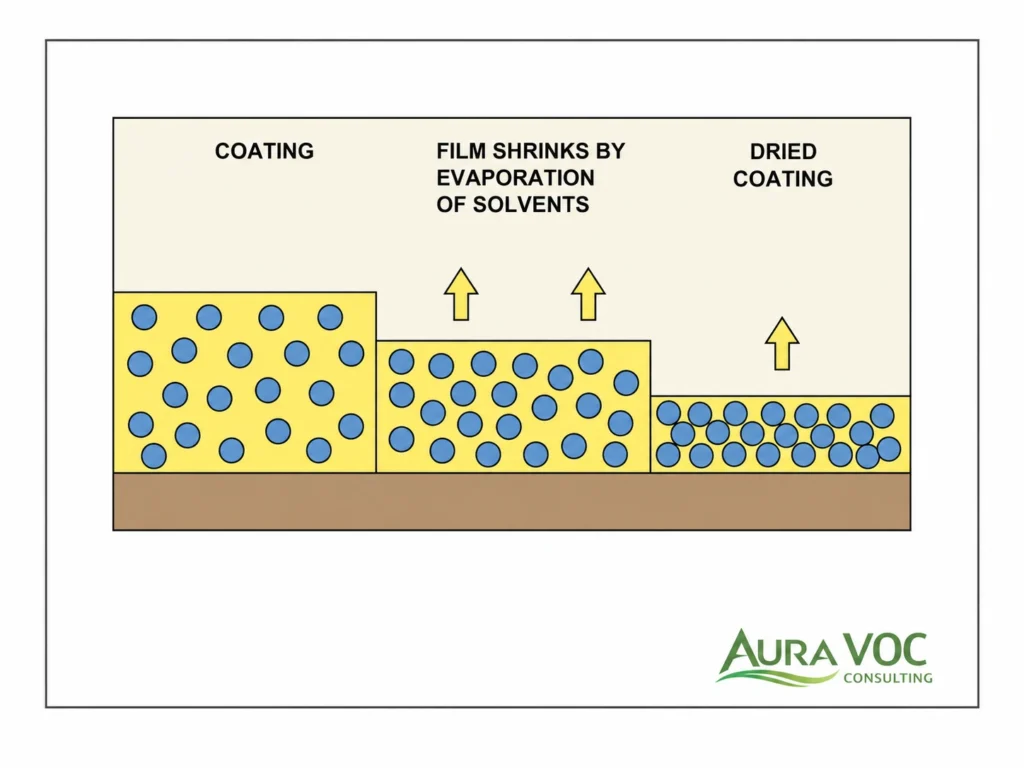
The main operating concerns are fouling, pressure drop, oven balance and heat integration. Recovery may be suitable where solvent concentration is high enough and the solvent composition is consistent, but large dilute flows often reduce recovery practicality.
Chemical process vents
Chemical process vents require detailed VOC speciation. Solvent value, reactivity, corrosive compounds, halogens, sulfur compounds, oxygen content and batch variability can all change the selection.
Recovery may be attractive for defined high-value solvents, but mixed or reactive streams can create off-spec recovered solvent or safety concerns. Oxidation may be more robust for variable streams, but acid gas formation, corrosion and downstream scrubbing should be evaluated early.
Food, flavour and ethanol-containing streams
Food, flavour and ethanol-containing processes may involve high moisture content, odour-active compounds and hygiene-related constraints. Ethanol recovery can be feasible in some applications, but water content and condensate handling must be reviewed.
Thermal oxidation may be used where odour-active VOCs or mixed organic vapours are not suitable for recovery. The design should account for moisture, cleaning cycles, corrosion risk and any hygienic requirements around ductwork or condensate handling.
Solvent-based industrial cleaning and manufacturing operations
Solvent cleaning and general manufacturing operations often produce intermittent emissions driven by operator activity, ventilation rate and solvent use patterns. These streams may be difficult to treat efficiently if airflow is high and VOC loading is low.
The first review should focus on capture design, segregation of high-strength vents and actual operating hours. In some cases, improving source capture or separating process vents from general room ventilation can make either recovery or oxidation more practical.
Solvent Recovery vs Thermal Oxidation Decision Matrix
Conditions that favour solvent recovery
Solvent recovery is usually favoured when the plant has a stable, valuable solvent stream and a defined reuse or purification route.
| Process condition | Solvent recovery implication | Data to confirm |
|---|---|---|
| Single or dominant solvent | Higher chance of reusable recovered solvent | VOC speciation and campaign schedule |
| Sufficient VOC mass loading | Better recovery economics | Concentration range and airflow |
| Low to moderate humidity | Better adsorption and lower condensate burden | Humidity, dew point and water balance |
| Existing solvent purification route | Easier reuse of recovered material | Distillation or blending capacity |
| Wastewater capacity available | Steam regeneration may be manageable | COD load, phase separation and storage |
Conditions that favour thermal oxidation
Thermal oxidation is usually favoured where the VOC stream is difficult to recover or where recovered solvent has limited value.
| Process condition | Thermal oxidation implication | Data to confirm |
|---|---|---|
| Mixed solvent stream | Avoids off-spec recovery issues | VOC speciation |
| Variable batch campaigns | More tolerant of composition changes | Batch emission profile |
| Low-value or contaminated VOCs | Destruction may be more practical than recovery | Solvent reuse assessment |
| Limited solvent handling capacity | Avoids recovered solvent logistics | Storage and waste handling review |
| Acceptable fuel and fan power demand | Oxidation can be operationally viable | Energy balance and fan curve |
Conditions that favour a hybrid VOC abatement system
Hybrid systems should be evaluated when one treatment method does not fit the entire operating envelope. Examples include bulk condensation followed by adsorption polishing, solvent recovery on high-strength vents with oxidation on residual streams, or concentration before RTO treatment.
Hybrid systems can reduce load on downstream equipment, but they require more controls, more maintenance points and clearer operating procedures. They should be selected only when the added complexity solves a defined process problem.
Conditions requiring additional sampling or pilot testing
Additional testing is required when VOC composition is uncertain, emissions vary by campaign, water content is high, aerosols are present, recovered solvent quality is unknown or catalyst compatibility is uncertain.
Useful testing may include VOC speciation, time-resolved concentration monitoring, carbon adsorption trials, condensation trials, solvent-water separation tests, LEL profiling and pressure drop assessment.
Design review checklist before equipment procurement
Before selecting equipment, review the VOC mass balance, airflow range, peak and minimum VOC loading, solvent reuse specification, pressure drop, fan curve, LEL controls, utility demand, wastewater capacity, maintenance access, control logic, bypass conditions and future production changes.
Procurement specifications should be based on the operating envelope, not only the nominal design case. This reduces the risk of selecting equipment that performs during acceptance testing but struggles during campaign changes, low-load periods or high-emission peaks.
Conclusion: Select Based on Process Data, Not Technology Preference
Summary of engineering selection criteria
Solvent recovery and thermal oxidation solve different VOC abatement problems. Recovery is practical when the solvent has value, composition is stable, and the site can manage recovered solvent, condensate and wastewater. Thermal oxidation is practical when the VOC stream is mixed, variable, contaminated or unsuitable for reuse, provided the plant can manage energy demand, pressure drop, safety controls and oxidation by-products.
The decision should be based on VOC mass flow, speciation, airflow, operating schedule, solvent value, LEL profile, utility availability, pressure drop and liquid waste constraints. A technology that looks suitable from a stack-emission perspective may still create operating problems if these factors are not defined before selection.
Why lifecycle performance depends on utilities, wastewater, pressure drop and maintenance
Lifecycle performance depends on more than removal efficiency. Thermal oxidizers can be affected by fuel demand, fouling, valve leakage, temperature imbalance and fan energy. Solvent recovery systems can be affected by regeneration quality, carbon capacity, condensate handling, recovered solvent quality and wastewater impact.
Pressure drop links the abatement system to process ventilation. Wastewater links recovery performance to liquid treatment capacity. Maintenance access determines how quickly problems can be corrected. These practical constraints often decide whether the selected system remains reliable after commissioning.
Next step: VOC abatement selection review using plant-specific operating data
A reliable comparison between solvent recovery and thermal oxidation requires measured process data, not only estimated annual emissions. The review should define the VOC operating envelope, including concentration peaks, airflow range, solvent composition, LEL profile, fan static pressure, utility limits, wastewater capacity and maintenance constraints.
AuraVOC can support this assessment by reviewing plant-specific VOC data and identifying whether recovery, oxidation or a hybrid arrangement is technically appropriate before equipment selection, retrofit or troubleshooting work.
FAQ
When is solvent recovery better than thermal oxidation for VOC emissions?
Solvent recovery is more suitable when the VOC stream contains a valuable and recoverable solvent, the composition is stable, and the recovered solvent can be reused or purified economically. The plant must also be able to manage condensate, wastewater and solvent storage safely. Recovery is less attractive when the recovered liquid is mixed, water-contaminated or off-spec.
When is thermal oxidation better than solvent recovery?
Thermal oxidation is generally more practical for mixed, variable, contaminated or low-value VOC streams. It avoids recovered solvent quality issues but introduces fuel demand, pressure drop, combustion controls and possible downstream scrubbing. The decision should consider energy use across the full operating schedule, not only peak VOC loading.
Is an RTO better than activated carbon for solvent vapours?
An RTO and activated carbon solve different problems. An RTO destroys solvent vapours, while activated carbon can capture and recover them if the stream is suitable. Activated carbon may be preferred for reusable solvent streams; an RTO may be preferred for mixed or non-reusable VOCs.
What VOC concentration is required for solvent recovery?
There is no universal concentration threshold. Solvent recovery depends on VOC mass flow, airflow, solvent partial pressure, adsorption capacity, regeneration method, humidity, required outlet concentration and recovered solvent value. A feasibility review should evaluate minimum, average and peak loading separately.
Can solvent recovery handle mixed solvent streams?
Solvent recovery can capture mixed solvent streams, but the recovered liquid may not be reusable without separation. In multi-product plants, mixed campaigns can produce variable solvent quality. Segregating high-value solvent vents may be more effective than recovering all VOCs into one combined stream.
Why is recovered solvent sometimes unsuitable for reuse?
Recovered solvent may contain water, other solvents, cleaning residues, reaction by-products, degradation compounds or odour-active contaminants. Even small contamination levels can be unacceptable in pharmaceutical, specialty chemical or high-specification coating processes. Reuse should be based on plant specifications, not only recovery percentage.
Why does steam-regenerated solvent recovery create wastewater?
Steam condenses with desorbed solvent during regeneration. The resulting condensate may contain dissolved solvent, separate organic phase or emulsified solvent. This stream can increase COD load, create phase separation problems or require distillation, pre-treatment or off-site disposal.
Why is my thermal oxidizer using too much natural gas?
High gas use may be caused by low VOC heat contribution, excessive airflow, poor heat recovery, fouled RTO media, leaking valves, cold inlet air, high temperature setpoints or intermittent operation. Burner firing rate should be reviewed alongside VOC load, airflow, bed temperatures and production schedule.
How does airflow affect the choice between solvent recovery and thermal oxidation?
Airflow drives equipment size, fan power, pressure drop and thermal load. High airflow with low VOC concentration is difficult for both technologies: recovery equipment becomes large, and oxidation may require significant auxiliary fuel. Reducing unnecessary dilution or separating high-strength vents can improve the selection options.
How does pressure drop affect VOC abatement system performance?
Pressure drop increases fan energy and can reduce source capture if the fan cannot maintain design airflow. This can affect hood face velocity, oven balance or enclosure negative pressure. Clean and dirty pressure drop should both be considered during design.
Can solvent recovery and thermal oxidation be combined?
Yes. Recovery can remove bulk solvent from suitable streams, while oxidation treats residual VOCs or non-recoverable vents. Hybrid systems are useful when different streams on the same site have different operating profiles, but they require more controls and maintenance planning.
Does thermal oxidation require a scrubber for chlorinated VOCs?
Oxidation of chlorinated VOCs can generate acid gases that may require downstream scrubbing and corrosion-resistant materials. The need for scrubbing depends on VOC speciation, concentration, emission limits and materials of construction. This should be reviewed before selecting the oxidizer.
What data is needed before selecting a VOC abatement system?
The minimum data set includes VOC speciation, concentration range, airflow, temperature, humidity, operating schedule, LEL profile, particulate or aerosol content, solvent reuse requirements, utilities, fan capacity and wastewater constraints. Time-resolved data is especially important for batch processes.