
VOC Emissions from Wastewater Equalization Tanks
Wastewater equalization tanks are normally designed to buffer flow, concentration, pH, and temperature before downstream treatment. In plants handling solvents, coatings, cleaning chemicals, pharmaceutical intermediates, or specialty chemical residues, the same tank can also become a variable VOC emission source.
The tank should be treated as an air-water interface, not only as a wastewater buffer. VOC release can change sharply with production campaigns, hot cleaning discharges, mixer operation, inlet turbulence, tank level, and whether the tank is open or covered. A system that appears stable during routine operation may generate short VOC peaks during reactor washing, CIP return, solvent rinse discharge, sludge removal, or weekend restart.
For plant managers, EHS teams, and process engineers, the practical issue is that average wastewater data rarely defines the full air-side design case. Daily COD, TOC, or composite VOC results may miss the 20–60 minute event that drives odour complaints, elevated PID/FID readings, carbon breakthrough, or abnormal loading to a scrubber, oxidizer, or biofilter.
A reliable assessment should connect the wastewater source profile to the air capture system. The key questions are operational: which streams contribute the VOC load, when do peak emissions occur, how does tank mixing affect stripping, does the cover maintain negative pressure, and can the abatement system tolerate the actual humidity, flow, concentration variability, and maintenance conditions.
Why Wastewater Equalization Tanks Become VOC Emission Sources
Equalization tanks are often reviewed first as wastewater equipment: they smooth hydraulic flow, reduce concentration swings, support pH adjustment, and protect downstream treatment. VOC emissions require a broader view. When volatile compounds enter the tank, the same conditions that support equalization can also promote transfer from the liquid phase into the air phase.
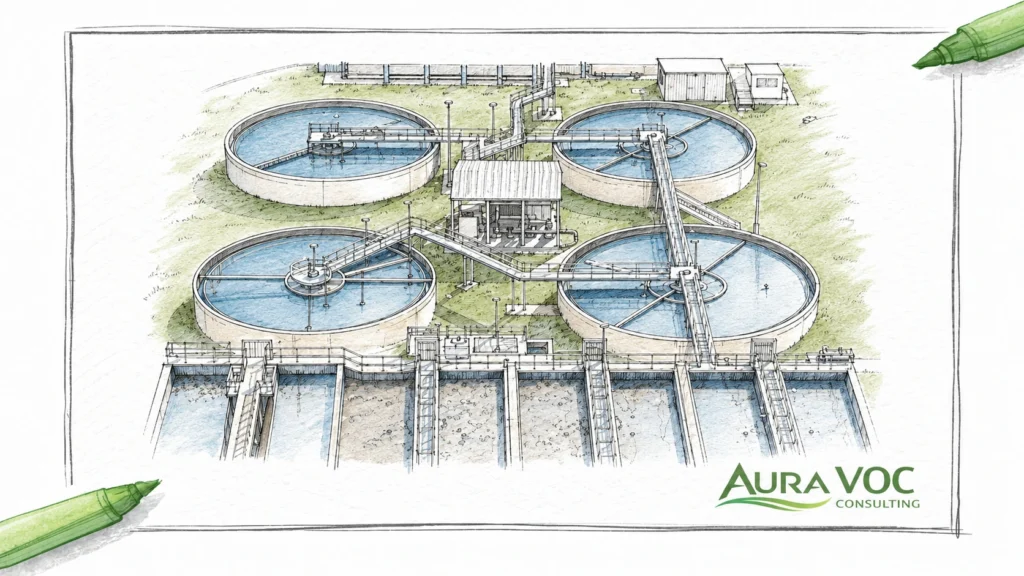
In chemical, pharmaceutical, coatings, food, and general manufacturing plants, the VOC load entering an equalization tank may come from a limited number of process events rather than from the full wastewater flow. A solvent cleaning operation, reactor rinse, coating washdown, or batch discharge can create a short-term concentration peak that is not visible in average daily wastewater data.
If the tank is open, these peaks may appear as localized odour or elevated VOC readings around the wastewater area. If the tank is covered, the same event may appear as a sudden increase in extracted air concentration, activated carbon loading, scrubber demand, or oxidizer inlet load.
Hydraulic Equalization vs VOC Mass Transfer
Equalization tanks are usually sized for wastewater objectives: flow smoothing, concentration buffering, pH control, and protection of downstream treatment. VOC control adds another design requirement. When volatile compounds enter the tank, part of the load may remain in the liquid phase and part may transfer into the headspace or surrounding air.
This is not only a theoretical mass transfer issue. A tank may be correctly sized for 8–12 hours of hydraulic buffering and still generate a short air-side VOC peak when a warm solvent rinse enters through an unsubmerged pipe or turbulent drop point. The wastewater plant may see a manageable average load, while the ventilation and abatement system receives a short high-concentration event.
The engineering conflict is common. Higher mixing intensity can improve homogenization and reduce solids settlement, but it may also increase surface turbulence and VOC stripping. A tank cover can reduce open fugitive release, but it creates a headspace that must be extracted, monitored, drained, and treated. Increasing extraction airflow can improve capture, but it may also dilute the VOC stream, increase fan power, and enlarge downstream abatement equipment.
Batch Discharges, Cleaning Cycles, and VOC Emission Peaks
Equalization tank VOC emissions are often driven by intermittent operating events. This is common in batch production facilities, multiproduct plants, and sites with periodic cleaning operations. A tank that appears stable during one shift may behave differently during product changeover, CIP discharge, solvent rinse, or reactor washing.
Typical peak-generating events include discharge of solvent-containing mother liquors, rinses, or wash waters; hot cleaning water containing volatile organics; coating, ink, resin, or adhesive residues entering wastewater collection; pharmaceutical or specialty chemical batch residues; maintenance draining of equipment, lines, or sumps; weekend accumulation followed by restart flow; and sudden pH or temperature changes that affect compound release.
These events are important because many abatement systems respond poorly to unrecognized peaks. Activated carbon may experience faster breakthrough than expected if short high-load events were not included in the sizing basis. A scrubber may not remove poorly soluble compounds even if the average VOC concentration appears manageable. A biological air treatment system may be sensitive to toxic or highly variable solvent peaks. An oxidizer may handle the load technically, but fuel demand and operating stability depend on concentration, flow, and continuity.
For this reason, a useful assessment should connect VOC measurements to production events. Sampling only during average operation can miss the emission conditions that drive complaints, exposure concerns, or abatement underperformance.
Why Average Wastewater Data Can Miss VOC Design Cases
Average wastewater data is useful, but it can be misleading when applied directly to VOC ventilation and abatement design. Daily flow, COD, TOC, or composite VOC data may smooth out the events that determine peak air emissions. Equalization tanks dampen wastewater variability, but they do not necessarily eliminate air-side peaks at the moment volatile streams enter the tank.
A composite sample may show a moderate VOC concentration over 24 hours, while the vent stream experiences a short high-concentration peak during a 30-minute cleaning discharge. Similarly, a tank may have acceptable average temperature but receive intermittent hot wastewater that temporarily increases volatilization. A fan or carbon bed sized only on average load may therefore appear adequate on paper but perform poorly during actual production cycles.
This distinction matters for both troubleshooting and design. For troubleshooting, it helps explain why odour complaints or PID readings occur at specific times rather than continuously. For design, it affects the selection and sizing of tank covers, extraction airflow, fan capacity, ductwork, demisters, condensate drains, carbon beds, scrubbers, oxidizers, or hybrid systems.
A practical VOC assessment should separate average operating conditions from credible peak cases. Average load influences operating cost, media consumption, fuel demand, and long-term performance. Peak load influences capture reliability, breakthrough risk, alarm conditions, and whether the selected abatement system can handle real process variability.
Operating Conditions That Drive VOC Release from Equalization Tanks
VOC release from an equalization tank depends on how the wastewater is generated, transferred, mixed, retained, and ventilated. In many plants, the useful starting point is not a theoretical emission factor, but a review of the operating conditions that can be observed or modified.
The main drivers are wastewater composition, temperature, turbulence, residence time, liquid level, pH, and tank configuration. These factors interact. A warm solvent-containing stream entering through a drop pipe into a highly agitated open tank will behave differently from the same stream cooled, submerged, and transferred into a covered tank under controlled extraction.
Wastewater VOC Concentration and Solvent Type
The first design variable is the VOC load entering the tank, but compound identity is just as important as total concentration. Acetone, ethanol, IPA, MEK, ethyl acetate, toluene, xylene, chlorinated solvents, amines, and process-specific intermediates do not behave the same way in wastewater or in abatement equipment.
For an industrial review, the useful questions are:
- Which wastewater sources contain the highest solvent or VOC load?
- Are the VOCs alcohols, ketones, aromatics, esters, amines, chlorinated compounds, or mixed residues?
- Are emissions continuous, campaign-based, or linked to cleaning events?
- Do the compounds adsorb well on activated carbon?
- Are they soluble or reactive enough for scrubbing?
- Are they suitable for oxidation, or do they require acid gas or corrosion review?
- Are there flammability or LEL considerations in the tank headspace or vent duct?
Wastewater matrix also matters. Oils, emulsions, surfactants, suspended solids, dissolved salts, and high organic loading can affect how VOCs partition between water and air. For example, an emulsified solvent layer may release VOCs when mixing intensity changes, while foam can carry VOC-laden aerosols into the vent system. This is why site-specific sampling and field inspection are often more useful than relying only on generic emission factors.
Temperature of Incoming Wastewater Streams
Temperature is one of the most common reasons VOC emissions increase during specific operating windows. Hot wastewater from cleaning, rinsing, sterilization, or process discharge can increase the tendency of volatile compounds to transfer into the air phase. The effect may be temporary, but it can be strong enough to create odour events or elevated VOC readings near the tank.
Temperature should be reviewed by source, not only at the equalization tank outlet. A tank outlet temperature may appear moderate because the stream has already mixed with cooler wastewater. The emission event, however, may occur at the inlet zone when the hot VOC-containing stream first enters the tank.
Relevant operating checks include temperature of high-VOC batch discharges, timing of hot cleaning or CIP streams, whether hot streams enter above or below the liquid surface, seasonal wastewater temperature variation, whether cooling or segregation is feasible before equalization, and whether ventilation and abatement systems were designed for warm, saturated air.
Temperature also affects the air-side system. Warm tank headspace air often carries high moisture. This can increase condensation in ductwork, wet activated carbon, raise pressure drop across mist eliminators, and increase corrosion risk. Temperature review should therefore include both the wastewater tank and the downstream VOC capture system.
Mixing, Aeration, Surface Turbulence, and Drop Points
Mixing is often necessary for equalization performance, but it can also increase VOC transfer. The concern is not mixing itself, but unnecessary surface turbulence, splashing, air entrainment, or high-energy inlet conditions.
Mechanical mixers, jet mixing, pump recirculation, and air sparging can all influence VOC release differently. Aeration and air sparging are particularly important because they intentionally introduce air into the wastewater, increasing contact between liquid and gas. Even without direct aeration, an elevated inlet pipe or cascading flow can create a localized stripping zone.
Operationally, the mixer should be reviewed against the actual purpose it serves. If the objective is only to prevent solids settlement or maintain concentration uniformity, continuous high-intensity mixing may not always be required. In some cases, changes to mixer speed, duty cycle, inlet submergence, or recirculation arrangement can reduce surface disturbance while preserving wastewater treatment performance.
Tank Level, Residence Time, and Exposed Surface Area
Tank level affects headspace volume, exposed wall area, liquid surface conditions, and ventilation behaviour. Low-level operation may increase the ratio of exposed surface area to liquid volume and can change how inlet streams fall into the tank. High level variation can also affect extraction performance if the ventilation system was not designed for changing headspace conditions.
Residence time is another practical consideration. Longer residence time may improve hydraulic buffering, but it also gives volatile compounds more time to transfer into the air phase. This does not mean shorter residence time is always better; downstream wastewater treatment still needs stable flow and load. The point is that air emissions and wastewater treatment performance should be evaluated together, especially where solvent-containing streams are present.
pH, Chemical Speciation, and Wastewater Matrix Effects
pH changes can affect whether certain compounds remain dissolved or become more likely to volatilize. This is relevant where acidic, alkaline, or reactive streams enter the equalization tank, or where pH correction is performed upstream of the tank.
Examples include amine-containing wastewater, sulfur-containing compounds, acidic cleaning streams, alkaline wash water, and mixed process drains. A pH adjustment that is acceptable for downstream treatment may still change odour or VOC release at the equalization tank. This should be reviewed when odour appears after a chemical substitution, new cleaning program, or change in neutralization control.
The wastewater matrix can also create practical air-side problems. Foam can increase surface area and entrain aerosols into ductwork. Oils or floating layers can release VOCs when disturbed by mixers. Sludge accumulation can release odorous or volatile compounds during tank cleaning, desludging, or maintenance. These conditions are not always visible in routine wastewater analysis but can dominate actual field complaints.
Tank Configuration and Ventilation Design for VOC Capture
Tank configuration determines whether VOCs are released directly into the wastewater area or collected into a controlled headspace. For equalization tanks, this is where wastewater design, process ventilation, and VOC abatement must be reviewed together.
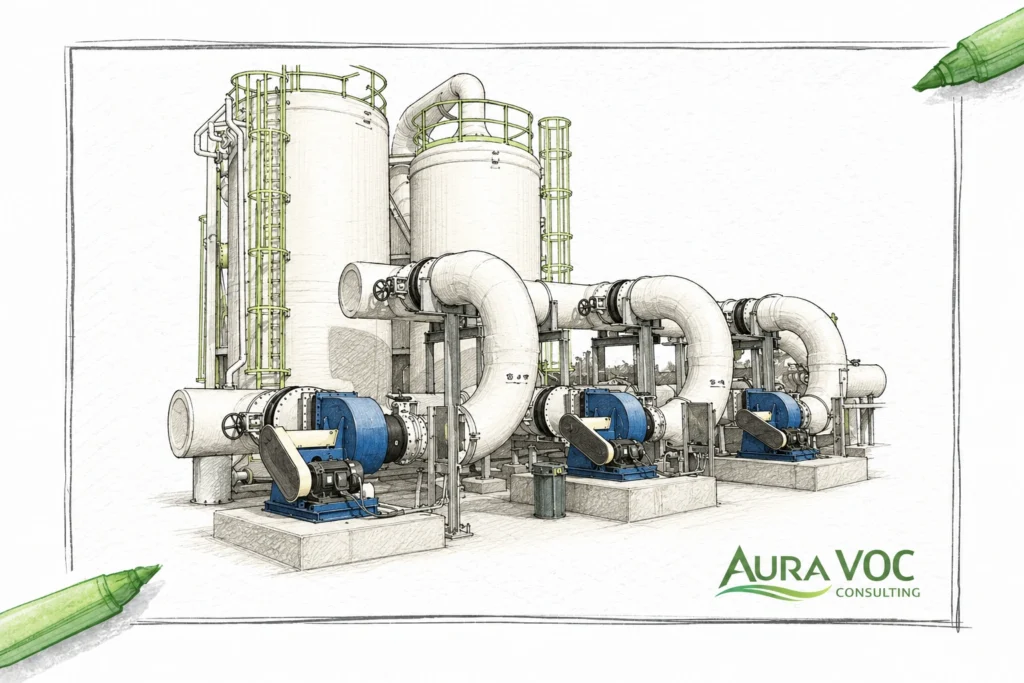
A cover, fan, duct connection, demister, or abatement unit should not be treated as a simple add-on. The system must maintain capture during real operating conditions: sampling, pH adjustment, cleaning, mixer maintenance, sludge removal, tank level variation, and temporary access opening.
Practical design review questions include:
- Is the tank open, partially covered, or fully covered?
- Are inlet pipes submerged at normal and low tank levels?
- Are extraction points positioned to sweep the headspace rather than short-circuiting make-up air?
- Are hatches and access panels included in the airflow basis?
- Is airflow measured in the duct, or only assumed from fan nameplate data?
- Is the fan selected for dirty-system pressure drop, not only clean installation conditions?
- Are drains, demisters, and duct slopes designed for saturated air?
- Are VOC, pressure, temperature, and LEL monitoring points accessible for maintenance?
Open Equalization Tanks and Fugitive VOC Emissions
Open equalization tanks provide limited control over VOC release. Emissions disperse into the wastewater area, outdoor treatment zone, or nearby access platforms depending on wind, building ventilation, tank geometry, and surface turbulence.
The practical problem is source definition. An open liquid surface is not a ducted emission point that can be easily measured or adjusted. VOC readings around the tank may vary with weather, doors, fans, operator location, and production timing. This can make troubleshooting difficult unless measurements are linked to process events.
Open tanks are most problematic when solvent-containing streams, hot wash water, or odorous process residues enter intermittently. In these cases, reducing drop height, submerging inlets, changing mixer duty, or segregating high-VOC streams may reduce release, but these measures do not provide the same control as a covered and extracted system.
Covered Tanks and Headspace VOC Accumulation
A tank cover reduces direct release from the liquid surface, but it does not eliminate VOC generation. It moves the emission source into the headspace. That headspace must be ventilated under controlled conditions and routed to suitable treatment when required.
Cover design should consider chemical compatibility, corrosion, condensate, access, and operator behaviour. If sampling, inspection, or sludge removal requires frequent opening of large panels, capture will be compromised during normal work. A cover that is difficult to operate is often bypassed in practice.
Good cover design includes sealed hatches, serviceable gaskets, access ports, mixer penetrations, pressure monitoring, and a defined ventilation basis for both normal and maintenance conditions.
Negative Pressure Control Under Tank Covers
Negative pressure confirms that the cover and extraction system are working as a controlled enclosure. Fan status alone is not enough. A fan can run while capture is poor because of a blocked demister, wet carbon bed, closed damper, leaking duct, open hatch, or increased pressure drop downstream.
Useful checks include:
- Tank headspace pressure relative to the surrounding area
- Static pressure before and after demisters, filters, or carbon beds
- Fan current and actual airflow
- Damper position
- Hatch and gasket condition
- Leakage at mixer nozzles, cable entries, and inspection ports
- Pressure trend before and after cleaning or media changeout
Where flammable vapours are possible, negative pressure control should be reviewed with LEL monitoring, fan interlocks, and safe access procedures.
For flammable solvent vapours, OSHA ventilation guidance provides a useful reference for reviewing dilution ventilation and lower explosive limit conditions.
Ventilation Airflow Rate: Capture Reliability vs Dilution
Increasing extraction airflow can improve capture, but excessive airflow creates its own problems. Larger airflow increases fan power, duct velocity, pressure drop, and abatement equipment size. It can also dilute the VOC concentration entering the abatement unit, which may affect technology selection and operating cost.
For activated carbon, higher airflow can reduce contact time if the bed is not sized accordingly. For thermal oxidation, diluted VOC streams may require more supplemental fuel. For scrubbers, larger gas flow increases vessel size and may reduce removal performance if liquid distribution and contact time are not adequate. For biofilters, excessive airflow can increase pressure drop and reduce residence time.
The design objective is not maximum airflow. It is reliable capture at the lowest practical airflow that maintains negative pressure under credible operating conditions. This requires reviewing cover tightness, hatch management, tank geometry, expected VOC peaks, abatement inlet limits, and fan capacity. In some cases, improving cover sealing or extraction point placement is more effective than installing a larger fan.
Ductwork, Condensate, Aerosols, and Corrosion
Wastewater tank vent streams are often humid and may contain aerosols, corrosive vapours, or entrained droplets. These conditions can create problems downstream of the tank if the duct system is not designed for drainage, inspection, and material compatibility.
Condensate accumulation can increase pressure drop, promote corrosion, block low points, wet activated carbon, and carry contaminants into equipment not designed for liquid loading. Mist carryover can foul demisters, blind pre-filters, and contribute to uneven flow distribution through carbon beds or scrubbers. Ducts should generally be sloped toward drain points or knock-out sections, and drain systems should be included in maintenance inspections.
Material selection is also important. Standard carbon steel may not be suitable where the headspace contains acidic, chlorinated, sulfur-containing, or solvent-rich vapours with high moisture. Corrosion can create leakage, pressure loss, and contamination of downstream equipment. Access ports for duct inspection, drain cleaning, and pressure measurement should be included where practical, especially for systems expected to operate continuously.
Assessing VOC Emissions from a Wastewater Equalization Tank
A useful assessment combines process knowledge, wastewater data, field inspection, and air-side measurements. Equalization tank emissions are rarely defined accurately by one sample or one calculation. The tank receives variable streams, and the most relevant emission events may occur during short production or cleaning periods.
The assessment should separate normal tank operation from credible high-load cases, such as solvent rinse discharge, hot CIP return, reactor washout, tank cleaning, or sludge disturbance. Average data supports long-term operating cost estimates and media consumption. Peak data supports fan sizing, capture review, carbon breakthrough risk, scrubber response, oxidizer stability, and monitoring requirements.
Process and Wastewater Data Required
The first step is to map the wastewater sources entering the equalization tank. This should include normal process drains, batch dumps, cleaning streams, utility discharges, floor washdowns, laboratory drains where relevant, and any high-strength or solvent-containing side streams.
Useful data includes wastewater flow rate, discharge timing, VOC species, VOC concentration, temperature, pH, COD or TOC, suspended solids, oil and grease, surfactants, and cleaning chemicals. Tank data should include volume, surface area, operating level range, residence time, inlet configuration, mixer type, mixer operating schedule, recirculation loops, tank cover details, and existing ventilation or abatement connections.
Production schedule is often as important as analytical data. A pharmaceutical or specialty chemical plant may have very different wastewater characteristics by campaign. A coatings or resin plant may generate short solvent-rich cleaning streams. A food or ingredients plant may have strong odour episodes linked to warm organic wastewater, even where classical solvent loads are lower.
Sampling Strategy for Batch and Cleaning Events
Sampling should be planned around the operating events most likely to drive VOC emissions. Routine composite wastewater sampling can be useful for average load evaluation, but it may dilute short-duration peaks. Grab samples from specific streams or time windows are often necessary for cleaning cycles, batch discharge, first flush events, or tank cleaning.
Air-side measurements may include headspace screening, ambient readings near the tank, vent duct monitoring, and abatement inlet and outlet measurements. PID or FID instruments can help identify timing and relative changes, but speciated VOC analysis is usually required when technology selection, adsorption capacity, oxidation suitability, scrubber chemistry, or regulatory reporting depends on compound identity.
Measurement locations should be selected carefully. Ambient readings near an open tank can be affected by wind or building ventilation. Headspace readings under a covered tank may vary with extraction point, tank level, and mixer operation. Vent duct measurements are often more useful for abatement design, but only if the ventilation system is already capturing the source effectively.
Estimating Peak and Average VOC Loads for Abatement Design
Both peak and average VOC loads should be estimated. Average load affects media consumption, chemical usage, fuel demand, and operating cost. Peak load affects breakthrough risk, emission limits, safety margins, and equipment response.
For activated carbon systems, peak concentration and compound type influence bed sizing, temperature rise, breakthrough behaviour, and changeout frequency. For thermal or catalytic oxidation, peak and average VOC concentration influence fuel demand, combustion stability, heat recovery potential, and catalyst considerations. For scrubbers, load variability affects chemical dosing, liquid recirculation, blowdown, and mass transfer. For biofilters or biotrickling filters, load stability is critical because biological systems are less tolerant of sudden toxic or high-concentration solvent peaks.
Emission estimates should account for the fact that not all VOC entering the equalization tank will immediately transfer to air. Some will remain in the liquid phase, some may biodegrade or react downstream, and some may be released gradually. However, for design purposes, conservative peak scenarios are often needed when high-volatility compounds, hot streams, and strong turbulence are present.
Field Inspection Points for VOC Capture Problems
Field inspection often identifies issues that are not visible in design drawings. For open tanks, inspection should focus on inlet drop points, turbulence, mixer operation, odour locations, access walkways, nearby sumps, and building ventilation patterns. For covered tanks, the inspection should include cover seals, hatches, penetrations, pressure readings, extraction point location, fan operation, damper position, and visible leakage paths.
The vent system should be checked for duct condition, condensate accumulation, blocked drains, demister fouling, corrosion, vibration, fan performance, and pressure drop. Abatement inlet and outlet readings should be reviewed where available, along with operating logs for carbon changeouts, scrubber pH or ORP, oxidizer temperature, catalyst differential pressure, or biofilter pressure drop.
A field review should also compare actual operation with documented procedures. It is common to find that hatches are opened for sampling, covers are removed during cleaning, fans are turned off during maintenance, or temporary bypasses are used without being reflected in emission assumptions. These operating details can determine whether a system performs reliably.
VOC Abatement Options for Wastewater Tank Vents
The appropriate abatement technology depends on VOC species, concentration, gas flow rate, humidity, temperature, variability, aerosols, corrosive compounds, and operating schedule. Wastewater tank vents are often challenging because they combine low to moderate VOC concentration with high moisture and intermittent peaks.
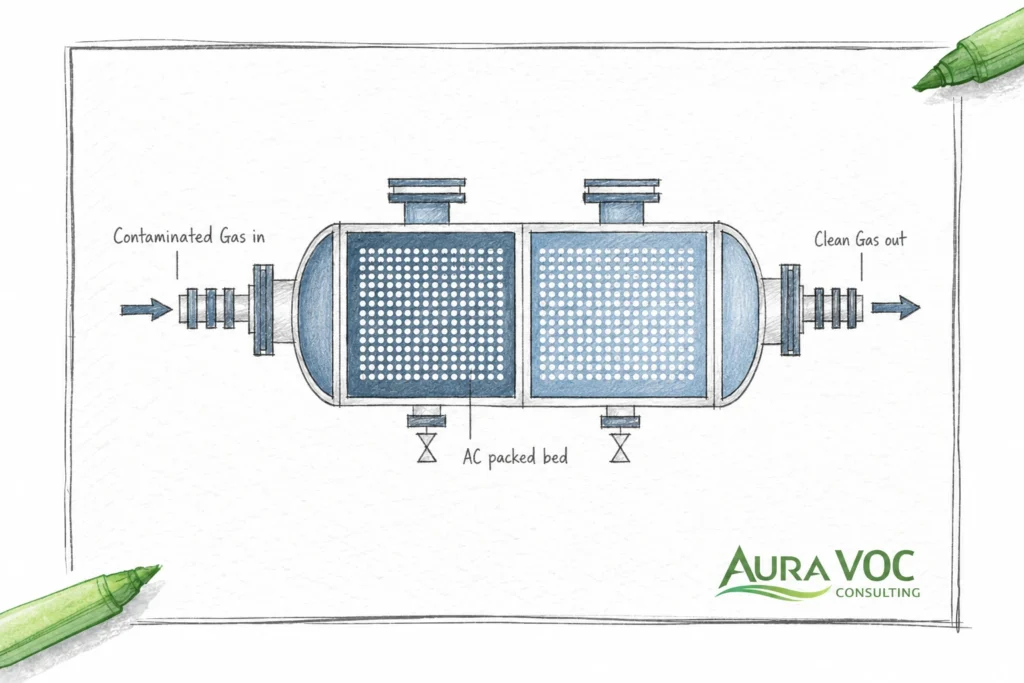
VOC abatement technology selection should start with the source profile, not with a preferred equipment type. A low-concentration, intermittent solvent stream may be suitable for carbon adsorption if humidity and breakthrough are managed. A concentrated solvent-rich vent may justify oxidation or recovery. A water-soluble compound may be scrubbed effectively, while a poorly soluble solvent may pass through a scrubber with limited removal. A biodegradable odour stream may fit biological treatment, but only if load variability and toxicity are controlled.
| Operating condition | Likely control direction | Main design checks |
|---|---|---|
| Low to moderate VOC load, intermittent operation | Activated carbon adsorption | Humidity, bed contact time, breakthrough monitoring, compound capacity |
| Low VOC load with high humidity or mist | Demister plus carbon, or alternative treatment | Condensate drainage, mist removal, wet carbon risk, pressure drop |
| High solvent concentration from defined streams | Segregation, recovery, condensation, or oxidation | Stream isolation, solvent value, LEL, temperature, flow variability |
| Soluble or chemically reactive compounds | Scrubbing | Solubility, pH/ORP control, chemical consumption, blowdown handling |
| Biodegradable odour/VOC load with stable operation | Biofilter or biotrickling filter | Residence time, moisture, nutrients, media condition, toxicity peaks |
| Highly variable batch peaks | Hybrid system or upstream buffering | Peak load, bypass control, monitoring, abatement response time |
| Halogenated or corrosive VOCs | Special review before oxidation or adsorption | Acid gas formation, materials, corrosion, secondary treatment needs |
For broader technical reference, see the Common Waste Water and Waste Gas Treatment BREF for industrial wastewater and waste gas treatment techniques.
Activated Carbon Adsorption for Low to Moderate VOC Loads
Activated carbon adsorption for VOC control is often considered for wastewater tank vents because it is mechanically simple and can tolerate intermittent operation. It can be effective for low to moderate VOC loads, polishing duty, or campaign-based emissions, provided the gas stream is suitable.
The main design issues are humidity, aerosol carryover, bed contact time, compound-specific capacity, and breakthrough monitoring. Wastewater tank vents are often near saturation. If condensate or mist reaches the carbon, adsorption capacity can fall and pressure drop can increase. A demister, drainable ductwork, and pre-filtering may be required before the carbon vessel.
Breakthrough risk should be evaluated by compound, not only by total VOC concentration. Some solvents adsorb strongly; others have limited capacity or may desorb when inlet concentration changes. Mixed solvent streams can create competitive adsorption, where one compound displaces another from the bed. For critical applications, lead-lag carbon beds and routine outlet monitoring are often more reliable than a single vessel operated to a calendar-based changeout interval.
High solvent loads also require review of bed temperature and fire risk. Exothermic adsorption, poor heat dissipation, or unexpected high-concentration discharges can create unsafe conditions if the system was designed only for low average load.
Thermal and Catalytic Oxidation for Solvent-Rich Vent Streams
Thermal and catalytic oxidation may be appropriate where the vent stream contains combustible VOCs at sufficient and reasonably defined load. These systems can provide robust destruction for suitable solvent streams, but they are not automatically the best fit for every wastewater tank vent.
For equalization tanks, the main limitation is often dilution. A covered tank with high extraction airflow may produce a large, wet, low-concentration gas stream. In that case, supplemental fuel demand can dominate operating cost, especially if the VOC load is intermittent. Heat recovery can improve performance, but only when flow and load conditions support stable operation.
Oxidation systems also require review of LEL control, start-up and purge requirements, moisture, halogenated compounds, sulfur compounds, silicon-containing residues, and catalyst compatibility. Halogenated VOCs may generate acid gases during oxidation and require downstream corrosion and scrubbing review. Catalytic systems may operate at lower temperature than thermal oxidizers, but catalyst poisoning or fouling can be a limiting factor.
Scrubbers for Soluble or Reactive Compounds
Scrubbers are suitable when target compounds are water-soluble, acidic, alkaline, or chemically reactive. They should not be selected only because the source is a wastewater tank. Many solvent VOCs are poorly soluble and may pass through a conventional scrubber with limited removal.
A scrubber may perform different duties depending on the compound mix: physical absorption, chemical reaction, mist removal, or odour reduction. These are not equivalent. If the target VOCs are poorly soluble and non-reactive, the scrubber may mainly remove aerosols or water-soluble odorous components while leaving much of the solvent load untreated.
Design checks include gas-liquid contact time, pH or ORP control, reagent consumption, blowdown volume, mist eliminator pressure drop, and compatibility with the wastewater treatment plant. If scrubber blowdown returns to the wastewater system, the plant should verify that it does not create secondary loading, pH instability, or toxicity.
Biofilters and Biotrickling Filters for Biodegradable VOCs
Biofilters and biotrickling filters can be suitable for biodegradable VOCs and wastewater-related odorous compounds when the load is moderate and reasonably stable. They are less suitable where solvent peaks, toxic compounds, long shutdowns, or frequent campaign changes disturb biological activity.
Key design variables include empty bed residence time, moisture control, nutrient availability, pH, media condition, irrigation, and pressure drop. Biomass overgrowth, media compaction, or solids carryover can increase resistance and reduce airflow. Dry media can lose removal performance, while excessive wetting can create channeling.
For equalization tank applications, biological treatment is more credible when high-load solvent peaks are segregated or buffered before the vent stream reaches the biofilter. Multiproduct chemical and pharmaceutical sites should be reviewed carefully before relying on biological air treatment as the only control stage.
Condensation or Solvent Recovery for High-Load Streams
Condensation or solvent recovery is generally more relevant for concentrated streams than for highly diluted tank ventilation air. In some plants, the better engineering solution is to segregate high-VOC wastewater or collect solvent-rich vapours before they enter the general equalization system.
If a specific process stream contains recoverable solvent, upstream separation, cooling, decanting, stripping with controlled recovery, or dedicated collection may reduce the load entering the equalization tank. This can improve both air emission control and downstream wastewater treatment stability.
For general equalization tank vents, condensation may be limited by low VOC partial pressure and high moisture. It may still be useful as part of a hybrid approach where concentrated emissions occur during defined batch events.
Hybrid Systems for Variable Wastewater Tank Emissions
Hybrid systems are often used where one technology cannot handle the full range of wastewater tank emission conditions. Examples include demister plus carbon, scrubber plus carbon, condenser plus carbon, biofilter plus polishing carbon, or dedicated treatment for high-load streams combined with general tank ventilation control.
Hybrid designs should be based on the failure modes of each technology. If humidity reduces carbon capacity, upstream mist control and condensation management may be required. If a scrubber removes only part of the compound mix, a polishing stage may be needed. If biological treatment handles the baseline odour load but not solvent peaks, bypass control or upstream segregation may be necessary.
A hybrid system is justified only when each stage has a defined duty, such as mist removal before carbon, soluble compound removal before polishing, or peak-load reduction before biological treatment.
Engineering Tradeoffs in VOC Control System Design
VOC control for equalization tanks is rarely a single-equipment decision. The most reliable designs account for wastewater operation, tank access, air capture, pressure drop, moisture, and the selected abatement technology.
Mixing Performance vs VOC Stripping
Mixing supports equalization, prevents concentration pockets, and can help keep solids suspended. The same mixing can increase volatilization if it creates surface turbulence, splashing, or air entrainment. Mixer speed, impeller position, recirculation flow, and inlet submergence should be reviewed when VOC emissions increase after operational changes.
The objective is not to eliminate mixing where it is required for wastewater performance. The objective is to avoid unnecessary stripping conditions, such as high-energy surface agitation or elevated drop points, when the same process objective can be met with lower turbulence.
Ventilation Rate vs Fan Energy and Abatement Size
Higher airflow may improve capture, but it increases fan power, duct pressure drop, and abatement equipment size. It can also dilute VOC concentration, which may reduce the efficiency of thermal oxidation or require larger carbon beds.
The design target should be controlled negative pressure and reliable capture, not the highest possible extraction rate. Fan selection should consider the system curve under realistic operating conditions, including fouled demisters, partially loaded carbon beds, condensate accumulation, and dirty ductwork.
Tank Enclosure vs Maintenance Access
A tight cover improves containment, but the tank still needs sampling, inspection, cleaning, mixer maintenance, and sludge removal. If access is difficult, operators may leave hatches open or remove panels during routine work. Cover design should include practical access points without undermining capture performance.
This tradeoff is especially important for older wastewater systems retrofitted with covers. The retrofit may meet the capture objective on drawings but fail operationally if operators cannot perform routine tasks without opening large sections of the cover.
Activated Carbon Simplicity vs Humidity and Breakthrough Risk
Carbon adsorption can be practical for low to moderate VOC loads, but wastewater tank vents are often humid and may carry mist. Wet carbon, aerosol fouling, and unexpected solvent peaks can shorten service life. Differential pressure, bed temperature, and outlet VOC monitoring should be included where carbon is used as a primary control.
Lead-lag vessels may be appropriate where breakthrough risk is high or where compound variability is significant. Calendar-based media replacement alone is usually weak for batch processes unless supported by inlet and outlet data.
Oxidation Performance vs Fuel Demand at Low VOC Concentration
Thermal and catalytic oxidizers can provide robust destruction for suitable VOC streams, but diluted or intermittent tank vents may require significant supplemental fuel. Before selecting oxidation, the plant should verify expected VOC load, operating hours, airflow, heat recovery potential, compound compatibility, and LEL controls.
Oxidation may be technically feasible but economically inefficient if high airflow is used to capture a low-concentration source. In those cases, source segregation, airflow reduction, pre-concentration, carbon adsorption, or hybrid treatment may be more appropriate.
Air Treatment vs Upstream Wastewater Segregation
In some cases, the better solution is not a larger air treatment system. High-VOC wastewater streams may be segregated, cooled, recovered, or pre-treated before reaching the equalization tank. This can reduce air emissions and improve downstream wastewater stability.
This tradeoff should be reviewed when a small number of process streams create most of the VOC load. Treating those streams before general equalization may be simpler than ventilating and treating a large diluted headspace stream.
Troubleshooting VOC and Odour Issues Around Equalization Tanks
Troubleshooting should start with timing. Equalization tank VOC issues often occur during defined operating windows: solvent cleaning, hot wash discharge, product changeover, sludge removal, mixer restart, or wastewater transfer after shutdown. A complaint log without production timing is rarely enough.
The first step is to compare the VOC or odour event against process activity, wastewater temperature, tank level, mixer operation, fan status, and abatement readings. If possible, use time-stamped PID/FID screening or vent duct measurements during the actual complaint window rather than after the tank has already equalized.
| Symptom | Likely causes | First checks |
|---|---|---|
| Odour during cleaning or product changeover | Hot solvent rinse, reactor washout, open hatch, high turbulence | Review cleaning log, wastewater temperature, tank level, inlet location, VOC readings during event |
| High VOC readings near covered tank | Loss of negative pressure, leaking hatch, poor extraction point, fan underperformance | Check tank pressure, fan airflow, seals, dampers, duct pressure |
| Carbon breakthrough earlier than expected | Underestimated peak load, humidity, mist, channeling, new solvent | Check inlet VOC profile, outlet readings, bed DP, bed temperature, media change records |
| Rising system pressure drop | Fouled demister, wet carbon, blocked drain, condensate in duct | Inspect drains, demister, low points, carbon vessel, fan curve |
| Odour after process modification | New solvent, new cleaning chemical, changed pH, changed discharge timing | Compare current campaign, SDS, wastewater analysis, sampling schedule |
| Poor capture during maintenance | Open access panels, fan off, temporary bypass, inadequate purge | Review maintenance procedure, lockout conditions, ventilation status, local VOC readings |
| Wastewater treatment upset after VOC events | Toxic solvent peak, pH swing, temperature spike, changed COD profile | Review batch discharge records, equalization tank data, biological treatment indicators |
Sudden VOC Odour During Production or Cleaning
Sudden odour usually indicates a change in wastewater load, temperature, turbulence, or pH. Check whether a solvent rinse, hot CIP return, reactor wash, tank cleanout, or maintenance drain entered the system. Also verify whether the inlet was submerged at the tank level during the event.
If odour occurs only during certain shifts or campaigns, the issue is likely linked to production timing rather than a constant tank condition. Sampling should be scheduled during the actual event, not several hours later after the tank contents have diluted or cooled.
High VOC Readings Despite a Covered Tank
A covered tank can still release VOCs if negative pressure is weak or leakage points are uncontrolled. Inspect hatches, mixer penetrations, cable entries, sampling ports, and flexible seals. Confirm actual airflow and tank pressure rather than relying on fan status.
Extraction point location should also be checked. If make-up air short-circuits directly to the extraction duct, the system may show airflow while poorly sweeping the tank headspace.
Loss of Negative Pressure or Poor Capture
Poor capture can result from fan trips, damper misalignment, blocked ducts, fouled demisters, wet carbon, high system pressure drop, or open access panels. Compare fan airflow against the fan curve and current system pressure drop. A dirty system may operate far from the original design point.
Pressure readings should be reviewed across the full system: tank headspace, duct, demister, carbon vessel or scrubber, fan inlet, and stack where relevant. A single pressure indicator is often insufficient for diagnosing capture loss.
Early Activated Carbon Breakthrough
Early breakthrough often means that the real VOC profile differs from the design basis. Check whether a new solvent, cleaning chemical, or campaign has been introduced. Review humidity, mist carryover, bed depth, vessel valve lineup, lead-lag operation, bed temperature, and outlet monitoring records.
Breakthrough during or after cleaning events is a common sign that short peak loads were not included in the original carbon sizing. A daily average concentration may not explain media consumption in a batch process.
Condensate, Mist, or Fouling in the Vent System
Condensate and mist should be expected in wastewater tank vent systems. Check low points in ductwork, drain legs, demisters, pre-filters, carbon vessel internals, and corrosion areas. Outdoor duct runs may experience seasonal condensation, especially in cold weather.
Fouling problems often appear first as rising pressure drop or declining airflow. If the system relies on negative pressure under a cover, this can quickly become a capture issue rather than only a maintenance issue.
Wastewater Treatment Upsets Linked to VOC-Containing Streams
VOC-containing wastewater can affect downstream treatment through toxicity, pH changes, temperature spikes, or organic shock loading. If treatment upsets coincide with odour or VOC events, review the same batch discharge records from both the wastewater and air emissions perspective.
In some cases, VOC stripping from the equalization tank may reduce the load reaching biological treatment. In other cases, remaining VOCs may still be toxic to biomass or contribute to shock loading. The direction of impact depends on compound type, concentration, and operating conditions.
Maintenance Requirements for Tank VOC Capture and Abatement Systems
Maintenance should verify that the system still captures the source under actual operating conditions. Servicing only the abatement unit is not enough if covers leak, drains block, dampers move, or pressure drop changes.
Tank Covers, Hatches, Seals, and Access Points
Inspect cover panels, hatches, gaskets, fasteners, hinges, mixer penetrations, instrument nozzles, and access ports. Failed seals can create localized VOC release even when the fan is running. Maintenance procedures should define when covers may be opened and what ventilation conditions are required during access.
Cover inspection should also include corrosion, mechanical damage, condensate pooling, and evidence of routine bypassing, such as panels left loose or hatches propped open for sampling.
Fans, Dampers, Ductwork, and Pressure Monitoring
Verify fan operation, motor current, vibration, damper position, actual airflow, duct static pressure, and duct integrity. Damper movement or increasing system resistance can reduce airflow without triggering a fan fault. Pressure trend data should be reviewed after media changes, demister cleaning, and process modifications.
Actual airflow measurement is important. Fan nameplate capacity or original commissioning data may not represent current operation after duct fouling, media loading, corrosion, or field modifications.
Demisters, Drains, and Condensate Handling
Demisters and drains are critical in high-humidity tank vent systems. Blocked drains can flood duct sections, increase pressure drop, corrode materials, and wet carbon beds. Demister fouling can reduce airflow and create mist carryover. Drain legs should be inspected, not assumed clear.
Where ducts run outdoors or through cooler areas, seasonal condensation should be considered. Low points, horizontal sections, and uninsulated duct runs can become recurring maintenance locations.
Abatement System Maintenance by Technology
Carbon systems require breakthrough checks, bed differential pressure, vessel temperature review, and media change records. Scrubbers require pH, ORP where relevant, conductivity, liquid flow, nozzle condition, blowdown, and mist eliminator checks. Oxidizers require temperature, residence time, burner performance, safety interlocks, catalyst condition, and pressure drop. Biofilters require media moisture, irrigation, nutrients, pH, airflow distribution, and pressure drop control.
Maintenance records should be compared against production changes. A sudden increase in carbon use, scrubber chemical consumption, oxidizer fuel demand, or biofilter pressure drop may reflect a process change rather than equipment ageing alone.
Instrumentation for VOC, Flow, Pressure, Temperature, and LEL
Instrumentation should be selected around the operating risk. Useful measurements include tank headspace pressure, vent airflow, VOC concentration, differential pressure, temperature, humidity, fan status, damper position, and LEL where flammable vapours may occur. Instruments should be located where technicians can calibrate and maintain them safely.
The monitoring plan should include alarm response. A low-pressure alarm under a covered tank, a high differential pressure alarm across a demister, or an outlet VOC alarm after carbon only adds value if operators know what action to take.
When to Request a Technical VOC Review of an Equalization Tank
A technical review is useful when operational symptoms suggest that the tank is acting as an uncontrolled or poorly characterized VOC source. It is also useful before capital modifications, because tank covers, fans, ducts, and abatement systems are difficult to correct after installation if the design basis is incomplete.
Repeated Odour or VOC Readings Around Wastewater Areas
Recurring odour, PID/FID readings, or operator complaints near the tank indicate that source capture, process timing, and wastewater composition should be reviewed together. The review should look beyond the tank itself and include upstream process drains, cleaning schedules, and the current ventilation arrangement.
Planned Tank Cover, Ventilation, or Abatement Modification
Before installing covers, fans, ducts, or abatement equipment, the plant should define airflow, pressure drop, condensate handling, access needs, and expected VOC load variability. A cover retrofit without a reliable extraction and maintenance strategy may shift the problem from open emissions to leaking hatches or unstable headspace conditions.
Solvent-Containing Wastewater from Batch Production
Batch chemical, pharmaceutical, coatings, and manufacturing processes can produce short high-load wastewater events. These events should be evaluated separately from average wastewater conditions, especially where cleaning solvents, reactor residues, resin wash waters, or product changeover streams enter the same equalization system.
Early Carbon Breakthrough or Abatement Underperformance
Frequent carbon changeout, unstable scrubber operation, oxidizer fuel demand, or poor removal performance may indicate that the design basis does not match actual tank emissions. The issue may be load variability, humidity, mist carryover, compound identity, pressure drop, or insufficient monitoring.
Process Changes Affecting Wastewater Composition
New solvents, products, cleaning agents, or production schedules can change VOC emissions from the tank even if wastewater flow remains similar. A review is particularly useful after new production campaigns, process equipment changes, cleaning procedure changes, or wastewater routing modifications.
Practical Checklist for Plant Evaluation
A practical evaluation should combine process data, field inspection, air measurements, wastewater data, and maintenance history. The objective is to define how the tank behaves during real operation, not only under nominal design conditions.
Process Data Checklist
Review:
- Wastewater source list by process area
- Batch discharge schedule
- Cleaning and CIP procedures
- Solvent or VOC-containing streams
- Wastewater flow profile
- VOC species and concentration
- Wastewater temperature by source
- pH range and neutralization points
- COD, TOC, suspended solids, oil and grease
- Production campaigns and product changeovers
- Weekend, shutdown, and restart conditions
- Known odour or VOC complaint timing
Field Inspection Checklist
Inspect:
- Open liquid surfaces
- Inlet pipe location and drop height
- Whether inlets remain submerged at low tank level
- Mixer type, speed, duty cycle, and turbulence
- Foam, floating layers, or sludge accumulation
- Tank cover condition
- Hatches, seals, nozzles, and penetrations
- Fan operation and actual airflow
- Duct slope, drains, and low points
- Demisters, filters, and mist carryover
- Corrosion, leakage, vibration, or temporary repairs
- Sampling and maintenance access practices
Abatement Design Review Checklist
Verify:
- Peak and average VOC load basis
- VOC species used for design
- Ventilation airflow and safety margin
- Fan capacity against dirty-system pressure drop
- Humidity and condensation assumptions
- Aerosol or mist removal requirements
- Carbon bed contact time and breakthrough monitoring
- Scrubber chemistry and blowdown handling
- Oxidizer fuel demand and LEL controls
- Biofilter residence time and load stability
- Materials of construction
- Maintenance access
- Instrumentation and alarm strategy
- Bypass, shutdown, and upset procedures
FAQ: VOC Emissions from Wastewater Equalization Tanks
Are wastewater equalization tanks significant VOC emission sources?
They can be significant when solvent-containing, hot, or highly variable wastewater enters the tank. Emissions depend on VOC type, concentration, temperature, mixing, tank configuration, and ventilation performance.
Why do VOC emissions increase during cleaning or batch discharge?
Cleaning and batch discharges can introduce hot water, solvents, residues, or high-strength wastewater. These short events may create VOC peaks that are not visible in daily average wastewater data.
Does covering an equalization tank solve VOC emissions?
No. A cover reduces open release but creates a headspace that must be extracted, kept under negative pressure, and treated if VOC loading requires abatement.
How much airflow is required for a covered wastewater tank?
Required airflow depends on tank geometry, cover leakage, access openings, VOC load, and capture objective. Excessive airflow can increase fan energy and dilute the VOC stream entering abatement equipment.
Can mixing increase VOC emissions from wastewater?
Yes. Mixing can increase VOC stripping when it creates surface turbulence, splashing, aeration, or air entrainment. Mixer duty and inlet configuration should be reviewed when emissions increase.
Is activated carbon suitable for wastewater tank VOC vents?
Activated carbon may be suitable for low to moderate VOC loads, but humidity, mist, compound type, bed contact time, and breakthrough monitoring are critical design factors.
Why does activated carbon break through faster than expected?
Common causes include underestimated peak load, high humidity, wet carbon, competitive adsorption, channeling, new solvent species, insufficient bed depth, or unmeasured cleaning events.
When is thermal oxidation appropriate for wastewater tank emissions?
Thermal or catalytic oxidation may be appropriate for solvent-rich vent streams where VOC concentration, airflow, fuel demand, LEL control, and compound compatibility support the design.
Can scrubbers treat VOC emissions from equalization tanks?
Scrubbers can treat soluble or chemically reactive compounds. They may provide limited removal for poorly soluble solvent VOCs unless specifically designed for those compounds.
Are biofilters suitable for wastewater tank vent emissions?
Biofilters may be suitable for biodegradable and relatively stable VOC or odour loads. They are less suitable for toxic, highly variable, or solvent-rich peaks without upstream control.
What causes odour around a covered wastewater tank?
Common causes include poor negative pressure, leaking hatches, open access points, fan problems, duct blockage, carbon breakthrough, or a recent change in wastewater composition.
What data is needed to size a VOC abatement system?
Key data includes VOC species, peak and average concentration, airflow, humidity, temperature, operating schedule, tank configuration, pressure drop, and maintenance constraints.
Can VOC stripping affect downstream wastewater treatment?
Yes. Stripping can change the organic load reaching downstream treatment, while remaining VOCs may still cause toxicity, pH effects, temperature effects, or shock loading.
When should high-VOC wastewater be segregated before equalization?
Segregation should be considered when specific streams create VOC peaks, overload abatement equipment, shorten carbon life, or cause wastewater treatment instability.
How does pressure drop affect VOC capture system performance?
Increasing pressure drop can reduce airflow, weaken negative pressure, increase fan energy, and indicate fouled demisters, wet carbon, blocked drains, or duct restrictions.
What maintenance issues are common in wastewater tank VOC systems?
Common issues include leaking covers, failed seals, fan faults, blocked drains, demister fouling, duct corrosion, wet carbon, high pressure drop, and poor monitoring.
What causes VOC emissions during wastewater tank mixing?
VOC emissions can increase when mixing creates turbulence, splashing, surface renewal, or air entrainment. The effect is stronger with warm or solvent-containing wastewater.
Can high humidity reduce activated carbon performance?
Yes. High humidity and condensation can reduce adsorption capacity, increase pressure drop, and shorten carbon life. Demisting and condensate management are often required.
When does a wastewater tank vent require LEL monitoring?
LEL monitoring should be reviewed when flammable solvents may enter the wastewater system and accumulate in the tank headspace or ductwork, especially during batch discharge or cleaning.
What measurements are needed before selecting a VOC abatement system?
Useful measurements include wastewater VOC composition, vent VOC concentration, airflow, humidity, temperature, tank pressure, differential pressure, and readings during peak production or cleaning events.
Conclusion
Wastewater equalization tanks can become variable VOC sources when volatile compounds enter the tank under conditions that promote stripping. The most important drivers are usually site-specific: which streams enter the tank, when they are discharged, their temperature and solvent content, how the tank is mixed, and whether the ventilation system maintains capture.
The main design risk is relying only on average wastewater data. Short events such as solvent rinsing, hot cleaning discharge, reactor washing, sludge removal, or campaign changeover can define the air-side design case even when daily wastewater data appears moderate.
A sound evaluation should review both water-side and air-side conditions: source streams, tank level, turbulence, covers, negative pressure, airflow, pressure drop, condensate, mist, and abatement technology limits. This approach helps avoid underperforming capture systems, premature carbon breakthrough, excessive fan energy, avoidable maintenance issues, and recurring VOC or odour problems around wastewater areas.
CTA
For industrial sites reviewing VOC emissions from wastewater equalization tanks, AuraVOC can assess the tank emission basis, wastewater source profile, ventilation performance, pressure drop, capture reliability, and abatement technology fit.
This review can support decisions on tank covers, controlled extraction, activated carbon, scrubbing, oxidation, biofiltration, high-VOC wastewater segregation, and troubleshooting of recurring VOC or odour issues near wastewater treatment areas.