
VOC Monitoring Requirements under BAT Conclusions for Industrial Plants
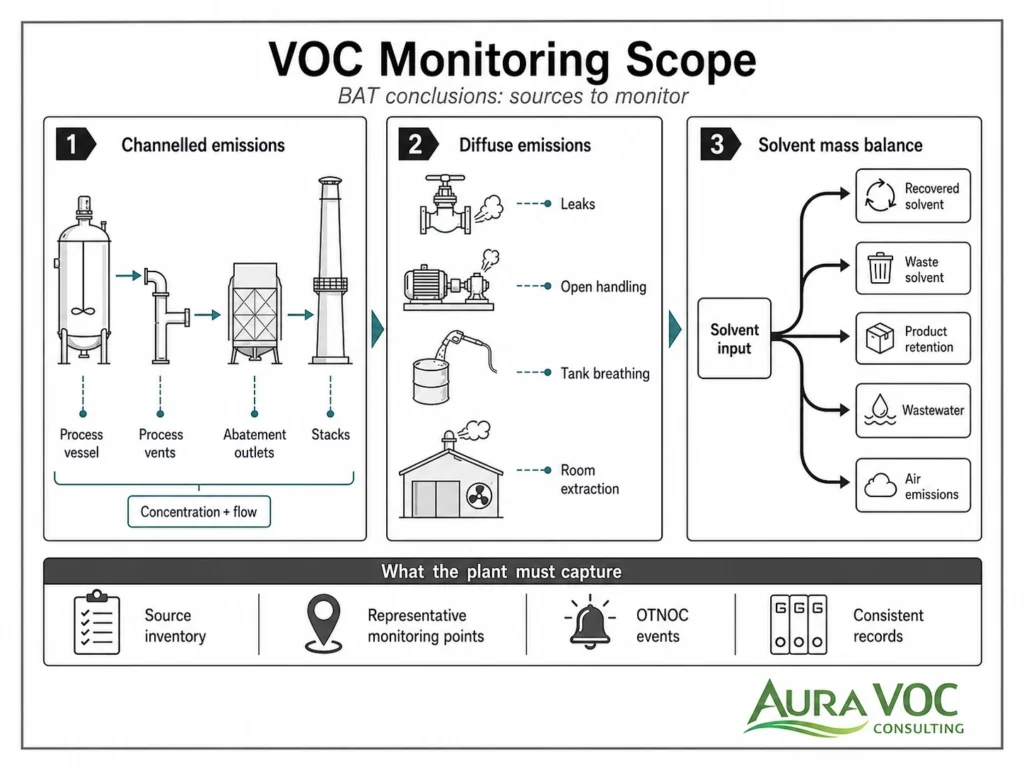
VOC monitoring under BAT conclusions should be treated as an operating and verification system, not as a separate reporting task. In an industrial plant, VOC results are only meaningful when they can be linked back to process conditions, exhaust flow, solvent use, abatement status, maintenance condition and other than normal operating conditions.
In chemical, pharmaceutical, coating, paint, food and manufacturing plants, VOC emissions rarely follow a single, steady pathway. They may originate from reactors, dryers, coating ovens, tank vents, vacuum systems, solvent transfer points, cleaning operations, wastewater collection systems and general building extraction. Some streams are captured and routed to treatment. Others may leave the process as diffuse or fugitive emissions if capture is incomplete or operating practices change.
A BAT-based monitoring approach therefore needs to reflect how the plant actually runs. The relevant questions are practical: which emission sources are controlled, which are diffuse, which campaigns create the highest solvent load, which abatement parameters demonstrate effective operation, and whether the records available during an inspection are consistent with production and maintenance history.
A technically credible monitoring system should connect measured emissions with abatement logs, solvent records, calibration evidence, maintenance work orders and production conditions. Without this link, a stack result or solvent balance may be difficult to defend, even when the abatement technology itself is suitable.
For regulatory context, the WGC BAT conclusions are relevant for common waste gas management and treatment systems in the chemical sector. The STS BAT conclusions are relevant for surface treatment activities using organic solvents, including coating and related solvent-use operations.
VOC Monitoring Requirements under BAT Conclusions for Industrial Plants
Why BAT-based VOC monitoring affects plant operation
BAT-based VOC monitoring affects plant operation because it connects permit conditions with production, maintenance and process control. VOC compliance is not demonstrated only by installing an oxidiser, carbon unit, condenser, scrubber or biofilter. The plant must also show that emission sources are captured, the abatement system operates within its design range, and the monitoring data are representative of real operating conditions. The European Commission notes that BAT conclusions are used as the basis for drafting permit conditions under the Industrial Emissions Directive.
For plant managers, this can influence production scheduling, shutdown planning, spare parts strategy and utility costs. A stack test may need to be performed during a representative or high-load campaign rather than during the most convenient operating window. An RTO may require additional fuel if exhaust airflows are increased and the VOC stream becomes too dilute. A carbon bed may need replacement before a solvent-intensive campaign, not after outlet VOC readings begin to rise.
For EHS managers, BAT-based monitoring creates an evidence requirement. Records should show whether the plant was operating at relevant solvent load, whether the abatement system was online, whether any bypass or abnormal condition occurred, and whether monitoring instruments were calibrated and maintained. Stack measurements, continuous parameter records, solvent mass balance, LDAR records, maintenance logs and OTNOC records should not contradict each other.
For process engineers, VOC monitoring becomes part of the process design basis. A solvent substitution, cleaning procedure change, airflow rebalance, new vent connection or production rate increase can change VOC concentration, mass flow and abatement loading. These changes should trigger a review of the monitoring basis before the modified operation becomes routine.
Industrial sectors where VOC monitoring is typically relevant
VOC monitoring is relevant where solvents or VOC-generating materials are stored, transferred, heated, dried, reacted, cleaned, recovered or destroyed. The monitoring method depends on the process layout, solvent profile and emission route.
In chemical and fine chemical production, relevant sources include reactor vents, vacuum pump exhausts, distillation vents, centrifuge opening, dryer exhaust, tank breathing, solvent recovery vents and wastewater collection systems. Batch operation can create short emission peaks during charging, venting, distillation, filtration, cleaning or vessel opening. Monitoring based on average conditions may not capture these peaks.
In pharmaceutical production, multipurpose equipment adds further variability. Different products may use different solvents, cleaning cycles and batch sizes on the same line. A campaign using alcohols may not create the same abatement load as a campaign using chlorinated or high-boiling solvents. Cleaning validation activities can also create solvent losses outside the main production step.
In coating, paint, printing and surface treatment operations, VOC emissions are usually linked to coating application, flash-off zones, drying ovens, solvent cleaning, formulation changes and line-speed adjustments. Stack monitoring alone may not capture total emissions if part of the solvent is lost through open handling, room extraction or cleaning activities.
In food and general manufacturing, VOC issues may arise from ethanol extraction, flavour and aroma volatilisation, adhesive use, packaging processes, heated organic materials or cleaning solvents. These streams can be difficult to monitor when moisture is high, concentrations fluctuate or odorous compounds are present at low levels.
Key VOC monitoring terms that affect engineering decisions
The most important distinction is between VOC concentration and VOC mass flow. Concentration indicates the amount of VOC in the exhaust gas. Mass flow combines concentration with exhaust flow. A fan change or additional dilution air can reduce concentration while increasing the total mass emitted.
TVOC and compound-specific VOC monitoring serve different purposes. TVOC monitoring is useful for trend control when the solvent mixture is stable. Compound-specific monitoring may be needed when individual solvents have different permit relevance, odour impact, toxicity, recovery value or abatement behaviour. A solvent substitution can make historic TVOC data less meaningful if the new compound has a different analyser response or removal efficiency.
Channelled emissions are discharged through ducts, vents or stacks and can usually be measured directly. Diffuse emissions require a different approach because they may originate from valves, seals, open containers, loading points, room extraction or building ventilation. A plant with acceptable stack results can still lose significant VOCs if capture at source is poor.
Solvent mass balance is used to reconcile solvent input with recovered solvent, waste solvent, product retention, wastewater transfer and air emissions. It is particularly important where emissions are distributed across several small sources.
OTNOC must be considered separately from stable operation. Start-up, shutdown, cleaning, carbon bed switching, oxidiser warm-up, scrubber chemical depletion or emergency bypass can explain emission peaks that would not appear in normal operating averages.
Which VOC Emission Sources Need to Be Monitored: Stacks, Diffuse Sources and Solvent Balance
Channelled VOC emissions from stacks, vents and abatement outlets
Channelled emissions are usually the first monitoring priority because they have defined measurement points. Typical sources include treated exhaust stacks, dryer exhausts, coating oven stacks, process vent headers, tank vent headers, vacuum system exhausts and abatement outlets.
Monitoring should include VOC concentration and exhaust flow. Temperature, moisture and correction conditions should also be recorded where they affect reporting. A concentration result without reliable flow data is incomplete because it cannot confirm the mass emission rate.
Sampling location should be checked before any test campaign. Ports placed near bends, fans, dampers, dilution air inlets or flow splitters may produce non-representative results. Where abatement efficiency is calculated from inlet and outlet measurements, both locations must represent comparable operating periods and gas flow conditions.
Mass flow should be treated as an operating parameter, not only as a calculation in the final report. Changes in fan speed, damper position, filter loading or ventilation balance can alter total VOC emissions even when stack concentration appears stable.
Diffuse and fugitive VOC emissions from equipment and buildings
Diffuse emissions are often missed because they are not always visible in stack test results. Relevant sources include pump seals, valves, flanges, sampling points, tank fittings, loading arms, drum filling, open cleaning stations, wastewater sumps, solvent storage areas and filter changes.
Building ventilation can become a VOC emission route when local capture is incomplete. Vapours that escape from the process may be removed by general room extraction instead of being routed through the intended abatement system. This can make the treated stack appear stable while uncontrolled emissions increase elsewhere.
VOC monitoring should therefore include inspection routes, LDAR where applicable, room extraction review, capture assessment and checks on enclosure integrity. Hood capture velocity, door opening frequency, room pressure and duct balance can be as relevant as stack concentration.
| Source type | Typical monitoring approach |
|---|---|
| Treated stack or process vent | Stack testing, continuous analyser, flow measurement |
| Oxidiser or carbon outlet | VOC outlet trend, operating parameters, bypass status |
| Equipment leaks | LDAR, inspection route, repair records |
| Coating or drying line | Stack testing, solvent mass balance, ventilation checks |
| Solvent cleaning area | Solvent records, local extraction review, inspection |
| Wastewater tank or sump | Vent review, VOC screening, emission source inventory |
| Tank farm and loading area | Breathing loss review, inspection, transfer procedure checks |
Solvent mass balance for total and fugitive VOC emissions
A solvent mass balance provides a broader view than stack testing where emissions are distributed across multiple sources. It compares solvent input with known outputs such as recovered solvent, waste solvent, product retention, wastewater transfer and measured air emissions.
The quality of the balance depends on plant data. Purchase records are not sufficient unless stock variation is included. Recovered solvent should be separated from waste solvent. Cleaning losses, packaging residues, contaminated filters and solvent in wastewater should be accounted for where material.
If the balance does not close, the issue is often a plant data problem rather than a calculation problem. Common causes include inconsistent stock measurement, unrecorded cleaning solvent, recovered solvent counted twice, incorrect waste classification or wastewater solvent losses omitted from the inventory.
A solvent mass balance is particularly important for coating, printing, cleaning and surface treatment operations, where part of the solvent loss may occur through multiple small sources rather than one main stack. It is also useful in batch chemical and pharmaceutical plants where several vents, campaigns and cleaning steps contribute to the annual VOC profile.
VOC emissions during OTNOC
VOC emissions during OTNOC should be recorded separately from stable operation. Relevant events include start-up, shutdown, cleaning, solvent charging, vessel opening, adsorber switching, oxidiser warm-up, scrubber depletion, condenser malfunction and bypass activation.
For each event, records should identify the time, duration, affected process, abatement condition, bypass position, exhaust flow and corrective action. This allows high VOC readings to be assessed against actual plant behaviour rather than treated as isolated measurement points.
Without OTNOC records, a high stack result can be difficult to interpret. With them, the plant can distinguish between a process-driven peak, an abatement malfunction, a sampling issue or an event that occurred outside normal operating conditions.
Building a VOC Monitoring Plan for BAT-Based Permit Conditions
Start with a VOC waste gas and solvent source inventory
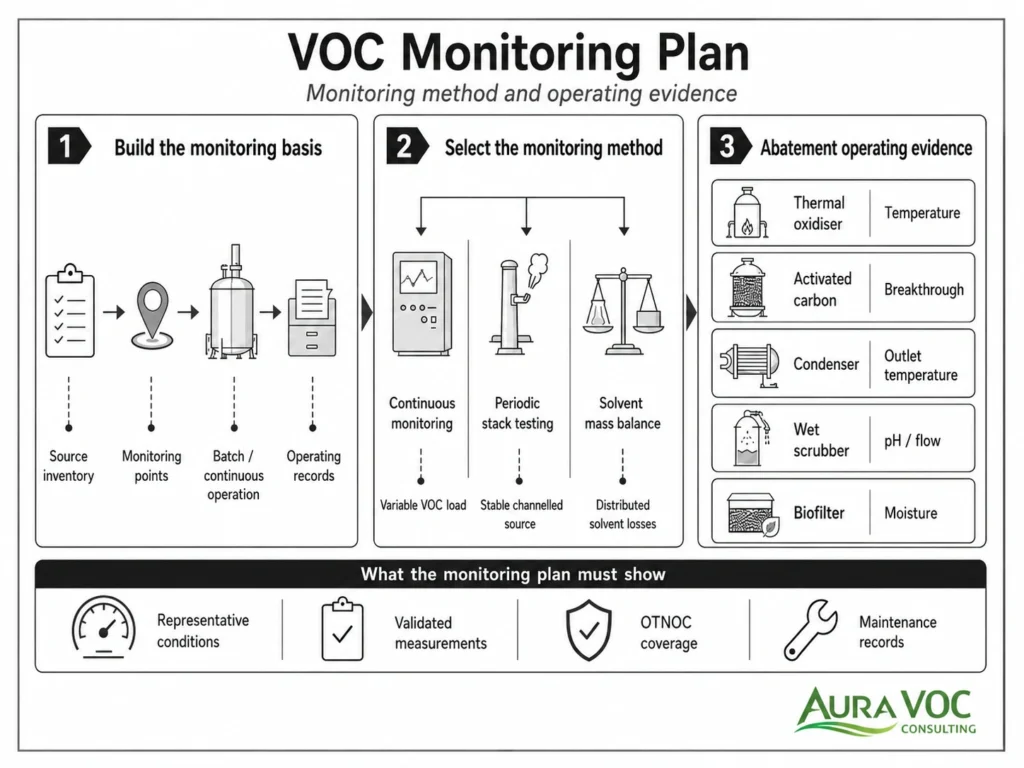
The monitoring basis should start with a source inventory. Each VOC source should be assigned to a process unit, operating mode, expected solvent mixture, flow range, concentration range, abatement connection and release route.
The inventory should include obvious stacks and less visible sources: vacuum pump exhausts, tank blanketing vents, solvent tote filling, drum cleaning, wastewater sumps, pilot plant vents, laboratory exhausts and carbon bed regeneration exhaust. In many plants, these smaller sources explain inconsistencies between stack measurements and solvent balance.
The inventory should also identify ownership. Production usually controls solvent use and operating schedule. Maintenance controls fans, dampers, filters and abatement equipment. EHS usually owns reporting and permit evidence. If these responsibilities are not connected, monitoring records may not explain the plant condition during the measurement period.
For batch operations, the inventory should distinguish between charging, reaction, distillation, filtration, drying, cleaning and standby. A single average VOC load is rarely sufficient for a multipurpose line or campaign-based process.
Define monitoring points before selecting instruments
Monitoring points should be selected before deciding whether to use continuous analysers, periodic testing or calculation methods. Poor sampling access or non-representative duct conditions can weaken the data regardless of the instrument used.
For channelled emissions, confirm straight duct length, flow profile, access platform, port orientation, safety clearance and availability of utilities for testing. For abatement systems, decide whether inlet, outlet or both are needed. Inlet measurements may be required to assess loading or removal efficiency, while outlet measurements usually support compliance reporting.
For diffuse sources, the monitoring point may be a defined process area, inspection route, tank group or ventilation exhaust. These boundaries should be documented so that repeat inspections are comparable.
Sampling point design should also consider future maintenance and retesting. If ports are inaccessible, unsafe or installed in poor duct conditions, the plant may have difficulty obtaining reliable data during permit reviews or deviation investigations.
Match monitoring frequency to process variability
Monitoring frequency should reflect the plant’s variability. Continuous operation with stable solvent load may be suitable for periodic stack testing supported by parameter records. Batch and campaign processes require more careful selection of test periods.
A pharmaceutical stack test during a low-solvent campaign may not represent a higher-load campaign. A coating line test may not be valid after a formulation or line-speed change. A carbon bed inspection frequency may be adequate during normal production but insufficient during cleaning-intensive operation.
Frequency should also respond to operating history. Repeated deviations, unstable analyser trends, frequent carbon replacement, rising pressure drop or repeated bypass events are reasons to review the monitoring schedule.
Abatement regeneration cycles should also be considered. Adsorber switching, carbon regeneration, oxidiser warm-up and scrubber chemical replacement can all affect VOC readings if they occur during or near a monitoring period.
Define the data needed for compliance evidence
The monitoring programme should define the data needed to demonstrate compliance and the data needed to explain deviations. These typically include VOC concentration, exhaust flow, calculated mass flow, production condition, abatement operating status, calibration records, maintenance records and OTNOC logs.
Management of change should be included. Any change in solvent, formulation, production rate, cleaning method, exhaust flow, ductwork, fan operation or abatement connection should trigger a review of the monitoring basis.
Data should be recorded on compatible time bases where possible. If stack measurements are linked to hourly operation, but solvent use is recorded monthly and maintenance logs are recorded by work order closure date, later reconciliation becomes difficult. The monitoring plan should define which records are needed for each reporting or investigation period.
Choosing the Right VOC Monitoring Method: Continuous Monitoring, Stack Testing or Solvent Balance
When continuous VOC monitoring is justified
Continuous VOC monitoring is justified when the plant needs real-time visibility of variable VOC load, breakthrough, bypass, unstable combustion or process peaks. It is most useful where short events can dominate emissions or where abatement performance can change before the next periodic test.
Typical triggers include variable batch venting, high-emission sources, critical RTO operation, carbon systems with breakthrough risk, previous unstable stack results, bypass paths or permit conditions requiring continuous evidence.
Continuous monitoring also creates maintenance obligations. Heated sample lines, filters, sample conditioning, zero/span checks, calibration gas, analyser drift and data validation must be controlled. A poorly maintained analyser can create more uncertainty than a well-planned periodic test.
Continuous monitoring should therefore be selected when the operational value justifies the maintenance burden. It should not be installed only to generate more data unless the plant can maintain and interpret that data consistently.
When periodic VOC stack testing is sufficient
Periodic stack testing is suitable for stable and predictable emission points where the test condition can be clearly linked to normal or relevant high-load operation. Before testing, the plant should define product campaign, solvent use, line speed, exhaust flow, abatement condition and any planned cleaning or changeover activity.
A periodic test is weak if the plant cannot show what was running during the measurement. Operating logs should therefore be retained with the test report.
For coating lines, this may mean documenting coating formulation, line speed, oven temperature and exhaust flow. For batch plants, it may mean identifying the process phase being tested and whether it represents the expected VOC load. For abatement systems, it means confirming that fans, dampers, burners, beds, scrubber pumps and interlocks were operating normally during the test.
When solvent mass balance is the main monitoring method
Solvent mass balance is often the main method for coating, printing, cleaning and surface treatment lines because not all solvent losses pass through one treated stack. It is also useful in batch plants with multiple vents and diffuse sources.
The balance should include stock variation, recovered solvent, waste solvent, product retention, wastewater transfer and measured stack emissions. Any assumptions used for fugitive losses should be documented and reviewed when production or solvent use changes.
A reliable mass balance requires coordination between production, warehouse, waste management and EHS records. If solvent inputs are recorded accurately but waste solvent, cleaning use or recovered solvent are poorly classified, the calculated fugitive loss can be misleading.
How to reconcile stack monitoring with solvent balance
Stack monitoring and solvent mass balance should be reconciled over comparable operating periods. If stack results are low but solvent losses are high, investigate fugitive emissions, room extraction, waste handling, wastewater transfer or data errors.
Avoid double counting. Solvent captured and destroyed should not also be counted as fugitive. Recovered solvent should not be counted as waste. Solvent transferred to wastewater should be evaluated separately from air emissions unless there is evidence of stripping or venting.
| Monitoring method | Best suited for | Main limitation |
|---|---|---|
| Continuous VOC monitoring | Variable or critical emission sources | Instrument maintenance and data validation |
| Periodic stack testing | Stable channelled sources | Representativeness of test window |
| Solvent mass balance | Distributed solvent losses and diffuse emissions | Data quality and reconciliation |
| LDAR / inspection | Fugitive equipment emissions | Requires defined routes and repair follow-up |
| Parameter monitoring | Abatement performance evidence | Must be linked to validated operating ranges |
VOC Abatement Systems: Monitoring Parameters, Failure Modes and Maintenance Evidence
Thermal oxidisers and RTOs
For thermal oxidisers and RTOs, VOC monitoring should be linked to combustion temperature, residence indicators, inlet VOC load, outlet VOC concentration, fan status, burner status and bypass damper position.
Common failure modes include low operating temperature, burner instability, valve leakage, bypass damper leakage, ceramic bed fouling, fan problems and excessive dilution of the inlet stream. Low calorific value streams may increase auxiliary fuel use. High VOC peaks may require review of LEL safety margins and temperature control. Halogenated VOCs may also require attention to downstream acid gas control.
Expected evidence includes temperature records, bypass status, burner maintenance, fan inspection, heat recovery condition, pressure drop trends and calibration records for relevant sensors.
From an operating perspective, RTO performance should be reviewed together with exhaust flow and VOC load. A system that was correctly sized for one production profile may become fuel-intensive or less stable after ventilation changes, process expansion or solvent substitution.
Catalytic oxidisers
Catalytic oxidiser performance depends on catalyst activity, inlet temperature and gas composition. Monitoring should include catalyst inlet temperature, outlet VOC trend, pressure drop and any indicators of catalyst deactivation.
Potential failure modes include catalyst poisoning, fouling, thermal ageing, poor temperature distribution and increased pressure drop. Silicon, sulphur, phosphorus, metals, aerosols or halogenated compounds can reduce catalyst activity. A process or raw material change should trigger a catalyst compatibility review.
Maintenance evidence should include catalyst inspection records, pressure drop trends, temperature records, outlet VOC trends and replacement planning. A gradual increase in outlet VOC concentration may indicate catalyst deactivation rather than an immediate mechanical fault.
Activated carbon adsorption systems
Activated carbon systems should be monitored for outlet VOC trend, breakthrough, bed temperature, humidity, pressure drop and replacement or regeneration interval.
Breakthrough can result from bed saturation, competitive adsorption in mixed solvent streams, high humidity, high-boiling compound accumulation, channeling, poor distribution, dust fouling or desorption during temperature rise. Cleaning solvent peaks can shorten bed life significantly compared with normal production.
Evidence should include carbon change-out records, regeneration cycles, differential pressure trends, temperature records, inspection findings and spent carbon documentation.
For duty-standby systems, valve sequencing and bed isolation should also be checked. A bed that is nominally offline may still receive vapour if valves leak or if the system is not properly isolated.
Condensation and solvent recovery systems
Condensation systems should be monitored through inlet load, outlet temperature, cooling duty, recovered solvent volume, condensate quality and residual VOC downstream.
Typical operating issues include condenser fouling, inadequate cooling capacity, defrosting problems, poor separation of mixed solvents, condensate handling issues and residual VOC load requiring downstream treatment. Recovery performance should be checked against solvent vapour pressure and actual operating temperature.
Recovered solvent quality is part of the engineering assessment. Water contamination, mixed solvent fractions or degradation products may prevent reuse and shift the stream into waste management rather than recovery.
Wet scrubbers for VOC control
Wet scrubbers are effective only when VOCs are soluble, reactive or otherwise transferable into the liquid phase. Monitoring should include liquid flow, pH, ORP where relevant, conductivity, reagent dosing, pressure drop, mist eliminator condition and wastewater discharge route.
Poorly soluble VOCs may pass through with limited removal. Absorbed VOCs can later strip from equalisation tanks, open drains or biological wastewater treatment. The scrubber should therefore be assessed as part of an air-to-water transfer system, not only as an air control device.
Maintenance should cover pump reliability, nozzle blockage, packing fouling, liquid distribution, chemical dosing and mist eliminator cleaning. A scrubber with acceptable outlet VOC data can still create secondary issues if the liquid stream is not controlled.
Biofilters and biological VOC treatment
Biofilters require stable moisture, temperature, nutrient condition, airflow distribution and biodegradable VOC loading. They are less suited to sudden solvent peaks, toxic compounds or long dry shutdowns unless these conditions are managed.
Failure modes include media drying, compaction, uneven airflow, nutrient imbalance, excessive pressure drop and slow recovery after shock loading. Monitoring should include bed moisture, temperature, pressure drop, inlet and outlet VOC trend, irrigation condition and drainage.
Biofilters should not be treated as passive equipment. Stable performance depends on maintaining biological activity and airflow distribution. Intermittent operation, solvent toxicity or inadequate humidity control can reduce removal efficiency even when the fan and ductwork appear normal.
Troubleshooting High or Unstable VOC Monitoring Results
High VOC concentration at the stack outlet
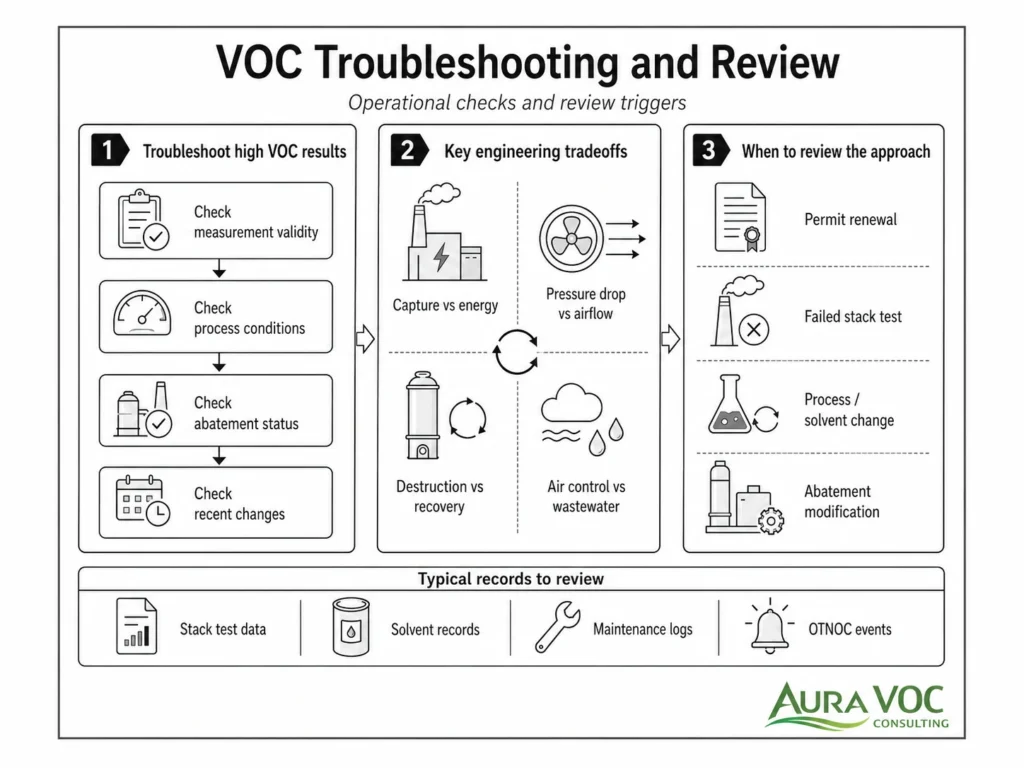
A high VOC concentration after abatement should be investigated in sequence. First confirm measurement validity: calibration status, zero/span drift, sample line temperature, probe condition, moisture interference and analyser response factor. Then check whether the result aligns with production timing, solvent charging, cleaning, batch venting or campaign change.
For oxidisers, review temperature, burner status, residence indicators, bypass damper position and valve leakage. For carbon systems, check breakthrough, bed temperature, humidity and bed duty status. For scrubbers, verify pH, liquid flow, dosing, packing condition and mist eliminator condition. For condensers, check outlet temperature, fouling and cooling duty.
The process side should be reviewed at the same time. A changed solvent, higher batch charge, faster coating line, longer cleaning cycle or different drying temperature can shift the VOC load outside the normal design envelope.
High VOC mass flow with acceptable concentration
This condition usually points to airflow. Fan speed changes, damper opening, filter replacement, added dilution air or ventilation rebalance can increase mass flow while keeping concentration below a limit.
Review the fan operating point, duct pressure, flow measurement basis and any recent ventilation changes. A concentration-only interpretation can miss the actual emission load.
This issue is common after ventilation modifications. A plant may increase extraction to improve capture or workplace conditions, but the resulting higher exhaust flow can increase total VOC mass flow and fuel demand in oxidation systems.
Unstable or inconsistent VOC readings
Unstable readings may reflect real batch peaks or a measurement problem. Compare analyser trends with production phases, cleaning events, adsorber switching, oxidiser temperature, fan operation and bypass status.
If no process or abatement event explains the trend, check sample conditioning, condensation, FID fuel gas, combustion air, calibration gas, heated line temperature and sampling location. Duct stratification or swirl can create inconsistent results even when the analyser is functioning correctly.
Sampling line condensation is a frequent problem in wet or partially cooled streams. If VOCs condense before reaching the analyser, measured concentrations may be unstable or biased low. Heated lines, probe temperature and sample conditioning should be reviewed before interpreting the result as a process trend.
Solvent mass balance does not close
When a solvent mass balance does not close, review the physical solvent routes. Check stock variation, recovered solvent, waste solvent, product retention, wastewater transfer, cleaning use, packaging residues and filter waste.
Also check whether the stack test period matches the solvent reporting period. Annual solvent balance data should not be compared directly with a short stack test unless the assumptions are clear.
Recovered solvent is a common source of error. If it is counted as both recovered and waste, or if returned solvent is not deducted correctly from input, the calculated fugitive loss can become misleading. Wastewater transfer is another frequent gap, especially where condensate, scrubber liquor or wash water contains dissolved VOCs.
VOC deviation after maintenance or process change
VOC deviations often follow changes that were not intended to affect emissions. Examples include ductwork modification, fan VFD adjustment, filter replacement, airflow rebalance, solvent substitution, increased cleaning frequency, new formulation, changed drying temperature or abatement media replacement.
Any change affecting solvent load, airflow, pressure drop, capture efficiency or abatement duty should be treated as a monitoring review trigger.
After maintenance, the plant should confirm that dampers, fans, interlocks, bypasses and sensor signals returned to their intended operating positions. A small change in airflow balance or damper position can alter capture efficiency and stack mass flow.
Engineering Tradeoffs in VOC Monitoring and Abatement Design
Capture efficiency versus exhaust flow and energy use
Increasing exhaust flow can improve capture at open sources, but it can also increase fan power and dilute the VOC stream. Dilution may reduce solvent recovery performance and increase auxiliary fuel demand in thermal oxidation.
The engineering target is controlled capture at the required source, not maximum ventilation. Excessive general extraction can shift the plant toward higher energy use without improving the quality of emission control.
For example, increasing building extraction may reduce odour in a process room but draw more low-concentration air into the abatement system. This can increase fan energy and oxidiser fuel use while still leaving fugitive losses from open handling points if local capture remains poor.
Pressure drop versus abatement reliability
Rising pressure drop across filters, carbon beds, scrubber packing or ductwork can reduce available airflow at hoods and enclosures. The fan may shift along its curve, lowering capture velocity and increasing diffuse emissions.
Operators may compensate by opening dampers or bypasses to maintain ventilation, which can undermine the monitoring basis. Differential pressure trends should therefore be reviewed as both maintenance and emission-control indicators.
Pressure drop also affects energy demand. A fouled system can increase fan load while reducing capture reliability. For carbon beds, scrubbers and filters, differential pressure should be trended against maintenance activity, not reviewed only during inspections.
Destruction versus solvent recovery
Destruction systems are generally more tolerant of mixed VOC streams but can increase fuel use and may require secondary treatment for certain compounds. Recovery systems can reduce solvent loss but require suitable concentration, stream segregation, temperature control and recovered solvent quality.
The decision depends on VOC composition, concentration profile, flow rate, solvent value, safety constraints, utility cost and waste handling options.
A mixed, dilute solvent stream may be technically unsuitable for efficient recovery and more appropriate for oxidation. A high-concentration, segregated solvent stream may justify condensation or adsorption recovery if recovered solvent quality is acceptable.
VOC control versus wastewater impact
Scrubbers and condensers may reduce air emissions while transferring VOCs to liquid streams. These liquids may affect wastewater treatment, tank venting, stripping potential or waste classification.
A VOC control review should trace the transferred load through condensate tanks, drains, equalisation tanks and wastewater treatment vents. Otherwise, the plant may reduce one measured stack emission while creating another VOC release point.
This tradeoff is especially important where scrubber liquor, condensate or wash water is stored in open or vented tanks. The VOC may not be destroyed; it may simply move from the air system to a liquid stream that later re-emits.
Monitoring accuracy versus operational burden
Continuous monitoring improves visibility but requires calibration, sample conditioning, maintenance and data validation. Periodic stack testing is simpler but depends on representative operating conditions. Solvent mass balance gives a broader view but relies on accurate production, warehouse and waste records.
The monitoring approach should match the source risk and process variability. More data are not useful if the plant cannot maintain or interpret them.
For many plants, the most defensible approach is a combination of methods: stack testing for defined discharge points, solvent mass balance for total solvent pathways, parameter monitoring for abatement operation, and inspection-based checks for diffuse or fugitive sources.
VOC Monitoring Compliance Checklist before Permit Review or Inspection
Checks for EHS managers
| What to check | Why it matters | Typical evidence |
|---|---|---|
| Applicable BAT-based permit conditions | Confirms monitoring obligations | Permit, BAT gap review, monitoring schedule |
| Emission point register | Prevents missing stacks or diffuse sources | Source inventory, site layout |
| Stack test reports | Demonstrates measured emissions | Reports, operating conditions, flow data |
| Solvent balance | Supports total VOC accounting | Solvent records, stock data, waste records |
| LDAR and inspection records | Supports fugitive emission control | Inspection logs, repair records |
| OTNOC logs | Explains abnormal emission periods | Event records, corrective actions |
| Calibration records | Supports data validity | Certificates, zero/span checks |
EHS records should not be limited to final emission values. They should also show the plant condition during the monitoring period: production campaign, solvent load, abatement operation, bypass status and any abnormal events.
Checks for plant managers
| What to check | Why it matters | Typical evidence |
|---|---|---|
| Abatement uptime | Confirms availability during production | Runtime logs, alarms |
| Maintenance backlog | Identifies reliability risk | Work orders, overdue tasks |
| Spare media and parts | Prevents operation beyond safe intervals | Carbon stock, burner spares, pump parts |
| Utility demand | Links compliance to operating cost | Gas, electricity, cooling records |
| Production constraints during testing | Ensures representative test conditions | Campaign plan, line speed, solvent use |
| Corrective action tracking | Shows deviation control | CAPA records, maintenance closure |
Plant managers should also consider whether VOC control limits production flexibility. Abatement capacity, carbon bed life, oxidiser fuel demand, fan performance or scrubber wastewater handling can become operating constraints during high-load campaigns.
Checks for process engineers
| What to check | Why it matters | Typical evidence |
|---|---|---|
| Capture points and enclosure condition | Controls diffuse emissions | Ventilation review, smoke tests |
| Duct flow and pressure drop | Confirms design basis | Flow checks, differential pressure trends |
| Solvent or formulation changes | Changes VOC profile and analyser response | MOC records, SDS, recipes |
| Batch peak emissions | Affects monitoring representativeness | Batch logs, venting records |
| Abatement design range | Confirms system capacity | Design data, actual load profile |
| Wastewater transfer | Identifies secondary VOC routes | Drain maps, condensate records |
Process engineers should review whether actual operation still matches the original VOC design basis. Changes in solvent, throughput, equipment use, cleaning frequency or exhaust balance can make historic monitoring assumptions unreliable.
When to Review or Upgrade the VOC Monitoring Approach
Before permit renewal or BAT gap assessment
Before permit renewal or a BAT gap assessment, review the emission source inventory, monitoring points, abatement performance data, solvent balance and maintenance evidence. Gaps are easier to address before the formal review begins.
This review should check whether all relevant channelled and diffuse sources are included, whether sampling points are technically suitable, and whether monitoring records are aligned with actual operating conditions.
After failed stack testing or recurring VOC deviations
A failed stack test should trigger root cause analysis, not only repeat measurement. Review process data, analyser condition, exhaust flow, abatement status, solvent use and OTNOC records for the test period.
Recurring deviations should be grouped by cause where possible. If events are linked to cleaning, carbon breakthrough, oxidiser warm-up or fan changes, the monitoring and operating procedures should be adjusted accordingly.
Before process, solvent or production capacity changes
New solvents, higher throughput, changed cleaning procedures, additional vents or modified exhaust flow can all alter VOC emissions. Monitoring and abatement assumptions should be reviewed before the change becomes routine operation.
The review should include VOC composition, expected load, capture arrangement, abatement design range, analyser response, solvent balance implications and wastewater transfer where relevant.
Before selecting or modifying VOC abatement technology
Technology selection requires VOC composition, load profile, concentration variability, flow rate, pressure drop margin, utility availability, wastewater implications and waste handling requirements. Monitoring should be designed together with the abatement system, not added afterward.
A new abatement system should include defined monitoring points, operating parameter records, maintenance indicators and OTNOC tracking from the start. This avoids later gaps between equipment performance and permit evidence.
FAQ: VOC Monitoring Requirements under BAT Conclusions
What VOC monitoring records are typically reviewed during a BAT-based inspection?
Typical records include stack test reports, monitoring schedules, calibration certificates, abatement operating parameters, maintenance logs, solvent balance, LDAR records, OTNOC logs and corrective actions.
The records should show not only the emission result but also the operating condition during the monitoring period. Production campaign, solvent load, abatement status, bypass condition and maintenance activity are usually relevant.
What is the difference between VOC concentration and VOC mass flow?
VOC concentration measures the amount of VOC in the gas stream. VOC mass flow combines concentration with exhaust flow and is often more relevant for total emission load.
A plant can reduce concentration through dilution while increasing total mass flow. For this reason, exhaust flow data should be reviewed together with VOC concentration.
When is continuous VOC monitoring required or justified?
Continuous VOC monitoring is justified when VOC loads are variable, emissions are significant, abatement performance is critical, or real-time detection of breakthrough, bypass or unstable operation is needed.
It is most useful where short-duration events can dominate emissions, such as batch venting, cleaning peaks, carbon breakthrough or oxidiser instability. The plant must also be able to maintain the analyser and validate the data.
When is periodic stack testing sufficient for VOC emissions?
Periodic testing may be sufficient for stable sources with predictable emissions and documented abatement operation, provided the tested conditions are representative of relevant plant operation.
The plant should record production rate, solvent use, exhaust flow, abatement parameters and any abnormal events during the test. Without operating context, the result may be difficult to defend later.
Why is solvent mass balance important for VOC monitoring?
Solvent mass balance captures solvent pathways that stack testing may miss, including diffuse emissions, waste solvent, recovered solvent, product retention and wastewater transfer.
It is especially important for coating, printing, cleaning and surface treatment operations, where VOC losses may occur through several small or diffuse routes rather than one controlled stack.
Why can VOC mass flow increase even when VOC concentration is acceptable?
VOC mass flow can increase when exhaust volume rises due to fan changes, dilution air, ventilation rebalance or production rate increase, even if concentration remains below a limit.
This is why VOC concentration should not be reviewed alone. Flow measurement and correction conditions are needed to understand the actual emission load.
What causes high VOC stack emissions after an abatement system?
Common causes include bypass, low oxidiser temperature, valve leakage, carbon breakthrough, scrubber depletion, condenser fouling, process peaks or solvent substitution.
Measurement issues should also be checked. Calibration drift, condensation in the sampling line, poor sampling location or analyser response-factor mismatch can affect the result.
How is activated carbon breakthrough detected?
Breakthrough is detected by rising outlet VOC concentration, reduced bed life, temperature changes, odour indicators or monitoring results that no longer match expected adsorption performance.
Breakthrough can occur sooner than expected when inlet load increases, humidity rises, the solvent mixture changes, or the bed develops channeling or fouling.
What operating parameters should be monitored on a thermal oxidiser?
Key parameters include combustion temperature, residence indicators, inlet VOC load, outlet VOC concentration, fan status, burner status, bypass damper position and heat recovery condition.
For RTOs, valve condition, bed pressure drop and ceramic media fouling should also be reviewed where relevant.
Can a VOC scrubber create wastewater or secondary emission issues?
Yes. VOCs transferred into scrubber liquid may affect wastewater treatment, tank venting, stripping potential or waste classification.
The liquid stream should be traced through drains, holding tanks, equalisation tanks and wastewater treatment. A scrubber may reduce stack emissions while transferring VOC load to another part of the plant.
What causes a VOC solvent mass balance not to close?
Common causes include stock errors, missing cleaning solvent use, recovered solvent double counting, incorrect waste records, solvent in wastewater or unrecorded product and packaging residues.
The balance should be reviewed as a physical solvent routing exercise. Each input and output should correspond to a real process, waste, recovery, product or wastewater pathway.
When should a VOC monitoring plan be reviewed after a process change?
A VOC monitoring plan should be reviewed whenever solvent type, throughput, cleaning method, exhaust flow, capture arrangement, abatement connection, production campaign or wastewater route changes.
Changes in fan settings, ductwork, formulation, production rate or abatement media can also affect monitoring assumptions and should be included in management of change procedures.
Conclusion
VOC monitoring under BAT conclusions is most credible when it reflects the way the plant actually operates. Stack measurements, solvent balance, continuous monitoring, LDAR and abatement parameter records each provide part of the picture. None of them is sufficient if disconnected from production conditions, exhaust flow, maintenance status and abnormal operating events.
For industrial plants, the practical challenge is to maintain consistency between measured emissions, solvent use, abatement performance and operating records. VOC deviations are often caused by process changes, airflow changes, breakthrough, bypass, poor sampling conditions or incomplete source inventories rather than by a single isolated failure.
VOC abatement systems should therefore be evaluated as operating assets. Oxidisers, carbon beds, condensers, scrubbers and biofilters each introduce specific monitoring requirements, failure modes, energy implications, wastewater implications and maintenance evidence. Reviewing these factors before permit renewal, process modification or repeated deviations reduces the risk of weak monitoring data and unexplained compliance issues.
Technical consultation
AuraVOC can review VOC emission sources, monitoring points, solvent balance assumptions, abatement operating records and maintenance evidence against the actual process configuration and BAT-based permit conditions.
This type of review is useful before permit renewal, inspection, stack testing, solvent substitution, production capacity changes or abatement system modification.