
BAT-AEL VOC Emissions Permit Interpretation for European Industrial Plants
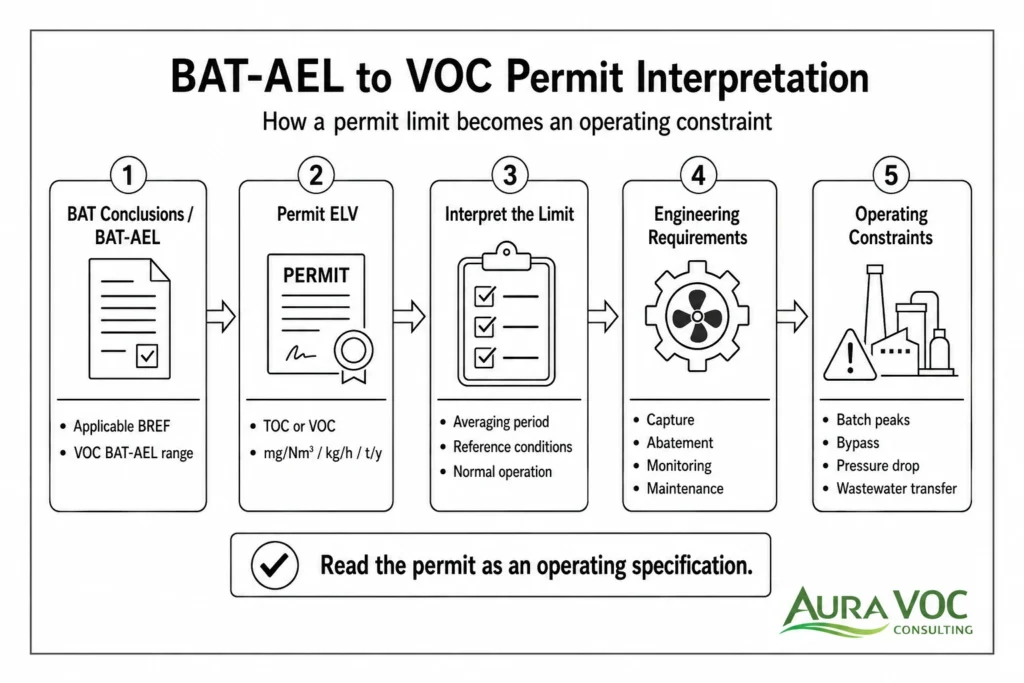
For European industrial sites using solvents, BAT-AEL-based VOC permit conditions need to be read against the actual plant configuration, not as standalone emission numbers. A limit expressed as TOC in mg/Nm³, kg/h VOC, or annual solvent load has different implications for capture design, abatement capacity, monitoring, operating hours, maintenance planning, and production flexibility.
The main compliance risk is often not the BAT-AEL range itself, but how the final permit ELV is applied to real operation. A plant may pass a periodic stack test during a stable production campaign and still have limited margin during cleaning, drying, solvent charging, tank breathing, or simultaneous venting. In batch chemical and pharmaceutical plants, coating lines, paint manufacturing, surface treatment, flavour production, and industrial cleaning systems, VOC emissions are rarely constant. They follow the process sequence.
For plant managers, EHS managers, and process engineers, the practical question is: which part of the system controls the compliance margin? It may be the abatement unit, but it may also be the capture hood, fan curve, duct pressure drop, bypass logic, carbon replacement interval, scrubber blowdown, FID sample line, or wastewater treatment capacity.
A useful BAT-AEL VOC permit review should therefore convert permit wording into engineering checks: emission point boundary, pollutant basis, averaging period, reference conditions, representative load case, abatement performance, maintenance triggers, and monitoring evidence.
How VOC BAT-AEL Requirements Become Operating Constraints
A BAT-AEL is not only a regulatory reference value. Once translated into a permit condition, it becomes a constraint on how the installation can be operated. It can affect which vents must be collected, how much production can run at the same time, whether cleaning operations can be routed to a shared abatement header, how much pressure drop the fan can tolerate, and how much process variation the treatment unit can absorb before outlet VOC approaches the ELV. In Europe, BAT conclusions are used within the Industrial Emissions Directive permitting framework when authorities set permit conditions for relevant industrial installations.
This is why BAT-AEL interpretation should be completed before selecting or modifying a VOC abatement system. The permit may require more than high nominal removal efficiency. It may require stable outlet performance under representative operating conditions, with monitoring data that can demonstrate compliance over the relevant averaging period.
From BAT-AEL range to enforceable permit ELV
The BAT-AEL range is the technical reference used when permit authorities define permit conditions. The enforceable requirement for the site is the permit emission limit value, or ELV. This distinction matters because the BAT-AEL range may be broad, while the permit condition defines the actual value, pollutant expression, averaging time, reference conditions, monitoring method, and emission point.
A VOC permit may express emissions as total organic carbon in mg/Nm³, total VOC, a mass flow in kg/h, an annual solvent emission limit, or a substance-specific value for selected compounds. Each expression creates a different engineering problem. A concentration limit drives outlet concentration control. A mass flow limit requires reliable flow and load data. An annual load limit may constrain operating hours, solvent consumption, production planning, or solvent recovery performance.
The permit ELV should therefore be treated as an operating specification. It defines what the process, capture system, abatement unit, and monitoring approach must deliver during the operating envelope considered normal for the installation.
Why VOC permit interpretation affects engineering decisions
VOC permit interpretation affects design and daily operation. A low outlet concentration requirement may push the plant toward thermal oxidation, catalytic oxidation, adsorption polishing, condensation plus polishing, or a hybrid system. A variable batch load may require vent sequencing, temporary buffering, segregation of high-load streams, or staged treatment rather than a single unit sized on average flow.
The same applies upstream of the abatement unit. A high-efficiency RTO or carbon system cannot compensate for VOC that is not captured. If hoods, enclosures, ducts, dampers, or fans do not maintain the required airflow, part of the VOC load may become fugitive before treatment. In that case, the limiting factor is not destruction efficiency but capture performance.
Maintenance also becomes part of the compliance strategy. RTO valve leakage, ceramic media fouling, carbon bed breakthrough, catalyst poisoning, scrubber packing fouling, blocked nozzles, drifting analyser calibration, or rising duct pressure drop can all reduce compliance margin. A permit interpretation that ignores equipment ageing and maintenance intervals is incomplete from an engineering standpoint.
Typical situations where interpretation becomes critical
BAT-AEL VOC interpretation becomes critical when the permit condition is close to the plant’s actual operating performance or when the process envelope changes. Common triggers include permit renewal, new BAT conclusions, installation of a new production line, solvent substitution, higher production rate, new cleaning procedure, failed stack test, odour complaint, planned abatement upgrade, or a regulator request for clearer evidence under normal operating conditions.
In multipurpose chemical and pharmaceutical plants, the issue often appears during campaign changes. A solvent that was not dominant in the previous product mix may create a higher peak load, lower carbon working capacity, catalyst compatibility issue, different scrubber performance, or additional corrosion risk. In coating and drying operations, higher line speed or oven temperature may increase short-term VOC release even if annual solvent use remains within expected limits.
How to Read a VOC Permit Limit Correctly
A VOC permit limit should be treated as an engineering specification. Before comparing historical measurements with the ELV, the plant should verify what is being limited, where it is measured, how the result is corrected, and which operating conditions were present during the test.
A practical permit review should extract each VOC condition into an engineering table.
| Permit wording | Engineering interpretation |
|---|---|
| TOC mg/Nm³ | Confirm analyser basis, dry/wet gas basis, oxygen correction, sample location, and outlet concentration stability |
| kg/h VOC | Verify stack flow, peak mass loading, production phase, and simultaneous venting |
| Annual solvent load | Link solvent consumption, recovery, operating hours, and campaign planning |
| No untreated bypass | Check damper position, interlocks, alarm records, bypass log, and maintenance procedure |
| Normal operating conditions | Define representative production rate, solvent mix, cleaning cycle, drying profile, and abatement settings |
| Periodic stack test | Confirm whether the test was performed under credible high-load conditions |
| Continuous VOC monitoring | Check data availability, calibration records, sample line condition, and alarm response |
A common error is to compare a vendor guarantee, previous stack result, or internal monitoring trend with the permit ELV without checking whether all values are expressed on the same basis.
Pollutant expression: TOC, total VOC, substance-specific VOC, or solvent mass
The pollutant expression determines the compliance calculation. A TOC result measured by FID is not automatically equivalent to a solvent mass balance or a compound-specific VOC result. The plant should confirm whether the limit is expressed as mgC/Nm³, mg VOC/Nm³, total organic carbon, total VOC, or a specific solvent such as toluene, methanol, ethanol, acetone, dichloromethane, or another regulated compound.
This matters for both monitoring and technology selection. A mixed-solvent stream from pharmaceutical production may contain alcohols, ketones, chlorinated compounds, and high-boiling residues in the same campaign. The analyser response, carbon adsorption capacity, catalytic compatibility, scrubber performance, and condensation efficiency can all change with solvent composition.
Concentration limit, mass flow limit, or annual load limit
A concentration limit focuses on outlet quality. A mass flow limit focuses on the combination of concentration and airflow. An annual load limit links compliance to production rate, operating hours, solvent recovery, and fugitive emissions.
These limits can create different operating constraints. Increasing airflow may reduce the measured concentration but increase total VOC mass flow, fan power, abatement size, and pressure drop. Reducing airflow may improve energy performance but weaken capture velocity or affect LEL control. The correct operating point has to satisfy permit compliance, process safety, and capture performance at the same time.
Averaging period and operating condition
The averaging period determines how much process variability the system can absorb. A short averaging period is more sensitive to charging, drying, cleaning, or vent switching peaks. A daily or annual limit may hide short high-load events but still constrain total solvent use and operating hours.
For batch plants, stack test timing is critical. A test performed during steady low-load operation may not represent peak emissions during vessel opening, filter change, dryer warm-up, cleaning solvent use, or simultaneous venting to a common header. The test report should be read together with production logs and abatement operating data.
Reference conditions: dry gas, oxygen correction, temperature, pressure, and flow basis
VOC concentrations should be checked on the same basis before any compliance judgement is made. Dry gas versus wet gas, oxygen correction, normal temperature and pressure, and stack flow calculation can all change the reported value.
This is especially relevant where dilution air, combustion air, humid gas, scrubber saturation, or condenser outlet conditions are involved. If the plant is comparing a vendor guarantee, a stack test, and a permit ELV, all three values must be converted to the same basis.
OTNOC, bypass, start-up, shutdown, and maintenance wording
Other-than-normal operating conditions should be reviewed before defining the compliance strategy. Oxidiser warm-up, carbon bed replacement, scrubber maintenance, fan trip, bypass damper operation, emergency venting, and analyser downtime may have specific permit obligations.
From an engineering perspective, this affects interlock design, operating procedures, maintenance scheduling, production hold points, alarm response, and documentation. A bypass that is physically possible but not procedurally controlled is a compliance risk, even if it is rarely used.
Identifying the Relevant BAT Conclusions and Emission Points
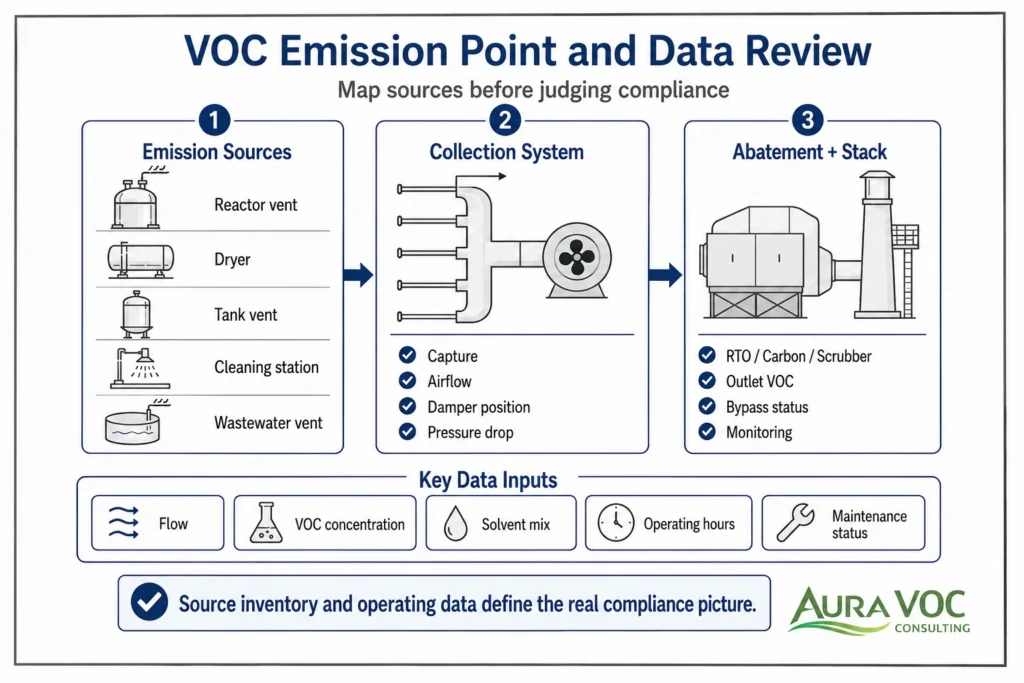
Before comparing emissions with BAT-AEL expectations, the plant should define the emission boundary. Many VOC compliance problems are caused by incomplete source mapping rather than poor abatement performance.
The review should confirm which process sources feed each stack, which vents are intermittent, which sources are untreated, and whether temporary campaign connections have changed the original permit basis. The applicable BAT reference should be checked against the European Commission’s official BAT reference documents before comparing measured VOC emissions with permit expectations.
Start with the industrial activity, not the abatement equipment
The installed abatement technology does not determine the applicable BAT context by itself. The relevant framework depends on the industrial activity and emission source. A carbon bed on a coating line, a carbon bed on a pharmaceutical reactor vent, and a carbon bed polishing a condenser outlet may have different operating risks even if the equipment type is similar.
The activity determines the expected VOC profile: continuous or batch, high-flow or low-flow, solvent-rich or diluted, clean or aerosol-laden, stable or campaign-dependent.
Sector-specific VOC situations
In chemical and pharmaceutical plants, the main issue is often variable batch loading. Solvent charging, reaction heating, distillation, filtration, drying, vessel opening, and cleaning can produce different VOC peaks. A system sized on average load may be weak during short high-concentration events.
In coating, painting, printing, and surface treatment, the operating variables are usually line speed, oven temperature, booth airflow, solvent formulation, and capture efficiency. High airflow may improve workplace extraction but increase abatement volume and fan energy.
In food, flavour, and fragrance processes, VOC mass may be moderate but odour threshold, condensation, and campaign variability can dominate the engineering review.
Multiple BREFs and cross-media references
Some installations need to read air, wastewater, storage, and monitoring requirements together. A VOC treatment decision may increase scrubber blowdown, condensate generation, spent carbon, fuel demand, or wastewater COD. For chemical-sector VOC sources, the Common Waste Gas Management and Treatment Systems BREF is a relevant reference when evaluating channelled and diffuse emissions to air.
For example, a wet scrubber may reduce a soluble VOC in the stack but transfer organic load to wastewater. A condenser may recover solvent but leave a residual gas stream needing carbon polishing. An RTO may reduce VOC concentration but require acid gas control if halogenated solvents are present.
Emission point mapping before BAT-AEL comparison
Emission point mapping should include more than permitted stacks. The review should check reactors, dryers, coating ovens, tank vents, cleaning stations, solvent storage, wastewater equalisation tanks, neutralisation tanks, open channels, sludge handling, maintenance vents, and bypass lines.
Typical findings include tank vents not routed to treatment, cleaning operations outside the designed enclosure, manual dampers left in the wrong position after maintenance, flexible ducting damage, temporary campaign hoses, or a wastewater vent omitted from the original VOC inventory.
Engineering Data Needed for BAT-AEL VOC Interpretation
A permit limit cannot be interpreted properly without process and equipment data. The required information is not limited to stack concentration. A credible assessment needs VOC mass flow, waste gas variability, solvent composition, capture conditions, operating hours, abatement performance, pressure drop, monitoring basis, and maintenance status.
The purpose of collecting these data is to define the allowable range for flow, VOC load, solvent mix, abatement temperature, pressure drop, and operating hours. Without that operating range, the plant may either underestimate a compliance problem or invest in equipment that does not address the actual constraint.
VOC source inventory and solvent mass balance
The VOC source inventory should identify where solvent enters the process, where it is consumed or recovered, where it evaporates, and where it leaves the installation. A solvent mass balance helps verify whether measured stack emissions are consistent with production data and whether significant emissions may be occurring outside the monitored stack.
For batch operations, the mass balance should not only be annual. It should also consider campaign periods, cleaning events, drying stages, tank transfers, filter changes, and simultaneous operations. A process with moderate annual solvent use can still generate short high-load VOC events that determine the required abatement capacity.
Waste gas flow, concentration range, and peak loading
Flow and concentration data should be collected across the full operating range. Average values are useful for annual reporting, but peak values are more relevant for abatement sizing and permit risk. A thermal oxidiser, carbon bed, scrubber, or condenser may perform adequately at average load but approach its limit during charging, drying, solvent displacement, or cleaning.
Peak loading also affects safety. If solvent concentration approaches the lower explosive limit, dilution, interlocks, inerting, or vent segregation may be required. If concentration is too low, a thermal oxidiser may need supplemental fuel and operate with higher energy cost per kilogram of VOC treated.
VOC composition and abatement compatibility
VOC composition affects monitoring and technology selection. Alcohols, ketones, aromatics, chlorinated solvents, aldehydes, high-boiling compounds, silicones, sulphur-containing compounds, and catalyst poisons behave differently in treatment systems. A technology selected on total VOC load alone may perform poorly when the solvent mix changes.
Chlorinated VOCs may require corrosion-resistant materials and acid gas handling after oxidation. Silicones can foul catalysts or create deposits. High-boiling VOCs can condense in ductwork, filters, carbon beds, or heat recovery media. Water-soluble VOCs may be scrubbed but can increase wastewater COD. Ketones and other reactive solvents may require closer review of carbon bed heat release and fire risk.
Capture system data
Capture system data are often underdeveloped during permit reviews, even though capture is a frequent cause of compliance problems. The assessment should include hood geometry, enclosure integrity, duct velocity, airflow balance, damper position, fan curve, pressure drop, access doors, flexible connections, and known fugitive emission points.
A reduction in airflow caused by fouled filters, duct deposits, or fan degradation may not immediately appear as a stack concentration problem. Instead, VOC may escape before reaching the abatement system. In that case, stack emissions may look acceptable while workplace odour, fugitive emissions, or local complaints increase.
Practical checks include hood face velocity, enclosure negative pressure, smoke testing, damper position verification, duct inspection, fan operating point, and comparison of measured airflow with design airflow.
Existing abatement system operating data
Operating data should be reviewed alongside stack results. For an RTO, relevant parameters include combustion chamber temperature, valve status, ceramic media pressure drop, fan speed, fuel consumption, alarms, and bypass events. For carbon adsorption, bed age, breakthrough checks, bed temperature, pressure drop, humidity, and replacement history are critical. For scrubbers, pH, ORP, reagent dosing, liquid-to-gas ratio, pressure drop, blowdown, and mist eliminator condition should be checked.
Without these data, a stack result is difficult to interpret. A compliant result from a freshly maintained system may not represent performance near the end of a maintenance interval. A failed test may reflect a temporary operating fault rather than a fundamental design limitation. The difference matters before selecting corrective actions.
Translating VOC Permit Limits into Abatement Requirements
Once the emission points and data are defined, the permit condition can be translated into engineering requirements. This means defining the required removal efficiency, capture performance, monitoring basis, operating margin, and process restrictions needed to maintain compliance.
This step should be completed before deciding whether the existing abatement system is sufficient. Otherwise, the plant may overinvest in treatment equipment while ignoring source capture, or underestimate the required upgrade because the calculation was based on average rather than peak operation.
Calculating required removal or destruction efficiency
Required abatement efficiency depends on inlet concentration, waste gas flow, outlet limit, and the pollutant expression used in the permit. For a concentration-based ELV, the key question is whether the outlet concentration can remain below the permitted value across the full operating range. For a mass flow limit, both concentration and flow must be controlled. For an annual load limit, operating hours and solvent consumption become part of the compliance calculation.
The calculation should include realistic maximum load cases. In batch processes, this may involve solvent charging, drying, cleaning, or simultaneous venting. In continuous coating or printing lines, it may involve maximum normal line speed, maximum solvent content, and oven operation at representative temperature.
Defining the compliance margin below the ELV
Operating at the permit limit is not an engineering strategy. A practical margin is needed for measurement uncertainty, solvent variability, ageing equipment, maintenance intervals, instrument drift, and abnormal but foreseeable process variation. The margin does not need to be excessive, but it should be deliberate and documented.
The required margin depends on process stability and abatement technology. A stable continuous stream with reliable monitoring may require a different margin from a multipurpose batch plant with changing solvent blends. Carbon systems, scrubbers, and catalytic units may need specific margin linked to breakthrough, chemical control, or catalyst condition.
When capture efficiency is the limiting factor
In many VOC systems, the limiting factor is not the abatement unit but the collection system. A high destruction efficiency guarantee applies only to the gas entering the equipment. If part of the VOC load escapes from open vessels, poorly enclosed cleaning areas, unbalanced ducts, or uncontrolled tank vents, the overall compliance position may be weak even if the treated stack is below the ELV.
Capture efficiency should be treated as part of the abatement requirement. Improvements may include better enclosure, local extraction, duct balancing, fan adjustment, automatic damper control, vent segregation, or improved operating discipline during vessel opening and cleaning.
When production flexibility is limited by the VOC permit
A VOC permit condition can become a production constraint. If the abatement system has limited capacity, the plant may need to avoid simultaneous high-load operations, restrict certain solvent campaigns, extend drying times, change cleaning schedules, or maintain minimum operating temperatures in the treatment system.
This is particularly relevant for sites planning production increases or product transfers. A permit review should test whether the current abatement system can support the future operating envelope, not only the historical one. Otherwise, the plant may remain technically compliant today but lack capacity for the next production scenario.
VOC Abatement Technology Implications Under BAT-AEL Constraints
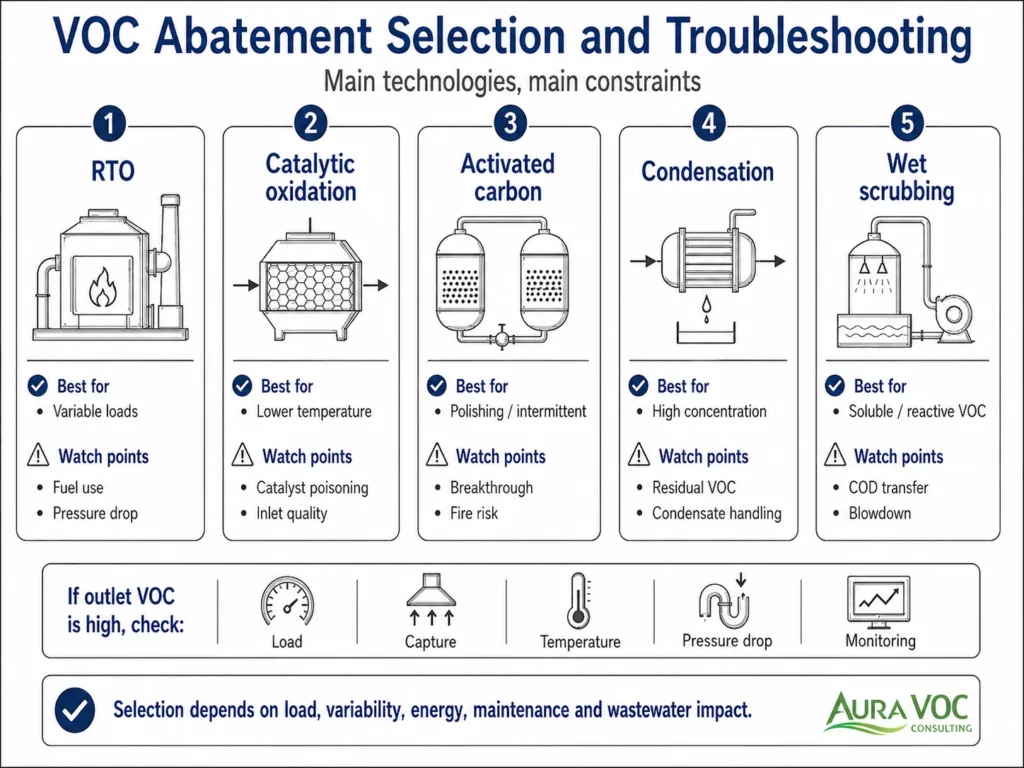
Technology selection should be based on the actual VOC operating envelope: flow, concentration range, peak load, solvent composition, humidity, particulates, aerosols, LEL margin, pressure drop, maintenance access, energy demand, and wastewater impact. Nominal removal efficiency is not enough.
The most reliable selection process compares technologies against the actual operating envelope rather than a single design concentration or annual solvent value.
Regenerative thermal oxidisers for variable VOC loads
RTOs are often suitable for mixed solvent streams where solvent recovery is not practical and high destruction efficiency is required. Their performance depends on chamber temperature, residence time, valve sealing, heat recovery, media condition, fan capacity, and stable inlet control.
Low-concentration high-flow streams may require continuous supplemental fuel. High-load peaks may require LEL control, dilution, or vent sequencing. Ceramic media fouling can increase pressure drop and reduce airflow. Valve leakage can reduce effective destruction performance. Chlorinated or sulphur-containing solvents may require corrosion review and downstream acid gas management.
Useful operating checks include combustion temperature trend, fuel use per operating hour, RTO differential pressure, valve leakage indication, fan speed, bypass status, and alarm history.
Catalytic oxidation for lower-temperature VOC treatment
Catalytic oxidation can reduce fuel demand compared with thermal oxidation, but it is more sensitive to inlet contaminants. Catalyst poisoning, masking, particulate fouling, silicone deposits, sulphur, phosphorus, metals, and halogenated compounds can reduce performance gradually.
This technology requires solvent compatibility review before campaign changes. Operating checks should include inlet temperature, catalyst bed temperature rise, outlet VOC trend, pressure drop, particulate carryover, and catalyst inspection or activity testing.
Activated carbon adsorption for VOC polishing or intermittent loads
Activated carbon is useful for polishing duties, intermittent vents, and lower concentration streams, but it needs active breakthrough control. Replacement based only on calendar time is weak if solvent mix or loading varies.
Key operating considerations include lead-lag bed configuration, outlet VOC monitoring between beds, bed temperature, humidity, pressure drop, channeling, fire risk, and spent carbon classification. High humidity can reduce capacity. Some solvents can generate heat during adsorption. High-boiling compounds may be difficult to desorb and can shorten carbon life.
Carbon systems should have a defined breakthrough curve, alarm point below the permit limit, and replacement procedure linked to measured outlet concentration.
Condensation and solvent recovery
Condensation is relevant where VOC concentration is high enough and recovered solvent has value or where load reduction before polishing is needed. Performance depends on vapour pressure, cooling temperature, residence time, fouling, condensate separation, and solvent-water behaviour.
Condensation rarely guarantees final compliance on its own when the permit ELV is tight. Residual VOC after the condenser may require carbon adsorption, oxidation, or another polishing step. The review should define recovered solvent quality, condensate storage, phase separation, hazardous waste classification, and residual gas treatment.
Wet scrubbing for soluble or reactive VOC streams
Wet scrubbing should be selected only where the VOC is soluble, reactive, or removable under realistic gas-liquid contact conditions. The main operating variables are liquid-to-gas ratio, pH, ORP, reagent dose, packing condition, nozzle performance, mist eliminator condition, blowdown rate, and liquid temperature.
The wastewater consequence must be checked early. Scrubber blowdown may increase COD, pH correction load, salinity, toxicity, sludge production, or biological treatment inhibition. A scrubber that solves the stack limit but overloads wastewater treatment has not solved the plant constraint.
Hybrid VOC abatement systems
Hybrid systems are common where the VOC stream does not fit one technology. Examples include condenser plus carbon for solvent recovery and polishing, scrubber plus RTO where acid or soluble compounds need pre-treatment, demister or filter plus catalyst to reduce fouling, carbon concentrator plus oxidiser for low-concentration high-flow streams, or quench and scrubber downstream of oxidation for acid gas management.
The advantage is better fit to variable operation. The drawback is more pressure drop, more instruments, more maintenance points, and more failure modes. Each stage should have a defined function, measurable operating parameter, and alarm response.
Design Tradeoffs When Targeting VOC BAT-AEL Compliance
VOC permit compliance is not only a question of selecting the highest-efficiency abatement technology. Each control option changes airflow, pressure drop, energy use, maintenance exposure, safety constraints, and sometimes wastewater load. These tradeoffs should be evaluated before defining the final compliance strategy.
Low VOC concentration versus thermal oxidiser fuel demand
Low-concentration, high-flow streams are often expensive to treat thermally. If the VOC load is below the autothermal range, an RTO or oxidiser may require continuous supplemental fuel. In that case, source concentration, flow segregation, or adsorption concentration may be more relevant than simply increasing oxidiser size.
For example, a diluted extraction stream may be technically treatable in an RTO, but the energy cost per kilogram of VOC destroyed can become high if most of the heat demand is supplied by natural gas rather than solvent calorific value.
Higher airflow versus abatement size and fan power
Increasing airflow can reduce VOC concentration, but it usually increases total treated volume, duct losses, fan power, and abatement equipment size. It can also reduce residence time or increase pressure drop across existing equipment. Dilution should therefore be treated as a ventilation and safety measure, not as a compliance strategy by itself.
In coating booths, dryers, and enclosed cleaning areas, airflow changes should be checked against capture velocity, operator exposure controls, LEL margin, fan curve, and abatement inlet design basis.
Pressure drop versus capture performance
Rising pressure drop can reduce capture velocity at hoods, booths, dryers, and local extraction points. Fouled filters, packed beds, carbon vessels, RTO media, or duct deposits can shift emissions from controlled stacks to fugitive release points.
For BAT-AEL compliance, pressure drop trends should be reviewed together with stack results and capture performance. A stack value alone may not show that part of the VOC load is escaping before treatment. Useful checks include differential pressure across filters, scrubbers, carbon beds, demisters, and RTO media, plus measured airflow at critical capture points.
Abatement efficiency versus wastewater transfer
Some systems reduce VOC emissions to air by transferring organic load into liquid streams. Scrubbers, condensers, and quench systems can create blowdown, condensate, or contaminated water requiring treatment. A system that performs well at the stack may still create a bottleneck in wastewater COD, toxicity, salinity, or hazardous waste handling.
This tradeoff should be reviewed during technology selection, not after commissioning. The plant should estimate liquid flow, expected COD load, solvent toxicity, pH correction demand, and whether organic peaks can be accepted by the wastewater treatment plant.
Compliance margin versus CAPEX and OPEX
A larger or more complex abatement system may provide stronger compliance margin, but it can also increase energy demand, maintenance hours, spare parts, instrumentation, and control complexity. The required margin should be based on process variability, measurement uncertainty, equipment ageing, and future production scenarios.
For some plants, the most effective margin is not larger equipment. It may be better vent sequencing, source segregation, additional monitoring, tighter carbon replacement triggers, improved capture, or planned maintenance before critical campaigns.
Safety constraints: LEL, ATEX, fire risk, and solvent compatibility
VOC systems must be evaluated against LEL limits, ATEX zoning, ignition sources, carbon bed heating, oxidiser inlet control, and emergency bypass philosophy. Solvent compatibility is also critical. A change in solvent formulation can alter flammability, adsorption behaviour, catalyst risk, corrosion potential, or acid gas formation.
Safety constraints can also limit compliance options. A high-concentration stream may be attractive for energy recovery or condensation, but it may require inerting, dilution, explosion isolation, or specific operating interlocks before being routed to treatment.
Maintenance Factors That Affect VOC Permit Compliance
Maintenance directly affects compliance margin. Many VOC failures are not caused by incorrect technology selection but by gradual deterioration of capture systems, media, instruments, fans, or control loops.
The maintenance plan should be linked to parameters that influence permit compliance, not only to mechanical availability.
RTO and oxidiser maintenance items
RTO performance depends on combustion temperature, valve sealing, media condition, fan capacity, burner control, and pressure drop. Valve leakage or ceramic fouling can reduce destruction efficiency or increase fuel use. Maintenance records should be linked to compliance-critical operating data, not treated separately.
Practical checks include combustion chamber temperature trend, burner tuning, fuel consumption at comparable loads, RTO differential pressure, media plugging, valve sealing, fan vibration, safety interlocks, and bypass damper status.
Activated carbon maintenance items
Carbon systems require breakthrough monitoring, bed temperature checks, humidity control, pressure drop tracking, and defined replacement intervals. Carbon exhaustion can be gradual or sudden depending on solvent mix and load.
Carbon maintenance should be based on measured breakthrough risk, not calendar assumptions alone. Lead-lag systems should include monitoring between beds where practical. Bed temperature and pressure drop should be trended because they can indicate adsorption heat, fouling, channeling, or abnormal loading. Fire risk and spent carbon classification should be included in the operating procedure.
Scrubber maintenance items
Scrubber performance depends on liquid distribution, pH or ORP control, reagent dosing, packing condition, mist eliminator cleanliness, and blowdown rate. Fouled packing or blocked nozzles can reduce mass transfer while the system still appears to be running normally.
Useful checks include recirculation pump flow, nozzle inspection, pH/ORP trend, reagent consumption, liquid temperature, scrubber pressure drop, blowdown rate, mist eliminator differential pressure, scaling, biological growth, and wastewater COD trend.
Capture and ductwork maintenance items
Dampers, hoods, flexible connections, access doors, duct deposits, fan belts, and balancing points can determine whether VOC reaches the abatement system. Routine checks should verify airflow and capture at source, not only stack concentration.
Common issues include damaged flexible ducting, open access panels, damper positions changed after maintenance, deposits reducing duct cross-section, insufficient face velocity at hoods, or production equipment blocking capture points.
Monitoring and instrumentation maintenance
FID or TOC analyser calibration, heated sample lines, oxygen correction, flow measurement, alarm setpoints, and data availability affect the credibility of compliance evidence. Instrument drift can either hide a developing issue or create false non-compliance signals.
Sample line condensation, calibration gas mismatch, blocked filters, analyser downtime, missing data, and incorrect correction factors should be treated as compliance-relevant issues. Monitoring maintenance should include calibration records, sample system checks, data validation, alarm response, and historian integrity.
Troubleshooting VOC BAT-AEL Compliance Problems
Troubleshooting should separate source changes, capture failures, abatement limitations, and measurement issues. Treating every high stack value as an abatement failure can lead to the wrong corrective action.
A useful investigation starts by asking whether the source load changed, whether the VOC reached the abatement system, whether the treatment unit was operating within design, and whether the measurement basis was correct.
Stack VOC concentration is higher than expected
Check inlet VOC load, process phase, flow rate, abatement temperature, carbon saturation, catalyst condition, scrubber chemistry, bypass status, and analyser basis. The first question should be whether the system is seeing the load it was designed to treat.
For an RTO, check chamber temperature, residence time assumptions, valve leakage, fan operation, and media pressure drop. For carbon, check breakthrough, humidity, bed temperature, and channeling. For a scrubber, check pH, ORP, liquid flow, nozzle condition, packing fouling, and mist carryover.
Compliance changes between production campaigns
Campaign changes can alter solvent mix, peak emissions, humidity, aerosols, cleaning frequency, and vent routing. A system that performs well for one product may have limited margin for another, especially in multipurpose chemical or pharmaceutical plants.
Troubleshooting should compare solvent formulation, batch sequence, production rate, drying profile, cleaning solvent, simultaneous venting, and abatement settings between the compliant and non-compliant campaigns.
Pressure drop increases over time
Increasing pressure drop usually indicates fouling, condensation, scaling, carbon fines, filter loading, mist eliminator blockage, or RTO media plugging. The operational impact is not limited to energy use; it may also reduce capture efficiency.
If pressure drop rises, the plant should check whether fan airflow has decreased, whether critical capture points still meet design flow, and whether fugitive emissions have increased. A stack concentration trend should be reviewed together with airflow measurements, not in isolation.
Stack test results do not match normal operation
A stack test must be interpreted with production rate, solvent use, operating phase, abatement settings, and maintenance condition. Testing during a low-load period may not represent the actual compliance risk during peak operation.
If results appear inconsistent, check test timing, solvent consumption during the test, process phase, cleaning operations, flow measurement, analyser calibration, sample line condition, dry/wet basis, oxygen correction, and whether all relevant vents were routed as they are during normal operation.
Odour persists even when VOC concentration appears compliant
Odour may be caused by compounds with low odour thresholds, fugitive emissions, wastewater vents, tank breathing, intermittent peaks, or poor dispersion. A compliant TOC value does not always prove that all relevant VOC sources are controlled.
The investigation should include fugitive source checks, wastewater vent review, tank vent routing, capture testing, process timing, and whether the sampling method is capable of detecting the compounds responsible for the odour.
Wastewater and Cross-Media Implications of VOC Abatement
VOC control should be reviewed across air, water, and waste systems. Moving organic load from the stack to another stream may still create a plant constraint.
This is especially important when wet scrubbers, condensers, quench systems, or solvent recovery equipment are considered as part of the BAT-AEL compliance strategy.
When air treatment transfers VOC load to wastewater
Wet scrubbing, condensation, quenching, and solvent recovery can transfer VOCs into liquid streams. This changes the compliance question from outlet gas concentration to total mass balance and downstream treatment capacity.
A plant should check whether the VOC is destroyed, recovered, transferred to wastewater, or transferred to waste. The route matters for wastewater COD, hazardous waste classification, biological treatment stability, and overall operating cost.
Scrubber blowdown, COD, pH, salinity, and toxicity
Scrubber blowdown may increase COD, salinity, reagent load, or toxicity to biological treatment. Before selecting scrubbing as a VOC solution, the plant should check wastewater treatment capacity and discharge limits.
The review should estimate blowdown flow, COD load, pH correction demand, salinity, solvent toxicity, sludge generation, and whether intermittent organic peaks can inhibit biological treatment. For reactive scrubbers, reagent by-products also need to be considered.
Condensate and recovered solvent handling
Condensate may contain solvent mixtures, water, emulsions, or hazardous residues. Recovered solvent quality, phase separation, storage compatibility, and disposal route should be defined before the system is installed.
If recovered solvent cannot be reused, the economics and waste route may differ significantly from the original design assumption. Condensate handling should include tank venting, secondary emissions, fire risk, waste classification, and compatibility with existing wastewater or waste management systems.
Wastewater treatment vents as VOC emission sources
Equalisation tanks, neutralisation systems, open channels, aeration tanks, and sludge handling can release VOCs after transfer to wastewater. These vents may need to be included in the emission point inventory.
A plant that installs a scrubber or condenser should check whether downstream wastewater equipment becomes a secondary VOC source. This is particularly relevant for volatile solvents, warm wastewater streams, stripping effects, aeration, and open tanks.
Monitoring and Evidence for Permit Compliance
Monitoring data should show how the plant operated when the emissions were measured. A stack value without production rate, solvent use, flow, abatement settings, and maintenance condition is difficult to interpret.
For BAT-AEL VOC permit compliance, evidence should connect measured emissions with actual operating conditions and the applicable permit basis.
Periodic stack testing versus continuous VOC monitoring
Periodic stack testing is a controlled snapshot. It can be useful for permit demonstration, but it may miss short peaks or campaign-specific emissions. Continuous monitoring provides trends, peak detection, and abnormal operation visibility, but only if the analyser, sample system, calibration records, and data handling are maintained.
For variable VOC systems, continuous or semi-continuous trend data can help identify whether excursions align with cleaning, drying, vent switching, carbon breakthrough, scrubber drift, or RTO operating changes.
Selecting representative operating conditions for VOC testing
Representative testing should be planned around credible high-load operation, not convenience. For a batch plant, this may mean testing during solvent charging, drying, cleaning, or simultaneous venting. For coating lines, it may mean maximum normal line speed, representative solvent formulation, and oven temperature.
If the test excludes known peak operations, the report should not be used as proof of full operating envelope compliance. It may still be valid for the tested condition, but it does not prove margin across all normal production scenarios.
Operating data to record during VOC stack testing
At minimum, record production rate, product or campaign, solvent use, solvent composition, operating phase, gas flow, inlet and outlet VOC, abatement temperature, fan speed, pressure drop, scrubber pH or ORP, carbon bed age, catalyst condition, bypass status, and analyser calibration status.
These data allow the result to be linked to a repeatable operating condition. They also help identify whether a failed test is caused by source load, poor capture, abatement condition, or measurement basis.
Using monitoring data to set maintenance and alarm triggers
Monitoring should be connected to maintenance. Examples include a carbon outlet VOC alarm below the permit limit, an RTO differential pressure trigger for media inspection, a scrubber pH deviation alarm, a minimum airflow alarm for capture points, a sample line temperature alarm, and a bypass damper position interlock.
Trend review is often more useful than isolated readings. Rising fuel use, increasing pressure drop, shorter carbon life, drifting pH, or declining airflow can indicate a compliance issue before the stack exceeds the ELV.
VOC BAT-AEL Permit Review Workflow for Industrial Sites
A structured review helps distinguish permit interpretation from equipment performance. The objective is to identify which part of the system sets the compliance limit.
The workflow should produce an engineering table that connects each permit condition to emission points, process sources, monitoring basis, operating data, and corrective actions.
Step 1 — Extract each VOC permit condition into an engineering table
List the emission point, pollutant expression, limit, averaging period, reference conditions, monitoring method, and operating restrictions. This prevents the permit from being reduced to a single VOC number without context.
The table should also identify whether the limit applies to a stack, a process area, a solvent consumption threshold, a mass flow, annual load, or an operating condition such as bypass prevention.
Step 2 — Match each emission point to process sources and applicable BAT conclusions
Connect stacks and vents to reactors, dryers, tanks, cleaning points, wastewater systems, and abatement equipment. The physical system must match the permit boundary.
This step should also identify shared headers, intermittent vents, temporary campaign connections, untreated sources, and sources that may have been added after the original permit basis was established.
Step 3 — Compare measured performance with permit limits and BAT-AEL expectations
Use stack tests, monitoring data, solvent mass balance, production records, and abatement trends. Compare both average operation and credible peak scenarios.
The comparison should include measurement basis, dry or wet correction, oxygen correction where relevant, flow measurement, operating phase, and abatement condition during the measurement period.
Step 4 — Identify whether the gap is regulatory, operational, maintenance-related, or design-related
A compliance gap may come from permit wording, measurement basis, process variability, poor capture, equipment ageing, or insufficient abatement capacity. Correct classification avoids unnecessary or ineffective upgrades.
For example, a high outlet value during cleaning may be caused by excessive peak load, wrong vent routing, low oxidiser temperature, carbon breakthrough, scrubber drift, or stack testing during a non-representative but routine operating phase. Each cause requires a different corrective action.
Step 5 — Define engineering options and implementation constraints
Options may include source reduction, vent segregation, capture improvement, abatement modification, monitoring upgrades, maintenance changes, or permit variation support. Each option should be checked against production, safety, energy, pressure drop, wastewater, and maintenance constraints.
The output should not be a generic list of technologies. It should define which plant constraint is being addressed, how the change affects compliance margin, and what new operating or maintenance requirements are introduced.
Practical Example: VOC BAT-AEL Interpretation for a Solvent-Based Process Line
A worked example helps show why VOC BAT-AEL permit interpretation should be based on operating conditions rather than one average emissions value.
Process configuration
Consider a solvent-based production line with mixing, coating, drying, cleaning, common extraction, abatement, stack discharge, and a wastewater interface. Normal production creates a moderate VOC load, while cleaning and dryer warm-up create short peaks.
Assume a simplified operating case:
| Parameter | Example value |
|---|---|
| Treated airflow | 15,000 Nm³/h |
| Normal inlet VOC | 300–800 mgC/Nm³ |
| Cleaning peak | 2,000–2,500 mgC/Nm³ |
| Permit ELV | 20 mgC/Nm³ |
| Current outlet during normal operation | 8–15 mgC/Nm³ |
| Current outlet during cleaning peak | 25–35 mgC/Nm³ |
| Abatement system | RTO with shared extraction header |
The normal production result appears acceptable, but the cleaning peak shows limited compliance margin.
Permit condition
The permit condition may specify TOC concentration in mgC/Nm³, dry gas basis, periodic monitoring, and operation without untreated bypass under normal conditions. It may also include a mass flow limit or annual solvent load condition.
The key interpretation issue is whether cleaning is part of normal operation. If cleaning occurs routinely as part of production, it should be considered in the operating envelope unless the permit clearly treats it differently.
Engineering interpretation
The measured exceedance during cleaning does not automatically mean the RTO is undersized. The review should check whether cleaning vents are routed correctly, whether simultaneous venting occurs, whether the airflow increases during cleaning, whether the RTO temperature remains stable, and whether the peak exceeds the design inlet load.
Possible findings could include:
- cleaning station extraction connected to the same header as dryer exhaust
- manual damper open during cleaning, increasing flow beyond fan design point
- RTO chamber temperature stable, indicating source/load issue rather than combustion failure
- pressure drop across the extraction system higher than design, reducing capture at the coating enclosure
- stack test performed during cleaning without recording solvent use rate
In this case, the correction may be vent sequencing, extraction balancing, cleaning procedure modification, or temporary load buffering rather than immediate RTO replacement.
Abatement option comparison
An RTO upgrade may provide additional capacity but increase fuel use during low-load operation. Carbon polishing may reduce short outlet peaks but requires breakthrough monitoring and fire risk review. Condensation may be useful if the cleaning stream is solvent-rich and segregated. Scrubbing is only relevant if the solvent is soluble or reactive and wastewater COD can be accepted. A hybrid solution may be justified if routine peaks are short but repeatable.
The correct decision depends on whether the limiting factor is peak load, airflow, capture, operating sequence, or treatment capacity.
Common BAT-AEL VOC Permit Interpretation Mistakes
Several recurring mistakes appear during VOC permit reviews. Most are not caused by lack of regulatory knowledge, but by weak translation between permit wording and plant operation.
Treating the BAT-AEL range as the permit limit
The enforceable condition is the permit ELV. The BAT-AEL range helps explain the basis, but the permit defines the actual obligation.
The permit value should be read together with the emission point, pollutant basis, averaging period, reference conditions, monitoring method, and operating restrictions. A BAT-AEL range alone is not enough to determine whether the installed system has sufficient compliance margin.
Ignoring reference conditions and averaging period
Dry or wet basis, oxygen correction, flow normalisation, and averaging time can change the compliance result. These details should be verified before making design decisions.
This is particularly important when comparing historical stack tests, vendor guarantees, continuous monitoring data, and permit values. If the values are not on the same basis, the calculated compliance margin may be wrong.
Sizing abatement on annual solvent use instead of peak load
Annual solvent use can hide short high-load events. Batch peaks, cleaning cycles, and simultaneous operations often define the real abatement requirement.
A plant with modest annual solvent use may still need a robust abatement strategy if the VOC is released in short, concentrated events. Peak load cases should be included in design and permit review calculations.
Assuming abatement efficiency equals overall compliance
Overall compliance depends on capture, routing, bypass prevention, monitoring, and maintenance. Abatement efficiency alone is not sufficient.
A treatment unit may achieve high destruction or removal efficiency on the gas it receives, while poor capture or uncontrolled vents leave part of the VOC load untreated. The whole system boundary must be reviewed.
Overlooking pressure drop, fan capacity, and airflow balance
Mechanical degradation can reduce capture and create fugitive emissions. Pressure drop should be part of the compliance review.
Filter loading, scrubber fouling, carbon fines, RTO media plugging, or duct deposits can move the fan operating point and reduce airflow at source. In VOC systems, this is both an energy issue and a compliance issue.
Solving air compliance while creating wastewater constraints
Scrubber blowdown, condensate, and solvent recovery residues can create COD, toxicity, disposal, or treatment issues. Cross-media effects should be checked early.
A technically acceptable air treatment option may be unsuitable if it overloads wastewater treatment, creates difficult solvent-water mixtures, or generates waste streams without a reliable disposal route.
FAQ: BAT-AEL VOC Emissions Permit Interpretation
What does BAT-AEL mean for VOC emissions permits?
A BAT-AEL is the emission level range associated with best available techniques. For VOC permits, it helps define the technical basis for the permit condition, but it must be interpreted together with the specific emission point, pollutant expression, averaging period, reference conditions, and monitoring method.
Is a BAT-AEL the same as a VOC permit ELV?
No. The permit ELV is the enforceable limit. The BAT-AEL range explains the technical basis, but the permit defines the actual value, reference conditions, averaging period, monitoring requirement, and operating restrictions.
How do I know which BAT-AEL applies to my plant?
Start from the permitted industrial activity and emission source. Then check the applicable BAT conclusions, BREF scope, national permit wording, and whether the emission point is linked to production, storage, cleaning, wastewater, or a common waste gas system.
Why can two plants with similar VOC emissions receive different permit limits?
The permit limit can depend on process type, solvent mix, abatement configuration, emission point boundary, operating pattern, local permit history, monitoring basis, and whether the plant has continuous or batch emissions.
Can capture improvements help meet a VOC BAT-AEL-based permit limit?
Yes. If VOC is escaping before it reaches the abatement unit, improving capture may be more effective than replacing the treatment system. Checks should include hood condition, enclosure leakage, duct velocity, fan capacity, damper positions, and pressure drop.
Why does my VOC stack test pass during one campaign and fail during another?
Common causes include solvent substitution, higher production rate, different cleaning solvent, simultaneous venting, dryer temperature change, carbon breakthrough, scrubber chemistry drift, catalyst fouling, or non-representative test timing.
How much compliance margin should a VOC abatement system have?
There is no universal percentage. The margin should reflect process variability, measurement uncertainty, maintenance interval, solvent changes, ageing equipment, and the permit averaging period. A stable continuous process may need less margin than a multipurpose batch plant.
Does increasing airflow help with VOC permit compliance?
Not necessarily. It may reduce concentration but increase total treated volume, fan power, pressure drop, and mass flow. It may also overload existing abatement equipment or reduce capture balance elsewhere in the system.
When is an RTO suitable for BAT-AEL VOC compliance?
An RTO is often suitable for mixed VOC streams requiring high destruction efficiency, especially where solvent recovery is not practical. It should be checked for low-load fuel demand, high-load LEL control, pressure drop, valve leakage, media fouling, and solvent compatibility.
When is activated carbon risky for VOC permit compliance?
Activated carbon becomes risky when there is poor breakthrough monitoring, high humidity, variable solvent composition, high inlet peaks, elevated bed temperature, channeling, or no defined replacement trigger before the permit limit is approached.
Can a VOC scrubber create wastewater compliance problems?
Yes. Scrubbers can transfer VOC and reagent by-products to blowdown. The plant should check COD, pH, salinity, toxicity, sludge impact, and whether the wastewater treatment plant can accept intermittent organic load peaks.
What data should be collected before a VOC permit renewal or BAT review?
Collect the permit conditions, emission point map, solvent mass balance, stack test reports, production records, monitoring data, abatement operating trends, pressure drop logs, maintenance records, bypass events, and wastewater or condensate data.
What is the difference between mgC/Nm³ and mg VOC/Nm³ in a VOC permit?
mgC/Nm³ expresses emissions as carbon. mg VOC/Nm³ expresses emissions as compound mass. The difference affects analyser calibration, reporting, and comparison with solvent mass balance. The permit basis should be confirmed before interpreting results.
Can a failed VOC stack test be caused by poor capture rather than abatement failure?
Yes. A stack test may fail because the abatement inlet load changed, but poor capture can also create uncontrolled emissions that are not fully represented at the stack. The review should check both treated stack data and source capture conditions.
When should a VOC abatement system be re-rated after production changes?
Re-rating should be considered after solvent substitution, production increase, new campaign introduction, new cleaning procedure, additional vent connection, line speed increase, dryer temperature change, or any modification that changes flow, VOC load, or solvent composition.
Conclusion
BAT-AEL VOC permit interpretation is an engineering exercise as much as a regulatory one. The permit ELV must be connected to emission sources, process variability, capture performance, abatement capacity, monitoring basis, and maintenance condition. Without that connection, a plant may misjudge whether the compliance constraint is caused by permit wording, poor capture, process peaks, abatement ageing, measurement basis, or cross-media transfer.
For industrial sites using solvents, the practical question is whether the whole system can maintain compliance during representative operation. That includes batch peaks, cleaning cycles, campaign changes, airflow balance, pressure drop, carbon breakthrough, oxidiser performance, scrubber chemistry, wastewater load, and monitoring reliability.
A credible VOC compliance review should start with the operating envelope and work outward: source inventory, mass balance, capture, abatement, monitoring, maintenance, and permit evidence. This gives plant managers, EHS managers, and process engineers a clearer basis for deciding whether the existing system is adequate, whether operating controls are sufficient, or whether an engineered upgrade is required.
Request a VOC Permit-to-Abatement Gap Review
A VOC permit-to-abatement gap review is useful when a site needs to understand whether its current VOC control system can meet permit expectations under representative operation, not only during isolated test conditions.
Technical information to prepare
Prepare the current VOC permit conditions, emission point list, process flow information, solvent inventory, solvent mass balance, recent stack test reports, production records during testing, abatement system data sheets, fan and pressure drop data, monitoring records, alarm history, bypass logs, maintenance records, and wastewater or condensate data linked to the VOC control system.
Where possible, include operating trends for the period around stack testing: production rate, solvent use, gas flow, outlet VOC, abatement temperature, scrubber pH, carbon bed age, pressure drop, fan speed, and bypass status.
What the review should determine
The review should produce an engineering table linking each permit condition to the relevant emission point, process source, monitoring basis, abatement design basis, operating data, and corrective action.
The objective is to identify whether the compliance constraint is caused by BAT-AEL interpretation, permit wording, process variability, insufficient capture, vent routing, abatement capacity, pressure drop, monitoring basis, maintenance condition, energy demand, or wastewater transfer. This gives the site a practical basis for maintenance actions, operating changes, abatement modification, or permit renewal discussions.