
Thermal Oxidizer vs Carbon Adsorption for Industrial VOC Abatement
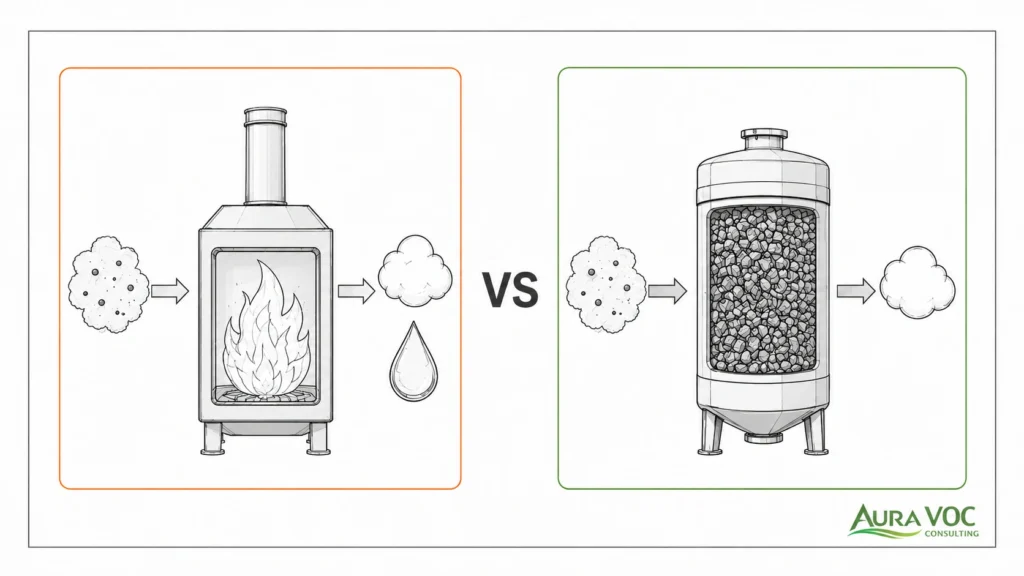
Selecting between a thermal oxidizer and a carbon adsorption system is not a simple comparison of removal efficiency values on equipment datasheets. In industrial VOC control, both technologies can be appropriate, but they behave very differently once connected to a real process exhaust system. The correct selection depends on VOC load profile, solvent composition, exhaust airflow, humidity, temperature, pressure drop tolerance, production schedule, utilities, waste handling capacity, and maintenance resources.
For a coating line, dryer, chemical reactor vent, pharmaceutical solvent exhaust, tank vent, or manufacturing process enclosure, the VOC abatement system becomes part of the production infrastructure. It affects fan operation, startup sequencing, downtime planning, energy consumption, safety controls, stack testing, and, in some cases, wastewater or waste disposal. A system that appears suitable based only on average VOC concentration may become problematic once peak emissions, batch campaigns, moisture, aerosols, or solvent changes are included in the design basis.
Thermal oxidation and carbon adsorption also represent two different control approaches. A thermal oxidizer is normally selected when the operating objective is VOC destruction. Carbon adsorption is normally selected when the objective is VOC capture, with subsequent carbon replacement, regeneration, solvent recovery, or downstream treatment. That distinction affects compliance strategy, operating cost, troubleshooting, and lifecycle management.
For plant managers, EHS managers, and process engineers, the practical question is not which technology is universally better. The relevant question is which system can operate reliably within the plant’s actual operating envelope.
Thermal Oxidizer vs Carbon Adsorption: Selection Depends on VOC Load, Airflow, and Operating Constraints
The comparison between thermal oxidation and carbon adsorption should begin with process data, not equipment preference. VOC abatement systems are often under-specified when the evaluation is based on limited stack data, single-point concentration measurements, or a general assumption about solvent type. In practice, the equipment must handle normal operation, cleaning cycles, batch peaks, startup and shutdown conditions, process upsets, and future production changes.
A thermal oxidizer may be appropriate where VOC mass loading is high enough to support the energy balance, where solvent mixtures are variable, or where the facility needs direct VOC destruction rather than recovery. The same system can become expensive to operate when treating very dilute, high-airflow exhaust with limited heat content. Fuel use, heat recovery performance, burner turndown, purge requirements, and pressure drop through the oxidizer all affect operating cost.
Carbon adsorption may be appropriate for lower concentration streams, intermittent emissions, tank vents, transfer operations, or selected process vents with adsorbable compounds. It can also be used where solvent recovery has value or where a polishing stage is needed downstream of another control step. Adsorption performance, however, is highly dependent on inlet temperature, humidity, solvent chemistry, bed design, residence time, and breakthrough monitoring. A carbon system does not eliminate the VOC load; it transfers it into spent carbon, regeneration gas, solvent condensate, or another treatment route.
Why nominal removal efficiency is not enough for technology selection
Nominal removal efficiency can be misleading if it is separated from the operating conditions used to achieve it. A thermal oxidizer may be capable of high destruction efficiency under proper combustion temperature, residence time, turbulence, and oxygen conditions, but performance can degrade if the unit operates below design temperature, experiences burner instability, suffers heat recovery fouling, or receives highly variable VOC peaks.
Similarly, a carbon adsorption system may show strong removal performance when the carbon is fresh and the inlet stream remains within the assumed design basis. The same bed may break through early if the process exhaust contains higher VOC loading than expected, elevated moisture, high temperature, aerosols, or competing solvent compounds. Removal efficiency at commissioning does not guarantee stable performance over a complete carbon service cycle.
Technology selection should therefore consider failure mode as much as design efficiency. For an oxidizer, failure may involve high fuel consumption, temperature excursions, valve leakage, RTO media fouling, insufficient residence time, or outlet VOC excursions. For a carbon bed, failure may involve early breakthrough, bed channeling, pressure drop increase, desorption during idle periods, or bed temperature rise.
Key plant-level variables: VOC composition, concentration, flow rate, humidity, temperature, and operating schedule
The most important selection variables are usually the ones that describe the exhaust stream under real production conditions. Average concentration alone is rarely enough. A plant should evaluate normal and peak airflow, minimum and maximum VOC concentration, total mass loading, solvent composition, gas temperature, humidity, particulate content, aerosol carryover, oxygen concentration, and operating hours.
VOC composition is especially important. Hydrocarbons, alcohols, ketones, esters, aromatics, chlorinated solvents, and high-boiling compounds do not behave the same way in either technology. In thermal oxidation, some compounds may create corrosion or acid gas control issues after combustion. In carbon adsorption, some compounds adsorb strongly, while others may break through earlier or be displaced by heavier compounds in a mixed solvent stream.
Humidity and temperature can shift the selection significantly. Elevated temperature can reduce carbon working capacity and accelerate breakthrough. Moisture can reduce adsorption performance or create condensation problems in the bed. For an oxidizer, inlet temperature may support energy balance, but corrosive or condensable components can affect materials selection, heat exchanger performance, and downstream treatment needs.
Operating schedule also matters. A continuous coating oven and a batch pharmaceutical line create different abatement demands. Continuous systems may favor stable energy recovery and predictable load. Batch systems require careful evaluation of peak emissions, purge cycles, idle periods, and the system response when production changes from one solvent campaign to another.
Why batch processes, production changes, and peak VOC loads affect system selection
Batch production is often where simplified technology comparisons fail. A VOC stream may appear low-load on a daily average, while short production steps generate high concentration peaks. These peaks can affect both thermal oxidizers and carbon adsorption systems, but in different ways.
For thermal oxidizers, sudden VOC load increases can influence combustion temperature, control response, and safety interlocks. The system must be designed to handle credible peak loading events without exceeding temperature limits or approaching unsafe inlet concentrations. If the exhaust stream varies widely, burner turndown, airflow control, LEL monitoring, bypass logic, and startup sequencing require careful review.
For carbon adsorption systems, peak events can shorten bed life and lead to unexpected breakthrough. A bed sized on average concentration may perform poorly if high-load events occur during charging, mixing, drying, cleaning, solvent transfer, or reactor venting. In mixed solvent applications, heavier compounds may displace lighter compounds, causing earlier outlet detection of specific VOCs even when total carbon capacity has not been fully used.
Production changes are another common issue. A plant may install a system based on one solvent blend, then later change formulations, increase batch size, extend operating hours, or add new process vents. Thermal oxidizers may have some flexibility if the full range of VOC chemistry and loading was considered in the original design. Carbon adsorption systems are often more sensitive to these changes because adsorbent selection, bed sizing, regeneration assumptions, and changeout intervals are tied closely to the original solvent profile.
Destruction vs Capture: The Fundamental Difference
The most important technical distinction between a thermal oxidizer and carbon adsorption is what happens to the VOC mass after treatment. Thermal oxidation is a destruction route. Carbon adsorption is a capture route. This difference affects system operation, maintenance planning, permitting strategy, waste handling, troubleshooting, and long-term cost.
In a thermal oxidizer, VOCs are converted through controlled oxidation. The operating focus is combustion performance: temperature, residence time, mixing, oxygen availability, burner stability, heat recovery, pressure drop, and safety interlocks. If the VOC stream contains halogenated, sulfur-containing, nitrogen-containing, silicon-containing, or corrosive compounds, the review must also include combustion byproducts, downstream scrubbing, corrosion risk, deposits, and materials compatibility.
In a carbon adsorption system, VOCs are removed from the air stream but remain in the system as adsorbed mass. They may leave the site as spent carbon, be recovered through regeneration, enter a solvent-water condensate, or be routed to a downstream treatment step. This is why carbon adsorption should not be evaluated only by initial outlet concentration. The plant also needs a reliable plan for breakthrough monitoring, carbon replacement, regeneration quality, spent media handling, and secondary waste management. EPA guidance on carbon adsorber monitoring identifies outlet VOC concentration, regeneration parameters, and bed activity as key performance indicators.
Thermal oxidation destroys VOCs through high-temperature oxidation
A thermal oxidizer treats VOC-laden exhaust by heating the stream to the required oxidation conditions. Direct-fired, recuperative, regenerative, and catalytic systems each have different operating constraints, but the same basic question applies: can the unit maintain required destruction performance across the actual production envelope? EPA technical guidance describes thermal oxidizers as combustion devices used to control VOC and volatile HAP emissions.
For continuous coating lines or dryers, the oxidizer may operate under relatively stable load. For batch chemical or pharmaceutical operations, the unit may see short VOC peaks, long idle periods, solvent changeovers, and variable flow. These operating conditions affect fuel demand, purge timing, burner turndown, thermal balance, and trip logic.
RTO systems add another layer of practical considerations. Ceramic media condition, valve sealing, purge performance, bed temperature balance, and pressure drop can all influence performance. A unit may still reach nominal temperature while losing efficiency due to valve leakage, fouled media, or poor flow distribution.
Carbon adsorption captures VOCs and transfers them to carbon, condensate, recovery, or disposal
A carbon adsorber removes VOCs by retaining them on activated carbon or another adsorbent. The key operating question is not only whether the bed removes VOCs when fresh, but how long it performs before breakthrough under real process conditions.
Carbon bed performance is affected by solvent chemistry, inlet concentration, peak loading, temperature, humidity, bed depth, gas distribution, and competing compounds. In mixed-solvent streams, heavier or more strongly adsorbed compounds can displace lighter compounds. This can produce compound-specific breakthrough before the total bed capacity appears fully consumed.
For disposable carbon systems, the practical issues are carbon service life, changeout access, spent carbon storage, waste classification, and replacement logistics. For regenerable systems, the practical issues shift toward regeneration completeness, steam or nitrogen demand, solvent recovery quality, condensate separation, and wastewater treatment.
Why destruction efficiency and removal efficiency are not the same operational question
Destruction efficiency and removal efficiency are often compared as if they were equivalent. Operationally, they are not.
A thermal oxidizer’s performance depends on whether the unit maintains oxidation conditions during all relevant operating states: normal production, low-load operation, high-load events, startup, shutdown, and trips. A carbon adsorber’s performance depends on whether the bed maintains capture before breakthrough and whether monitoring detects breakthrough early enough to act.
For plant-level selection, the relevant question is not only “What is the outlet VOC concentration?” The better question is: what operating conditions are required to maintain that outlet concentration, what happens when conditions drift, and what maintenance or waste-handling burden is created?
Thermal Oxidizer vs Carbon Adsorption Comparison Table
A comparison table is useful early in the evaluation because the two technologies have different operating assumptions. Thermal oxidation should be assessed as a combustion-based destruction system. Carbon adsorption should be assessed as a mass transfer and media management system. Both can meet VOC control objectives in the right application, but their operating risks are not the same.
VOC destruction or capture mechanism
| Selection factor | Thermal oxidizer | Carbon adsorption | Engineering implication |
|---|---|---|---|
| VOC control mechanism | Destroys VOCs by oxidation | Captures VOCs on adsorbent media | Oxidation reduces VOC mass in the gas stream; adsorption transfers VOC mass to carbon, condensate, recovery, or disposal |
| Primary design basis | Airflow, VOC heat value, residence time, combustion temperature, heat recovery | Airflow, VOC composition, bed depth, contact time, humidity, breakthrough curve | The oxidizer is sized around combustion and heat balance; carbon is sized around capacity and breakthrough |
| Daily operator focus | Temperature, fuel use, alarms, pressure drop, valve status, LEL readings | Differential pressure, bed temperature, outlet VOC, carbon age, prefilter condition | Different operating checks are required |
| Common cost driver | Fuel during dilute or low-load operation | Carbon replacement, regeneration, fan energy, waste handling | Capital cost alone is a weak selection basis |
| Common downtime driver | Burner faults, valve issues, RTO media fouling, refractory or heat exchanger inspection | Carbon changeout, high pressure drop, breakthrough, regeneration equipment faults | Maintenance access and isolation should be reviewed during design |
| Sensitivity to humidity | Usually indirect through heat load, condensation, or corrosion issues | Often direct through reduced adsorption capacity or condensation | Humid streams may require conditioning before carbon adsorption |
| Sensitivity to mixed solvents | Important for heat release, byproducts, corrosion, and catalyst compatibility | Important for competitive adsorption and compound-specific breakthrough | Multiproduct plants should review each solvent campaign |
| Secondary waste | Usually limited unless scrubber, quench, or condensate handling is required | Spent carbon, regeneration condensate, recovered solvent, or off-site reactivation | Carbon systems require a defined downstream management route |
| Typical troubleshooting focus | Fuel use, temperature control, heat recovery, pressure drop, outlet VOC, valve leakage | Breakthrough, bed condition, humidity, temperature, channeling, pressure drop | Troubleshooting methods are not interchangeable |
Best-fit operating conditions
Thermal oxidizers are often stronger candidates when VOC mass loading is significant, solvent composition varies, or the plant requires VOC destruction rather than recovery. They are also commonly applied where process exhaust comes from coating ovens, dryers, chemical process vents, or solvent-intensive manufacturing steps with continuous or semi-continuous operation.
Carbon adsorption is often a better fit for lower-flow or lower-concentration streams with adsorbable compounds, especially when the gas is cool, relatively dry, and free from significant aerosols or particulate loading. It may also be suitable where emissions are intermittent or where solvent recovery is part of the operating strategy.
The distinction is not absolute. A dilute high-airflow exhaust can be challenging for both technologies. In that situation, the first engineering question may not be “oxidizer or carbon?” but whether the capture system can be improved, airflow can be reduced, sources can be segregated, or a concentrator configuration should be evaluated.
Energy, pressure drop, maintenance, and secondary waste comparison
Energy use in a thermal oxidizer is driven by airflow, inlet temperature, VOC heat content, heat recovery efficiency, and operating schedule. A dilute stream with high airflow can require substantial supplemental fuel, even if the outlet VOC concentration target is achievable. Regenerative thermal oxidizers can reduce fuel demand through heat recovery, but they introduce ceramic media, valve sequencing, purge control, and pressure drop considerations.
Carbon adsorption usually has lower direct thermal energy demand in disposable carbon configurations, but this does not mean low lifecycle cost. Pressure drop through the bed affects fan power and capture performance. Carbon replacement, off-site reactivation, regeneration steam, nitrogen, cooling, condensate handling, and monitoring can become significant cost items. Where steam regeneration is used, wastewater or solvent-water separation may become part of the VOC control system.
Typical failure modes and troubleshooting focus
For thermal oxidizers, troubleshooting often starts with combustion temperature, fuel valve operation, burner tuning, airflow, pressure drop, heat recovery condition, and outlet VOC data. In RTO systems, additional checks include valve leakage, media fouling, bed temperature balance, purge operation, and media condition.
For carbon adsorption, troubleshooting usually starts with inlet loading, breakthrough monitoring, bed temperature, bed pressure drop, prefilter condition, gas distribution, humidity, and carbon service history. Early breakthrough should not be treated only as a carbon replacement issue. It may indicate a process change, underestimated peak loading, moisture carryover, competitive adsorption, bed channeling, or incorrect carbon selection.
VOC Stream Characteristics That Drive Technology Selection
The most reliable technology comparison starts with the exhaust stream itself. Equipment selection based on a single concentration value or a generic solvent category is usually incomplete. The system must be evaluated against the full range of process operation, including startup, shutdown, cleaning, batch peaks, and abnormal but credible loading conditions.
VOC concentration and mass loading
VOC concentration indicates how much contaminant is present in the exhaust, but mass loading determines how much VOC the abatement system must actually handle over time. A low concentration in a very large airflow can represent a substantial total load. A high concentration in a small vent may be easier to manage if the stream is stable and compatible with the selected technology.
For thermal oxidation, VOC mass loading influences energy balance. If the VOCs contribute useful heat value, supplemental fuel demand may be reduced. If the stream is dilute, the oxidizer may spend most of its energy heating excess air. For carbon adsorption, mass loading drives bed life, regeneration frequency, carbon usage, and breakthrough risk.
High airflow and dilute VOC streams
High airflow, low concentration exhaust is one of the most common problem cases in VOC abatement. It can occur when process capture systems collect large volumes of room air, oven ventilation, enclosure exhaust, or multiple low-strength sources combined into one header.
For an oxidizer, high airflow increases equipment size, fan power, heat duty, and stack losses. For carbon adsorption, it increases vessel size, bed area, pressure drop, and carbon inventory. Before selecting either technology, the plant should review whether all collected air actually requires treatment. Source segregation, enclosure improvement, hood balancing, recirculation strategy, or process vent separation can materially change the abatement design basis.
Solvent chemistry and mixed VOC streams
Solvent chemistry strongly affects both technologies. In oxidation systems, chlorinated or sulfur-containing compounds can form acidic products that may require downstream scrubbing and corrosion-resistant materials. Silicon-containing compounds can contribute to deposits. High-boiling compounds, resin components, or condensable organics can create fouling issues in ductwork, heat exchangers, or RTO media.
In carbon adsorption systems, mixed solvents create competitive adsorption. Heavier or more strongly adsorbed compounds can displace lighter compounds, causing earlier breakthrough of specific VOCs. This is relevant in pharmaceutical and specialty chemical plants where solvent campaigns may change by product. A bed that performs well on one solvent blend may not maintain the same service life after formulation or production changes.
Temperature, humidity, and condensation risk
Carbon adsorption is particularly sensitive to inlet temperature and moisture. Higher gas temperature can reduce working capacity and shorten bed life. High humidity may reduce effective adsorption capacity, especially where water competes for adsorption sites or condenses in the bed. Condensation can also increase pressure drop, promote channeling, and damage media performance.
Thermal oxidizers are less limited by humidity from a VOC capture standpoint, but temperature and moisture still affect the design. Moisture increases heat load. Condensable compounds may foul heat exchangers or RTO media if upstream duct temperatures fall below dew point. Where acid gases may form, temperature control and materials selection become important for corrosion management.
Particulates, aerosols, and condensable compounds
Particulate and aerosol carryover should be addressed before either technology is selected. Carbon beds can plug, experience pressure drop increases, or lose effective surface area when exposed to mists, oils, powders, or sticky condensables. Prefiltration may be required, but filters add pressure drop and maintenance tasks.
Thermal oxidizers can also be affected. Particulates and condensables may accumulate in heat exchangers, burners, dampers, or ceramic media. In RTOs, media fouling can increase pressure drop, reduce heat recovery, and create uneven flow distribution. For process exhaust from dryers, coating lines, food manufacturing, or resin-containing operations, upstream conditioning may be as important as the abatement equipment itself.
Batch operation, intermittent emissions, and peak loading events
Batch and intermittent processes require particular attention because average emissions rarely represent design risk. Short peak events can determine LEL strategy, oxidizer temperature control, carbon bed life, and monitoring requirements.
For thermal oxidizers, batch peaks may require conservative design of inlet concentration controls, dilution strategy, burner turndown, and high-temperature interlocks. For carbon adsorption, the same peaks can rapidly consume bed capacity and lead to breakthrough earlier than predicted from daily averages. Idle periods also matter: some adsorbed VOCs can desorb during shutdown or low-flow operation, creating outlet concentration changes that are not visible in simple design calculations.
When a Thermal Oxidizer Is Usually More Suitable
A thermal oxidizer is normally evaluated when the plant requires VOC destruction and the stream can be treated safely and economically by oxidation. It is not automatically the best option, but it can be more practical when carbon handling, breakthrough risk, or solvent recovery is not attractive.
High VOC mass loading or useful VOC heat value
Higher VOC mass loading can improve the thermal balance because the solvent contributes heat during oxidation. This is relevant for coating ovens, dryers, printing lines, and solvent-intensive manufacturing. The review should still include low-load periods, idle exhaust, purge air, burner turndown, and expected production variability. A favorable heat balance at peak load does not guarantee low fuel consumption across the full operating schedule.
Variable solvent mixtures requiring VOC destruction
Thermal oxidation may be more tolerant of changing solvent blends than carbon adsorption, provided the oxidizer is designed for the full range of chemistry and heat release. This can be relevant in multiproduct chemical and pharmaceutical plants. The review should include halogenated compounds, sulfur or nitrogen content, acid gas formation, catalyst compatibility, corrosion risk, and credible maximum inlet concentration.
Processes where carbon breakthrough risk is unacceptable
Carbon adsorption requires confidence in bed life and monitoring. If solvent loading is highly variable, if outlet limits are tight, or if bed service life is uncertain, breakthrough risk may become difficult to manage. In these cases, oxidation may provide a more stable compliance basis, provided fuel use, safety controls, and maintenance requirements are acceptable.
Coating lines, dryers, chemical vents, and pharmaceutical solvent emissions
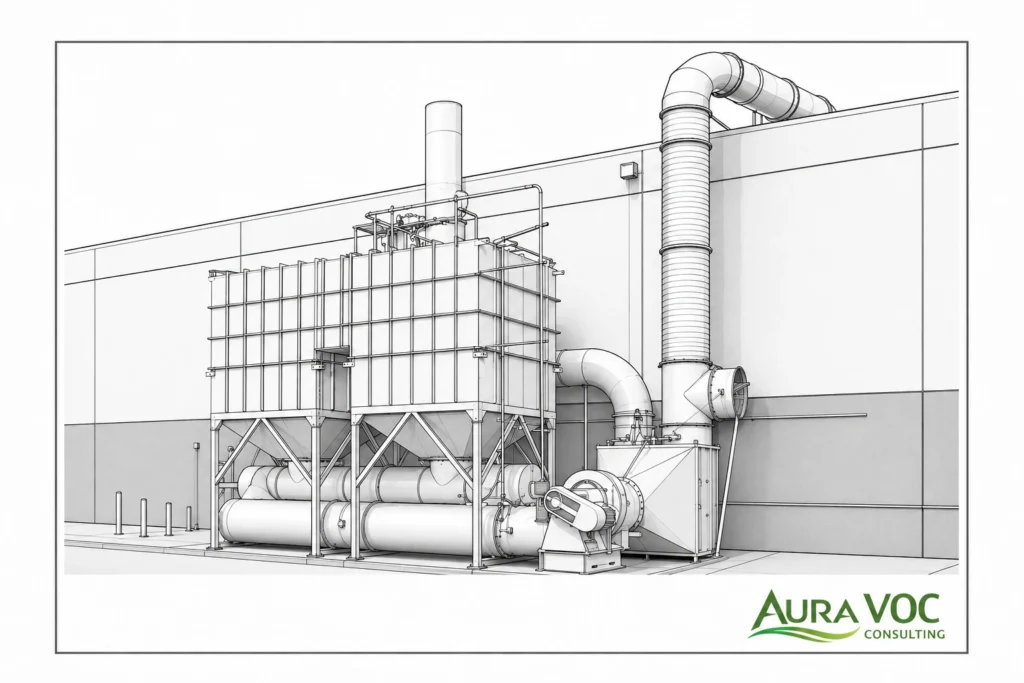
Thermal oxidation is commonly evaluated for coating and paint curing ovens, dryers, reactor vents, solvent cleaning exhaust, and pharmaceutical solvent emissions. These applications often involve sustained VOC loads, elevated exhaust temperatures, or mixed solvent profiles. RTOs are commonly reviewed for larger airflows where heat recovery is important, while recuperative or catalytic oxidizers may be considered where the process stream is compatible.
Cases where spent carbon handling or solvent recovery is impractical
Carbon adsorption becomes less attractive when carbon changeout is frequent, access is difficult, spent carbon classification is complex, or solvent recovery produces a low-value or difficult-to-separate mixture. In those cases, the apparent simplicity of carbon vessels can be offset by recurring logistics and waste-management work.
When Carbon Adsorption Is Usually More Suitable
Carbon adsorption is normally evaluated when the VOC stream is compatible with the adsorbent and the plant can manage breakthrough monitoring, carbon service life, and secondary handling. It can be effective in the right operating envelope, but it should not be treated as a generic low-cost substitute for oxidation.
Low to moderate VOC concentrations with adsorbable compounds
Carbon adsorption is often practical for low to moderate VOC concentrations where the compounds have suitable adsorption behavior and the expected bed life is acceptable. The design should be based on the actual solvent blend, including minor components that may break through early or affect bed performance.
Cool and relatively dry gas streams
Cool, dry exhaust is generally more favorable for activated carbon. Elevated temperature reduces working capacity. High humidity can reduce available capacity or create condensation problems. If the stream contains moisture, mists, or condensables, the need for cooling, demisting, drainage, or prefiltration should be reviewed before selecting the bed.
Intermittent or low-flow VOC sources
Carbon adsorption can be suitable for tank vents, transfer operations, pilot production vents, laboratory-scale process exhaust, or intermittent low-flow sources. The plant should still check short-duration peak emissions, breathing losses, solvent changeovers, and desorption during idle periods.
Solvent recovery or polishing applications
Regenerable carbon systems may be considered where solvent recovery has practical value. The review should include recovered solvent purity, water content, phase separation, regeneration utility demand, and condensate treatment. Carbon can also be used as a polishing stage after condensation, scrubbing, or another control device, but the bed still requires monitoring because breakthrough may occur gradually.
Tank vents, transfer operations, and selected pharmaceutical or chemical process vents
Carbon adsorption is often reviewed for tank breathing vents, loading operations, solvent storage, and selected pharmaceutical or chemical process vents. In multiproduct plants, one carbon service-life estimate is rarely sufficient. The limiting case may be the most weakly adsorbed compound, the highest humidity campaign, or the shortest high-load emission event.
Energy Consumption and Operating Cost
Energy and operating cost comparisons are often simplified too early. Thermal oxidizers and carbon adsorption systems carry different cost structures, and the difference may only become visible after including operating schedule, dirty pressure drop, carbon life, maintenance access, and secondary waste management.
Thermal oxidizer fuel demand and heat recovery performance
Thermal oxidizer operating cost is driven by more than the specified destruction efficiency. Airflow, VOC heat content, inlet temperature, heat recovery, operating hours, purge cycles, and low-load operation all affect fuel use.
Dilute high-airflow streams are often the most expensive cases because the oxidizer spends energy heating a large volume of air with limited VOC heat contribution. This can occur when production exhaust is heavily diluted by room air, oven ventilation, enclosure exhaust, or combined low-strength sources.
Heat recovery condition also matters. A recuperative oxidizer with fouled or corroded heat exchanger surfaces can lose efficiency over time. An RTO with fouled ceramic media, valve leakage, or poor bed balance may consume more fuel even if the combustion chamber temperature appears acceptable. Air leakage into ductwork can also increase the volume of air heated by the system without increasing VOC load.
RTO energy implications for dilute high-airflow streams
RTOs are often considered for larger airflows because regenerative heat recovery can reduce supplemental fuel demand. The benefit depends on steady operation, balanced flow, clean media, reliable switching valves, and appropriate purge control.
For batch or intermittent processes, RTO energy performance can be less favorable than expected if the unit remains hot during long idle periods or cycles through frequent startup and purge sequences. Low VOC loading, excessive dilution, or frequent bypass or trip events can also increase actual fuel consumption relative to design expectations.
A proper RTO operating-cost review should include normal production, minimum load, idle operation, startup frequency, purge requirements, expected pressure drop, and maintenance condition of the media and valves.
Carbon adsorption fan energy, regeneration energy, and carbon replacement cost
Carbon adsorption usually has lower direct fuel demand than thermal oxidation, but total operating cost can still be significant. Costs appear through fan energy, carbon replacement, off-site reactivation, spent carbon handling, regeneration utilities, condensate treatment, labor, and downtime.
Short carbon life is one of the most common cost surprises. It can result from underestimated peak loading, high humidity, elevated temperature, mixed solvent displacement, or aerosol carryover. A bed that appears cost-effective on average concentration may require frequent changeout once actual batch peaks are included.
For regenerable systems, operating cost shifts toward steam, nitrogen, hot gas, vacuum, cooling water, solvent recovery, and condensate handling. Steam-regenerated carbon adsorption can also create a wastewater or solvent-water separation issue that must be included in the lifecycle review.
Why lifecycle cost should include utilities, downtime, monitoring, and waste handling
A useful cost comparison includes both steady operating costs and maintenance-related costs. For thermal oxidation, this means fuel, electrical load, burner service, valve maintenance, refractory or media inspection, instrumentation, and stack testing support. For carbon adsorption, it means pressure drop, carbon usage, changeout labor, regeneration utilities, sampling, spent carbon storage, and waste or condensate handling.
For many plants, the economic difference becomes visible only after including dirty-system pressure drop, idle operation, campaign changes, and maintenance downtime. Capital cost alone is rarely a reliable basis for choosing between a thermal oxidizer and activated carbon for VOC control.
Pressure Drop and Fan System Impact
Pressure drop should be reviewed as a process ventilation issue, not only as an abatement equipment specification. Added resistance can affect capture velocity, dryer balance, hood performance, enclosure containment, and fan power.
Carbon bed pressure drop, bed fouling, and fan margin
A carbon adsorber adds resistance through prefilters, distributors, the carbon bed, vessel internals, dampers, and associated ductwork. Clean pressure drop is only the starting point. Over time, particulate loading, aerosols, condensate, carbon fines, and bed compaction can increase resistance.
The fan must be checked against the expected dirty pressure drop, not just the commissioning condition. If the system has limited fan margin, airflow may fall as the bed loads. Reduced airflow can lower capture velocity at hoods, reduce enclosure containment, affect oven balance, or change process vent performance.
RTO media pressure drop and fouling over time
RTO ceramic media pressure drop can increase when the exhaust contains particulates, resinous material, condensables, inorganic salts, or process carryover. Fouling may reduce heat recovery, increase fan load, and create uneven flow distribution through the beds.
A gradual increase in RTO pressure drop is often treated as a fan problem, but the root cause may be upstream. Duct temperature, condensation, particulate capture, process carryover, and media condition should be reviewed together.
Impact of added pressure drop on capture velocity and process exhaust performance
VOC abatement equipment is part of the process ventilation system. Added pressure drop can shift the fan operating point and reduce the actual airflow pulled from hoods, enclosures, dryers, or process vents.
This can create plant-level issues that are not visible from the abatement equipment panel. Operators may see increased solvent odor near equipment, poor hood capture, oven imbalance, door leakage, or process-area VOC readings. These symptoms can appear even when the oxidizer or carbon vessel is operating as designed.
Why existing fans should be checked before adding abatement equipment
Before installing either technology, the existing fan curve, motor capacity, duct losses, damper positions, filter loading, and required capture airflow should be reviewed. The assessment should include clean and dirty pressure drop cases.
If the existing fan cannot maintain required airflow, the plant may need fan replacement, variable frequency drive review, duct modifications, source segregation, or reduced system resistance. Ignoring this step can result in an abatement system that meets outlet requirements during testing but weakens source capture during routine operation.
Maintenance Requirements and Common Failure Modes
Maintenance requirements differ substantially between thermal oxidation and carbon adsorption. A plant should compare not only the expected maintenance frequency but also the type of skill, access, downtime, instrumentation, and spare parts required.
Thermal oxidizer maintenance: burners, valves, dampers, refractory, heat exchangers, media, and controls
Thermal oxidizer maintenance should be planned around combustion reliability, heat recovery, pressure drop, and safety controls. Typical tasks include burner inspection and tuning, flame safety checks, combustion air fan maintenance, actuator and damper inspection, refractory inspection, heat exchanger review, instrumentation calibration, and LEL monitor checks.
RTOs add maintenance requirements for switching valves, valve seals, ceramic media, purge systems, and bed temperature balance. Valve leakage can reduce destruction performance or increase fuel use. Media fouling can increase pressure drop and reduce heat recovery. Uneven bed temperatures may indicate flow distribution problems, fouling, or control issues.
Catalytic oxidizers require additional attention to catalyst poisoning, masking, plugging, and temperature control. Solvent changes, silicon compounds, metals, phosphorus, sulfur, or particulate carryover can affect catalyst performance.
Carbon adsorption maintenance: carbon replacement, prefilters, bed condition, breakthrough monitoring, and regeneration equipment
Carbon adsorption maintenance depends on bed condition and breakthrough control. The plant should track carbon age, operating hours, inlet loading, differential pressure, outlet VOC readings, bed temperature, and prefilter condition.
Prefilters are not a minor accessory. If particulates, aerosols, or mists reach the bed, pressure drop can rise and effective adsorption capacity can fall. Poor gas distribution can produce channeling, allowing part of the flow to bypass the active bed depth.
Regenerable systems require additional maintenance for steam valves, nitrogen systems, heaters, vacuum equipment, condensers, phase separators, pumps, and condensate handling equipment. Incomplete regeneration may reduce working capacity from one cycle to the next, shortening the time to breakthrough.
Maintenance access, downtime planning, and spare parts considerations
Maintenance access should be treated as a design constraint. Carbon vessels need space for carbon changeout, safe handling of spent media, dust control, lifting or vacuum equipment, and isolation from the operating process. Oxidizers need safe access to burners, fans, valves, dampers, media chambers, platforms, sampling ports, and stack test locations.
Plants should also review spare parts with realistic failure modes in mind. For oxidizers, critical items may include flame rods, igniters, actuators, valve seals, thermocouples, pressure transmitters, and burner components. For carbon systems, they may include prefilters, carbon inventory, sampling hardware, temperature probes, gaskets, valves, and regeneration components.
Instrument calibration and performance monitoring requirements
Poor instrumentation can mislead troubleshooting. Temperature sensors, pressure transmitters, VOC analyzers, LEL monitors, differential pressure gauges, flow instruments, and bed temperature probes should be calibrated and checked against operating history.
For carbon systems, outlet monitoring should be located and specified to detect meaningful breakthrough, not only average total VOC. For oxidizers, temperature readings should represent the actual control point and be reviewed with flow, fuel use, and production events.
Troubleshooting Thermal Oxidizer and Carbon Adsorption Problems
Troubleshooting should be based on operating data and process conditions, not only alarm history. In many cases, the abatement device is responding to a change upstream: altered solvent blend, increased airflow, new production schedule, added process vent, mist carryover, or poor capture balance.
High outlet VOC concentration from a thermal oxidizer
High outlet VOC from a thermal oxidizer should be investigated in a structured sequence. First confirm the inlet VOC load, airflow, and production condition during the excursion. Then check combustion chamber temperature, burner operation, fuel valve position, airflow, pressure drop, and residence time assumptions.
For RTOs, valve leakage, poor purge performance, media fouling, and uneven bed temperatures should be reviewed. For catalytic oxidizers, catalyst deactivation, masking, or temperature below the required operating range may be the cause. Sampling error should also be considered, especially if outlet readings do not correspond with operating data.
Rising thermal oxidizer fuel consumption
Rising fuel consumption can indicate reduced heat recovery, excess airflow, air leakage, lower VOC heat content, burner tuning issues, valve leakage, RTO media fouling, or extended low-load operation.
A practical review should compare fuel use against production rate, inlet VOC load, airflow, stack temperature, bed temperatures, and pressure drop. If fuel use increased after a process or ventilation change, the oxidizer may be treating more dilution air rather than more VOC mass.
RTO pressure drop increase or media fouling
Increasing RTO pressure drop often points to fouled ceramic media, particulate carryover, condensables, resin buildup, inorganic deposits, or duct condensation upstream of the unit. The plant should check whether pressure drop increases correlate with specific products, campaigns, cleaning cycles, or seasonal moisture changes.
Corrective action may require more than media cleaning. It may involve upstream filtration, demisting, duct insulation, source segregation, process exhaust temperature control, or changes to capture points that are pulling in particulate or aerosol sources.
Early breakthrough in carbon adsorption systems
Early breakthrough should not be treated only as a carbon replacement issue. The first checks should be inlet VOC concentration, peak events, solvent composition, humidity, temperature, bed pressure drop, gas distribution, and carbon service history.
In mixed-solvent streams, early breakthrough may be compound-specific. A weakly adsorbed solvent may appear at the outlet while other compounds remain retained. If the plant recently changed formulations, batch size, cleaning solvents, or operating hours, the original carbon service-life estimate may no longer apply.
Carbon bed temperature rise, channeling, or desorption during downtime
Carbon bed temperature rise can occur due to exothermic adsorption, high inlet loading, reactive compounds, or poor heat dissipation. Temperature monitoring should be installed where it can detect bed heating before it becomes a fire-risk condition.
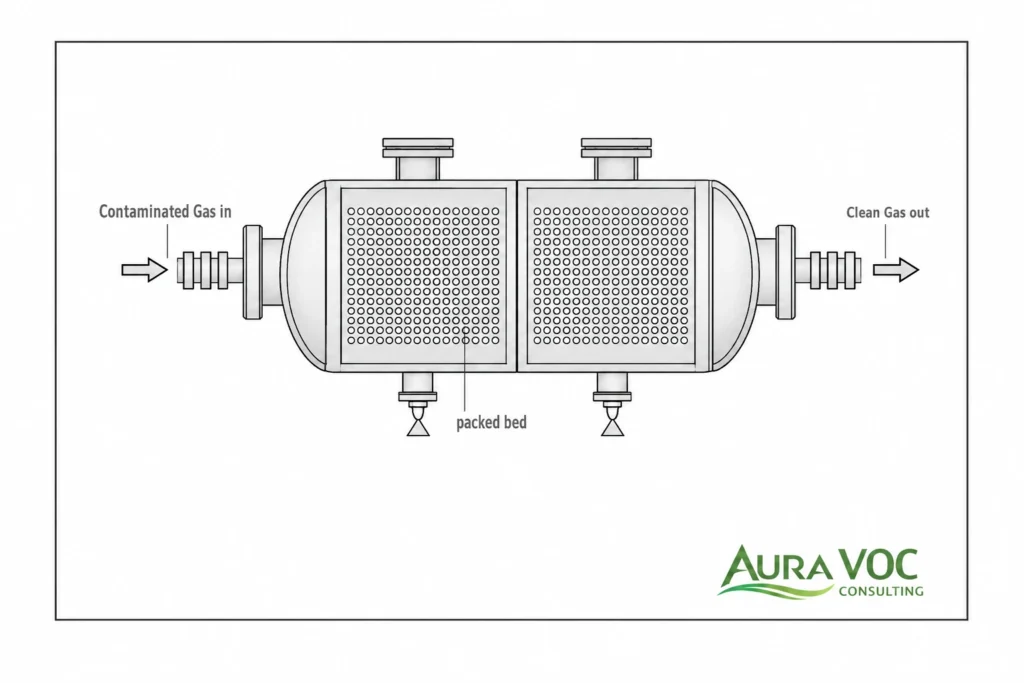
Channeling can occur from poor distribution, bed settling, improper filling, liquid carryover, or carbon compaction. Desorption during downtime can produce unexpected outlet VOC readings when flow is low or when the bed warms after shutdown. These issues are common in intermittent operations and should be considered during troubleshooting.
High pressure drop across carbon beds
High pressure drop across a carbon bed may be caused by fouled prefilters, particulate loading, carbon fines, condensate, aerosol carryover, bed compaction, or damaged internals. The impact should be checked at the fan operating point and capture source.
If pressure drop rises repeatedly after carbon replacement, the root cause is likely upstream. Mist eliminators, filtration, duct drainage, temperature control, or process carryover should be reviewed before another bed is loaded.
Wastewater and Secondary Waste Implications
Wastewater and secondary waste are often underestimated during early technology screening. Thermal oxidation and carbon adsorption can both create downstream handling requirements depending on VOC chemistry and system configuration.
When thermal oxidizers may require scrubbers or quench systems
A thermal oxidizer does not normally produce wastewater by itself. Wastewater becomes relevant when the system includes a quench, wet scrubber, or acid gas control stage. This is common where VOCs can form corrosive combustion products.
A scrubber adds chemical dosing, blowdown, pH control, solids or salts management, corrosion-resistant materials, and additional pressure drop. These items should be included in the technology comparison, especially for chlorinated or sulfur-containing solvents.
Acid gas control for halogenated or acid-forming VOCs
Halogenated VOCs can form acidic combustion products that may require downstream treatment. The review should include expected acid gas load, scrubber chemistry, chloride or fluoride concentration, blowdown rate, materials compatibility, and wastewater treatment capacity.
If these issues are ignored during selection, the plant may solve the VOC emission problem but create a corrosion or wastewater bottleneck.
Spent carbon handling and disposal
Disposable carbon systems create a spent solid waste stream. The plant should define how spent carbon will be removed, stored, transported, classified, and replaced. These activities can affect downtime, housekeeping, operator exposure, and waste documentation.
Carbon changeout frequency is also a practical constraint. A system requiring very frequent changeout may be difficult to operate reliably, even if the equipment itself is simple.
Steam regeneration condensate and solvent-water separation
Steam-regenerated carbon systems can generate VOC-laden condensate. Depending on the solvent mixture, this condensate may separate into organic and aqueous phases, form emulsions, or contain dissolved organics that require treatment.
The plant should evaluate whether recovered solvent has reuse value, whether the condensate can be treated on site, and whether off-site disposal is required. Biological treatment compatibility should not be assumed for solvent-rich condensates.
Why carbon adsorption can shift VOC management from air emissions to waste or wastewater
Carbon adsorption can reduce outlet VOC concentration, but the VOC mass still requires management. Depending on the configuration, the mass leaves as spent carbon, regeneration condensate, recovered solvent, or a concentrated gas stream.
This transfer is acceptable when the downstream route is technically and economically manageable. It becomes a problem when waste classification, condensate treatment, recovery quality, or carbon changeout logistics were not included in the selection stage.
Safety and Process Risk Considerations
Safety review should be tied to actual operating conditions, not only equipment type. VOC concentration peaks, solvent compatibility, ignition sources, temperature rise, pressure drop, and bypass conditions can all affect operating risk.
LEL monitoring and high VOC concentration events
LEL review should be based on credible peak events, not daily averages. OSHA ventilation guidance includes LEL considerations for solvent vapors in industrial exhaust design. Charging, cleaning, solvent transfer, oven startup, reactor venting, or batch drying can create short-duration high concentrations.
Both oxidizers and carbon adsorption systems may require inlet concentration monitoring, dilution control, interlocks, alarms, or defined shutdown procedures. Sampling location and response time are important because a delayed signal may not protect against fast peak events.
Thermal oxidizer purge cycles, burner management, and bypass logic
Thermal oxidizers require controlled startup, purge, ignition, flame supervision, temperature control, and trip logic. Operators should understand what happens during a failed ignition, high-temperature alarm, fan trip, or LEL alarm.
Bypass logic should be reviewed carefully. A bypass may protect equipment during an upset, but it may also create an uncontrolled emission route. The plant should define when bypass is allowed, how it is recorded, and how production responds.
Carbon bed fire risk and exothermic adsorption
Carbon beds can heat during adsorption, especially under high VOC loading or with reactive compounds. Deep beds, poor heat removal, inadequate temperature monitoring, and incompatible solvent mixtures can increase risk.
Bed temperature monitoring should be included where applicable. Reactive, polymerizable, or oxidation-prone compounds should be reviewed with the adsorbent supplier before assuming standard activated carbon is suitable.
Reactive VOCs, polymerizable compounds, and incompatible solvent mixtures
Some VOCs can polymerize, oxidize, or react on adsorbent surfaces. Monomers, aldehydes, ketones, and certain specialty chemicals may create fouling, heat generation, or loss of capacity. Oils, plasticizers, resin components, and high-boiling compounds can also reduce bed effectiveness.
For oxidizers, these same compounds may create deposits, catalyst masking, heat exchanger fouling, or RTO media plugging. Compatibility should be evaluated at the process-stream level, not by broad solvent category alone.
Safe operation during startup, shutdown, and process upset conditions
Startup and shutdown are often more difficult than steady operation. Oxidizers require purge and temperature conditions before accepting process exhaust. Carbon beds may experience desorption, condensation, or low-flow distribution problems during idle periods.
Procedures should address restart after trip, low-flow operation, bypass events, production hold points, condensate drainage, and abnormal solvent releases. These operating modes should be included in the selection review because they often define the real risk profile.
Hybrid VOC Abatement Configurations
Thermal oxidation and carbon adsorption are not always mutually exclusive. Hybrid systems can be appropriate when the plant needs to manage high airflow, low concentration, acid-forming compounds, polishing requirements, or solvent recovery objectives.
Carbon or zeolite concentrator followed by thermal oxidation
A concentrator can reduce the airflow sent to an oxidizer by transferring VOCs from a large dilute stream into a smaller, more concentrated stream. This can improve the energy balance for high-airflow, low-concentration VOC treatment.
Suitability depends on solvent chemistry, humidity, particulates, desorption temperature, media compatibility, and fouling risk. Concentrators are not a generic fix for every dilute stream; they require the same level of process-stream review as the primary abatement equipment.
Carbon adsorption as a polishing stage
Carbon adsorption may be used downstream of condensation, scrubbing, or another primary control device to polish residual VOCs. This can be effective when inlet loading is low and predictable. The bed still needs outlet monitoring and changeout criteria because polishing service can hide gradual capacity loss until breakthrough occurs.
Thermal oxidizer with downstream scrubber
An oxidizer followed by a scrubber may be required for acid-forming VOCs. This configuration combines combustion reliability requirements with scrubber operation, chemical dosing, blowdown management, corrosion control, and additional pressure drop.
The scrubber also changes the utility and maintenance profile of the system. Pumps, recirculation lines, mist eliminators, pH control, chemical storage, blowdown handling, and corrosion-resistant materials become part of the VOC abatement package.
When source segregation or airflow reduction should be evaluated before equipment selection
Before committing to oxidation, adsorption, or a hybrid system, the plant should review whether high-volume clean air can be separated from VOC-rich sources. Reducing unnecessary airflow can lower oxidizer fuel use, carbon vessel size, fan power, and pressure drop.
In many projects, improving capture and segregation changes the technology comparison more than selecting a different abatement unit. Source-level review is especially important for coating lines, dryers, room exhaust systems, and plants where multiple low-strength vents have been combined into one large header.
Engineering Data Required Before Selecting a VOC Abatement System
A reliable comparison requires a defensible design basis. Where an existing system is operating, field measurements should be used where possible. Where the system is being specified for a new process, design assumptions should be conservative enough to cover peak loading, solvent changes, and expected production growth.
Normal and peak airflow
Design airflow should include normal production, maximum exhaust, purge flow, cleaning cycles, startup, shutdown, and credible upset cases. Field measurements are preferable where existing systems are available.
The airflow value should also be tied to source capture requirements. Treating less air may reduce abatement cost, but the system must still maintain capture at hoods, enclosures, ovens, dryers, and process vents.
VOC concentration range and mass loading
The design should use concentration profiles and mass loading, not a single average concentration. Short-duration peaks may determine LEL controls, carbon bed life, and oxidizer temperature response.
Mass loading should be reviewed for both normal operation and peak campaigns. For carbon adsorption, this affects breakthrough and carbon service life. For oxidation, it affects heat release, fuel demand, and thermal control.
VOC composition and solvent blend variability
Each solvent blend should be reviewed for adsorption behavior, oxidation byproducts, heat value, corrosion potential, catalyst compatibility, and expected campaign changes.
In multiproduct plants, the design basis should include the most challenging solvent blend, not only the most common one. A minor solvent in the formulation may control breakthrough, acid gas formation, or catalyst compatibility.
Temperature, humidity, oxygen content, and LEL data
These values affect adsorption capacity, condensation risk, combustion safety, purge strategy, and instrumentation. Humidity and temperature are especially important for carbon adsorption.
LEL data should consider credible peak concentration events. If process concentration varies quickly, the monitoring method and response time become part of the safety design.
Operating schedule, batch cycle, and peak emission events
Operating schedule determines whether the system sees stable continuous load, intermittent operation, frequent idle periods, or short high-load peaks. Batch timing should be reviewed against abatement system response.
For batch operations, the highest-risk period may be a short process step rather than the full batch average. Cleaning, charging, transfer, drying, solvent addition, and reactor venting should be reviewed separately where relevant.
Existing fan capacity and duct system pressure drop
The fan system should be checked against clean and dirty equipment pressure drop. The goal is not only to move air through the abatement device, but to maintain required capture at the source.
Fan curve review should include duct losses, damper position, filter loading, equipment fouling, stack resistance, and future expansion where known.
Available utilities: gas, steam, electricity, nitrogen, compressed air, cooling water
Utility availability may determine whether a recuperative oxidizer, RTO, disposable carbon system, steam-regenerated carbon system, or hybrid arrangement is practical.
The review should include not only whether a utility exists, but whether it has enough capacity during production peaks. Steam, cooling water, nitrogen, and electrical capacity can become limiting factors for regenerable adsorption systems and hybrid configurations.
Wastewater treatment capacity and spent carbon handling constraints
Wastewater and waste handling should be reviewed before equipment selection. Scrubber blowdown, regeneration condensate, solvent-water separation, spent carbon storage, and off-site disposal can affect feasibility.
A plant with limited wastewater treatment capacity may prefer a configuration that avoids condensate or scrubber blowdown. A plant with limited maintenance access may struggle with frequent carbon changeout. These constraints should influence selection early.
Required emission limits, monitoring approach, and stack testing requirements
The selected system should support the required monitoring and compliance demonstration. Sampling points, access platforms, representative flow conditions, and operating records should be considered during design.
Stack testing should be evaluated against actual production conditions. A system that passes during stable operation may still require operating controls to manage peaks, bypass events, carbon breakthrough, or oxidizer temperature excursions.
Technology Selection Checklist for Plant Managers, EHS Managers, and Process Engineers
The final selection should be based on how the system will operate at the site, not only on vendor equipment descriptions. The following questions help identify whether further engineering review is needed before specifying equipment.
Questions to ask before choosing thermal oxidation
Can the oxidizer handle the minimum and maximum VOC load? Is the stream dilute enough to create high fuel demand? Are halogenated or acid-forming compounds present? Is there enough fan margin? Can the plant maintain burners, valves, heat recovery equipment, media, instrumentation, and safety systems?
The review should also address startup, shutdown, bypass logic, LEL monitoring, pressure drop, stack testing, and whether production can continue during oxidizer maintenance or trip conditions.
Questions to ask before choosing carbon adsorption
Is the stream cool, dry, and free of mists or particulates? Are the compounds strongly adsorbed? What is the expected breakthrough profile? How will bed temperature be monitored? Can the plant manage carbon replacement, regeneration, condensate, spent media, and sampling?
For multiproduct or batch operations, carbon adsorption should be checked against each relevant solvent campaign. A carbon bed sized for one solvent blend may not provide the same service life after a formulation or cleaning solvent change.
Questions to ask before considering a hybrid system
Can the source airflow be reduced first? Is the VOC stream compatible with concentrator media? Will humidity, aerosols, or solvent variability create fouling or desorption problems? Does the concentrated stream match the downstream oxidizer or recovery system?
Hybrid systems can improve feasibility in some dilute high-airflow applications, but they add controls, maintenance, and compatibility questions. The plant should understand how each stage behaves during startup, shutdown, upset, and low-load operation.
Red flags that require deeper process review before equipment specification
Red flags include unknown solvent variability, missing peak concentration data, high humidity, condensables, aerosols, reactive compounds, poor fan margin, frequent process changes, unclear waste handling, missing LEL data, or no defined monitoring strategy.
Any one of these issues can affect technology selection. Several combined issues usually indicate that a simple equipment comparison is not sufficient.
FAQ: Thermal Oxidizer vs Carbon Adsorption
Is a thermal oxidizer better than carbon adsorption for VOC control?
Not in every case. A thermal oxidizer is usually better suited when the plant needs VOC destruction and the stream is compatible with oxidation. Carbon adsorption may be more suitable when VOC capture, recovery, or polishing is practical and breakthrough can be managed reliably.
Which option has lower operating cost?
The lower-cost option depends on airflow, VOC loading, operating hours, utilities, pressure drop, carbon life, maintenance, and waste handling. Oxidizers can have high fuel demand on dilute streams. Carbon systems can become costly when carbon replacement is frequent or regeneration creates condensate handling requirements.
Does carbon adsorption destroy VOCs?
No. Carbon adsorption captures VOCs on the adsorbent. The VOC mass must later be managed through carbon replacement, off-site reactivation, regeneration, solvent recovery, condensate treatment, or downstream destruction.
What causes early breakthrough in a carbon adsorption system?
Early breakthrough can result from higher inlet loading, high humidity, elevated temperature, bed channeling, poor gas distribution, inadequate bed depth, competitive adsorption, or a solvent change not reflected in the original design.
When does a thermal oxidizer become expensive to operate?
A thermal oxidizer becomes expensive when airflow is high, VOC concentration is low, heat recovery is poor, air leakage is significant, or the unit operates long hours during low-load or idle conditions.
How does pressure drop affect VOC capture performance?
Added pressure drop can reduce exhaust airflow if the fan lacks margin. This can lower hood capture velocity, affect enclosure performance, change oven balance, or reduce process vent flow.
Does carbon adsorption create wastewater?
Disposable carbon does not normally create wastewater directly. Steam-regenerated systems can produce VOC-laden condensate that may require phase separation, treatment, recovery, or off-site disposal.
Does thermal oxidation require a scrubber?
A scrubber may be required if the VOCs form acidic or corrosive combustion products, such as in some halogenated or sulfur-containing streams. The scrubber adds pressure drop, chemical use, blowdown, and wastewater considerations.
Can carbon beds catch fire when treating VOC emissions?
Yes, under certain conditions. High VOC loading, reactive compounds, exothermic adsorption, poor heat dissipation, or inadequate temperature monitoring can create bed heating risk.
Which technology is better for batch pharmaceutical production?
The decision depends on solvent campaigns, peak emissions, humidity, recovery objectives, LEL controls, waste handling, and batch timing. Batch averages are not enough; short peak events often define the design basis.
Can an existing exhaust fan be reused with either system?
Only if the fan can maintain required airflow with the added clean and dirty pressure drop of the abatement equipment. Fan curve review is usually needed before assuming reuse is practical.
What data is needed before comparing thermal oxidation and carbon adsorption?
The main data are airflow, VOC concentration profile, VOC composition, mass loading, temperature, humidity, oxygen content, LEL data, operating schedule, pressure drop, utilities, maintenance constraints, and waste-handling route.
Conclusion: Select the VOC Abatement Technology Based on Operating Envelope, Not Equipment Category
Thermal oxidizers and carbon adsorption systems should not be compared only by nameplate efficiency or initial equipment cost. They control VOCs through different mechanisms, create different operating burdens, and fail in different ways. The correct selection depends on the full operating envelope of the process.
Why process data should drive technology selection
Thermal oxidizers and carbon adsorption systems are not interchangeable devices with different names. The selection should be based on measured or defensible process data, including normal load, peak events, batch changes, solvent variability, temperature, humidity, fan capacity, and maintenance constraints.
A coating oven, a pharmaceutical batch vent, a solvent tank vent, and a chemical reactor exhaust may all involve VOCs, but their abatement requirements can be very different. The system must be selected around the actual source behavior.
When to evaluate lifecycle cost, pressure drop, waste handling, and troubleshooting risk
A credible comparison includes the full operating envelope. For thermal oxidation, that means fuel demand, heat recovery, purge requirements, pressure drop, burner reliability, valve condition, and possible downstream treatment. For carbon adsorption, it means carbon life, breakthrough monitoring, bed temperature, pressure drop, regeneration, spent carbon, and condensate or recovery management.
The best-fit technology is the one that can maintain required performance without creating avoidable production, maintenance, safety, or waste-handling problems.
Next step: technical review of VOC stream data
For plants comparing thermal oxidation, carbon adsorption, or hybrid VOC abatement configurations, the next practical step is a review of the actual VOC stream data and operating conditions. AuraVOC can assess measured exhaust data, solvent campaigns, fan capacity, pressure drop margin, utility availability, maintenance constraints, and waste-handling routes before equipment selection or system modification.