
IED Permit VOC Abatement Technology Selection for Industrial Plants
Selecting VOC abatement technology for an IED permit is not only a question of meeting a stack emission limit. In industrial plants, the more difficult task is defining a treatment system that can operate reliably across the actual production range: solvent changes, batch peaks, cleaning cycles, ventilation constraints, pressure drop, maintenance windows, utility availability, and wastewater capacity.
For plant managers, EHS managers, and process engineers, the technology selection stage is where many future operating problems are either prevented or built into the permit basis. A regenerative thermal oxidizer, catalytic oxidizer, activated carbon system, condenser, wet scrubber, biofilter, or hybrid arrangement can all be technically valid under the right conditions. The risk comes from selecting the technology before the VOC emission profile, process constraints, and operating modes are understood in sufficient detail.
An IED permit application should therefore treat VOC abatement selection as an engineering decision supported by process data. The selected system has to match the actual VOC mass load, gas flow, solvent composition, temperature, humidity, safety constraints, secondary waste streams, monitoring requirements, and maintenance capability of the site. If these factors are simplified too early, the plant may later face high energy use, unstable capture, premature breakthrough, corrosion, unreliable monitoring, or repeated corrective maintenance.
The purpose of this article is to structure VOC abatement technology selection from an industrial operating perspective. The focus is on how abatement systems behave in real plants, what data should be defined before equipment selection, and which engineering tradeoffs should be visible before the IED permit design basis is finalized.
Why VOC Abatement Selection Can Create IED Permit Risk
VOC abatement becomes a permit risk when the system described in the application does not reflect how the plant actually operates. This can happen when the design is based on average emissions, when batch operations are treated as steady-state conditions, or when pressure drop, fuel demand, wastewater load, and maintenance downtime are not considered early enough.
A permit may define emission limits, monitoring requirements, operating parameters, and assumptions about treatment performance. If these commitments are based on incomplete process data, the plant can end up with conditions that are difficult to maintain during normal production. The issue is not only compliance. Poorly matched abatement technology can also affect ventilation stability, production availability, energy consumption, operator workload, and maintenance planning.
Permit commitments must reflect the real operating envelope
The operating envelope of a VOC abatement system should include more than nominal flow and average concentration. It should describe the range of conditions expected during normal production, campaign changes, cleaning, start-up, shutdown, and foreseeable abnormal operation.
For an oxidizer, this means understanding whether the VOC load is sufficient to support stable thermal operation or whether auxiliary fuel demand will dominate. For activated carbon, it means knowing whether humidity, solvent mix, or concentration peaks will shorten bed life or increase fire risk. For a scrubber, it means checking whether absorption is technically meaningful for the VOC species present and whether the resulting blowdown can be handled by the wastewater system.
Permit commitments become problematic when they assume a constant inlet condition that the plant does not actually have. A pharmaceutical batch process, a coating line, a chemical reactor vent header, or a solvent tank farm may all generate highly variable emissions. If the permit design basis does not reflect this variability, the abatement unit may be correctly sized on paper but unstable in operation.
VOC load, flowrate, and solvent variability drive technology selection
VOC concentration alone is not enough to select abatement technology. The mass load, flowrate, and solvent composition normally drive the engineering decision.
A high-flow, low-concentration exhaust stream creates different constraints from a low-flow, high-concentration solvent vent. The first may lead to large equipment, high fan power, and significant heating demand if thermal treatment is selected. The second may raise LEL management, condensation, recovery, or dilution questions. In both cases, the same outlet emission target can lead to very different technology choices.
Solvent variability also matters. Alcohols, ketones, aromatics, chlorinated solvents, sulfur-containing compounds, nitrogen-containing compounds, and high-boiling organics do not behave the same way in adsorption, oxidation, condensation, or scrubbing systems. A technology that performs well on one solvent family may become less suitable after a formulation change, new product campaign, or raw material substitution.
For this reason, the selection process should include a realistic solvent inventory and, where necessary, representative sampling. Vendor removal efficiency assumptions are not a substitute for defining the actual inlet stream.
Batch peaks and abnormal operating modes can define the design case
Many industrial VOC systems are not governed by the average production hour. They are governed by short-duration peaks: solvent charging, reactor venting, drying, filter opening, equipment cleaning, tank filling, or purge operations. These events can define the maximum VOC load, the LEL risk, the required buffer volume, or the need for staged treatment.
Batch peaks are especially relevant in pharmaceutical, fine chemical, coatings, and specialty manufacturing plants. A daily average may appear moderate, while a specific process step creates a short but significant solvent release. If the abatement technology is selected only from averaged data, the system may show high outlet VOC during peak events or force operational restrictions that were not anticipated during permitting.
Abnormal operating modes also need attention. Start-up, shutdown, bypass conditions, emergency ventilation, cleaning cycles, fan trips, low-temperature operation, and analyzer downtime may all affect permit robustness. These conditions do not necessarily determine the entire design, but they should be identified and addressed before the permit narrative is finalized.
Poor technology selection can create compliance, energy, and maintenance problems
A poorly matched VOC abatement system often creates several problems at the same time. An oxidizer applied to a dilute, intermittent stream may consume excessive auxiliary fuel. A carbon bed exposed to humid, variable solvent emissions may break through earlier than expected. A scrubber applied to poorly soluble VOCs may transfer only a limited fraction of the load while creating a wastewater stream requiring management. A retrofit abatement unit with excessive pressure drop may reduce capture velocity at the source.
These issues are operational, not theoretical. They affect fan sizing, duct balance, control logic, spare parts, inspection access, wastewater handling, operator alarms, and production scheduling. In some cases, the abatement unit may meet its design intent only when operated within a narrow range that does not reflect normal production.
This is why technology selection should be documented as a structured engineering comparison. The selected option should be shown to fit the plant’s emission envelope, utility limits, safety requirements, maintenance capability, and monitoring obligations. Rejected options should also be documented, especially where they are unsuitable due to solvent chemistry, energy demand, wastewater generation, pressure drop, poor turndown, or limited maintainability.
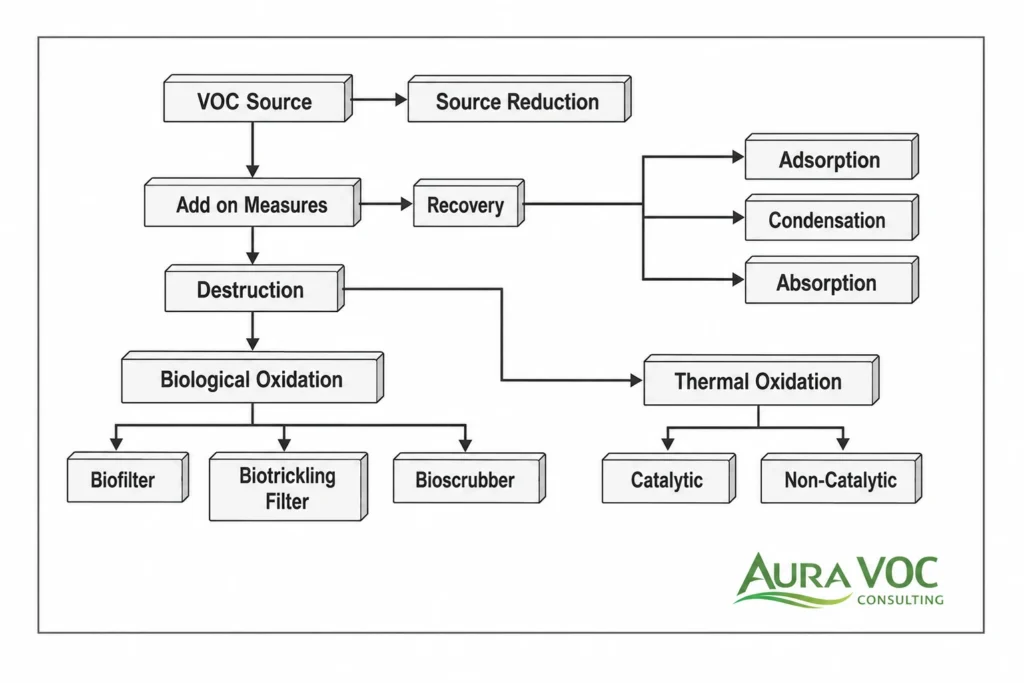
VOC Emission Data Required Before Selecting Abatement Technology
The quality of the VOC abatement decision depends on the quality of the emission data. Before comparing equipment, the plant should define the process streams to be treated, their variability, and their physical and chemical characteristics. This information forms the basis for equipment sizing, technology screening, permit documentation, and later troubleshooting.
Incomplete data usually leads to conservative assumptions, oversized equipment, or hidden operating risks. In some cases, it also leads to under-design, especially where short-duration peak loads or solvent changes are missed.
Flowrate range, minimum flow, maximum flow, and operating hours
Gas flowrate determines equipment size, pressure drop, fan power, residence time, heat demand, and capture stability. The relevant values are not only the average flowrate. The engineering basis should include minimum flow, maximum flow, normal operating flow, number of connected sources, and expected operating hours.
Minimum flow is important for oxidizers, biofilters, scrubbers, and systems with control stability limits. Maximum flow is important for residence time, pressure drop, duct sizing, and stack velocity. Operating hours influence annual mass emissions, energy cost, maintenance frequency, and suitability of intermittent technologies such as carbon adsorption or condensation.
For retrofit projects, the existing ventilation system should be reviewed together with the abatement unit. Adding treatment equipment can shift the fan operating point and reduce extraction at the source if static pressure is not properly assessed.
VOC concentration range, peak loads, and annual solvent mass balance
VOC concentration should be defined as a range, not a single value. The design basis should identify normal concentration, minimum concentration, expected peaks, and short-duration maximum events. These values should be converted into mass load using the corresponding flowrate.
An annual solvent mass balance is useful because it checks whether measured or estimated emissions are consistent with purchasing, usage, recovery, waste, wastewater, and product retention. It also helps identify whether the main VOC load comes from production vents, drying, cleaning, tank breathing, fugitive losses, or wastewater interfaces.
Peak loads should be evaluated separately from annual totals. A plant may have a manageable annual emission level but still require specific controls for short high-load events.
VOC speciation and solvent families
VOC speciation affects almost every abatement decision. Activated carbon capacity varies by compound and is influenced by boiling point, polarity, concentration, and humidity. Catalysts may be affected by poisons or masking agents. Thermal oxidation of halogenated solvents can generate acid gases requiring downstream treatment. Scrubbing is strongly dependent on solubility and mass transfer limits. Condensation depends on vapor pressure and achievable cooling temperature.
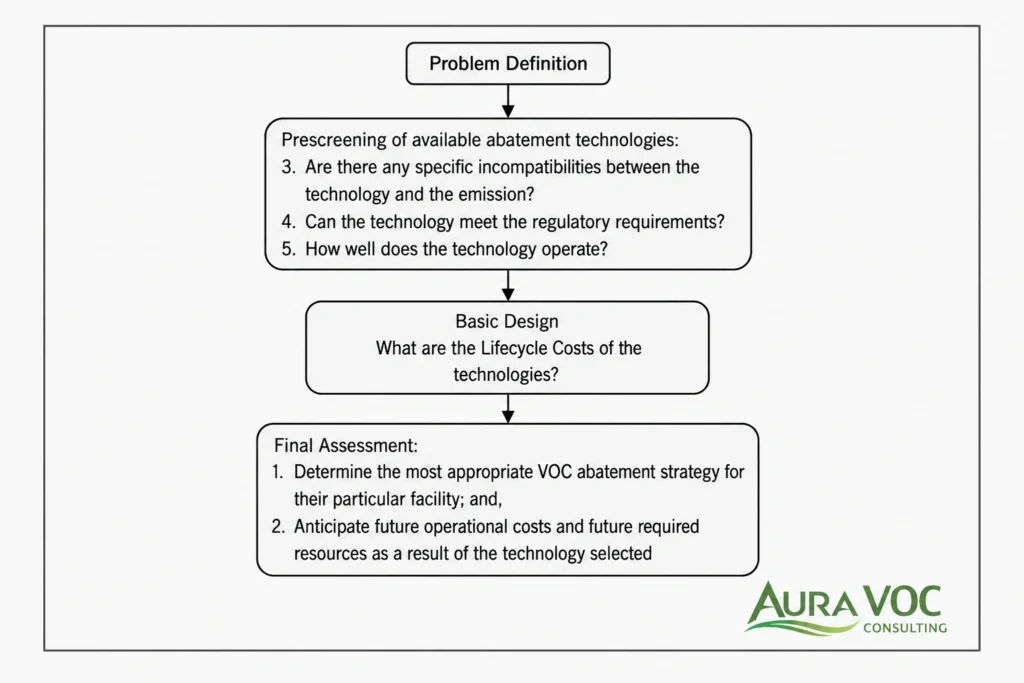
Grouping solvents by family is a practical first step, but detailed speciation may be required where solvent mixtures are variable or where hazardous by-products, corrosion, or monitoring issues are possible.
Temperature, humidity, dust, aerosols, and condensable compounds
Physical stream conditions can determine whether a technology is viable. High humidity can reduce adsorption capacity and affect monitoring. Dust and aerosols can foul catalysts, carbon beds, RTO media, scrubber packing, filters, and demisters. Condensable compounds can accumulate in ductwork or treatment units, creating pressure drop, drainage, or fire-risk issues.
Temperature also affects density, fan performance, condensation risk, adsorption behavior, catalyst activity, and material selection. These factors should be reviewed before equipment selection, not left to vendor correction after the technology has already been chosen.
LEL risk, oxygen content, and inerted process streams
Solvent-rich vents require a clear assessment of explosivity. LEL monitoring, dilution, interlocks, purge logic, flame arresting, and bypass philosophy may influence both the selected technology and the control system architecture.
Inerted streams require additional attention. Oxygen concentration may be too low for direct oxidation without dilution, while dilution can increase total flow and energy demand. The interface between process safety and emission control should be defined early, especially for reactors, dryers, solvent tanks, and nitrogen-blanketed equipment.
A safe and technically workable solution may require segregation of solvent-rich vents, condensation before treatment, controlled dilution, or dedicated interlock logic for batch release events.
Channelled emissions, diffuse emissions, and capture system boundaries
Abatement equipment can only treat the emissions that are captured and conveyed to it. For this reason, the source inventory should distinguish between channelled emissions, diffuse emissions, and fugitive releases.
Capture boundaries should be clearly defined: hoods, enclosures, tank vents, local exhaust points, general ventilation, transfer stations, and process vents. Poor capture design can result in compliant abatement equipment but uncontrolled emissions at the source. In retrofit projects, improving capture may be as important as selecting the treatment technology itself.
Process Constraints That Affect VOC Abatement Technology Selection
The same VOC abatement technology can perform very differently depending on how the process operates. A system selected for a stable continuous exhaust may be unsuitable for a plant with short solvent peaks, frequent recipe changes, or multiple sources tied into a common header. Before comparing equipment, the process constraints should be defined with enough detail to test whether each technology can operate within realistic limits.
Continuous versus batch VOC emissions
Continuous VOC emissions are generally easier to characterize and control because the treatment unit can be designed around a relatively stable flow and load. Drying ovens, coating lines, and certain manufacturing exhausts may allow predictable sizing, heat balance calculations, and monitoring logic.
Batch processes are less straightforward. Solvent emissions may occur during charging, heating, drying, vacuum breaking, filtration, cleaning, or transfer. The abatement unit may spend long periods at low load and then receive a short high-concentration peak. This affects thermal stability in oxidizers, breakthrough risk in carbon beds, absorption efficiency in scrubbers, and sizing of condensers or buffer volumes.
For IED permit documentation, batch emissions should not be reduced to a simple daily average. The critical question is whether the abatement system can handle the highest credible operating step without unsafe dilution, excessive bypassing, or loss of removal performance.
Solvent changeover and campaign-based production
Campaign-based production can change the VOC profile significantly. A system designed around ethanol or acetone may not behave the same way when exposed to aromatics, chlorinated solvents, high-boiling compounds, or solvent blends with different adsorption and condensation characteristics.
Solvent changeover affects more than removal efficiency. It can alter LEL risk, catalyst compatibility, corrosion potential, wastewater load, bed temperature, and analyzer response. Process engineers should therefore assess whether future products, alternative raw materials, or planned capacity changes are covered by the engineering basis.
A common permit weakness is to document the current solvent mix without defining how technology suitability will be maintained when formulations change. For multi-product plants, the abatement selection should include a solvent envelope, not only a snapshot of current operation.
High-flow, low-concentration exhaust streams
High-flow, low-concentration VOC streams are common in general ventilation, coating booths, drying lines, food processing, and some manufacturing exhaust systems. These streams can be difficult to treat efficiently because the pollutant load is diluted across a large air volume.
Thermal oxidation may require significant auxiliary fuel unless the VOC load is high enough to contribute useful heat. Large flowrates also increase equipment size, fan power, ductwork requirements, and pressure drop sensitivity. Carbon adsorption may be technically possible, but bed size, humidity effects, and replacement logistics can become limiting. Biofiltration may be suitable for some low-concentration biodegradable VOCs, provided the stream is stable and adequately humidified.
The first engineering question should be whether dilution can be reduced at source. Segregating high-load vents from general ventilation can sometimes produce a more controllable treatment problem than sending all airflows to one oversized abatement system.
Low-flow, high-concentration solvent vents
Low-flow, high-concentration vents are often found on tanks, reactors, dryers, solvent transfer systems, and vacuum equipment. These sources may be suitable for condensation, adsorption, recovery systems, or controlled dilution before oxidation, depending on solvent properties and safety constraints.
The main issue is usually not equipment size but concentration management. LEL assessment, oxygen content, vent intermittency, flame arresting, inerting, and interlock logic must be considered before selecting a technology. Sending a solvent-rich vent directly to an oxidizer or carbon bed without proper safety review can create operating risks.
Where solvent value is significant, recovery should be evaluated before destruction. Condensation or adsorption with regeneration may reduce the load to downstream treatment, but the residual VOC concentration and recovered solvent handling still need to be addressed.
Halogenated VOCs, acid gas formation, and corrosion risk
Halogenated VOCs require specific review because oxidation can produce acid gases such as HCl or HF, depending on the compound. This can create downstream scrubbing requirements, corrosion risks, wastewater neutralization needs, and material selection constraints.
For thermal systems, the design should consider combustion chamber conditions, quench requirements, acid dew point, scrubber performance, stack materials, and condensate handling. Cold spots in ducts, stacks, heat recovery sections, or drains can become corrosion points if acid gases condense. For catalytic systems, halogenated compounds may influence catalyst selection or suitability. For carbon adsorption, disposal or regeneration of spent carbon loaded with halogenated solvents must be considered.
Ignoring halogenated content during technology selection can lead to a system that appears acceptable from an air-side removal perspective but creates unacceptable corrosion, maintenance, or wastewater issues.
Available utilities: fuel, electricity, steam, cooling, compressed air, and wastewater capacity
Abatement selection should be checked against site utilities early. RTOs and thermal oxidizers require fuel and electrical power. Condensers may require chilled water, glycol, refrigeration, or cryogenic media. Scrubbers require water, chemical dosing, pumps, and wastewater capacity. Instrumentation may require compressed air, calibration gases, heated sampling lines, or analyzer shelters.
Utility limitations often become critical in retrofit projects. A technology may be technically suitable but impractical if the plant cannot support the additional electrical load, fuel demand, cooling duty, or wastewater discharge. These constraints should be included in the technology comparison matrix rather than treated as installation details.
Retrofit constraints: ductwork, fan capacity, footprint, access, and shutdown windows
Many VOC abatement projects are installed on existing plants. In these cases, the abatement unit has to fit into an existing ventilation and production system. Available footprint, crane access, duct routing, stack location, fan capacity, structural support, hazardous area classification, and shutdown duration can all influence technology selection.
Pressure drop is often the most underestimated retrofit constraint. Adding filters, beds, packing, heat exchangers, dampers, or oxidizer media changes the system resistance. If the existing fan cannot handle the new duty, capture velocity may fall at the source, even if the abatement unit itself is properly designed.
Maintenance access also needs review before the permit basis is finalized. Carbon replacement, catalyst inspection, ceramic media access, demister removal, pump maintenance, and analyzer calibration all require physical access and planned downtime.
VOC Abatement Technologies for IED Permit Applications: Fit, Limits, and Operating Risks
The technology review should not be treated as a generic equipment list. For an IED permit file, each option should be assessed against the plant’s exhaust profile, safety constraints, utility limits, maintenance capability, and monitoring approach. The key question is not whether a technology can remove VOCs under ideal conditions, but whether it can remain stable under normal production variation, batch peaks, fouling, solvent changes, and planned shutdown intervals.
Regenerative thermal oxidizer selection: VOC load, heat recovery, LEL control, and pressure drop
A regenerative thermal oxidizer is usually considered when the plant has a continuous or semi-continuous VOC load with enough operating hours to justify the equipment and energy demand. RTO suitability depends heavily on the relationship between airflow, VOC mass load, heat recovery, and turndown.
The main operating risk is applying an RTO to a dilute or intermittent stream without checking the low-load heat balance. In that case, the unit may meet the destruction requirement but operate with high auxiliary fuel demand for long periods. Batch peaks create a different problem: the control system must manage solvent concentration, LEL margin, purge timing, and potential temperature excursions.
For retrofit projects, RTO pressure drop should be checked against the existing fan curve. Ceramic media fouling, valve leakage, condensable carryover, and poor upstream filtration can increase pressure drop over time and reduce capture at the source. The permit file should therefore define expected inlet load cases, minimum and maximum flow, combustion temperature, residence time, pressure drop limits, bypass logic, and fuel demand at low-load operation.
Catalytic oxidizer selection: inlet temperature, catalyst poisoning, and clean gas requirements
Catalytic oxidizers can reduce oxidation temperature compared with thermal systems, but they are less forgiving of contaminated gas streams. They are most appropriate where the VOC composition is reasonably stable and the exhaust is free from particulates, aerosols, condensables, and known catalyst poisons.
The weak point is usually catalyst life, not initial removal efficiency. Silicones, sulfur compounds, phosphorus compounds, heavy metals, halogenated compounds, and oil aerosols can reduce catalyst activity or create masking. Poor upstream demisting or filtration can also cause gradual pressure drop increase and uneven flow distribution.
The engineering review should check catalyst compatibility with the full solvent envelope, not only the current product campaign. The equipment specification should include inlet temperature control, catalyst temperature monitoring, differential pressure monitoring, inspection access, and a realistic catalyst testing or replacement strategy. Where the solvent mix may change, the permit file should avoid assuming stable catalyst performance without a defined change-control review.
Activated carbon adsorption: breakthrough monitoring, humidity effects, fire risk, and spent carbon management
Activated carbon is often practical for intermittent VOC loads, polishing duties, temporary control, and retrofit applications where combustion equipment is not suitable. In many plants, it is selected because installation can be simpler than thermal treatment. The operational risk is that carbon performance can change quickly when humidity, solvent composition, concentration peaks, or bed temperature changes.
Breakthrough is the main control issue. A carbon bed can show good removal initially and then reach a point where outlet VOC rises rapidly. If outlet monitoring, bed temperature monitoring, or changeout criteria are not defined, the system may become unreliable for permit compliance. Solvent mixtures with poorly adsorbed compounds can also create early breakthrough even when total VOC concentration appears moderate.
Fire risk should be reviewed for high inlet concentrations, ketones, reactive compounds, poor heat removal, or inadequate airflow distribution. Spent carbon handling is also part of the technology decision. Replacement frequency, off-site regeneration, waste classification, transport, isolation during changeout, and downtime should be included in the engineering comparison.
Condensation and cryogenic condensation: solvent recovery, cooling duty, and residual VOC polishing
Condensation is relevant where VOC concentration is high enough for meaningful solvent recovery. It is often considered for solvent tank vents, vacuum systems, dryers, and batch exhausts with high solvent content. It is usually less effective as a standalone solution for dilute general ventilation streams.
The practical limit is the residual VOC concentration after cooling. A condenser may remove a large mass fraction of solvent but still leave an outlet stream requiring carbon polishing, oxidation, or another secondary treatment step. Cooling duty, solvent vapor pressure, mixture behavior, ice or hydrate formation, and condensate quality all affect feasibility.
Recovered liquid should not automatically be assumed reusable. It may contain water, multiple solvents, degradation products, acids, or process contaminants. Storage, classification, reuse, or disposal of the condensate should be reviewed before the system is presented as a recovery solution in the permit design basis.
Wet scrubbing: water-soluble VOCs, reagent use, corrosion, and wastewater generation
Wet scrubbing should be selected only where the target compounds are sufficiently soluble, reactive, or associated with other contaminants that justify liquid-phase treatment. For many VOCs, especially poorly soluble solvents, a scrubber can produce limited removal while adding pumps, chemicals, mist eliminators, corrosion risk, and wastewater load.
Scrubber performance depends on gas-liquid contact, liquid distribution, pH control, liquid-to-gas ratio, packing condition, and mist eliminator performance. Field problems often come from partially blocked nozzles, scaling, biological growth, liquid maldistribution, demister fouling, or pH control instability.
The wastewater stream must be treated as part of the abatement decision. Blowdown may contain absorbed organics, salts, suspended solids, neutralization products, and high COD. If the wastewater treatment plant cannot accept the additional load, the air-side solution may create a new operating constraint.
Biofiltration and biotrickling filters: low-concentration VOCs, biomass stability, and pressure drop control
Biofiltration and biotrickling filters can be suitable for stable, low-concentration, biodegradable VOC streams. They are less suitable for highly variable solvent mixtures, toxic compounds, dry exhausts, long shutdowns, or high peak loads.
The main engineering concern is biological stability. The system depends on moisture, nutrient supply, pH, temperature, residence time, and biomass condition. Extended shutdowns, sudden solvent changes, or shock loads can reduce performance, and recovery may not be immediate. Pressure drop can also increase due to biomass growth, media compaction, or solids accumulation.
For IED permit use, these systems should be evaluated against actual production rhythm. A stream that looks suitable on average may not be suitable if the plant has long idle periods followed by high solvent releases.
Hybrid VOC abatement systems for variable industrial emissions
Hybrid systems are often required where a single technology cannot manage the complete emission profile. Examples include condensation followed by carbon adsorption, scrubber plus oxidizer for halogenated streams, demister plus catalytic oxidizer, or concentrator plus RTO for high-flow dilute exhausts.
A hybrid configuration should be designed as one integrated treatment train, not as separate equipment items. The control philosophy should define how each stage behaves during start-up, shutdown, low load, peak load, bypass, and maintenance. Monitoring should confirm both primary and polishing performance. The additional complexity is justified only if it reduces a real operating risk, such as solvent peaks, acid gas formation, high flow dilution, or variable solvent chemistry.
Engineering Tradeoffs in VOC Abatement Technology Selection
Technology comparison should make the tradeoffs visible. A system with high nominal removal efficiency may still be a poor fit if it creates excessive pressure drop, fuel demand, wastewater load, or maintenance downtime. For IED permit work, the comparison should show why the selected technology is practical under the site’s operating constraints. For cost comparison, the EPA Air Pollution Control Cost Manual provides a technical reference for estimating costs of stationary air pollution control devices.
Energy consumption versus VOC destruction efficiency
Oxidation systems can achieve high VOC destruction, but dilute or intermittent streams may require significant auxiliary fuel. The review should check fuel demand at normal load, minimum load, and standby operation, not only at the design peak. For high-flow systems, fan power can be as important as burner fuel.
Heat recovery can improve the energy balance, but only where the VOC load is stable and the recovered heat has a reliable use. Fouled heat recovery media, air leakage, purge losses, and low production load can reduce expected energy performance.
Pressure drop versus capture performance in retrofit projects
In retrofit projects, pressure drop is often the limiting factor. Adding carbon beds, filters, scrubber packing, demisters, dampers, or RTO media changes the system resistance. If the fan has no spare static pressure, airflow at hoods, booths, tank vents, or local exhaust points may fall.
A fan curve review should be completed before the abatement unit is specified. After installation, branch flows and capture velocities should be verified. A treatment unit that performs well at the stack is not sufficient if source capture has deteriorated upstream.
Solvent recovery versus thermal destruction
Solvent recovery can reduce VOC load and may be justified for high-concentration streams with recoverable solvents. However, recovery requires suitable vapor concentration, manageable cooling or regeneration duty, compatible solvent mixtures, and a practical route for recovered liquid.
Thermal destruction may be more straightforward operationally, but it eliminates recovery potential and may increase fuel use. For solvent-rich vents, the selection should explicitly compare recovery, destruction, and hybrid pre-treatment rather than defaulting to one approach.
Wastewater generation versus air emission reduction
Wet scrubbers, quench systems, and condensers can reduce air emissions but create liquid streams. The wastewater implications should be assessed before technology selection. COD load, chloride or fluoride concentration, pH, salts, suspended solids, solvent content, and discharge limits may drive the final decision.
This is especially important where halogenated VOCs are oxidized and then treated in a downstream scrubber. The air-side control may be technically effective, but the resulting blowdown can become a maintenance, corrosion, or wastewater treatment issue.
CAPEX versus maintenance burden and plant availability
Lower installed cost can lead to higher operating burden. A simple carbon unit may require frequent media replacement if the VOC load is underestimated. A scrubber may appear economical but require continuous chemical control, nozzle maintenance, blowdown treatment, and demister cleaning. A catalytic system may have moderate energy demand but high sensitivity to catalyst poisoning.
The comparison should include expected inspection frequency, spare parts, safe access, isolation requirements, and production downtime. Plant availability is often more important than the purchase price difference between two technologies.
High removal efficiency versus operational flexibility
Some systems perform well within a narrow range but are sensitive to flow changes, solvent changes, or low-load operation. Multi-product plants should avoid selecting technology only around the current product campaign. A system designed too tightly around one solvent mixture may become unsuitable after a formulation change or production increase.
Operational flexibility should be weighted where the plant has campaign production, frequent solvent substitution, variable operating hours, or planned capacity changes.
Robust operation versus sensitivity to solvent variability
Different technologies react differently to solvent variability. Carbon adsorption is sensitive to humidity, boiling point, polarity, and concentration peaks. Catalysts are sensitive to poisons and masking agents. Condensation depends on vapor pressure and cooling temperature. Biological treatment depends on biodegradability and load stability.
Where solvent variability is high, the selected technology should either tolerate the full solvent envelope or include upstream segregation, pre-treatment, or operating controls that prevent unstable conditions.
VOC Abatement Selection by Industrial Operating Scenario
Technology selection becomes clearer when the emission source is described by operating scenario rather than only by sector. A pharmaceutical batch vent, coating oven exhaust, solvent tank vent, humid food-process exhaust, or multi-source header can each require a different treatment philosophy even when the target pollutant group is broadly described as VOC.
Batch solvent peaks in pharmaceutical and fine chemical production
Batch plants often generate VOC emissions in short, high-load steps rather than steady operation. Reactor charging, vacuum drying, filtration, solvent transfer, equipment cleaning, and vacuum breaking can define the abatement design case. The abatement system should be checked against the highest solvent-release step, the lowest expected standby load, and any planned campaign solvent changes.
For oxidation systems, this means assessing peak concentration, LEL controls, and low-load fuel demand between batch events. For carbon adsorption, it means checking whether the peak mass load shortens bed life or causes bed temperature increase. For condensation, it means matching cooling duty to the peak release rather than the daily average.
Coating, drying, and curing line exhausts
Coating, drying, and curing lines usually involve higher airflow with solvent concentrations that vary with line speed, coating formulation, oven temperature, and product width. Thermal oxidation may be suitable where the solvent load is stable enough, but energy demand, heat recovery, and fan power should be evaluated carefully.
Capture balance is also critical. Poor hood, booth, or oven extraction can create uncontrolled emissions before the abatement unit. Where several zones are connected to one system, branch balancing and damper settings should be checked after installation and after production changes.
Solvent tank vents, breathing losses, and transfer emissions
Tank vents and transfer operations often produce low-flow, high-concentration emissions. Condensation, carbon adsorption, vapor balancing, or hybrid recovery systems may be more appropriate than treating these sources as general ventilation.
LEL risk, inerting, flame arresting, tank pressure/vacuum protection, and compatibility with vent devices should be reviewed before connecting tank vents to a common abatement header. Tank filling and displacement events should be considered separately from normal breathing losses because they may define peak concentration and flow.
Humid VOC streams from food, fermentation, and washing operations
Humid exhaust streams can reduce carbon adsorption capacity, affect analyzer reliability, and create condensation problems in ducts. Biofiltration or scrubbing may be technically relevant for some biodegradable or soluble compounds, but biological stability, odor load variation, pH control, and pressure drop increase need to be considered.
Where condensation is likely, duct slope, drain points, demisters, and heated sampling lines may become as important as the main treatment unit. A system that performs well during stable operation can become unreliable if moisture loading varies with cleaning cycles or product changeovers.
Cleaning, degreasing, and surface treatment emissions
Cleaning and degreasing operations can create intermittent emissions with solvent mixtures that change over time. Local capture, enclosure design, and operator practices often determine actual VOC collection efficiency. Carbon adsorption may be practical for intermittent loads, but breakthrough monitoring and fire-risk controls should be defined.
For manual operations, capture performance may vary with doors, lids, access panels, and operator work methods. The abatement design should therefore be reviewed together with the source enclosure and ventilation layout.
Multi-source exhaust headers with variable VOC composition
Combining multiple sources into one header can reduce equipment count but may create a highly variable gas stream. The abatement unit must then handle changes in flow, VOC family, temperature, humidity, and concentration.
Segregating incompatible streams is often more robust than forcing all emissions into one treatment device. Solvent-rich vents, humid exhausts, dusty streams, and halogenated streams may require different pre-treatment or separate routing to avoid fouling, corrosion, unstable removal, or excessive dilution.
Pre-Treatment Requirements Before VOC Abatement
Pre-treatment is often where abatement reliability is won or lost. Many performance problems are caused not by the main abatement unit but by aerosols, particulates, condensate, or temperature conditions entering the system without control.
Particulate filtration and aerosol removal
Particulates and aerosols can blind filters, mask catalysts, foul RTO ceramic media, load carbon beds, plug scrubber packing, and contaminate analyzers. For coating, drying, mixing, filling, and surface treatment applications, aerosol removal should be assessed before the final abatement technology is selected.
Differential pressure monitoring across filters or pre-separators is useful because filter loading directly affects airflow and capture. Maintenance access for filter replacement should also be included in the layout review.
Demisters, knock-out pots, and condensate management
Mist and condensate can create several operating problems: pressure drop increase, corrosion, poor analyzer response, carbon bed wetting, catalyst fouling, and duct drainage issues. Knock-out pots, sloped ductwork, drain points, heat tracing, and demisters should be considered where water or solvent condensation is credible.
Drain design should not be left as a construction detail. Blocked drains and low points in ductwork can accumulate solvent-water mixtures, creating odor, corrosion, or flammable residue risks.
Temperature conditioning and condensation control
Temperature affects adsorption capacity, catalyst activity, biological performance, condensation risk, fan density correction, and material selection. Cooling may improve solvent recovery or carbon adsorption, but it can also create condensate that must be drained and classified. Heating may be required to prevent condensation in ducts or sample lines.
For streams near dew point, the design should define where condensation is allowed and where it must be prevented. This is particularly important upstream of carbon beds, catalysts, analyzers, and fans.
Acid gas pre-treatment or downstream scrubbing after oxidation
Halogenated VOCs can form acid gases after oxidation. The design should consider HCl or HF formation, quench conditions, caustic scrubbing, acid dew point, corrosion-resistant materials, and scrubber blowdown composition.
Cold spots in ducts, stacks, heat exchangers, or drains can become corrosion points if acid gases condense. Materials of construction and drainage should be reviewed together with the oxidation and scrubbing design.
Protecting catalysts, carbon beds, RTO media, and scrubber packing from fouling
Fouling changes both performance and operating cost. RTO media fouling reduces heat recovery and increases pressure drop. Catalyst fouling reduces activity. Carbon fouling reduces useful capacity and can promote channeling. Scrubber packing fouling causes maldistribution and high differential pressure.
The equipment specification should include inspection points, pressure drop alarm levels, cleaning access, and maintenance intervals based on the expected contaminant load.
Pressure Drop, Fan Capacity, and Energy Implications
Pressure drop is not only a mechanical design issue. It affects capture efficiency, fan operation, electrical demand, duct balance, and long-term abatement performance. For retrofit projects, pressure drop should be evaluated before the technology is selected, not after supplier quotations are received.
How abatement pressure drop affects capture velocity
If the abatement unit adds resistance to an existing ventilation system, airflow may fall at the source. This can reduce face velocity at hoods, booths, enclosures, or tank vent headers. In practice, this may increase diffuse emissions even while the stack treatment unit remains operational.
Capture measurements should be taken before and after installation. Where multiple branches feed a common header, damper positions and branch velocities should be checked after commissioning and after major maintenance.
Fan curve review for VOC abatement retrofit projects
A fan curve review should compare current operating flow and static pressure with the expected system resistance after installation. The review should include clean and fouled pressure drop cases, not only the new equipment’s clean condition.
If the fan is upgraded, the review should also consider motor load, noise, vibration, duct velocity, hazardous area classification, damper suitability, and control stability. A larger fan can solve static pressure limits but create secondary problems if the duct system was not designed for the new operating point.
Pressure drop increase from fouling, media aging, and liquid carryover
Pressure drop should be tracked as a maintenance indicator. Carbon bed compaction, RTO media fouling, scrubber scaling, biological growth, wet filters, demister blockage, and liquid carryover can all increase system resistance.
A useful engineering basis includes expected clean pressure drop, alarm pressure drop, shutdown pressure drop, and the inspection action associated with each level. Without these limits, operators may continue running the unit until capture or treatment performance is already affected.
Electrical energy demand from high-flow exhaust treatment
High-flow VOC streams can create large fan power demand even at low VOC concentration. Treating unnecessary dilution air increases equipment size, pressure drop, and electricity use. Before specifying the abatement unit, the plant should check whether source capture can be improved, whether high-load streams can be segregated, or whether general ventilation can be excluded from treatment.
This is often a better engineering intervention than simply increasing treatment capacity.
Auxiliary fuel demand in oxidizers at low VOC load
RTOs and thermal oxidizers should be evaluated at minimum VOC load as well as design load. Low solvent concentration, excessive dilution, intermittent operation, and poor heat recovery can increase auxiliary fuel demand substantially.
The fuel balance should include start-up, purge, standby, partial-load operation, and expected production gaps. A system that is efficient at peak load may be expensive to operate during normal low-load production.
Heat recovery opportunities and practical limitations
Heat recovery should be assessed against real plant demand. Recovered heat is useful only if there is a consistent heat sink at the right temperature level and operating schedule. Corrosion, fouling, variable production, and long duct routes can reduce practical recovery.
Where heat recovery is included in the permit or project justification, assumptions should be conservative enough to remain valid during partial-load operation.
Wastewater and Secondary Waste Implications
VOC abatement can create secondary waste streams that are operationally significant. These streams should be evaluated during technology selection because they may affect wastewater treatment capacity, waste classification, maintenance planning, and permit assumptions.
Scrubber blowdown, pH control, salts, and COD load
Scrubbers may convert an air emission problem into a wastewater treatment duty. Blowdown can contain absorbed organics, salts, neutralization products, suspended solids, and high COD. The actual composition depends on the VOC species, scrubbing chemistry, pH control, blowdown rate, and any acid gas load.
The wastewater treatment plant should be checked for hydraulic capacity, COD load, salts, pH control, toxicity, and discharge limits. Scrubber operation should also include a defined blowdown strategy; simply recirculating liquid until performance drops can create unstable operation and scaling.
Condensate from solvent recovery systems
Condensate from VOC recovery systems may not be clean solvent. It may contain water, mixed VOCs, degradation products, acids, or entrained solids. This affects reuse potential, storage requirements, classification, and disposal route.
Where recovery is part of the project justification, the quality and destination of the recovered liquid should be defined. A condenser that produces a mixed or contaminated stream may still be technically useful, but it should not be presented as straightforward solvent recovery without checking the liquid handling route.
Quench systems and acid gas neutralization after oxidation
Oxidizing halogenated or sulfur-containing VOCs can require quench and neutralization. This creates liquid streams that should be assessed for pH, chloride, fluoride, sulfate, salts, suspended solids, and corrosion potential.
The quench and scrubber design should be reviewed together with materials of construction, drain layout, blowdown control, chemical dosing, and wastewater compatibility. A technically effective oxidizer can still create plant problems if the downstream neutralization and blowdown system are not properly sized.
Spent activated carbon, spent catalyst, and contaminated filter media
Secondary solid wastes should be included in the technology comparison. Activated carbon, catalyst, ceramic media, demister pads, filters, and contaminated packing may require special handling depending on the compounds captured or formed.
Replacement frequency, waste classification, transport, regeneration, disposal cost, and downtime during changeout can materially affect operating feasibility. For carbon systems, spent media management is not a peripheral issue; it is part of the compliance strategy.
Avoiding simple transfer of VOC burden from air to wastewater
The selected system should be assessed across air, water, waste, and maintenance interfaces. A solution that reduces stack VOC but creates an unmanageable wastewater or solid waste stream is weak from an operating perspective.
This does not mean scrubbing, condensation, or adsorption should be avoided. It means the secondary stream should be quantified, classified, and connected to a practical handling route before the abatement technology is finalized.
Operating Controls, Monitoring, and Permit Robustness
Monitoring should confirm that the abatement system is operating within the conditions assumed in the permit file. It should also give operators early warning before a performance issue becomes a compliance issue.
Operating parameters that should be defined in the permit design basis
The engineering basis should identify measurable operating parameters for each technology. Examples include inlet and outlet VOC concentration, gas flow, pressure drop, combustion temperature, catalyst inlet temperature, carbon bed temperature, scrubber pH, conductivity, liquid flow, blowdown rate, fan status, and bypass position.
The parameters should be tied to operator actions. A high pressure drop alarm, for example, should trigger inspection or cleaning, not simply generate a logged event.
VOC inlet and outlet monitoring points
Monitoring locations should represent the treated stream. Sampling before complete mixing, after dilution, or upstream of an unmeasured bypass can give misleading results. Where multiple sources feed one header, the plant may need additional upstream measurements to diagnose which source is driving outlet excursions.
Sampling systems should also be checked for condensation losses. Solvent or water condensation in sample lines can cause false low VOC readings and unreliable compliance data. Heated sample lines, correct filtration, calibration gas selection, and moisture management should be reviewed where condensable solvents are present.
Temperature, pressure drop, flowrate, and fan status monitoring
Temperature, flow, and differential pressure trends often show deterioration before VOC outlet readings increase. Examples include rising RTO media pressure drop, falling scrubber liquid flow, unstable fan operation, or declining catalyst temperature profile.
Trend review should be part of the operating routine. Single readings are less useful than changes over time under comparable production conditions. Where possible, trends should be linked to maintenance thresholds.
LEL monitoring, interlocks, alarms, and bypass logic
LEL monitoring should be positioned where solvent peaks are likely to appear, not only where installation is convenient. Response time matters in batch systems because solvent releases can be short and intense.
The control philosophy should define dilution, shutdown, diversion, purge, and alarm response. Bypass logic should be carefully documented because bypass operation can become a permit issue if it is not limited, recorded, and justified.
Scrubber pH, conductivity, liquid flow, and blowdown monitoring
Scrubber pH is important but not sufficient on its own. Liquid flow, conductivity, oxidation-reduction potential where relevant, blowdown rate, pump status, and pressure drop across packing or demisters may also be needed.
Mist carryover should be checked because it can damage downstream ducts, fans, stacks, or analyzers. Demister pressure drop and visual inspection should be included in maintenance procedures.
Carbon breakthrough monitoring and changeout criteria
Carbon systems should have defined breakthrough criteria. This may include outlet VOC monitoring, bed temperature monitoring, sampling frequency, service time, mass loading estimate, or a combination of these.
Changeout should be planned before breakthrough becomes visible at the stack. Where emissions are variable, relying only on operating hours can be misleading. Bed life should be checked against solvent mass load and actual inlet conditions.
Start-up, shutdown, cleaning, and campaign changeover controls
Start-up, shutdown, cleaning, and campaign changes can create emissions that differ from normal operation. Cleaning solvents, purge steps, vacuum breaks, and tank transfers should be included in the control philosophy.
The permit narrative should explain how these events are managed: whether they are routed to treatment, delayed until the abatement unit is online, controlled by interlocks, or subject to operating restrictions.
Maintenance Planning for VOC Abatement Systems
Maintenance requirements should influence technology selection. An abatement system that cannot be safely inspected, isolated, cleaned, or serviced within available shutdown windows may become difficult to operate, even if the process design is sound.
Maintenance requirements by technology type
Each technology has specific maintenance drivers. RTOs require burner, valve, media, insulation, and seal checks. Catalytic oxidizers require catalyst inspection and activity monitoring. Carbon systems require bed replacement or regeneration. Scrubbers require pump, nozzle, packing, pH probe, and demister maintenance. Biofilters require media, moisture, nutrients, and pH control.
The maintenance workload should be compared during technology selection, especially for plants with limited shutdown availability.
Critical spare parts and instrumentation
Critical spares may include temperature probes, pressure transmitters, LEL sensors, pH probes, pumps, burner components, fan bearings, dampers, demister pads, gaskets, catalyst modules, and carbon media.
Instrumentation spares are often underestimated. A failed analyzer, pH probe, flow switch, or pressure transmitter can limit operation if it is part of the permit control strategy.
Catalyst, carbon, ceramic media, packing, and demister replacement
Media replacement should be based on operating conditions and inspection data. Supplier life estimates are useful, but they should be checked against actual solvent load, fouling rate, humidity, and pressure drop.
Replacement work also has practical constraints: lifting access, isolation, hot surfaces, confined space entry, spent media classification, and restart checks.
Inspection access, isolation, and safe maintenance planning
The layout should allow safe inspection and maintenance without excessive dismantling. Access platforms, isolation dampers, drain points, clean-out doors, lifting points, and safe sampling points should be considered during design.
Maintenance work may involve solvent residues, acidic condensate, hot surfaces, oxygen-deficient areas, or contaminated media. These hazards should be reflected in the maintenance plan.
Using pressure drop, temperature, and outlet VOC trends for preventive maintenance
Routine trend review can identify problems before they become failures. Rising pressure drop can indicate fouling. Falling oxidation temperature can indicate burner or control issues. Increasing outlet VOC can indicate breakthrough, catalyst decline, or scrubber performance loss.
Preventive maintenance should use these trends to plan inspection, cleaning, replacement, or recalibration before the abatement system reaches an unstable operating condition.
Troubleshooting VOC Abatement Performance Problems
Troubleshooting should start by confirming whether the abatement system is receiving the stream assumed in the engineering basis. Many performance issues are caused by process changes, ventilation changes, solvent substitutions, or maintenance conditions rather than a failure of the main equipment item.
High outlet VOC concentration after abatement
High outlet VOC can be caused by inlet load above design, solvent composition changes, insufficient oxidizer temperature, catalyst deactivation, carbon breakthrough, poor scrubber absorption, bypass damper leakage, or gas maldistribution.
Field checks should include comparing current inlet load with the design case, checking bypass position, verifying analyzer calibration, inspecting sample lines for condensation, reviewing recent solvent changes, and confirming flowrate. For oxidizers, review combustion temperature and residence time. For carbon, check bed temperature and breakthrough trend. For scrubbers, check pH, liquid flow, packing condition, and mist carryover.
Rising pressure drop across the abatement system
Rising pressure drop usually indicates fouling, liquid carryover, media compaction, blocked filters, biological growth, scrubber scaling, demister plugging, or RTO media contamination.
Operators should compare current differential pressure with clean-condition and alarm limits. Inspection should focus on the first restriction point in the system: pre-filters, demisters, packing, beds, or media. If pressure drop increases after a product change, the plant should check for new aerosols, solids, or condensable compounds.
Excessive auxiliary fuel or electrical energy consumption
High auxiliary fuel use in oxidizers may indicate low VOC heat contribution, excessive dilution air, air leakage, poor heat recovery, unstable production load, or incorrect standby operation. High electrical demand may indicate excessive airflow, high pressure drop, fouled filters, or fan operation away from the efficient point.
Troubleshooting should compare energy use against flowrate and VOC load, not only operating hours. A fuel increase may be expected after production changes but should be investigated if the inlet load has not changed.
Carbon breakthrough or shortened carbon bed life
Short bed life may result from underestimated VOC mass load, high humidity, poorly adsorbed compounds, concentration peaks, high bed temperature, channeling, or inadequate pre-filtration.
Field checks should include outlet VOC trend, bed temperature, inlet humidity, solvent mix, pressure drop, airflow distribution, and actual operating hours. Where solvent campaigns change, bed life should be recalculated rather than assumed from previous operation.
Catalyst deactivation or oxidizer temperature instability
Catalyst decline may be caused by poisons, aerosol masking, particulate carryover, high-temperature exposure, or incompatible solvent changes. Oxidizer temperature instability may be caused by low solvent load, burner tuning, airflow variation, poor heat recovery, or control valve issues.
Checks should include catalyst pressure drop, activity testing where available, inlet contaminant review, burner status, temperature profile, and recent maintenance history.
Scrubber pH instability, poor absorption, or mist carryover
Scrubber issues often come from blocked nozzles, poor liquid distribution, failed dosing pumps, incorrect blowdown rate, scaling, demister fouling, or treating VOCs with low water solubility.
Field checks should include pH probe calibration, chemical dosing rate, recirculation flow, conductivity, packing condition, nozzle spray pattern, demister pressure drop, and visible plume or carryover evidence.
Corrosion, condensate accumulation, and material compatibility failures
Corrosion can indicate acid gas formation, operation below dew point, poor drainage, incompatible materials, or carryover from wet sections. Condensate accumulation may occur in duct low points, sample lines, fans, or stacks.
The inspection should identify where condensation forms and whether the liquid is water, solvent, acidic condensate, or a mixture. Materials and drainage should then be checked against the actual liquid composition.
Fan instability, poor capture, and duct leakage
Poor capture can occur even when the abatement unit is operating normally. Causes include added extraction points, blocked ducts, moved dampers, filter loading, fan wear, duct leakage, open doors, or pressure changes in enclosures.
Field checks should include branch airflow measurements, hood face velocity, damper positions, fan vibration, duct inspection, and pressure readings before and after filters or abatement equipment. Capture performance should be verified after major maintenance or production layout changes.
VOC Abatement Design Basis for IED Permit Documentation
The permit file should show how the selected technology was chosen and how it will be operated. A weak design basis creates future problems because operators, inspectors, and project engineers may not know which assumptions are critical to compliance. The technical justification should also be consistent with the applicable Industrial Emissions Directive framework and relevant BAT conclusions for the installation.
Emission source inventory and VOC mass balance
The source inventory should identify each channelled source, relevant diffuse source, operating step, and connected exhaust route. The VOC mass balance should reconcile solvent use, emissions, recovery, waste, wastewater, and product retention where possible.
This avoids selecting equipment from isolated measurements that do not represent the whole plant.
Design emission envelope and operating scenarios
The design emission envelope should include normal operation, minimum load, maximum load, short-duration peaks, start-up, shutdown, cleaning, and campaign changeover. For batch plants, emissions should be assigned to process steps rather than averaged across a full day.
The objective is to define the operating cases that the abatement system must manage, not only the case that produces the simplest calculation.
Technology screening and rejected-option justification
Rejected technologies should be documented with technical reasons. Examples include excessive pressure drop, poor solvent compatibility, high wastewater load, unacceptable auxiliary fuel demand, catalyst poisoning risk, poor turndown, or insufficient maintenance access.
This makes the technology selection more defensible than simply stating the preferred option.
Technology comparison matrix for VOC abatement selection
The comparison matrix should include removal performance, flow sensitivity, VOC composition, LEL risk, pressure drop, energy demand, wastewater generation, secondary waste, pre-treatment needs, monitoring requirements, maintenance burden, retrofit constraints, and safety controls.
A useful matrix compares operating consequences, not only expected removal efficiency.
Monitoring, maintenance, and alarm response philosophy
The permit documentation should link operating parameters to actions. For example, a high pressure drop alarm should trigger inspection or cleaning; carbon breakthrough should trigger changeout; scrubber pH deviation should trigger dosing or blowdown checks.
A monitoring plan without response criteria is weak from an operating perspective.
Residual emissions estimate and permit operating assumptions
Residual emissions should be estimated from realistic removal performance and representative inlet cases. The assumptions should state whether they apply to normal operation, peak operation, batch events, or specific production campaigns.
Where removal efficiency is taken from supplier data, the applicable inlet conditions should be checked against the plant’s actual stream.
Linking BAT assessment to practical plant operating limits
BAT alignment should be supported by operating evidence and engineering constraints. The selected system should be technically appropriate for the plant’s actual flow, solvent mix, production pattern, utilities, and maintenance capability.
For chemical-sector installations, the Common Waste Gas Management and Treatment Systems BREF is a relevant reference when assessing channelled and diffuse waste gas treatment.
The goal is to avoid a permit basis that looks strong in the application but requires operating conditions the plant cannot maintain reliably.
Common Mistakes in IED VOC Abatement Technology Selection
Many VOC abatement problems are created before equipment is purchased. They come from incomplete data, weak assumptions, or insufficient review of how the system will interact with production and ventilation.
Designing from average concentration instead of peak VOC load
Average concentration can hide short high-load events. This is common where solvent charging, dryer unloading, tank filling, or cleaning creates brief releases that are diluted in daily averages but still determine LEL risk, carbon bed loading, condenser duty, or oxidizer control requirements.
Ignoring pressure drop and existing fan limitations
In retrofit projects, added pressure drop can reduce source capture if the existing fan has no spare static pressure. A fan curve review, branch airflow check, and post-installation balancing should be treated as part of the abatement project.
Selecting oxidation without evaluating halogenated VOCs
Oxidizing halogenated VOCs can create acid gas, corrosion, and wastewater issues. Quench systems, caustic scrubbing, acid dew point control, material selection, and blowdown composition should be reviewed before oxidation is selected.
Using activated carbon without a breakthrough and fire-risk strategy
Carbon systems require more than initial removal efficiency. The project should define outlet monitoring, bed temperature checks, changeout criteria, spent carbon handling, and fire-risk controls for high solvent load or reactive compounds.
Treating scrubber wastewater as a secondary issue
Scrubbing may reduce air emissions while creating blowdown with COD, salts, absorbed solvents, or neutralization products. Wastewater capacity and composition should be assessed before selecting scrubbing as the preferred option.
Underestimating maintenance downtime and access requirements
Limited access can turn routine maintenance into production downtime. Carbon changeout, catalyst inspection, media replacement, demister cleaning, fan maintenance, and analyzer calibration should be reviewed during layout and technology selection.
Failing to update the design basis after solvent or production changes
A valid abatement design can become unsuitable after a new solvent, higher production rate, new cleaning procedure, or additional exhaust source is introduced. Management of change should include VOC load, solvent compatibility, pressure drop, LEL risk, and monitoring implications.
Practical VOC Abatement Technology Selection Matrix
A selection matrix is useful because it forces the project team to compare technologies against the same operating assumptions. It also creates a clear record for permit documentation and internal decision-making.
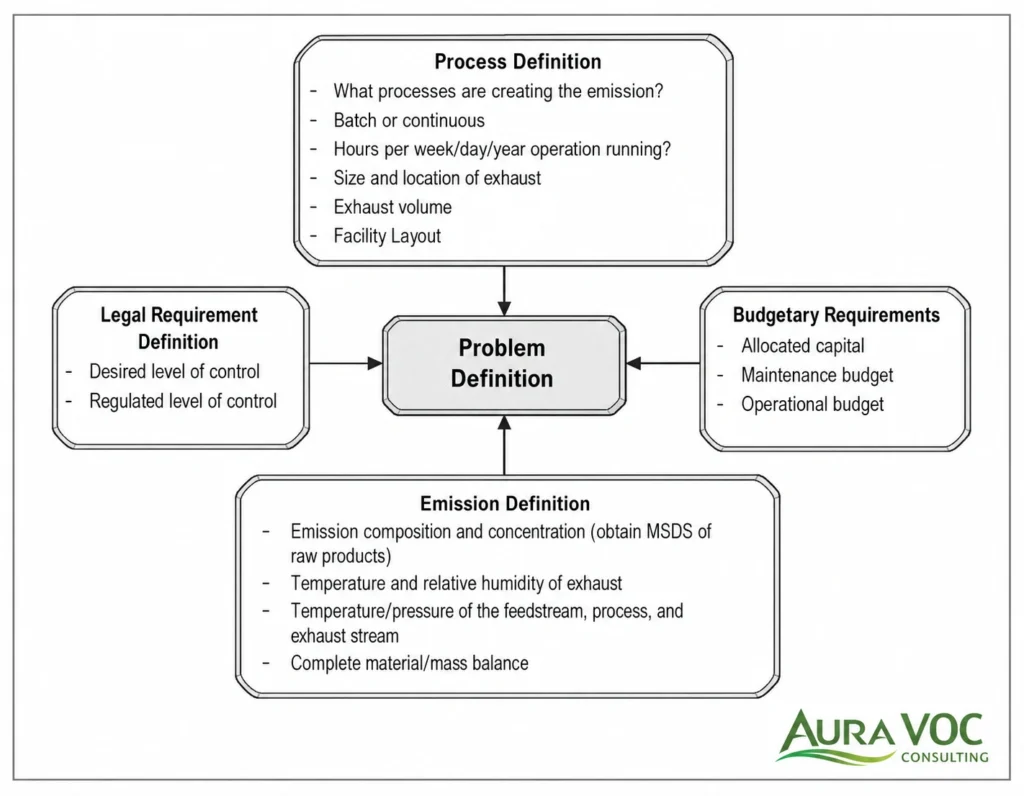
Required inputs for the selection matrix
The matrix should start with source-specific data: exhaust flowrate range, VOC concentration range, VOC mass load, solvent speciation, peak release events, operating hours, temperature, humidity, particulates, mist, condensables, LEL risk, oxygen content, existing fan and ductwork data, available utilities, wastewater constraints, shutdown windows, and maintenance access.
Where data are uncertain, the uncertainty should be visible. A technology decision based on assumed VOC load or assumed solvent composition should be flagged for confirmation.
Technical screening criteria for each abatement option
Each technology should be screened for technical fit and exclusion reasons. Catalytic oxidation may be excluded due to catalyst poison risk. Scrubbing may be excluded due to low VOC solubility. Standalone condensation may be excluded where residual VOC concentration remains too high. Carbon adsorption may be excluded where humidity, bed temperature, or breakthrough risk cannot be controlled.
Screening should also identify required pre-treatment, such as demisting before carbon, filtration before catalyst, condensate removal before fans, or downstream caustic scrubbing after oxidation of halogenated VOCs.
Energy, pressure drop, wastewater, and maintenance comparison
The matrix should compare operating consequences, not only removal efficiency. Key rows should include auxiliary fuel, electrical power, clean and fouled pressure drop, wastewater load, secondary waste, inspection frequency, media replacement, analyzer requirements, and maintenance access.
This prevents the selection process from over-weighting nominal removal efficiency while under-weighting plant operability.
Permit robustness and monitoring implications
The preferred option should support clear operating controls. If the technology requires continuous temperature control, breakthrough monitoring, scrubber chemistry control, or LEL interlocks, those requirements should be visible in the matrix.
A technology that is difficult to monitor under real plant conditions may create permit risk even if its nominal treatment performance is high.
When to select a hybrid VOC abatement configuration
A hybrid system should be considered when emissions are variable, chemically mixed, or difficult for one technology to manage. Examples include condenser plus carbon adsorption for solvent-rich vents, scrubber plus oxidizer for halogenated streams, or concentrator plus RTO for high-flow dilute exhaust.
The decision should be based on defined operating risks, not on adding equipment for redundancy without a clear function.
FAQ
What should be included in a VOC abatement design basis for an IED permit?
A design basis should include the emission source inventory, VOC mass balance, solvent speciation, flowrate range, concentration range, peak loads, operating hours, start-up and shutdown scenarios, LEL assessment, utility constraints, wastewater implications, technology screening, monitoring philosophy, and maintenance assumptions.
How do batch solvent peaks affect VOC abatement sizing?
Batch peaks can define the maximum VOC load, LEL risk, carbon bed loading, condenser duty, or oxidizer control requirements. Daily average emissions may understate the design challenge if solvent charging, drying, cleaning, or transfer steps create short high-load events.
Why is VOC mass load more important than concentration alone?
VOC mass load combines concentration and flowrate. It determines heat balance, adsorption capacity, solvent recovery potential, wastewater load, residual emissions, and equipment duty. Concentration alone can be misleading when comparing a high-flow dilute stream with a low-flow concentrated vent.
How should a plant evaluate pressure drop before installing VOC abatement equipment?
The plant should measure current flow and static pressure, review the fan curve, estimate clean and fouled pressure drop for the proposed system, check branch balancing, and verify capture velocity after installation. Pressure drop alarms should be set for maintenance action before capture deteriorates.
What causes activated carbon breakthrough in VOC service?
Breakthrough can be caused by underestimated VOC mass load, high humidity, poorly adsorbed compounds, high concentration peaks, bed channeling, high temperature, or delayed changeout. Outlet VOC monitoring and bed temperature checks are important for reliable operation.
When does an RTO require excessive auxiliary fuel?
An RTO may require high auxiliary fuel when VOC load is low, airflow is high, production is intermittent, heat recovery is degraded, or dilution air is excessive. Fuel demand should be assessed at minimum and normal load, not only at the design peak.
How do halogenated solvents affect oxidizer and scrubber design?
Oxidation of halogenated VOCs can form acid gases such as HCl or HF. The design may require quenching, caustic scrubbing, corrosion-resistant materials, acid dew point control, and wastewater assessment for chloride, fluoride, salts, and pH.
What monitoring points are needed before and after a VOC abatement system?
Monitoring may include inlet VOC, outlet VOC, gas flow, temperature, pressure drop, fan status, LEL, scrubber pH, conductivity, liquid flow, carbon bed temperature, and bypass position. Sampling points should avoid locations where dilution, poor mixing, or condensation could distort results.
What is the difference between VOC capture efficiency and abatement efficiency?
Capture efficiency refers to how much VOC is collected from the source and sent to treatment. Abatement efficiency refers to how much VOC is removed by the treatment unit. A plant can have good abatement efficiency but poor overall control if capture at the source is weak.
When is a hybrid VOC abatement system required?
A hybrid system is appropriate when one technology cannot manage the full emission profile. This may occur with solvent-rich peaks plus low residual limits, halogenated streams requiring oxidation and acid gas scrubbing, or high-flow dilute streams requiring concentration before thermal treatment.
Conclusion: Selecting VOC Abatement Technology as an Engineering and Permit Decision
Match the technology to the emission envelope, not only the emission limit
VOC abatement selection should start from the emission envelope: flow, VOC mass load, solvent composition, operating hours, peak events, humidity, temperature, particulates, LEL risk, and process variability. The emission limit defines the required outcome, but the operating envelope determines whether the selected system can achieve it reliably.
Evaluate pressure drop, energy, wastewater, maintenance, and monitoring before committing
The strongest technology choice is usually the one that remains stable across normal production, batch peaks, maintenance intervals, and foreseeable process changes. Pressure drop can affect capture. Low VOC load can increase fuel use. Scrubbers and quench systems can create wastewater constraints. Carbon and catalyst systems require defined monitoring and replacement strategies. These factors should be resolved before the permit basis is finalized.
Use the design basis to support a practical and defensible IED permit application
A clear design basis helps the plant justify the selected technology and operate it consistently. It should show why alternatives were rejected, how the selected system matches the plant’s process conditions, which operating parameters will be monitored, and how performance drift will be detected and corrected.
CTA
For IED permit preparation, renewal, or plant modification projects, a technical review of the VOC abatement design basis can help identify weak assumptions before they become operating constraints.
AuraVOC can support the review of source inventories, solvent load assumptions, technology screening, pressure drop constraints, wastewater implications, monitoring parameters, and maintenance requirements for industrial VOC abatement systems.